Keeping Ahead of Your Firm’s Challenges
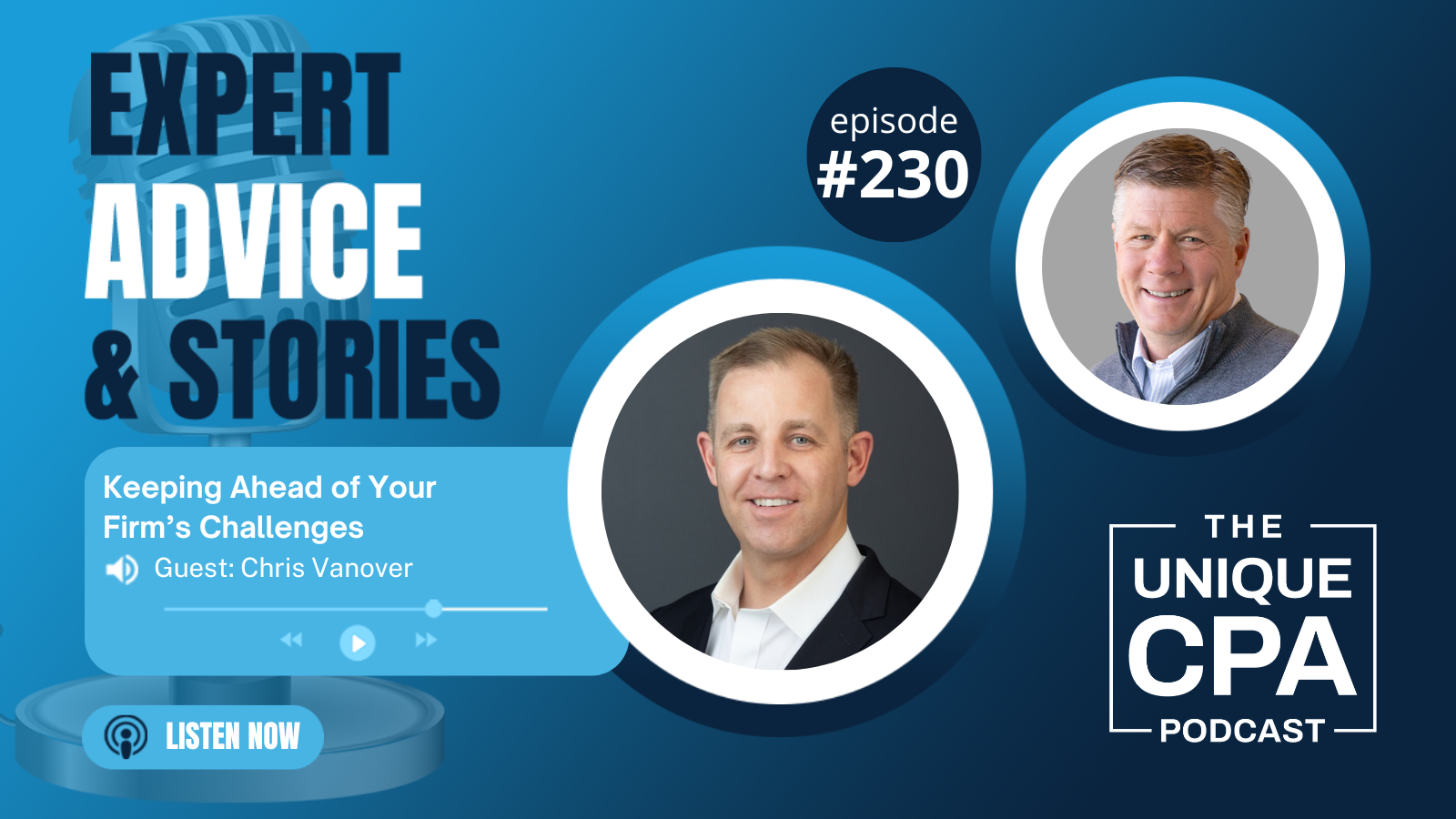
With Chris Vanover
Forget everything you know about the billable hour. On Episode 230 of The Unique CPA, Randy Crabtree welcomes Chris Vanover, CEO of CPA Club, who’s rewriting the rules of accounting with a subscription-based model and a bold focus on quality management. Learn how Chris and his team work directly with firms to tackle new compliance standards, champion work-life balance, and build a culture where accountants and clients both win. Packed with real-world stories and fresh ideas, Chris’s entrepreneurial journey is a must-listen for anyone ready to rethink what an accounting firm can be.
Today’s guest is Chris Vanover. Chris is co-founder and CEO of CPAClub—love the name, by the way. CPAClub was recently named “Firm of the Year” by the California CPA Society, or Cal CPA, as it’s commonly known. Chris has also been named one of the top 100 most influential people in accounting by Accounting Today. Today, Chris and I will discuss both CPAClub and how it’s changing the traditional firm model. In addition, we’re going to discuss—and I shouldn’t say discuss, I’m going to be educated, I guess—on some new quality management standards that are quickly approaching, and we’re going to talk about how Chris sees these compliance exercises as more than just exercise, but as a catalyst for meaningful change. Chris, welcome to The Unique CPA.
Randy, it’s awesome to be here and appreciate the invite.
Yeah, no problem. I mean, we’ve known each other for almost a week now, so this is like we’re old friends at this point.
That’s right. Amazing what a couple conversations can do.
Exactly. And we didn’t say it ahead of time, but you are out in California, I think you say Orange County area, is that right?
That’s right. Irvine, California.
Irvine, California. There you go. And I’ll be in California in about eight hours—a little north of you, but looking forward to my trip there today. So let’s talk. I teased a few things we’re going to talk about today on the show. So first one is this whole—it’s funny, you and I had never met. We may have been connected on LinkedIn. I have no idea if we were, I think we might have before that, but in the last two weeks, your name keeps coming up. I was talking to Cal CPA Society, your name came up. I was talking to Liz Far, your name came up. I was talking to someone else, I think, and your name came up and I’m like, “Okay, I’ve got to talk to this guy.” And the reason your name keeps coming up is CPAClub, and this new model, this different model. I love when I see people creating change in the profession, and that’s honestly what you’re doing. So for people who aren’t familiar with CPAClub, why don’t you give us an overview of what it is, and then we’re going to get into why this is, or how this is changing the traditional model.
Yeah. So we launched CPAClub back in 2022, so we’d like to think of this as our senior year, we’re growing up a little bit and starting to act like a real company, which is pretty cool. And a lot of the impetus behind CPAClub comes from my own personal background and professional background. I spent about 13 years at PwC. Four of that was in their national quality organization helping a lot of engagement teams with methodology questions, training, transformation activities. I also spent a few years at the Public Company Accounting Oversight Board, the regulatory body of the audit firms that audit public companies, and then also was an audit partner overseeing quality control for a large regional firm that eventually got picked up by Baker Tilly.
So, I launched CPAClub a few years ago and realized that I had somewhat of a unique skill set that perhaps could be—there could be a market for it. And a lot of the local and regional firms actually don’t have access to talent like I had, as well as my team, now, that we have. And so we really tried to fractionalize that concept and give it to them, on that subscription on demand model. So that really created CPAClub. Very successful. And so we eventually expanded out into helping both private and public companies with anything from managed accounting to technical accounting. But a vast majority of our business these days is actually helping CPA firms.
So you—are you technically a CPA firm? Are you registered as a CPA firm?
Yeah. So we’re licensed in the state of California and we also are registered with the Public Company Accounting Oversight Board.
I figured you must be, especially since audit is something that the people that you work with concentrate on, right? Is audit—I mean, you started as—in fact, your original name was not CPAClub?
Yeah, it was Audit Club, and then we expanded out and said, look, we can do a lot more than just the audit stuff. So let’s kind of expand the scope of what we can do.
Okay. So let’s dig into that deeper, because do you—here’s my question. Do you actually have your own clients or you’re an outsource partner? Well, no, you do put people into some companies as well that are not CPA firms, but expand on that model, because it’s so interesting to me.
Yeah. So we actually don’t maintain our own book of business, per se, from an audit or assurance services perspective. There are a limited number of engagements that we have taken on ourselves strictly for the purposes of being able to be eligible as a peer reviewer, which obviously goes hand in hand with a lot of quality management, quality control activities we support CPA firms on. So our goal is not necessarily to own our own book of business, our goal is actually to provide that fractional resource support to both CPA firms and companies. And ultimately, my view is that compliance is not necessarily the best thing to be in these days, just given the automation and AI efforts that are really changing the game in that area. So, we would much rather be considered strategic accounting and advisory for both CPA firms and companies.
Yeah, I love that. That’s—I mean, really, you and I discussed this last week when we talked, but that’s pretty much Tri-Merit’s model too, is we support CPA firms, support the accountant with the services that we bring to them. And so you have expertise in certain areas that you get to bring to them. Was it hard to get people to wrap their minds around this? Or was it easy, was the need there? Did you have to show them the need? How did that all, when you started this, go?
Yeah, I’d say there’s definitely a very traditional base of professionals that we sell into at these CPA firms and companies. A lot of them tend to be former Big Four, top 10 professionals, that all they know is the billable hour model. And so when you come to them with a subscription access model, they shake their head a little bit and wonder, “I don’t get it. I understand how it’s possible.” But then you also get some more—maybe the trailblazers out there that latch onto it very quickly. So there’s a bit of a mix out there. But as more and more folks and firms sign on with us and see how transformative we can be and how frictionless and easy we can be to work with, it’s a little bit like a wildfire starts to catch steam, and that’s what we’ve seen over the past couple years in particular.
Yeah. Well, let’s dig into that a little more, your subscription model, because I am personally not a big fan of the billing by the hour. And so you got away from that with the way you set this up. Was this the way it started from day one when you started Audit Club, or how’d it go?
Yeah, I would say when I initially started this, obviously as an entrepreneur you just need to eat, and so you tend to acquiesce and even though you go out there with what you envision as, hey, this grand subscription model, the market doesn’t react necessarily the way you want them to, so you act with, and we ended that initially and said, “Okay, instead of a true subscription model, we’ll give you a bucket of hours per quarter,” and that sort of garbage, right? And so ultimately it was, what’s my rate per hour? How many hours am I getting? Kind of that bulk buying mentality. The more you buy, the cheaper your rate per hour type stuff.
What we quickly realized was that nobody—even though we had contractual restrictions in the contracts—January would come around, nobody would use their hours. February would come around, nobody would use their hours, and then March would come around, you’d have 15, 20 CPA firms and companies going, “Okay, I’d like to use my hours now.” We’re like, “Okay, well, we don’t have a team to actually support that hour demand because nobody used them in January and February.” So we realized that that was a recipe for disaster and we had to make a pivot. And so in August of 2022 is when we officially launched the subscription model. And a lot of that, I owe a lot of credit to great guys—Ron Baker and Ed Kless were gracious enough to give me their time and really try to help me frame what this would look like eventually. And it’s obviously iterated a number of ways since we launched it, but we’ve gotten to a really nice spot where we feel very liberated because we’re out of that billable hour mindset. We would never go back by any means.
So everybody you work with has a subscription with you. This is how it works. And is there different levels of that subscription? I mean, it’s common at like the three tier price on that. How do you work on that?
Yeah, so a lot of what we do here at the club is, there’s a nautical theme to it. So we have three different levels of passes: we have a crew pass, a chief’s pass, and a captain’s pass, and just simply think about those in order of progression, kind of your bronze, silver, and gold type packages. The more complex your project, the more likely you need more of that captain’s level of support. Each of those passes, when they subscribe to it, they have an option to go either month to month with us and they obviously pay premium pricing for that flexibility, or they can opt into an annual pass and obviously have some additional passholder privileges. Different ways to talk about those. But ultimately, locks into one of those subscriptions. We spin up the model. We start on the calendar month. So typically the first of the month, we turn the access on. Our professionals just simply have to coordinate and prioritize with the company or CPA firm pretty much every single day and figure out exactly what we can do to deliver value to them in a given month or in a given annual period. So it’s honestly—I scratch my head because to me it sounds relatively simplistic, but for a lot of people it’s not simple. So this is why I keep trying to say, guys, it’s not rocket science we’re trying to solve for here.
Yep. When did you first talk with Ron and Ed about this?
Yeah, this was probably summer of 2022.
Okay.
And I think that, at the time I was—this is the analytical side of me that kind of tries to be in harmony with the creative side of me, but ultimately, I think the analytical side won and said, “Look, have a subscription model and it’s going to be X number of access sessions per month” and all that sort of stuff. And Ed and Ron, I think, were shaking their head a little bit and eventually I got there. But it took some time. And ultimately, because you want to put the guardrails in place and you worry, can this actually work? And so sometimes you just have to understand, you have to experience it and trust the process and understand that it will work out. And that’s kind of what we did.
Alright. So I have to ask, did you read Ron’s book, Time’s Up?
Oh, yeah. It’s a mandatory reading for all of our employees here at CPAClub.
Is it really?
It’s one of a couple books that we actually send out to all of our new hires and say, “Hey, look, this is a little bit like our Bible, so make sure you read it and appreciate it, and understand that this is ultimately how we’re going to run this company.”
Nice.
Yeah, and we go back to it time and time again. It’s really interesting because we’ve had situations where prospective passholders approach us and they say, “Look, we want to do it this way under kind of a project scope.” And we’re just like, “That’s really hard to fit in our model.” And we struggle internally and have those conversations because it’s a nice lucrative opportunity, but we’ve ultimately turned them down because it doesn’t quite fit and that’s okay.
Yeah, I love that. I love the fact that you stick to pretty much boundaries you’ve set: This is who we are, this is what we’re going to do. Because it’s so easy for companies, and again, when you started you said, man, we did a little bit different because you know we need to eat. But the cool thing is that then as you grew, you stuck to here’s the boundaries, here’s what we’re going to do, here’s who we will take on, here’s who we won’t take on. Or at least here’s the model that we’re interested in. Was that almost like an instant shift, or was that an evolving, hey, alright, we want business.
Yeah, it was pretty instantaneous. And once we realized that people were, again, latching onto it, there was no turning back. And I think the beauty of it is we are fully transparent with every single prospective passholder that comes to us. And that includes, “Hey, you have the choice. We’re not hiding anything from you. Here’s our investment per month. You decide what you want to pay, what you’re comfortable with, you decide your term, and also you decide whether you—what importance you place on being a monthly versus an annual passholder. If you’re an annual, then realize that you have actually the ability to engage with us for extra access on Fridays by request, or you have the ability to engage with us for emergency access on a weekend as needed.”
So the choice is always on them and the consumer. I think that’s what’s the beauty of it, it’s that it’s not us controlling the shots. Yes, we have our boundaries and parameters, but ultimately the choice is up to the consumer to make that decision, what’s right for them. No different—I know, I think Ron’s given this example before—it’s like, where do you want to sit on the plane, right? Do you want to sit in first class or do you want to sit by the lavatory? Up to you, right? I mean, you’re the consumer and you have that information at your disposal. That’s what’s important.
2B. That’s my seat. I was going to ask you. That’s a pretty good seat.
It’s a good seat at that point.
In fact, though, I think today I’m in 4E, which is still an okay seat. So let me ask you this: Is there an average, you know, definition of who you do support—firm size, firm type, services they’re offering?
Yeah, and so for us, we go back to our mission. Our mission is—I know it sounds a little bit maybe lofty—but we want to ultimately make our profession better. And so one of the ways we do that is obviously we focus on the experience of our passholders and want to make sure that’s a five-star experience. And equally important is we want to make sure our employees have a five-star experience, and there’s ways we do that as well. But we intentionally set it up that way because we didn’t want to necessarily lock out—call it a sole proprietor that needs help in terms of helping them with the quality management activities that they have to go through as a firm, being an A&A practice. But we also—and the beauty of the model is you can engage with us on a month-to-month pass, or you can engage on an annual, and we have a variety of passholders that do different options, but because of that, we’ve supported anything from a sole proprietor all the way up to $5 billion public companies. So the model works for all of them, and that’s where I think, for us, you know, initially it’s the local regional companies and firms, but as we’ve moved upstream, we’ve seen that even in spite of these companies having very long procurement cycles, that their MSAs and the SOWs, which typically don’t come into play until you’re dealing with some of those large companies, we’ve been able to navigate through those MSAs and SOWs and stay true to our subscription—which is really telling that even at large companies, they’re willing to ultimately understand how valuable this concept can be.
Nice. And so when you started this, there was a need that people didn’t even realize, I’m assuming, that they had. Did you have to educate on that need? And so it’s a two-part question: Educating on that need—you know, why do they need you? What was missing? But then are you competing with something else too that you have to say, well, this is why we’re better than that, or different than that?
Yeah, I think—I mean, there’s two different angles here. One is the CPA firms that we support. Sometimes a lot of them just don’t understand how transformative a lot of these, what they view as compliance activities, can be. These firms have to go through quality control. They have quality management—you know, you mentioned at the onset, there are new standards coming down the pipeline due December 15th, 2025 for AICPA A&A practices. That’s a watershed moment for our profession. So we’ve seen a lot of activity from firms understanding they’ve got to get their infrastructure in place to help support this, and we support a number of firms on that front.
But just generally speaking, they’re a little bit more reactive on the quality control side in the audit practice. And that’s just historically rooted in kind of the past practice they’ve had. And so for us to come along and they say, “Okay, we’ve got to make an investment. Do we go out there and hire a quality control director, a quality control partner?” Typically, that doesn’t come into play until you’re probably at least—even top 50 is sometimes questionable. But top 40 and above will have that, ultimately a dedicated function. Most firms are just, you know, basically run quality control by committee or the managing partner kind of dabbles in that space, and it becomes dangerous because you have the inherent conflict between profitability and quality. Now, in my view, those two can coexist, but that’s where our team can really come in there and help drive some transformation and ultimately these compliance-based activities that they see as such can actually be very transformative because when we get under the hood, we start to identify, “Hey, you’ve been doing it like this for the last 10 years. Maybe you should think about doing it this way. Why is your materiality so low?” And they’re like, “Oh, we never even thought about that.” So it’s that fresh set of eyes that ultimately make an investment in us. And lo and behold, that investment has paid off immensely because they’ve been going through, reviewing their engagements to understand how to better run the practice.
So that’s kind of that aspect, and then the company side of it is there are a lot of technical accounting needs out there, a lot of companies that need managed accounting—in my view, they’re being very poorly serviced right now by a lot of the consulting players out there that are again tied to that billable hour model where there’s no actual incentive to actually be more efficient or automate, use AI. And I bring an example—a competitor. We went in there and proposed to this company, and this is a healthy size biotech company that was using a service provider that part of their function was to actually do payroll for them. Well, because they were on a billable hour arrangement, there was no incentive to actually try to make that payroll process smoother. We came in there and said, “You know, this whole payroll process, we can probably do it in a matter of less than a day, probably half an hour, if we really wanted to, through automation.” We did that, because our job under a subscription is just to deliver more and more value, and that’s where AI and automation become our greatest friends.
Yep. You mentioned that these new quality management standards that are coming out—one, you’re going to have to educate me what this means—but this is important because this is—you and I are recording on September 15th. Three months from today, there’s a requirement out there that people have to comply. Firms have to comply with this. So what is this and what do firms need to do to get compliant?
Yeah, so the AICPA—and I remember being there at Engage in Vegas back in June of 2022—basically announced these new standards, SQMS 1 and SQMS 2. And as you can imagine, a lot of the CPA firms in the room just said, “Oh, that’s 2025, let’s not think about that for a while,” and that’s what many of them have done. But all these firms—and they’re talking about an audit and assurance practice—have been under decades-old quality control standards that ultimately don’t really have a purpose anymore. And so the AICPA said, “Look, based on what the international bodies have been doing,” they had their own version of ISQM, they said, “Look, we need to have similar standards here in the United States.” And so these standards have, again, quality management standards, basically building out an infrastructure around quality control—what they now call quality management activities. So anything from how do you accept a client, to how do you actually perform an engagement, to how do you then monitor an A&A practice, and how do you ultimately make sure that people are qualified to do it?
So there’s a lot of similarities to the prior quality control standards, but it does kind of almost require a wholesale rewrite of what they historically have been doing. And so a lot of firms, literally over the past couple of months, have finally been coming up for air and saying, “You know what, yeah, we probably need to get this done at this point.” And all of a sudden, as you know, the talent, one is hard to find these days, and they’re looking at their book of business and going, “We’ve got all our clients to support. We have a 9/15 deadline, a 10/15 deadline,” and they quickly do the math and realize this is not something they can undertake on their own. So we’ve been helping a ton of firms on this, probably for the last couple of years. And then the demand has just shot through the roof over the past several months and we would anticipate more of that coming through as we get closer and closer to December 15th. But time is running short. And then similarly, the Public Company Accounting Oversight Board said, you know what, “AICPA is doing this, international standards are doing this. We need a set of standards.” So they introduced QC-1000, which is basically the PCAOB’s version of quality control. They couldn’t agree even on the naming—quality management versus quality control—and that’s very typical for these regulatory bodies. So folks that actually do audit public companies have to comply with QC-1000. It’s not even those that do an audit of a company, but actually anybody registered with the PCAOB, whether they’re doing audit or not, have to comply with these new QC-1000 standards. That being said, just a couple weeks ago, the PCAOB did announce a deferral of the implementation date from December 15th of this year to December 15th, 2026. So, a little bit longer runway, something that firms have to contend with, so it’s a lot going on in that one.
Yeah. So you mentioned you’re helping firms do this. What does that mean? You’re going in and writing process procedures to manage risk, is that what it is?
Yeah. So, I mean, think about it—I don’t know how much the audience here would know about Sarbanes-Oxley back in the day. When that was introduced, public companies had to ultimately create their internal controls, and ultimately, a lot of it was deferred maintenance—they had a little bit over here, a little bit over here, let’s bring it together in an organized way and create the system and then now make sure we can operate these controls effectively. That’s exactly what’s happening here for CPA firms with an A&A practice, you have to have controls in place and ultimately our team will come in. A lot of us are former Big Four national office experts. We come in there, we’ve been able—this is what we do for a living, our bread and butter—and so we’ll come in there either on a co-source or an outsource model and actually stand up their new system of quality management.
Alright, so one thing you made me realize is I am so glad that I don’t do any audit work, audit assurance work because, man, I was always a tax person anyways—I did do audits in the past. There was a reason that I started to gravitate towards tax more.
Well, if it’s any comfort, tax was my highest score on the CPA exam, and audit was my lowest score, and yet here I am. Who knows? Stranger things have happened.
Yeah. Well, you found your niche, you found what you love. You’re smiling. So I assume that this is a thing that you’re enjoying doing, which is awesome.
We’re having fun.
Before we wrap up, I do want to highlight or ask you on something—you know, starting whatever, you’re starting your senior year now, you said. You were, I think it was just this year, named Firm of the Year by Cal CPA, how did that come about? And congrats, by the way.
Yeah, that’s one that was very humbling and obviously very validating for what we had been doing the last few years. But in my view, it wasn’t just a matter of, “Hey, we’re recognized because of what we’re doing,” but ultimately it was like a call to action and continue what we’re trying to do. And so we really see it as, you know, we want to really make our presence even more known out there, and so ultimately we spun up what we call CPAClub Ally, which is actually a referral program so that if people really believe in what we’re doing, we need more people to believe and ultimately become either buyers of our services or help spread the word of how things can be done to disrupt this profession. And so we spun that up and that’s really been our marquee moment for this year is just trying to help again, propel CPAClub forward because of that award, making sure that it doesn’t get lost and we ultimately capitalize on that for the benefit of the profession. So we’re big on that.
And then I think another big piece we’re trying to work on is our role, and I’ve always seen this—I’m an adjunct professor at my alma mater. I’m a real big believer that our call as professionals is to guide people. And so we really are very laser focused on not just being a consulting resource to somebody, but ultimately helping them to understand, to educate and empower them. So we’ll continue to obviously push the envelope in terms of how do we ultimately use technology to help maybe better educate people and better inform people so that this doesn’t all just stay within us, but ultimately help our profession move forward.
Yeah, I think you and I both have a passion that way. Let’s move the profession forward. Let’s see change. Change can be scary, but change is necessary. And looking at different ways. In fact, our conference, Bridging the Gap, we had a session on basically different people are changing the firm model, and the way they’re doing things and, you know, some friends of mine, Chase Birky and the way the model he’s doing with Dark Horse and Kristen Keats up in Portland area and how she’s changed the model with her Breakaway Bookkeeping and Jacob Schroeder—I always say it wrong, it’s one of those two, Jacob, sorry if you’re listening, I know I always say it wrong. He did this thing where he broke his firm into three separate firms—accounting, tax, and advisory—and run by three separate people and really independent. And it’s just cool to see people doing things different and not being afraid to take a risk.
Yeah, we didn’t talk too much about the employee side of it, but that again is near and dear to everything we’re doing is that we always think about balancing the passholder experience, but also the employee experience. Every one of our people is incredibly talented, they’re employees of CPAClub, that’s intentional—we didn’t want to do independent contractor model. They’re getting paid top of market compensation. They’re working reasonable workloads and most of them actually have a four-day work week, so that’s something special that a lot of people—a lot of people can’t claim to have that, and that’s probably one of the things that we’re doing to really, again, just change it and make sure people understand that this profession can be better. Just a matter of having the creativity to try to figure it out.
Yep. Well, that’s awesome. Well, Chris, this is all amazing stuff. The deadline coming up with the standards, people need to be aware of that. They should reach out to you. We’ll talk about that in the end. But before I ask for contact information, we talked about everything you’re doing and obviously the way you’re doing it with the four-day work weeks, it looks like you’re trying to build in the work-life balance, which is awesome. But when you are not working, when you’re not transforming the profession, what do you enjoy doing? What are your outside of work passions?
Yeah, so I’ve got two young kids, a 12-year-old daughter and a 10-year-old son. So a lot of my weekends are spent obviously on the sports fields or participating in whatever plays they might be doing or whatever extracurricular academic things they’re doing. So love seeing them thrive and ultimately become great little human beings. But love getting out to sporting events, whether it’s the Angels, the Rams, or the USC Trojans. I was fortunate to actually go to every home opener this year, so the Angels, in spite of how bad they are, and the Rams just a couple weeks ago, and then the USC Trojan football team a couple weeks ago. So doing that and then I try to do these little challenges every single quarter. So my Q2 challenge was I took up the piano, just an app that I bought for like 34 bucks, so I advanced to an intermediate piano player at this point in time and hoping to get better with that.
Wow, that’s awesome. I love it. If anybody wants to find out more about what you’re doing, what the club’s doing, or reach out to you about some help that they may need with these new standards, what’s a good place for them to reach out to you?
Yeah, we try to make it super simple, so it’s CPAClub.cpa, but obviously I’m more than happy to answer any questions. You want to email me directly at Chris@CPAClub.cpa.
Alright. Well, Chris, thank you so much. This has been a fun discussion. I love to see what you’re doing and I can’t wait to watch the progression as it keeps going over the years. So thanks again for being on The Unique CPA.
Take a detour down to Orange County and pick me up on the way to Napa, alright?
You got it. I’ll be there tonight. In fact, I’ll be at Cal CPA on Wednesday, so looking forward to meeting with that group too. Alright, thanks again, Chris.
Alright, Randy. Appreciate it.
Important Links
About the Guest
Chris Vanover is the co-founder and CEO of CPAClub. With over 20 years of unique public accounting experience, including distinctive auditing, regulatory, and educational roles with Big Four and regional firms, the Public Company Accounting Oversight Board (PCAOB), and multiple universities.
Prior to the founding of CPAClub, Chris was an audit partner at a Top 40 firm with responsibility for overseeing the firm’s system of quality control for the audit practice across nine offices. Chris also spent a combined 13 years with a Big Four firm. In addition to his client-service responsibilities, Chris was also part of a Big Four firm’s Chief Auditor Network within its National Quality Organization. In this role, Chris provided both PCAOB and AICPA auditing and methodology advice to engagement teams, assisted both national and local leaders with various audit quality initiatives, and created and facilitated numerous technical trainings. From 2011-2013, Chris served as a technical advisor within the PCAOB’s Office of Research & Analysis, where he primarily performed technical consultations and assisted with various strategic projects, including audit quality indicators.
Meet the Host
 Randy Crabtree, co-founder and partner of Tri-Merit Specialty Tax Professionals, is a widely followed author, lecturer and podcast host for the accounting profession.
Since 2019, he has hosted the “The Unique CPA,” podcast, which ranks among the world’s 5% most popular programs (Source: Listen Score). You can find articles from Randy in Accounting Today’s Voices column, the AICPA Tax Adviser (Tax-saving opportunities for the housing and construction industries) and he is a regular presenter at conferences and virtual training events hosted by CPAmerica, Prime Global, Leading Edge Alliance (LEA), Allinial Global and several state CPA societies. Crabtree also provides continuing professional education to top 100 CPA firms across the country.
Schaumburg, Illinois-based Tri-Merit is a niche professional services firm that specializes in helping CPAs and their clients benefit from R&D tax credits, cost segregation, the energy efficient commercial buildings deduction (179D), the energy efficient home credit (45L) and the employee retention credit (ERC).
Prior to joining Tri-Merit, Crabtree was managing partner of a CPA firm in the greater Chicago area. He has more than 30 years of public accounting and tax consulting experience in a wide variety of industries, and has worked closely with top executives to help them optimize their tax planning strategies.