Small Firm, Big Heart
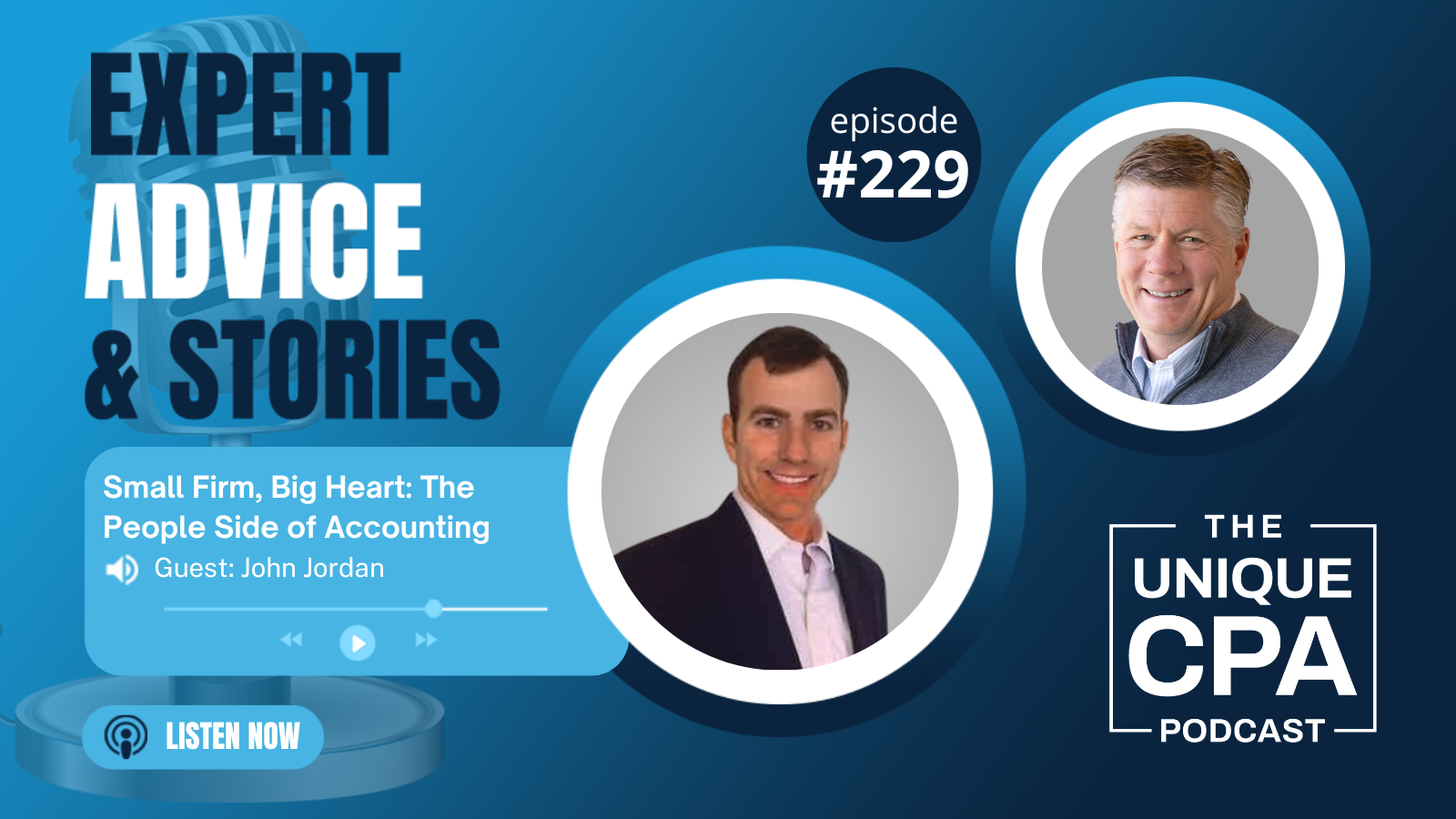
The People Side of Accounting with John Jordan
Randy Crabtree welcomes John Jordan, a small firm owner from Raleigh, North Carolina, and fellow member of the Intuit Tax Council, for Episode 229 of The Unique CPA. John shares his journey from working at large and regional accounting firms to founding his own people-focused practice, where building lasting client relationships is at the heart of his business. Sales-oriented by nature, John enjoys running a small firm and forging very strong personal relationships with his clients, and he talks to Randy about how he still manages to stay in business mode while doing so. He discusses his approach to pricing, technology, and staff management, as well as how important his connections on the Intuit Tax Council and other accounting groups has been both for his mental health and the growth of his firm.
Today’s guest is John Jordan. John is a small firm owner out of Raleigh, North Carolina, and a fellow member of the Intuit Tax Council. John brings heart and insight to the profession. He’s passionate about helping people, connecting with entrepreneurs, and learning what drives them to his firm. He offers a full financial platform from accounting and tax prep to planning and controller services, supporting clients on their small business journey. We’re diving into industry trends, the real relationship needs in accounting, and yes, even the fun mental health stuff. John, welcome to The Unique CPA.
Thanks for having me, Randy.
Alright, John, this is going to be a lot of fun. It’s very fortunate to have met you. Actually, by the time this runs, it’ll be three years at the Intuit Tax Council meetings where we’ve built a lot of relationships. I know that’s something we’re going to talk about today, but before we get into that, let’s talk about you and your firm and your journey in the accounting profession, and what led you to starting your firm?
I started my firm right after we had kids, so it was sort of a transition period. I’d been at a much larger accounting firm, then at a regional accounting firm, and I was really getting sort of burned out working at that size firm. I really struggled on the relationship side, because my clients were sort of like my friends, is how I viewed them. I would build these relationships and then a lot of times, either something would happen in an audit, maybe someone got fired, they didn’t come back, or like, the turnover. So there are a couple things that went into me leaving, and really a lot of it had to do with me being a people person, and that just doesn’t really fit in a traditional firm.
Yep. So when you say a traditional firm, how’s your firm different from a traditional firm? What do you base that on?
Mainly because I can control who we work with, which is pretty nice. I know starting out, I probably didn’t stay true to what I was doing, but we’ve definitely done a much better job recently of just working with people that are good people, that we want to work with client-wise, that I’ve had relationships with. Our average client is probably five to seven years now at this point. We don’t have a whole lot of turnover, but it lets me get to know the clients. It’s tough when you lose one, if you have to let one go, but I just really enjoy that side of the business.
So relationships are one reason you started your firm, because you could build these relationships. Does that ever get in the way of, “Hey, I’ve got a great client here, I really love them, I like hanging out with them, but really it’s somebody I probably shouldn’t be working with anymore, because they can’t pay the fees that I want to charge, or I’m giving them a discount because I like them so much?” How do you balance that, hey, I want to have a great relationship, but I also need to have this business relationship too?
Yeah, that is a huge struggle that we’ve tried to overcome, probably mainly in the past three years. So now I don’t answer the phone as much. We have, I call it a gatekeeper, basically, so calls go to an admin or a bookkeeper who can try to filter out who gets to talk to me, because I’m the typical accountant who wants to help everybody. So that’s really helped. Also, letting the staff have more input, like when we do price increases or at the end of the year when we look at clients. Even though it might be a client that I was friends with in college and have this relationship with, if they’re taking too much time, if they’re rude to the staff, then we’ve definitely started to let those go and look at it more as a business. I think that’s the hardest part, that transition from starting your own business to then actually running it as a business.
Yeah, I like the way you say that, because that is important. We too often don’t look at our accounting firm as a business because, as you said, a typical accountant just wants to help everybody. That’s what we do. We have answers and they need these answers, so how do we get it to them? We have to be there for them. Unfortunately, sometimes we think we have to be there for them all the time, and that’s where we get into trouble. So you said, now the last few years, a gatekeeper that keeps you out of the way, I assume, somewhat from—
Trying to keep me out of the way. It’s interesting because when I started my firm, I’m definitely more of the salesperson. That’s sort of the other issue at a traditional firm—as a staff, you just don’t get that many opportunities to go out and sell. Even when I was trying to get on boards and do different things and would bring in a new client, I wasn’t in control of that process, and I didn’t always like the way it was handled, so it just didn’t really fit. Which is interesting because when I started my firm, sales was never the problem. I went from probably making my salary at the end of nine or ten months on my own, and then doubled it every year after that. But the problem then became, “Who’s coming to help me? Where’s the next smart person that’s going to come do all the technical work?” I think that’s where the industry has been. It was easier to hire ten years ago than it is now, but that’s definitely been the cap of the firm, basically—I’ve now limited it down to where it’s me and a couple staff that can handle everything.
There are a couple things you said there that I’d like to dig deeper into, because you said for you, sales is not a problem. That’s not a typical accountant. I think sales is not something accountants—even though in many, many firms we’re tasked with that, especially if we want to be partner level—how did sales come so easy to you, or what is it about sales that you enjoy?
It’s interesting because most of my family still doesn’t believe that I’m an accountant. The sales is genetic. Both of my grandfathers were big sales, national company, head of sales type positions. So when I went into accounting, they were both like, “What in the world is going on? You’re a people person, you should not be in accounting.” When I got my master’s, I met my wife when I was getting my master’s, and they separate you out in the rooms based on your DISC and your personality types, and I’m sitting in the corner with three other people and she’s over there with 80% of the class—the typical accountant. So we met a lot because they did some little groups and tried to pair you with opposites to get your teamwork and all that type of stuff.
But yeah, so I’m the sales part, the people part. I can talk accounting. I think that’s the biggest difference—people will come in and meet with me about taxes and I can explain what they can do, what they can’t do, where the gray area is, and get to it in a plain English type thing, whereas their normal accountant or someone they were using, a lot of times, they struggle to understand or get that interpretation. So that definitely helps me.
So then right now, are you looking to add more clients? Are you out selling? Or where are you at? You said staff is an issue, it’s hard to get staff. How do you balance that passion for selling with the ability to do the work?
My wife—no, my sister work for the firm. My wife does not work for the firm. I’ve tried to trick her into coming to work for me because she is the typical accountant, and I could then go do more sales. But my sister works for the firm, and they have both put the kibosh on trying to sell any more clients for the past two years. They’re like, “Can we please just get it down? Let’s just take some time off,” because I was growing too fast. I see that with my own clients—a lot of the times they’re sales guys that start companies and they start growing, and they grow too fast. So it’s one of those, what you see is one step back to take two steps forward. I think right now we’re in that process.
You just mentioned that a lot of your clients are salespeople. Is that because, from a relationship standpoint, you mesh with them because you have the sales mindset, they have that sales mindset? Have you ever thought about that, or is it just the type of businesses you’re going after?
I think it’s the personalities. When they meet a couple different accountants and then they meet me, it’s something very different that they probably haven’t seen before. I’m not—so I think part of it is that. I think part of it is I understand their problems a lot of times. I also coach my kids’ soccer team, and when they’re winning 10–0, you’re trying not to get them to score, that’s like talking to a sales guy and getting him to try to slow down his own business.
Yeah!
So I understand that, because I’ve been trying to do it. So the conversations are very natural. I think it is helpful with sales-oriented people like a CFO—when that person is really more geared towards sales. We don’t niche, so I don’t have exactly a type. We do lots of professional services with lawyers, engineers, but my background being in public, we just saw so much, we did a lot of construction, a lot of professional services. So I have lots of experience across a wide base. We have tried to get rid of certain industries, maybe stuff that has inventory. We don’t do restaurants, which really helps, more so for the staff so they can see the same things repeatedly.
Yep. So let’s dig into your business a little bit, because I want to get into the relationship side in the profession a little bit more, but I want to set the background for the firm a little bit. I think you told us staff-wise—how many people total?
We probably have four part-time people. We’ve bounced around with maybe me and another full-time person, and then usually two part-time people. But right now, probably around three part-time, and I’ll probably hire another full-time person this summer.
Oh, so you could sell, right?
I would love to get back into selling. I need to merge with someone that really just wants to manage the business, do all the tax returns and tax work.
Oh, believe me, there are a lot of firms out there looking for targets like that to merge in. I get interested to hear how people are running their business. You said no niche really, but you said a little bit in professional services. Don’t you do some with technology companies as well?
We do. Being in Raleigh, there’s a good number of software startups. We have several software companies, and every year we usually take on one, but that takes a lot of my time, so we’ve tried not to take on as many startups. But I would say software is definitely something we’ve worked with that a lot of accounting firms don’t.
We talked about relationships. How about from a pricing standpoint with the clients? Are you hourly billing, subscription pricing, value billing? Do you have a set-in-stone type, or is it case by case?
We do have a methodology that’s like value billing. Our traditional model right now is that when they come in, we’re going to do bookkeeping, tax planning, the whole package, and we’ll price that out based on their revenue and transaction volume. I think that there’s a lot of—like, I’ve been doing that type of pricing for ten years now, but that’s not the only thing. A lot of firms are like, “We have to do this one way and we stick to it.” I do have the old traditional 1040s that we’ve phased down some and taken just some business clients. So we haven’t completely gotten rid of that side of the business, but about 80% of our revenue is probably value-billed monthly.
And monthly—so paid upfront, beginning of the month, end of the month?
Yeah, the beginning of the month. They pay the whole 12 months for their tax returns and everything in that year. So for tax year 2024, they’ve paid for 2024, even though we’re doing returns in 2025.
Okay, good. It evens out cash flow. I’m assuming that’s one of the goals. I want to get into technology a little bit too, because you’re a small firm, but from a technology standpoint, I feel you’re very advanced. I’ve heard you talk, I know there are different things you’re looking for from technology that you’re not getting, but things that you are. So like from a tech stack standpoint, is this something you’re looking at all the time? Are you evaluating, are you seeing if there’s anything better? How do you look at your tech stack and how that plays into how you run your business?
There’s a ton of FOMO—fear of missing out, I can tell you that. I’m always looking at different software, which is good and bad. When I started my firm, I started with QuickBooks Online. At that point, I was using QuickBooks Online and Drake, because it was just me. Once we started adding people, now looking at different tax software, we ended up going with ProConnect through Intuit, which has been great. On the small firm side, it’s nice because you don’t have to have hosting, you don’t have to have all the IT side. If you can stick with your cloud programs. Sure, there’s some security and different things that’s still a lot to manage, but it’s not like you have to have a server and all the laptops. That’s really helped push, with those types of technologies and more updated software, it’s just trying to avoid the IT side of it and having to deal with that in addition to everything else.
How about from a billing standpoint? Client relationship, billing, what other things are integrated? Payroll?
Yeah, so we use QuickBooks Online, ProConnect. We use Ignition for our billing and engagement letters. We use Karbon for practice management and emails. Payroll is a little bit—we actually have two different providers. It sort of depends on what type of company it is and which one will fit them best. It’s all definitely still cloud-based.
Okay, nice. And when you bring on a new client, is there a requirement that they have to be on QuickBooks Online, or do you deal with what they’re working with?
It can depend on their size. I would say 99% right now are on QuickBooks Online. I don’t think we have anybody not—no desktop. If they were big enough, which I think is a separate issue, there are times where we’ve moved them up through QuickBooks Online to a point where they need something else. I have a couple clients now where I need to find them a new firm because they’re getting too big at their revenue size for me. Luckily, we haven’t had that problem. If someone comes in with something completely different, a lot of times we just tell them it’s not going to work, it just takes too much. It doesn’t fit inside their system, it just takes a lot of time.
It’s not worth your time, right. Okay. I just wanted to see the background. Anything I missed on background on the firm that you want to highlight before we jump into relationships and mental health?
I think on the background, that’s probably good. I think we did about $600,000 last year, so we’re definitely on the small firm side.
Yeah, but like you said, you are growing every year and then you had to throttle it because of—
Yeah, I think it’s interesting because I think the industry is really—that’s where it’s been heading. I know there’s a lot of consolidations with private equity and different things, but I feel like the majority of firms now are going in two different directions. They’re either all consolidating and getting bigger and bigger, or we end up with these tiny little firms.
Yeah. I think it’ll be hard to be in the middle. I think that’s just a hard place to be. I think there’s a need for the smaller firms for that relationship side of things, like you’re doing, and if you’re in the middle, trying to compete with that firm and trying to compete with the consolidating firms, it’s just—you’re trying to compete with both ends? That’s going to be so difficult to do, especially as we see all these acquisitions, which is nonstop. Honestly, it feels like it’s been 30 years, my entire career. It feels like acquisition’s been part of it, but I believe—well, 30 years, I think it’s more like 40 years now—but it feels like it’s really, really obviously ramped up now.
Alright, so at the beginning, I talked about the fact that you and I met at Intuit Tax Council, which, about 30 days from now, will be my last day on the tax council. Are you off the council too?
I’m off. They gave me an extra year last year, and then they were like, “Alright, you gotta go for real this time.”
We have a big group. I’m going to get into relationships now. We’ve built some really strong relationships with from that tax council. Everybody on the council is good, but we’ve had this group that’s been together for quite a while—Al-Nesha Jones, Dawn Brolin, Kristen Keats, Diana Crawford, and you, and me, and now we let the new guy in, Nick Basha, who I think is the only one that is going to be on the council of that group, that relationship we’ve built. We’ve talked about how important relationships are for you, and it’s not just with your clients, but in the industry. So how do you look at relationships within the industry? And specifically, we can even talk about that group that we’ve formed, and how those relationships help you in your business. So in general, how do you look at relationships within the accounting profession?
So yeah, within the profession, I think it’s interesting because when I started my own firm, you really don’t have that many resources. I would network or talk with my old firm, some of the partners I was still really good friends with, and people I went to grad school with. But then I started to meet people either through some of the Facebook groups and different groups. So it was interesting meeting them, giving people pointers and doing different things, and then meeting them at a conference and seeing them. But really, our group—like, my first year on the council, you guys hadn’t joined yet, and everyone had just rolled off. Basically what’s happening now is half the group was rolling off. I didn’t have those relationships. Then once you and Dawn and Kristen and others joined right after that, it was really nice, because now you’ve got all these other accountants you can talk to about things and sort of discuss with.
I think, the other few accountants I’ve talked to, and just how the industry’s gone, where now we have all these tiny firms—it’s just so hard to be a firm by yourself, I think. I’ve read and talked to other business owners, because I think that’s part of the relationship I have with our client owners. Sometimes I’ll be talking to them and they just want to spill everything to me. You’re already the accountant, so you already know all the financial stuff, but then so much of it becomes personal, and I think it’s interesting because I’ve heard a lot of different articles on the mental health side, about how lonely it can be as a solo business owner. Now I’ll bring that up to business owners—when we start talking and they start getting into a lot of different details, it’s about trying to connect with them. I can bring that up and say, “Yeah, I know it’s a lot just to be on you.” I think that’s really helped for some good relationships now with clients.
Yep. And just in general, just knowing that you have somebody you can rely on to at least throw a question to. In that group chat we have, so many times that somebody will bring up, “Hey, I don’t know how to do a specific state pass-through entity tax, has anybody dealt with this?” Then all of a sudden somebody chimes in, or, “I know this person in this industry that has this firm that can help with that.” Just being a small firm and knowing that you have resources, and those are built through relationships.
Yeah. I definitely feel lucky now, because before, you sort of feel isolated. I think that’s what I tell clients—I talk about that. As a firm owner, we go through basically that exact same thing. You sort of have to find your network or the other firm owners you can connect with, maybe about the technical stuff, but also just about running your own firm and having that group. I think in a traditional firm, you have partners and there’s a lot of dynamics that go on there, but I think just having a network of friends and other accounting firm owners you can bounce stuff off of really makes having your own firm a lot more enjoyable.
Yep. I really am all in on that. So let’s talk about the other thing we mentioned at the beginning—mental health awareness is an important topic to you. It’s a topic that’s gaining more traction, I feel, in the profession. For you personally and professionally, why is that an important aspect of running the firm?
I think partly because I’m non-traditional—I’m a people person, but I’m sitting behind my desk all day, so I have my own struggles with that because it’s not my ideal situation. I don’t want to necessarily be sitting here doing this, but at the same time, I do love helping people. We just came out of busy season, so one of my struggles every year is I come out of the season where I’m talking and on the phone all day, which I may complain about sometimes, but I really enjoy the people aspect of that. And then it’s just like, I need some quiet time, some downtime from the work aspect, but I definitely feel it. I sort of feel like I’m lost because I don’t have those relationships and all the calls I just got through. I’ve noticed I struggle with that every year, right after busy season. I need to add projects or something to keep my mind going.
So that’s a little different than the way most people see it, because most people are just exhausted and burnt out after tax season, and you are craving that relationship side of things still, and so where do you get that? I know family’s probably a big part of that. I saw just yesterday that you were out with the kids working on bike riding.
Yeah, we were trying to teach one how to ride his bike. And like, this year, Easter came right after busy season, so I actually got to see them do the Easter egg hunt and all the Easter stuff. I can’t remember the last time I saw that—they must have been tiny, probably, because I always take that week to work. My mind is exhausted from work, from looking at the spreadsheets and having to worry and do all that type of stuff. It’s sort of like you get to that finish line, but as an accountant, there’s no big celebration, so that’s another thing about being with a small firm—there’s no big party for you, usually. Your family is like, “Okay, now you’re back home and you can help me do everything.”
That’s a good point. I never looked at it that way, but it’s just a complete drop-off. You’ve got one way of doing things for three and a half months or whatever, and then all of a sudden you have to integrate into a whole new way of living, and that’s a big adjustment. For me personally, I never—I mean, I built my firm way too tax heavy, which was a problem, but I never—I couldn’t even get back into the routine, the swing of things, until after the summer. I never felt like I was ready to get back in the office. Part of it was probably just being out with my friends or my family is what I wanted to do. So from that standpoint, we’ve mentioned earlier your technology is integrated pretty well. You probably are more efficient than most firms, but you still have these extra hours, you still are busy. What can we do? What can we change? How can we make this so we don’t have this instant drop-off of what we’re doing and have to integrate into some new method of living for the next six months until we get busy again?
I think especially on the technology side, it’s interesting because if you look at GruntWorx or the PDF scanning ability, we’ve had a lot of this ability for 15, probably 20 years now, and not much has really changed. That’s what everyone is looking for. I haven’t gotten too much into ChatGPT and some of the AI, so I’m thinking a lot of the vendors are going to be bringing that out more and more, just to see if we’re going to get any technology support. I know everyone’s scared of them taking their jobs, but really there’s such demand for accountants that we don’t have to worry about that. It’s more about helping on the technical side, so we can have the relationships with clients, which is what I’m hoping for.
Yeah. AI and whatnot should be able to free us up, and technology in general, from the menial tasks that hopefully we can automate, and then you could spend more time on the relationship. Then this is going to be a perfect new world for you. It’s relationship time.
I’m hoping so. I haven’t cracked the employee hiring side of the business. We get good employees and I train them, and a lot of times they leave to go start their own firms. I feel like that’s either one path that happens, or they’re bouncing around between firms, or they just weren’t a good fit. Part of that’s like, well, I can’t be mad that they want to go and start their own firm because that’s basically what I did. If I could help them to do that, and if I could just be consistent and get more people like that, that would be good.
Now what you have to do is go and consolidate all those $600,000 firms, and then you can just be the runner of that. Now you’ve got the $60 million firm when you put a hundred together. I don’t know if my math was right there or not. Nope, it’s probably a thousand of those together. I don’t know. Do the math.
Hey, I’m a people guy. I’m not the math guy. I’ve got to have Excel open.
Alright, John, this was a lot of fun. I got to know even more about you than I knew before, which I think I knew quite a bit. But just hearing the whole story and how you’re looking at this from a relationship side and your personality as a CPA salesperson, which has its own challenges, it sounds like, post-tax season and trying to build a firm, looking for people. But it’s interesting, I always love hearing these stories of how people are in the firm, what they’re doing different, and how they’re handling the obstacles that get in the way, which at this point is probably people as much as anything.
But as much as I enjoy that, I’d like to hear more about what people enjoy doing personally outside of work. So we’ve been talking about your firm, and you, and business in general, and mental health, but how about personally—what do you enjoy doing when you’re not working, when you’ve got time off, when it’s not tax season anymore and you can have some free time, what’s your outside-of-work passion?
I like sports, and we spend a ton of time at the beach. I try to get around to playing some golf, play some tennis with friends, coach a lot of kids’ soccer throughout the year. But yeah, we spend a lot of time on the boat, going to the beach—a lot of the time.
A lot of family time.
Yeah, a lot of family time to make up for.
Well, that’s good. Maybe we need to schedule a golf outing when we’re all together in Denver, because I know Don enjoys golfing too. I’m not sure who else in our group, but maybe we can do that.
That’s my goal for the summer—to get stuff on my schedule so that I don’t accidentally end up working.
Alright, John, it’s been a pleasure. Always enjoy talking to you. I look forward to seeing you I guess next month in Dallas!
Alright, thanks for having me Randy.
Important Links
About the Guest
John Jordan has 14 years of experience as a Certified Public Accountant, having received a Master’s in Accounting from UNCW. His passion is working with individuals and small businesses to provide guidance that helps all clients achieve success. Colleagues and clients know him as a highly energized, trusted advisor. He enjoys spending time understanding businesses and what drives them.
John’s client focus is on individuals that own small privately held companies that are in the fields of real estate, professional services, consulting, software, manufacturing, construction management, and various others. He has prepared thousands of personal and small business tax returns, and enjoys tax planning to save clients money. He also has experience working on financial audits, reviews, and compilations of multi-million dollar businesses.
Meet the Host
 Randy Crabtree, co-founder and partner of Tri-Merit Specialty Tax Professionals, is a widely followed author, lecturer and podcast host for the accounting profession.
Since 2019, he has hosted the “The Unique CPA,” podcast, which ranks among the world’s 5% most popular programs (Source: Listen Score). You can find articles from Randy in Accounting Today’s Voices column, the AICPA Tax Adviser (Tax-saving opportunities for the housing and construction industries) and he is a regular presenter at conferences and virtual training events hosted by CPAmerica, Prime Global, Leading Edge Alliance (LEA), Allinial Global and several state CPA societies. Crabtree also provides continuing professional education to top 100 CPA firms across the country.
Schaumburg, Illinois-based Tri-Merit is a niche professional services firm that specializes in helping CPAs and their clients benefit from R&D tax credits, cost segregation, the energy efficient commercial buildings deduction (179D), the energy efficient home credit (45L) and the employee retention credit (ERC).
Prior to joining Tri-Merit, Crabtree was managing partner of a CPA firm in the greater Chicago area. He has more than 30 years of public accounting and tax consulting experience in a wide variety of industries, and has worked closely with top executives to help them optimize their tax planning strategies.