Gen Z’s Challenge to the Status Quo
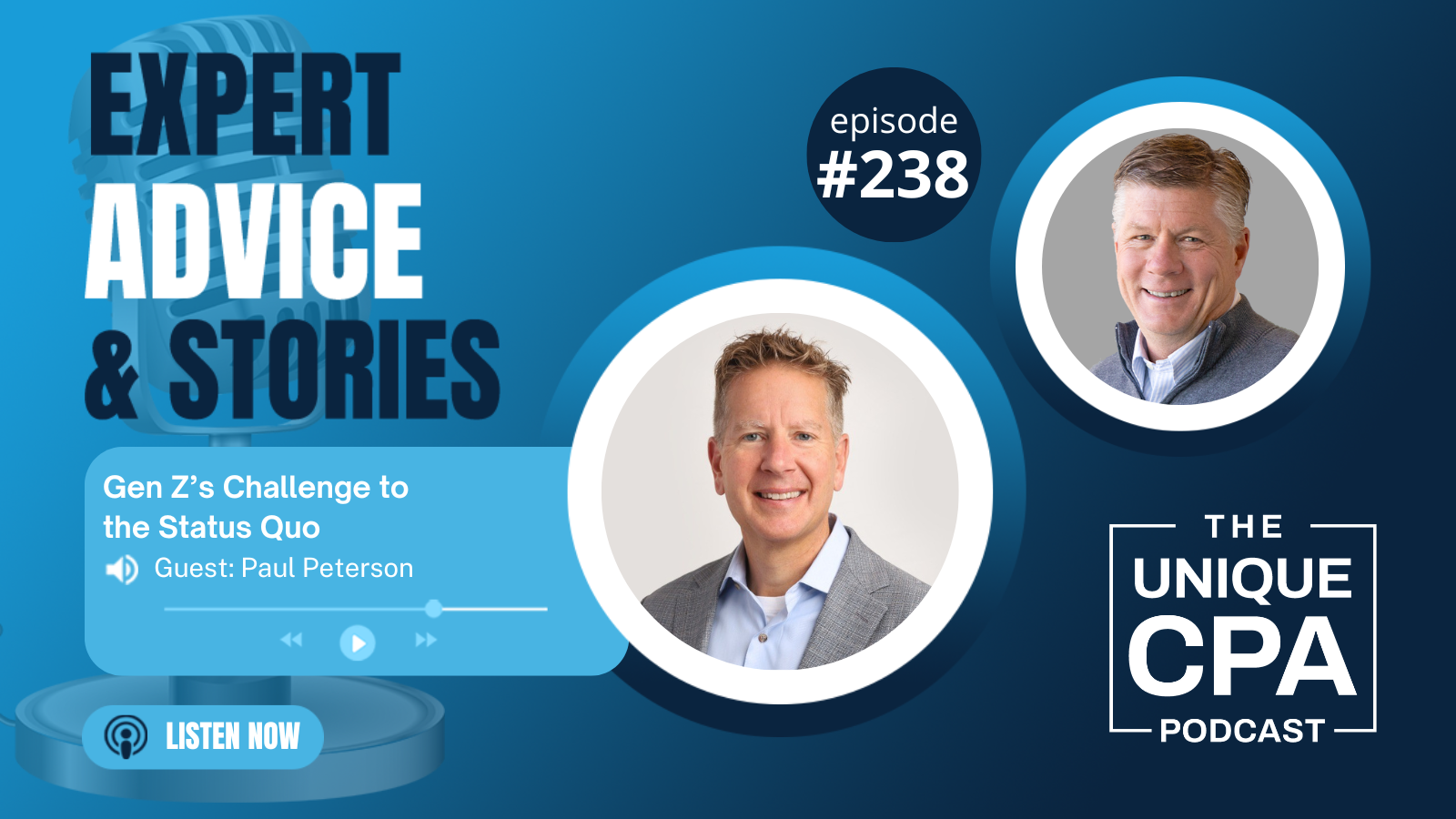
With Paul Peterson
When Paul Peterson looks across his firm, he sees a new generation rewriting the rules. On Episode 238 of The Unique CPA, he joins Randy Crabtree to trace the ripple effects of Gen Z’s arrival in accounting as young professionals who expect flexibility, are driven by their purpose, and challenge the status quo while setting new standards for everyone. Paul recounts how a twenty-something team member became the office’s AI expert, teaching partners to rethink their approach to technology. He describes Gen Z’s insistence on open dialogue and their willingness to question outdated practices, and the way they bring their whole selves to work. From the pressures of private equity to the importance of mental health, Gen Z’s presence is forcing even the most established leaders to adapt and build a culture where everyone can belong—something that is paying dividends economically even now.
Today’s guest is Paul Peterson, CEO of top 100 CPA firm, Wiss—a company, technically. Paul believes that if accounting firms want to attract the next generation of talent, especially Gen Z, which we will be talking about today, they need to go beyond competitive salaries, they need to offer impact, mentorship, and a sense of purpose. I love all that. With Gen Z showing a rising interest, which is pretty cool in accounting—we saw a 12% jump in enrollment this last fall, which still has not made up from the drop we’ve had—but Paul thinks there’s a unique opportunity for firms to meet the generation where they are. Paul joins us to discuss how firms can rethink their value proposition and what type of initiatives could be the blueprint for the profession’s future. Paul, welcome to The Unique CPA.
Yeah, Randy, thanks for having me. I appreciate it. Looking forward to today.
Yeah, this’ll be fun. A lot of the things you’re talking about, I’m super passionate about. I can tell you’re super passionate about, so I think our passion’s going to show through as we talk about things today.
That’s awesome. Yeah. Excited for it.
Yeah. So let’s just before we even get into, I teased a little bit, we’re going to talk about Gen Z, obviously, and we’re going to talk about the profession and attracting, retaining, you know, things we could do, but why don’t you give us a little bit, you’ve been what I think I saw, was it 12 years now, managing partner of Wiss?
Yeah. Which is crazy. I mean, time goes faster and faster the older you get, that’s for sure. I’m pretty much a homegrown Wiss person. I did leave at one time for the internet startup dreams, but you know, it was one of those, the grass was greener and you know, I went over to the other side. Found that it was not as green as I thought it would be, especially with the money, because we never started up and made any.
Yeah, that’s an issue. Alright.
Yeah! So, but it was really good because I think when I, you know, so I’ve been at Wiss for 30 years, you know, without counting that brief exit. But it was really good for me, ’cause I think what it did for me was number one. It really made me appreciate what I had. So seeing something else and getting that sense of, wow, I really did belong where I was and also just really appreciating public accounting in general. So it wasn’t just Wiss, but also just the excitement of the public accounting industry and what it really offers an individual in the way of so much fulfillment. I think there’s not a lot that’s said about financial success ’cause there is a lot of financial success in accounting, but also I think, which is really understated, the whole way was like the freedom and the flexibility that you get, you know, if you’re able to kind of get to that point where, yeah, you put a lot of time in the beginning and you’re running around a lot, but eventually you do have more control. And that was very important to me was being able to be entrepreneurial in that from that standpoint.
Yep. No, I think that’s great. The problem is, I’m jumping ahead already, Gen Z look at things the same way as what we were just discussing?
Yeah, no, and I think that’s what’s great about what we are talking about because I’m a Gen Xer. So I think what’s interesting about the Gen Xers, like we were more seeing what, let’s say, wasn’t the way in which we would run the business when we were on staff and when we were starting out, but we were more of like, yeah, we don’t like it, but we do it anyway, right? But one of the things that I was very fortunate at Wiss to be surrounded with people within my class or, you know, within the earshot of my class where we all were like, why does accounting have to be such a crappy place to work?
Exactly!
Yeah, so that was really our mission as we moved along and, you know, I was fortunate to become the managing partner and have more of influence on the direction and really start to bring more humanity into the culture. But I always felt like there was a way you could do both; that you didn’t have to leave the humanity outside of what you do on the inside of an accounting firm and that the two can coexist and that you can bring your individual self. So there was like this, I think that’s where the passion comes from, is this continued quest to continue to make it better, ’cause I think there are a lot of inflection points that are still to come, but that we’ve experienced since COVID that are spurring on change. And I know you’ve talked a lot about that on prior podcasts and you’ve been doing a lot of work on this. But I think we’re at a really cool time, even though there’s a lot of headwinds the accounting profession is facing, I think it provides a lot of opportunity.
Yeah. So, man, there’s so many things I could jump into just on that. I mean the humanity, the culture, everything. But let’s go into, ’cause we were just talking about your leadership and what a little bit of your philosophy there. Have you had to change your philosophy or have you always been this way in the last 12 years? Or how have you seen your leadership evolve in the time you’ve had the CEO role there?
Yeah, it’s a great question. I think the north star has always been, you know, around the culture and bringing the human, let’s say, “fact” more to the table, like really what’s in the best interest of people and that. Be like, say, Hey, that’s the north star, but you also have to have the economics to make it work, right? So I think there was a lot of, I would say the first, it took longer than I thought, honestly, to get to a point where you’re cleaning up a little bit of the dysfunction of, let’s say, the partnership and the way things kind of got to be, and to really establish trust across organization. ’Cause it’s just not a, you know, first of all, it has to start at the top. I mean, you know, you look at every Harvard case study that’s out there on change—it has to start at the top, but it is a top down, bottoms up, like you gotta meet, it’s just not going to work unless you really have other people.
I’ve always said it’s like an accounting firm in a way as there, it’s like no difference in sports where it’s like, where the real stuff is, is in the locker room. You know, the coach goes to the microphone and says everything to the press that they need to, you know, you want them to hear, but it’s really what do the players think? You know, what’s the chemistry like? And that’s what I always felt like that’s our true test is we’ll know if we’re doing it right if we have people that are going out actively speaking on behalf of the firm to bring people in, and they’re referring, getting their friends to join, or they’re speaking on our behalf. And you know, that was what, like what the, to me, like how you can get validation around, are we really, are we acting in the way that we’re talking? And it took a long time, you know? And getting the economics right, you know, like that’s a big part of it. And to converge on both of those takes a lot of work. And I think our industry now and is real interesting because you have private equity, and what does that do to the firm? Like, ’cause it’s like, yeah, you know what Gen Z wants and what PE is looking to do. It’s really like they’re really not in sync.
No, I agree. It scares me. PE scares me. I mean, I know it’s not going away. I know it’s here. I just want to see what’s going to happen over the next, whatever, five years or whatever the timing is, and I don’t blame anybody for getting involved with it. I know plenty of managing partners that I’m friends with, of larger firms that have done it and we’ve talked and they tell me all positive things, so I’m going to go with that. So I just don’t know the end game. That’s what I don’t know.
Yeah. And then what does it do? You know, I just think, you know, again, not to go too far off from the Gen Z, but I think yes, there’s ways that I think are really cool in terms of bringing incentives down throughout the organization. So let’s say for if like to get on topic with Gen Z and how does it benefit them would be, can there be more, let’s say, realization events on monetization along the journey, as opposed to the back endedness of what the profession looked like previously. So that could be a pretty cool thing.
No, I see that. And let’s talk about, because I mentioned, I teased at the beginning of the intro a little bit about salaries and how salaries aren’t enough anymore. And so really, what does matter if it’s not just sellers? And let me set the stage here for a second, I wanted to do this. But I mentioned off air when you and I were talking, we just did a, a year ago we did a professional satisfaction survey. It was just finding out satisfaction levels within the profession. And the funny thing is salary was not one of the higher up things. It was as long as I felt my salary was competitive, other things affected my satisfaction level so much more than salary. Even if I was underpaid and I had these other things in the organization, the satisfaction level of the respondents was high. And so, you know, why do you think that is? Or what are you doing to go beyond just the salary to make this experience a positive one to keep people and attract people?
Yeah, no, I think that’s really well said, and I think your research and the findings there is what we’re seeing in action there. I think number one, I think that there’s more of a curiosity that’s in Gen Z where it’s about the evolution of their learning and their experience looking at their path, not just so career oriented, but more of the, I would say, the interplay of how does this also bring personal fulfillment, right? Like more of the, you know, their soul, they’re bringing that to the table too, and is, are there values correlating to how the organization positions itself? And so there’s more around that. And I think that they also want opportunities to experience, like we have—I’ll give you an example of someone now that came to us and asked for permission, was here for a few years, said, “Hey, I feel that I have the foundation. I could really work remotely. I can be a valued team member, but I’d like to travel the world and do it.” And they’re doing it! So can you do that with the whole organization? Probably not, but not everyone wants to do that anyway.
Right.
So, you know, there’s plenty of people still that are like, Hey, I just, I love coming to the office. I’ll be here five days a week. But I think it’s more of like, can you come up with, even at an early on point in their career where it’s more of a journey and not thinking so much like giving them the carrot, like, hey, here’s where you want to be your ultimate destination, more of like, how can you make this experiential for them along the journey? So it’s almost much more short term, much more around their own individual evolution, and matching, you know, the interests of the firm. You know, like what’s benefit one another.
Yeah. And you kind of alluded to it but making an impact too. They want to have a difference in the world. Is there a way to show that… I mean, ’cause what we do as accountants has a huge impact. A friend of mine who you, you may know her, Jennifer Wilson, she was at our speaking at our conference last year and she talked about how accounting professionals are guardians of the galaxy’s economy. And so that’s just, that gives me goosebumps. And, and so is there a way that you kind of communicate that, hey, this, we are having an impact and this is what we’re doing?
Oh, a hundred percent. And I think that the impact, you know, especially, you know, we’ve been very fortunate over the past several years to kind of grow in terms of service offerings. So what I really love is the ability to provide someone with the opportunity, so that could be what they’re really passionate about, is like they’re in audit or they’re in assurance and that matters to them, right? The protectionism around, “Hey, listen, like there’s truth out there that people can trust because of CPAs and financial reporting.” And then there’s like the advisory practice now, where we go and we have people that augment, you know, an internal accounting team at a company. So you are getting some fulfillment out of, like, you’re part of helping someone on a more, let’s say, like granular level. You’re closing their books with them and you’re helping bring insights that they’ve never had before. Or you’re in our wealth management practice and you’re, you know, you’re getting involved in financial planning or the estate planning that goes on. So there’s so many ways that we become impactful.
And the other thing we try to do is look at, like for us financial literacy is like our, I would say our number one targeted program where we are looking to bring, you know, some social benefit to what we do. So, you know, in the summertime we offer up the ability for people to go teach financial literacy, we have a whole program. We brought in someone into our people operations that used to be a teacher. And so this person now works with us and helped us develop this whole financial literacy program. So that’s kind of cool. It’s kinda like, you know, it’s the combination of what can you get, you know, in your career and, and the benefits, like you said, like the fulfillment there. But also can we offer other supplemental ways that you can derive value from, you know, the community aspects.
Yeah. And so you’re creating this culture where people feel open to share their ideas, to communicate what they like and don’t like too. And what you said at the beginning of that I am super passionate about is allowing people to find that role that fits them perfectly, that, “Hey, I love audits and I love trucking companies, and so can I start? That could be that my niche, do we have that niche? Can we build that niche?” And I call that, I’w pretty sure I coined this phrase, maybe I stole it from somebody, but I say it all the time, “living at the intersection of your passion and your skills.”
That’s awesome.
And if you can build that into what you’re doing at work, I mean, I don’t work a minute in the day. Yeah. Because I get to talk to people like you. And this is so fun. So I want to be able to figure out ways where we can at least slowly get everybody into that role. And that sounds like you’re open to that.
No, and I appreciate that. And that you’re actually, you know, again, I think we just have to get a better narrative out there around the profession. And you know, it’s interesting, on Monday we have our intern, summer intern class coming in. Myself and really my right hand person, Jim Duffy, will go and meet with them and I will ask the, the opening kind of question. Trying to get contributions at first is always hard too. They’re looking at us like, yeah, don’t ask me to talk. But you know, like we always say like, tell us about what you hear about public accounting. And we find it’s the same stuff they’ve been hearing that we used to hear, you know, the horror stories, the long hours, the like, you know, leaving your personal life behind. And, and it’s just like, wow, that’s not true.
It’s not true. And I shouldn’t say this, but I’m going to anyways, ’cause I’m guessing Big Four people don’t listen to this podcast as much.
Yeah. You and I both.
Yeah. At that level, which is, and, and again, I haven’t experienced it. I never worked there. I’ve just heard stories and most of the, again, not to. This is not controversial. Most of the universities are pushing, you know, accounting students to Big Four. At least they hear that. And so that’s, I think where those stories come from.
Same. And I think there’s a little bit of a disorientation that’s gone on too, where I think that there has been talk of certain firms saying that they’re one way and then people get there and they’re another way. And I think that hasn’t done us a favor either. ’Cause it would’ve been better off being like, no, this is the way we are. And that’s just like the truth. And so, you know, I think, overall, I just feel like the trust within the public accounting community has really been lost. And you see that with the going concern websites. And these like, you know, stuff like that where, you know, it’s unfortunate that, you know, we’ve really lost a lot of, I think the trust within the profession itself is damaged.
Yep. But we’re going to fix that.
That’s right.
You’re working on it. I’m working on it. Jennifer Wilson’s working on it.
That’s right. No, we have so many of us. Yeah. We’re going to be fine.
Yep. Alright, so let’s pivot a little bit ’cause I know one of the things that you mentioned, uh, off air again, is mentorship program and how important that is to you and the organization. You know, I guess if we’re going to stay on Gen Z specifically. Yeah. You know, what does Gen Z expect from leadership, and then how would you address that through mentorship programs?
I think with Gen Z, what I love about Gen Z is they’re a mirror. You have to live up to what you tell them, you really do. That’s number one. I feel like it’s a good litmus test, in a way, and they’re going to tell you if you’re not. I like that about them, that they will say what’s on their minds. The other thing is they’re very open-minded, so when we look at programs we can offer them, they’re open-minded about what that looks like. I don’t think they have anything that’s so strict in what it looks like, but they appreciate that we are doing something there. We were fortunate enough, as the firm grew and we had resources, to add people. We now refer to HR as people operations. We’ve added teammates, dedicated people to the service areas. Their primary job is to help provide coaching, make sure they’re lined up with the right people, they can pick the growth champion, and that can change—maybe this person for a year, and then I’ve developed a better relationship with this person because I’m working more with them, so they can be flexible. There’s a lot more interaction and ongoing feedback, it’s not anymore like once a year or twice a year, it’s more embedded, more fluid. That really helped, and they have a two-way dialogue now, let’s say. That’s really helped.
What we’ve seen is people feel more portable within the firm too, because we’ve designed it, people aren’t just leaving Wiss now because they’re not really fulfilled doing audit. They can go to tax, let’s say. I feel like that occurs so much more now because of the ways our people operations team are connecting them to the organization.
Yeah, that’s nice. I think that’s important. People feel valued, they feel important, they feel like they can speak their mind, they feel like they can share their ideas. That’s the type of culture that needs to happen within organizations. Really I go all the way back to the bottom line that I think the culture starts with vulnerable leadership.
Totally.
I don’t know if you’ve ever thought about that specifically, or do you think Wiss lives vulnerable leadership?
I think we’ve gotten better at it, for sure. I think that took time, I think, to really get approachable. Approachable is probably another word for vulnerability. Are you able to get yourself to a point where you’re actively engaging with the people that you want to. When you walk around the organization—I used to laugh because there were certain people when I was younger, I’d see them coming and I’d go the other way, you know?
I know what you mean.
We have a lot less of that now, which is nice. But it is, and it’s contagious. I really feel that we have much more enthusiasm within the organization than we used to. I really believe you need your leaders to pay for it.
And leaders can’t, I mean, I’m putting my two cents in here, but leaders have to not try to put this aura of “I’m perfect, and you have to be perfect like me,” because if you do that, people are going to be afraid to take chances, people are afraid to be innovative or creative because that’s a mistake, and I can’t, I just have to know a hundred percent that it’s going to be accurate.
No, it’s so true. You have to be careful, even with the littlest things, like even the way you do your review notes. You have to make it so it’s not so much like this—you’re not their mom or dad, and you’re not their teacher. You’re not grading them. They’re a part of your team. How would you bring someone along? If you’re going to critique them and they’re going to feel critiqued, they’re not going to perform well because they’re always going to feel guarded. You have to break that from the ways in which the firm used to be. I think it used to be that was the way it would be. It would be more hierarchical, and yes, you need hierarchy in terms of how work gets done, but you don’t need hierarchy in the way you’re treating an individual.
You and I are on the same page. I have a hard time with “leadership,” just the word, because whether it associates with me is like, I’ve got people at the top and then people below. With leadership, I think everybody in the organization has an opportunity to lead because you want to hear the ideas everybody has.
Totally. It’s perspective and experience. I have the benefit that I’ve been here for 30 years, so I’ve seen a lot more in 30 years, but it doesn’t mean that I’m any more right than anyone else. I just may have had an experience where I’ve seen and said, “Hey, this is what I’ve seen before. Tell me why you think differently.”
Yep. Let’s go back to Gen Z, because I love the topic. I’m no expert, but I did research some characteristics of Gen Z, so I thought maybe we’d do a little speed round of just talking about certain characteristics and how that has been addressed. So one of them is just from a digital standpoint, from a technology standpoint. This is what they grew up with, and they are so far advanced. I know for you personally, AI is a big thing in accounting. So how would you see the digital, the technology aspect and Gen Z coexisting?
Yeah, you took the words out of my mouth. They are the generation that’s only known digital. I think it was 1997 to 2012 was Gen Z, the range they give, something like that. Digital native, this is what they’re totally comfortable with. I think it’s a huge advantage now that we are on the cusp of entering into a much more technologically driven world, where technology has been a part of accounting firms for many years now, but not at the level that it’s going to be at in a few years. It’s coming soon, and I think we’ve seen it already. We’ve embraced and we’ve been piloting some AI programs.
Our younger people—one of our best performers right now is 24 years old—knows this AI program in and out, is the champion, is teaching everyone, is teaching the higher-ups. We’ve embraced that. They are so comfortable just with all new technology, there’s no resistance, and they incorporate it, and what we’re trying to find out is the way they incorporate it and the way that they’re using it, how can we get others to use it in the way that they are using it? Especially when we tracked, when we gave Microsoft Copilot, we threw it out there and were looking at usage. Younger people, it’s like the new Google for them.
Yeah I haven’t got the hang of Copilot yet too well.
It’s an adjustment.
I want to, because I write so many PowerPoint presentations. I want it to help me with that, but I need some of your people to come help me with it.
That’s what I’m saying, you surround yourself with people. That’s the other thing, which is why I love public accounting. It’s hard to get old!
To go on a Gen Z rant a little bit, I was writing a presentation. I was fortunate enough to speak at the National Restaurant Association Leadership Summit a couple weeks ago in Chicago. We had a company retreat, flew everyone to one location, and there was a Gen Z gentleman—good friends, we hung out in California earlier this year. He looked at me writing this and said, “No, let me fix this for you.” He just went in there, cleaned it up, rewrote it, took words out, put graphs in. I need you every time I do this now.
Which is great, I was going to segue into communication, which is interesting to me. There’s been a knock that Gen Z isn’t great at communicating, that they’re not effective communicators, and you see them sitting around a table, all on their phones, not talking. But when you think about it, what they’re really good at is presenting something in a way: illustratively, digitally, in a much better way. I’ve seen them put together insights, like, we have a data person who puts insights together in four pages, and you get it. It’s not a lot of words; they use charts, graphs, whatever, to communicate very effectively, especially when dealing with companies or people who may not have the best understanding of accounting. But when you have them on your team, helping you present information so the picture tells the story, it’s a beautiful thing.
Oh yeah, I’m definitely going to surround myself with more people like that. Communication was not an issue with him either. So, a couple of these other things—purpose-driven, we already went through this, kind of. We talked about the fact that they want to have an impact, a social impact. I don’t know if we want to add anything on Gen Z with the purpose-driven aspect of things?
The one thing you’ll find is they’re active. They get themselves involved. We’ll do activities where their participation is great. One thing we opened up to is, if they have a passion around a specific charitable organization, just bring it to the table and tell us how we can support it. And really, they’re so non-judgmental—it’s really impressive. And we’ve seen that recently, we’ve been doing June 30th feedback, and I don’t know, it’s very impressive just how much more open minded and objective they are.
Alright, next one, speed round I guess. The financial stability side of things seems to be a part of Gen Z. One, they grew up through 2008, when we had those issues with stability, and then went through college during COVID, and having something stable was probably important. Does this play into how you look at Gen Z?
Yeah, definitely. And from what I understand too, they’re more savers than we expected, and they want to think about that financial side, how they can provide security for themselves. There’s more interest, even early on, even around like the 401(k) plan, and wanting more knowledge about investing and creating wealth down the line, and that’s something that’s pretty cool too. And I feel for them, too. Where our offices are is so expensive, we’re in Northern New Jersey and New York City, like oh my gosh. And they’re seeing the cost of living is dramatically different in terms of when I first came out of school, and how much you have to pay just to live. Your monthly costs are much higher now, so I think that’s another driving factor for them, and the importance of making sure they have stability.
Yep, I think so too. I wish I had that when I was their age.
Same.
And I wouldn’t be surprised if that’s why we saw a 12% jump in enrollments into accounting programs, because of the stable profession and the financial aspect of it.
Yeah. I’m seeing it because my son is going to be a senior in college next year, so just talking to his friends, listening to those that are rethinking their majors because they’re starting to get a sense of whether there will be a job. So I think there’s a little bit of a change now where they feel like they’re going to have a job. They’re starting to see layoffs at tech companies, AI is starting to take over coding and software, and disruption at the grassroots level, so, when you think about, like your comment about the 12% jump, I think you’re spot on.
I agree. Alright, two more speed rounds. Probably the first generation that’s had the most mental health awareness involved in it. How have you seen that as well?
Oh, a hundred percent. Very different. I think it’s going to be great for them in the long run. I had massive anxiety disorder in my 30s, and I had no idea what it was. When someone told me I had anxiety, like, what do you mean? Like what is that? I didn’t know what that meant.
Yeah, and no, you didn’t know what it was, and probably weren’t comfortable talking about it either.
Not at all! It was almost like, “Get over it.”
Right. Exactly.
“What’s the matter with you?”
See! That’s where vulnerable leadership comes in. That’s a big thing I’m a proponent of—mental health awareness and avoiding burnout. I actually think maybe I might be part Gen Z. I don’t know.
Yeah, no, seriously. I always feel that way too. We were born in the wrong generation.
And the last one—it’s probably the most, or not probably, it is the most diverse generation in US history, and so diversity and inclusion are important to them. What’s the impact of diversity and inclusion you’ve seen with Gen Z?
It’s been great. Again, just speaking candidly, when I started in accounting, it was mostly people who looked like me. So when I looked up top, they looked like me. That has changed significantly. I absolutely love what I see now. The representation is great for accounting, and there are still challenges with getting more minority participation in accounting, and I think there will be real benefits from states rethinking what are the number of hours you need to get your CPA, so I’m happy to hear it’s going to be potentially reduced, because that’s a prohibitor in many places, economically. So I think, yeah, it’s been great. I mean, we are a different firm. I mean, you walk around this firm now, it is awesome because it has changed significantly on the representation from so many different ethnicities. Like race, religion, all of it, you know?
Yeah, across the board, yep. I talk about this too, ’cause I think one of the, where we really started our, we were on this hockey stick growth curve, you know, going up the hockey stick, it’s the exact same time where we became a much more diverse organization, and there’s multiple things that happened at that time, but being diverse. getting all these new ideas from these new people looking at things different ways, I think was so important. So I think, yeah, I think that is a great aspect of, uh—
And it’s really helped culturally! It’s awesome, and I think again, like it goes hand-in-and with the experiential, which I think is so important for Gen Z, the craving that different experience. We have a Gen Z guy from Iran, who’s also an entrepreneur at heart—he roasts his own coffee beans on the side. So that’s the other thing about Gen Z—they can do multiple jobs, they have all kinds of things going on. But he’s just so grateful for the opportunities, and it’s really nice to have that added element, someone thriving in this, like the American dream is still alive.
Right, yeah. And what you just said is so important—you knew the things he does outside of work. You get to know the people and their passions outside of their job title. Being known was one of the highest satisfaction level creators in that survey we did, so I applaud you for even knowing that he roasted coffee beans.
Well, I’m a big coffee aficionado, so.
That’s good. Alright, well, I love the conversation. I love what you’re doing. I love being educated on Gen Z. At our conference last year, we had a session on Gen Z in the profession. We’re going to have another one this year as well.
Oh that’s awesome. I gotta get invited to that.
Yeah, well, I’m going to invite you. We’re excited to hear it, excited to see what’s happening, excited to see people coming into the profession. What do you see as Gen Z’s impact, long term and short term, and Wiss’s impact on that as well?
Yeah, I think the timing couldn’t be better, quite honestly. Sometimes the universe works in interesting ways—it’s like the perfect generation to help us embrace what’s to come. Their open-mindedness and the way they’re going to adopt technology is going to be so important because there’s a lot of change, whether we like it or not, and it’s right on the doorstep, and they’re going to be very important in helping us become whatever the next iteration of Wiss will be, because it’s going to happen, they’re going to be at the center of it. Being so native to the digital aspect is going to be such a help.
Yeah, and one of the things I heard at the conference last year is that one of the first questions Gen Z has when they’re interviewing a firm is, “How is your technology integrated into your organization?”
Yes, a hundred percent. We get that too.
And you have it. We didn’t even get into your tech stack, but I know from a technology standpoint, you’re probably up there with the best of them.
Yeah, but again, that’s because we need to be, or we don’t get them.
Exactly, no!
That’s why I feel like they’re making us build a firm that’s needed to economically survive.
Yep. It is perfect timing. We were all worried. We’re still a little worried, but I think things are turning, and I have a positive outlook on the future of this profession.
Me too, me too.
Alright, so bottom line, when you personally aren’t leading this purpose-driven charge with Gen Z at Wiss, what do you do outside of work that brings you joy? What are your outside-of-work passions?
Yeah, I’m blessed. I have a great family, love that side of it. My two kids are now in college, so my wife has to spend a lot more time with me now. But no, I love learning, music, play the piano, so that’s been a nice relief for me, and I love to run. Running is my peace.
That’s one thing I wish I could do. I’ve got two replaced knees, so running’s not in my future anymore, but man, I miss that. I do get to do the elliptical and just exercise.
Yeah, to get that endorphin rush.
And if people want to find out more about you and Wiss and what you’re all doing—obviously sounds like a great organization—where would they look?
You can always email me, PPeterson@Wiss.com. I’d love to talk to anybody who wants to hear about what we’re doing, or I can hear about what you’re doing. Would love to continue to share ideas and, like you said, Randy, at the beginning, how to continue to make our wonderful industry better.
Awesome. Well, Paul, this has been a pleasure.
Yeah, a pleasure. I’m so happy I met you. Thank you, Randy.
Believe me, I’m happy too. I could talk all day. We can do this again, there are plenty of topics we can discuss.
Oh, there’s going to be more to come. We’re just on the cusp.
Alright. Well, thanks again.
Alright. Thanks, Randy.
Important Links
About the Guest
Paul Peterson is the Managing Partner at Wiss. He is grateful to work with colleagues who have built a culture of genuine care and innovation. Together, they have created an environment where people feel valued and are empowered to excel. It’s this unique culture, grounded in authenticity and mutual support, that make him the proudest. As the accounting profession evolves, Wiss enthusiastically embraces the potential of technology and AI to elevate our role from number crunchers to trusted strategic advisors. But beyond the numbers and technology, Paul’s success will always be rooted in people—in building teams that thrive and helping others grow personally and professionally.
Meet the Host
 Randy Crabtree, co-founder and partner of Tri-Merit Specialty Tax Professionals, is a widely followed author, lecturer and podcast host for the accounting profession.
Since 2019, he has hosted the “The Unique CPA,” podcast, which ranks among the world’s 5% most popular programs (Source: Listen Score). You can find articles from Randy in Accounting Today’s Voices column, the AICPA Tax Adviser (Tax-saving opportunities for the housing and construction industries) and he is a regular presenter at conferences and virtual training events hosted by CPAmerica, Prime Global, Leading Edge Alliance (LEA), Allinial Global and several state CPA societies. Crabtree also provides continuing professional education to top 100 CPA firms across the country.
Schaumburg, Illinois-based Tri-Merit is a niche professional services firm that specializes in helping CPAs and their clients benefit from R&D tax credits, cost segregation, the energy efficient commercial buildings deduction (179D), the energy efficient home credit (45L) and the employee retention credit (ERC).
Prior to joining Tri-Merit, Crabtree was managing partner of a CPA firm in the greater Chicago area. He has more than 30 years of public accounting and tax consulting experience in a wide variety of industries, and has worked closely with top executives to help them optimize their tax planning strategies.