The ROI of Wellbeing
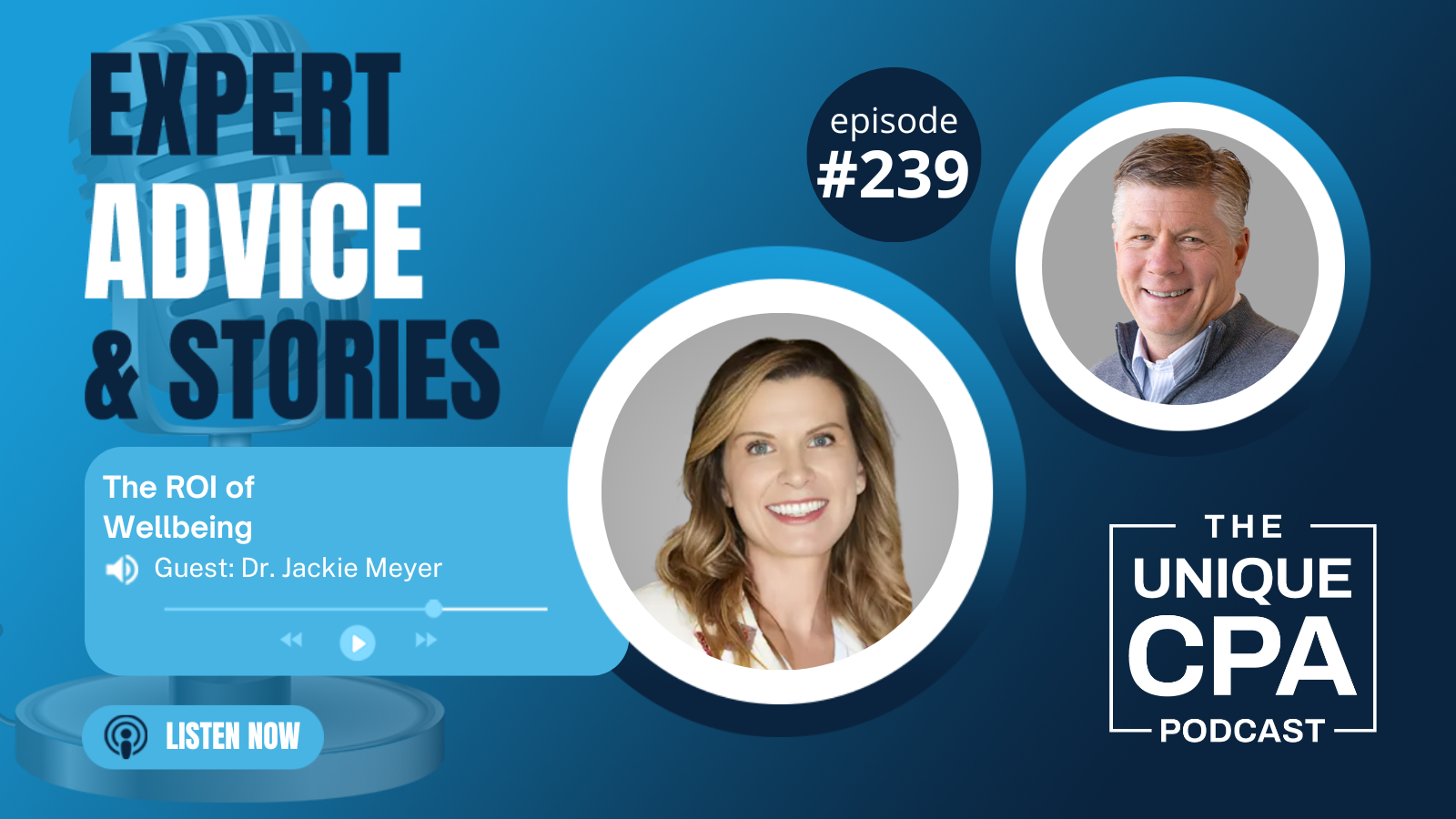
With Dr. Jackie Meyer
About a decade ago, Dr. Jackie Meyer hit a wall of exhaustion running her CPA firm, but she refused to hide behind the industry’s mask of perfection. Diagnosed with chronic fatigue and juggling motherhood and her work responsibilities, she began to question the relentless pace and the culture of stoicism that define the profession. On her return to The Unique CPA for Episode 239, she explains that instead of retreating, she transformed her struggle into a mission: she built TaxPlanIQ, a platform that lets accountants reclaim their time and sanity, and developed the ROI Method, a value pricing formula now championed by the AICPA. Since then, she’s completed her doctorate in leadership and written a forthcoming book, The Balanced Millionaire. Jackie’s journey, from iron infusions and late-night epiphanies to a much healthier, sustainable pace now, offers a candid look at what it takes to change not just a career, but an entire profession.
Welcome back to The Unique CPA, where we celebrate innovators, change makers, and passionate voices shaping the future of accounting. Today’s guest is someone who truly lives at the intersection of innovation and intention: Dr. Jackie Meyer. Jackie is a serial entrepreneur, CPA, and nationally recognized thought leader who’s graced the CPA Practice Advisor’s “40 Under 40” list from 2018 through 2022. She’s the founder of an award-winning CPA firm, now leading the charge with TaxPlanIQ, a SaaS platform that’s transforming tax advisory services, and she’s doing that while writing her new book, The Balance Sheet of Life, which I love the name, we’ll talk about that today. Her “ROI Method” of value pricing is shaking up the way firms approach client relationships, pricing, and culture. Focusing on impact instead of hours and people instead of burnout. Jackie’s mission is to help us all improve our health, wealth, and relationships, and she’s here to share how we can all do just that. Jackie, welcome back to The Unique CPA.
Thank you, Randy. It’s a pleasure to be here. I’m a big fan of you and all you advocate for, for mental health and physical health, of course, in our industry. So excited to chat again.
Well, I am too. And it’s great to see you. Boy, when was the last time I saw you in person? It couldn’t have been that long ago, was it? My mind’s blank.
Well, It wasn’t at Scaling (New Heights). I skipped Scaling for Costa Rica—darn. But it was probably a few months ago. Who knows? You’re everywhere.
It feels like that. I’m actually at home today, which is not normal, but it’s good. I’m glad I’m here. So, just to let everybody know we don’t normally do this, but we’re recording June 30th. I’m not sure when this is gonna be released, so we’re just getting ready for 4th of July weekend, but we’re also getting ready for Bridging the Gap. I think this will probably be released after the conference, but you will be speaking at the conference, very excited about that. You have two other people on a panel with you. Can you give us a little background of what you will be speaking on in your session?
For sure. It’s actually like the one speaking event that I’m looking forward to the most, because it’s really from the heart and it’s gonna be a fireside chat with my friend Samantha Halburn, and then Seth Weinberg will moderate it. So the title we have reframed because we noticed we have a lot of competition with other panels—y’all have a lot going on over there—so I’m making it new title: “The Burnout Breakthrough, How Real Life Wellbeing Stories Spark Massive Growth, with Dr. Meyer, Halburn and Feinberg.” So yeah, that’ll be our topic. We’re really gonna make it very audience driven, so hopefully people listening after the fact, if you are able to attend, you’re able to ask a lot of great questions and we’re gonna get real about all the things. I think every day I get more and more real about life and the stressors of it. And you definitely inspired me to do that because you’re very open about those things as well.
Well, thank you. And you are as well, so I appreciate that. So I love the topic—I don’t love the fact that we have to talk about burnout, but we do—and it’s a real thing. I think before we even get into some other things, can you give us an idea of why this topic is passionate to you?
Oh, yeah, sure. So, just to be real, like, as of today, I am kind of like on the ebb, like the lower ebb and flow of my health or journey, which I think for everybody it’s important to note, like we’re always on a ebb and flow in our journeys, like it’s never gonna be perfect. So I hit burnout in my own CPA firm several years ago around 2013 through 2016 when I had my two kiddos and got diagnosed with chronic fatigue. I mean, I’m diagnosed with all the things that are like called “trash diagnosis,” where like they’re nothing, but they like impact everything in your life. Just this year I noticed my iron levels are extremely low for the last year consistently, and so right now I just started doing iron infusions. So I’m feeling really tired today, just to be honest with everybody, and a little googly woogly, but I think it’s important to kind of share those things, ’cause I used to be so embarrassed about it and I felt like I had to be such a perfectionist and like the perfect CPA and etc., and none of us are like that, we all have our flaws and I think being real about it is important, right?
Oh, it’s definitely important. And what you just said is a, what’s the right word? Epidemic. It’s a, in the profession, I’m not sure the right word. We’ll figure that out. It’s a problem—there, that’s a good word, I’ll use that—In the profession because especially as entrepreneurs and a lot of us owning our own firms and we feel that yes, we can’t show any sign of weakness. We have to show that we are, we’re stoic, that we’re strong, that we have all the answers, that we can help everybody. When in reality, the things that you just said, being vulnerable, sharing that I do need help at times, that there are things that are not perfect. That right there, that leadership, that being able to share makes such a big impact on others. And that’s why this is so important to me. If we can show that it’s okay to say “I need help with something,” or it’s okay to say “I don’t have all the answers,” all the research I’ve done and all the statistics I’ve seen, that alone right there is one of the ways to create a firm that’s gonna thrive. And so that’s why it’s important. And so I’m so excited you’re doing that. I’m very happy you’ll be there this year and I’m looking forward to that session, so thank you.
Yeah, for sure. Thank you. It’s interesting, like I don’t want people to get caught up in the terminology around the word “burnout.” I think like people start overly focusing on, “Oh, it’s not burnout, it’s X, Y, Z, or like, we have to call it not work-life balance, work-life harmony.” I’m like, who cares? We all know there’s a problem. Let’s just try to fix it, and it’s a constant work on ourselves to get there. But yeah, burnout, I also think, which I would love—I didn’t study this in my doctorate in leadership, but I’d love to eventually kind of write an official paper around is burnout curable? Because I think that there’s, now I’m gonna mess up the word… Irreconcilable.
There you go! You got it!
Yes. Thank you. There’s permanent damage!
There, okay.
It happens when you hit burnout and the health problems that go along with it and whatnot. And gosh, I spent a lot of money to maintain all those things now on a daily and weekly basis. So I really encourage listeners to really invest in themselves, not only professionally, but also personally to make sure that your health is good. I mean, the cost effectiveness of just getting one of those heart tests to make sure your cholesterol’s okay and stuff like that are just phenomenal these days. So go get yourself checked out.
Well, so that reminds me, I’ve got to put a reminder, Randy, go do your test. So I, I’m very good at seeing my doctor very often, but I’ve been thinking about doing one of those full body scan tests and haven’t done it. So that’s good advice. Look at you, you’re just advising on everything.
I know! I just can’t help myself!
That’s fine. That’s great. Yeah. So let’s transition into, ’cause you said the work-life balance, harmony, whatever, and being more efficient I think is part of what comes into that. And then you’ve got a couple of things out there that are helping people be more efficient. First, let’s talk about TaxPlanIQ. Give us a little background on that and let’s see, what’s the goal with that? What are you trying to help the accounting profession with it?
So we’re almost five years into TaxPlanIQ. I created it during COVID—I went to a software vendor of mine and said, “Hey, I have this vision of just pulling together everything I learned in tax advisory and all the education you need and the support into one platform. Will you create this for me?” They said yes, and I mean, it took off. It didn’t take off as quickly as I expected it to, I wanted thousands of users in one year, but we’re hitting 500 firms now, we are really starting to make a great impact. People are very thankful for the support that we provide. And I think there’s a lot of different influences with the economy and our profession that are tightening around us to be like, you’ve really got to look into this advisory thing, and tax advisory is just so freaking fun if you ask me. I just love finding people magical money.
Yes, I agree.
And so it’s so cool to be able to help other accountants do the same. So that’s what TaxPlanIQ does.
So TaxPlanIQ, it’s a tool to basically help firms be stronger advisors, especially on the, or specifically on the tax side?
For sure.
How does it work? Let’s get into the mechanics a little. Does it tie in with your current software? Do you plug in numbers? I am honestly curious to see the impact?
Yeah. So you upload a PDF of the client’s 1040, so it’s agnostic to any particular software, which is great ’cause that alone can be like a full-time job! So you upload the client’s 1040, I got it down this spring to where we can literally, we’ll suggest over 50 strategies—we have 130 plus in the system—but over 50 we can auto suggest off the 1040 itself within about 60 seconds. And then we suggest how to value price it based on my ROI method of value pricing; so we take the estimated tax savings, we apply a few factors: complexity of engagement, urgency, risk, and benefits you bring to the table for the client, and then we produce a value price. And then within like literally three minutes, we have a full tax proposal, tax plan, presentation, and tax plan report with all the details of those strategies and whatnot, for the client. It just blows my mind that we’re able to do that so quickly with technology today.
But what’s ironic is that we went thinking like ChatGPT and all this new AI stuff was gonna expedite it, and we ended up going back old school to just like literally exactly how I would analyze a 1040, I mean, if there’s just these if then scenarios, right? And you hone in on when you would suggest something and why, and that’s actually became a lot faster than using AI, which can be a little inconsistent when it comes to formulaic stuff.
Well, that’s a good point. Do you see AI being integrated at some point? Do you think that’s inevitable, or?
Yeah, we have a chatbot. Her name’s JAIne, J-A-I-N-E. When ChatGPT first came out, I really wanted it to be a girl, but I’ve realized like girl power, but I realized it’s just an “it” and so be it, it’s an “it.” But our chatbot is Jane, and she’s like a very smart tax manager that you can interact with, chat with, and then she’ll produce some ideas for you and whatnot as well. So we do have that component. It’s just figuring out the right balance, right between using that and then using good old fashioned logic.
Yep. And I think from just an AI standpoint in general, and I am, I shouldn’t downplay myself, I am an expert, well, not really.
Yes, you are, sir.
I’m an expert, but it’s inevitable that that’s going to be a huge part of the accounting profession, tax profession going forward. Obviously I see a point in time, and I don’t know when, where everything’s gonna be automated through AI from the compliance standpoint, from a data entry standpoint, from a whatever standpoint. But what I think the importance of what you’re doing then with the TaxPlanIQ is now the AI’s gonna free us up to be the more bigger part of the advisory part of things that we can spend our time on that. And so now all this is more automated, all this is quicker, all this is in our hands. Now you plug this into TaxPlanIQ and you can go out there and use your brainpower and your personality. So I guess my question is, what do you see AI in the long run, what’s the role of accountants, I guess going forward? If we have automation, where do we fit in? Because we’re not gonna be eliminated. We are gonna be as important in my opinion, as ever. Right. But where do you see that happening?
It’s in that all the things you would anticipate out of a good advisor? So personality, all these things that we naturally don’t want to go towards as accountants, like, you’re gonna have to. So it’s the way that you communicate the information to the client, handle the client. Make sure that they feel good about the transaction. I mean, we all know we’re just as much like their financial advisor as we are, probably know the most about their personal life details as anybody—that was interesting in my firm, like all the ins and outs of things that I would learn about my clients. But yeah, so I think that it’s okay if you’re an introvert. It’s okay if you love the numbers, but we just cannot process the level of data or audit and assess the level of data that AI can, and so it will just be a huge disservice if you’re not using it for the baseline. And then adding your flair to it to communicate it better to the client.
Yeah. I see the differentiations going forward is not the inputting of data or preparing a financial statement or preparing the tax return, but it’s gonna be the way that you can communicate that data and can communicate the opportunities going forward. So the things that we don’t teach as much or don’t stress as much—your personality, your ability to communicate, your vulnerability, your empathy, your whatever—those I think are some of the biggest skills going forward that you’re gonna need in this profession and, and pretty much every profession.
Yeah, and the good news is, Randy, that empathy is apparently learnable because I’m looking into it right now for my children, my 8 and 11 year olds, ’cause I don’t think they have any. So it’s like, “Oh, you can teach this to people. Okay, cool.” So yeah, I think that all these skills and traits, a lot of them are very learnable. I’m an extreme introvert. Everyone’s always surprised when I say that because I can talk a lot when I’m passionate about things, but like literally, I’d rather be sleeping in my bed right now, or like watching a Hallmark movie. But this stuff jazzes me up and that’s why the passion and purpose, like you’ve got to find that in your work. You’ve got to figure out how to niche down, find that passion and purpose in your work, and if you can’t find that, that’s what’s gonna ultimately lead to burnout or whatever the cycle is. And it’s also gonna work you out of a job with AI coming.
Yep. I agree. You’re talking my language for sure right now, so I appreciate that. Well, let’s transition to the, ’cause you, you mentioned it. ROI method, the value pricing ROI method. Because if we are getting faster with everything else, and if people are charged by the hour and all of a sudden everything’s automated and, and now we can really do this more advisory that you mentioned there’s a value to that, you can communicate that. So what is the ROI method of pricing that you have developed? Explain that to us.
Yes. So developed over many, many years for my own firm. It really transformed everything. I just interviewed Reza Hooda on The Concierge CPA Podcast this morning. He wrote these four pillars, he’s like the English version of me—it’s like exactly what I would advise people to do. But he has this pricing methodology that’s almost exactly like what I was doing. The only reason mine’s trademarked, etc., is just that I was told that it would give more validity to the profession, right? So none of this stuff’s new, but for some reason people just aren’t using it. So it’s just a formula, it’s a math formula, which accountants love, right? So we take estimated tax savings, which you can do very quickly within minutes with tech tools and whatnot. Today, let’s say that’s a hundred K that you can estimate for the client between R&D credit, what are all the things that you love, Randy, over there at Tri-Merit?
Cost segregation, renewable energy…
Cost seg, all the fun stuff.
Yeah, exactly.
So you add that all up and you’re like, Hey, I think we can probably get about 100K tax savings per year for you. And then you take this four factor of what I call curb. So we’re kicking time and billing to the curb.
Yes, yes. Nice.
Complexity and engagement, score it, 1 to 4, urgency of the engagement score it, 1 to 4, risk of the engagement score it, to 4, and then benefits like unlimited email support or concierge services, etc. You’re giving the client 1 to 4, let’s say all those average [to] two. Turn that into a percentage, 20%. And your fee that’s getting suggested is about 20K, and that’s upfront based on estimates. You’re never guaranteeing that work, but I guarantee you, you’re working your bum off to do well by the client and make sure that everything is good to go and that you’re doing your most proactive work for them, and that’s the ROI method. So it’s actually very simple. It took me a long time to figure how to explain it like that.
But what’s so cool, and like I feel almost like the pride of my career is that two weeks ago at AICPA Engage, I was able to mass release it to all AICPA members. So we’re looking at what, 700,000 I think members of the AICPA that there’s an Excel worksheet that just, you pop in some estimates and it calculates it for you, and then you go from there. And so it’s been through AICPA compliance, all that jazz. There’s no reason why you should not be using this method.
Yeah, and that’s awesome. I just think anything we can do to promote alternative billing methods other than the hour, not even, it should be called alternative because it should be the, it should be the “ternative,” not the alternative. I don’t think that’s a word either, but I’m going with it. It should be, because if we go back to what we talked about at the beginning, I think the billable hour is one of the biggest culprits for burnout in our profession. And so if we could start valuing ourselves the right way, if we could start to put some emphasis on being able to charge what we’re worth, I mean, that is, and, you know what, and there’s no reason, oh, I’m going on a rant now. There’s no reason we can’t because there’s so much need for us, and every client has needs us, and there’s people begging to use our services, so why are we undervaluing ourself? I think anything, and especially this, the ROI method, the fact that now you can point to that it is part of AICPA’s, it’s been promoted by them. That alone, we’ve got to get this out in everybody’s hands. If we’re going to have that work life balance, if we’re gonna live at the intersection of our passions and our skills, and enjoying what we’re doing, this is a big part of it. There’s my rant. I’m done with my rant now.
No, I love it. I’m with ya. So if any listeners, which we can add this to the show notes, but what I did is whether you’re an AICPA member or not, I have the exact workbook that they’re mass releasing on their member website. If you go to TaxPlanIQ.com/AICPAEngage, you can grab the exact workbook and just run with it, have a lot of fun. Let me know how it changes your life. Because when you change pricing, it flows to every other problem that we have in this profession: you can hire better, you can take more time off, ’cause you’re charging based on your knowledge, not your time, right? It just solves all of those problems and it really gets you out of that burnout cycle.
Nice. Well, I think that’s a good place to transition to The Balance Sheet of Life, ’Cause I want to hear about this, the book you’re writing, because to me it sounds like, yes, you’ve learned all these things over your career: the pricing, the advisory, the niche, which you mentioned earlier. So give us a description of what the book is about.
Yeah! So I did a doctorate in leadership and my final project was writing a book. And so what I did was I wrote a formula—shocker—a formula to measuring different areas of your life. I don’t know why we don’t do this every day for everybody, ’cause what gets measured gets done, right? I mean, that’s a saying, so. But I woke up in the middle of the night; Randy, you mentioned you did this too the other night about something. And I don’t normally do this, and I was like, oh crap, I’ve been calling this the wrong thing. It’s not a balance sheet, it’s a trial balance. It’s literally a trial balance of like you’re measuring your assets against your liabilities, and then you’re getting kind of like retained equity. So I’m still playing around with the words and people that are not accountants, which this book is actually for anyone, I think entrepreneurs will be the most inspired by it, but it’s for anyone to measure different areas of their life.
I’m just gonna go with The Balanced Millionaire or Becoming a Balanced Millionaire. ’Cause someone the other day was like, “Well, I’m not a millionaire yet, so I can’t read your book.” I’m like, no, that’s not the point! So yeah, we’re measuring those different categories of life and then optimizing them and making sure you’re identifying, like most of us know in our heart and our gut, like one particular thing that we can do today to drastically improve different areas of our life, right? And so it’s just about taking that literally one minute to 30 minutes every quarter or so, and being like, where do I feel like I’m failing? Like it’s almost like it’s your truth because it’s how you feel, right? Like where do you feel like you’re struggling the most? Is it a health problem, is it a relationship issue, things like that, and then determining what that one thing is that you can do to improve that, that quarter.
And so it’s really powerful stuff. And next year, I’m trying to get a traditional book deal for The General Balance Sheet or Trial Balance / Balanced Millionaire, but I was so encouraged because Rick Telberg at CPA Trendlines has become a big fan of mine, and so we’re releasing an accountant edition specifically of this book this fall. So it will not only talk about the balance sheet and measuring it, but it’s going to get into the nitty gritty details of exactly how to build a seven figure firm down to four hours a week. So I’m really excited.
Oh, that’s awesome. Alright, I’m in, actually, I don’t want to build a firm anymore. But still I want to read the book. I want to read the book, that’s for sure. Okay, so this is pretty cool. When I started talking about mental health awareness and burnout in the profession. I developed a burnout balance sheet, so similar to what you were saying.
Oh, so cool!
Yeah. All the assets were like, here’s all the positive things you’re doing: You’re taking a break, you’re going for a walk, you’re eating healthy, you’re exercising, you’re billing correctly, you’re doing this. And then all the liabilities were, hey, I’m sitting at my desk 10 hours, or whatever. There are all these different things. And then what you did and you looked at, and then the last column was your retained energy.
Oh, okay! Yeah! I go back and forth with like retained peace. Yeah, but like there, yeah, you’re right. It is a, it’s about like energy or whatever vibe you want to go for.
Yes, exactly.
That is so neat! I love that. Like, that’s what I was literally just talking about with Reza is like. None of this stuff is new. Like these are all, it’s weird that we all have these different ideas of how we would apply the same knowledge. But it’s just about like finding a way to streamline and communicate it to where you can help the most people, right?
Yep. That’s exactly it. That’s so cool to see what you’re doing to help, you’re doing it with multiple things with the book, coming out with the TaxPlanIQ, with the billing, the ROI method, with just living the life that you want to live and displaying that to others and sharing that knowledge. So this is awesome. Before we start wrapping up, is there anything that we didn’t discuss today yet that you’d like to make sure we touch on?
Oh, I think we hit a lot of great topics, so yeah, I really appreciate it. Randy, again, really admire your work and how much you influence the profession in a positive way. It’s really hard to find people that are that transparent and positive about their work, so thank you for all you do.
Well, thank you. And same back to you. So before we finish up, then a couple final questions, at the end we’ll get some contact information, but you know, we talk about the work life balance, harmony, whatever, living the life you want to live. So when you’re not out helping others with all the tools and services you provide, what is your outside of work passions? What do you love doing? What brings you joy outside of work?
Travel, travel, travel. So I’m trying to figure out how to get my three dogs and two cats down to Costa Rica, ’cause I just got back from there and it was wonderful. I love the Pura Vida lifestyle, we’re building a home down there. It’s just like a dream come true right now. Next week we’re headed to Bahamas. I set a goal like, gosh, it’s been probably six years ago now that we would travel for at least a month every summer as a family. And it’s really just a great way to connect with my kiddos. They’re hitting that age, 11 and 8 where they just want to kind of be on their iPads a lot, and whatnot, and I just, I want to live life with them. And that’s the best way to do it, is like to be out international or anywhere besides home, living life with them. So that’s my passion.
Nope, I agree with that. Travel’s always been a big part of what we do. Our kids are soon to be 30 and 32, 29 and 31 right now, and they still travel with us.
That’s amazing!
Which is a lot of fun. So we usually do a winter trip out west and the kids come out for a long weekend for that. And the cool thing is that’s not gonna happen this year, and the cool part of why it’s not gonna happen this year is that Kathy and I will be grandparents for the first time at the end of this year.
Oh, congrats! That’s amazing!
Thank you. Yeah, so we’re gonna be sticking around for that.
How much are you looking forward to that?
Oh, you don’t, you don’t even know how much we’re looking forward to it. Like, I get goosebumps every time I think about it.
So yeah, you get to make up for all the things you messed up with your kids.
There you go. This, boy, I shouldn’t even say it now on here, but I am: Granddaughter, and “Charlotte Carol Crabtree.” So we are very excited to meet Charlotte for the first time.
Wow! Oh man, you’re gonna be such a great papa, grandpa, whatever they end up calling you.
We’re going to figure that out. So, alright, well then you got me on the travel and family and all that, so I had to put my own 2 cents in there. Sure. And then last thing. If anybody wants to find out more of all the cool things you’re doing, we didn’t even talk about the doctorate. We probably should have talked about that next time.
We’ll talk about that. Yeah, next one. It’s all good. So I’ve been really putting a lot into LinkedIn just this last year or so. I’m really enjoying connections there and I’m getting to meet a lot of people that I hadn’t in the past. So find me on LinkedIn. I’m redoing my personal website ’cause I’m constantly doing something different and so it’s like a freaking disaster, But Jackie.CPA. And then we actually are releasing a wait list for the accountant specific edition of the book, and I’ll get the link over to you if you can get that in the show notes. Anyone that resonates with what we’re talking about today, you’ll want to be part of that wait list. I’ll be doing some workshops and free chapters, stuff like that. It’s going to be so much fun. So I’m looking forward to forming a whole new community around this concept instead of just tax advisory in the past.
And speaking of community, we didn’t even talk about your community on Facebook too, so we will at some point.
Yes, yes. I need to correct something I said on someone else’s podcast a couple weeks ago about my Accounting Firms Influencer Facebook Group, [it] was like the bane of my existence. I need to say it’s more like a double-edged sword, because people will get real mean on there, and I’ve had some of the worst attacks of my life on there, but then I’ve also had some really hopeful experiences and that’s what the group’s about. And so I’m just trying to kind of figure out how to redirect the energies because there’s like 8,000 people there and they all want to talk about different things. And at the end of the day, we need to come together as a community. And so that’s probably my goal this next year is to be like, let’s make sure we keep the naysayers out and we really hone in on making everyone’s lives better. And so it’s a fun place but it’s got a lot of drama too.
Oh yeah, I’m sure anytime and you’re online there’s going to be that potential for that. Well, we appreciate that and I get a lot out of it. I see it all the time, so I appreciate you doing that.
Oh, thank you. I appreciate that.
Yep. Alright, well thanks again Jackie. This has been awesome. It’s every time I get an opportunity to talk to you, I have a great time, so thanks for being part of the show.
For sure. Thank you so much for having me back.
About the Guest
Dr. Jackie Meyer is the founder of TaxPlanIQ, a software designed to help accounting firms keep track of their tax planning, which has officially launched in partnership with the AICPA. She is the author of the forthcoming book, The Balanced Millionaire, for which the Advisor Edition is being published in partnership with CPA Trendlines. Jackie is also a coach for the Certified Concierge Accountant Mastermind Group to help tax firms operate more efficiently, and the creator of the Accounting Firms Influencer Facebook group, which includes over 8,000 members who support each other through the accounting industry’s daily occurrences. She received her doctoral degree in Leadership at Regent University.
Meet the Host
 Randy Crabtree, co-founder and partner of Tri-Merit Specialty Tax Professionals, is a widely followed author, lecturer and podcast host for the accounting profession.
Since 2019, he has hosted the “The Unique CPA,” podcast, which ranks among the world’s 5% most popular programs (Source: Listen Score). You can find articles from Randy in Accounting Today’s Voices column, the AICPA Tax Adviser (Tax-saving opportunities for the housing and construction industries) and he is a regular presenter at conferences and virtual training events hosted by CPAmerica, Prime Global, Leading Edge Alliance (LEA), Allinial Global and several state CPA societies. Crabtree also provides continuing professional education to top 100 CPA firms across the country.
Schaumburg, Illinois-based Tri-Merit is a niche professional services firm that specializes in helping CPAs and their clients benefit from R&D tax credits, cost segregation, the energy efficient commercial buildings deduction (179D), the energy efficient home credit (45L) and the employee retention credit (ERC).
Prior to joining Tri-Merit, Crabtree was managing partner of a CPA firm in the greater Chicago area. He has more than 30 years of public accounting and tax consulting experience in a wide variety of industries, and has worked closely with top executives to help them optimize their tax planning strategies.