Breaking the Rules and Redefining Leadership
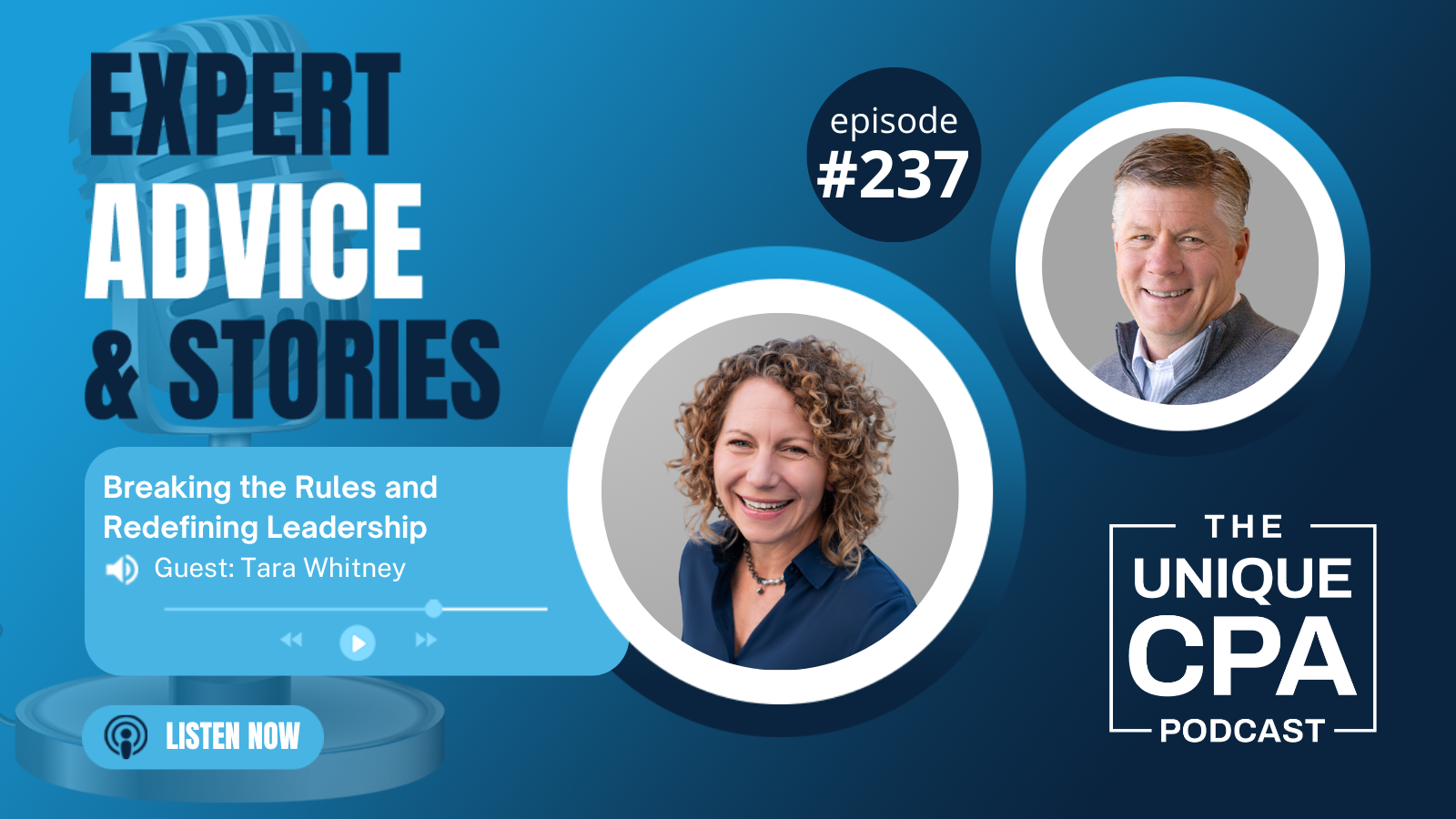
With Tara Whitney
Tara Whitney, CEO of White Birch Advisory, steps into the studio with a confession: she was drawn to accounting for its clear rules and right answers. But as the conversation unfolds, Tara reveals how the very habits that once defined her success, like perfectionism, self-reliance, and yes, rule-following, became obstacles as she rose to leadership. On Episode 237 of The Unique CPA, she and Randy trace the burnout and stress plaguing members of the profession, and recounts the moment she realized that breaking her own rules and embracing vulnerability would open the door to creativity and growth. Having found her “zone of genius,” Tara explores how letting go of old scripts can transform your life and career, as well as your entire organization.
Today our guest is Tara Whitney. Tara is CEO of White Birch Advisory; she helps growing organizations build financial discipline and leadership excellence so they can scale with purpose. Ooh, I love that. With a background in audit, financial planning, and CFO advisory, Tara combines deep financial expertise with executive coaching to help leaders sharpen focus, boost performance, and—as important as the rest—lead with clarity, which I think is extremely important. Tara, welcome to The Unique CPA.
Thanks for having me, Randy. What do they say? Longtime listener, first time caller?
Nice! Anytime someone says they listen, I’m always surprised, but I don’t know why.
Yep, like me and your wife, right? No, just kidding.
That’s what I normally say, yeah, there’s a couple of us. I think Justin, who produces it, listens. There’s somebody in India that I know—actually, India is our second most listeners of any country. I found that out a few years ago, which I assume my data’s still good. I guess we’ll find out. Justin will correct me when I’m wrong. (Note: Canada has now taken over the second spot, followed by the United Kingdom, then India. -Justin)
But let’s get into this. I really look forward to a discussion with you today. Helping leaders, helping organizations build with clarity and performance and everything else. That’s something I think we need as a profession, because I feel like we get a little too bogged down in just, let’s keep going, let’s keep doing what we’re doing. We’re doing great things, we’re helping a lot of people, so why make changes? But I know we talked about before going live here, that you have talked about how leaders who follow the rules can often get in the way. So what do they mean? How can following the rules hold us back?
Yeah. Well, I’m glad we have a little bit of time scheduled here. As a CPA and as a financial leader, we all value doing things right. We all value getting the answers right, getting the right outcomes, basically following the rules. That was one of the things that drew me to this profession—I knew what was right and what was not right. But I think what we’re finding and what we have been seeing over, say, the past five or ten years is the demands on the CPA leader, the CFO, and the CPA leader, are becoming and have become increasingly more dynamic and more profound. CFOs in particular are asked to not just be the person or the group that produces information and reads it out to the CEO or the management team, they’re asked to be more strategic, they’re asked to do more with less, they’re asked to be more effective in their communication. We could go on and on about the demands on these roles.
What I’m seeing is that if we continue to sort of follow the way we’ve always done things—which tend to be the rules that I’m talking about—then our ability to be successful in those roles just becomes more and more challenging. So it’s partly we can’t continue to be the CFO or the CPA leader that we want to be by doing things the way we’ve always done them.
Yep. I couldn’t agree more. It’s something I talk about a lot. Not that I’m the expert that you are on this. I just see people doing things the same that they did 30 years ago, because this is the way we’ve done it, so let’s keep doing it. I think we need to be more strategic thinkers. The rules sometimes keep us away from strategic thinking because why change what we’re doing? This is going so well. That same as last year, the “SALY” method really stifles, I believe, innovation in our profession. We often are like, well, we can’t be innovative because one plus one equals two. This is the way it is. We get bogged down on that. But we are not going to advance as a profession, as an organization, without creativity and innovation, if we just keep following the same things we did in the past. So, I don’t know. Do you have an opinion on, to move forward, I believe innovation and creativity is probably something that’s important in our profession?
Yeah, absolutely. And here’s at the heart of it, we’re talking about risk taking. We’re talking about risk taking, and in order to take risk—and it could be a calculated risk, I mean, we’re not talking about putting significant things on the line—but what’s required is that we have to be okay with not getting it right. Or we have to be okay with being vulnerable to having an answer, having a solution that might not be the perfect one. I think this goes counter, and I’d love what you think about this too, Randy, is like, this is counter to how we’ve been trained. We’ve been trained to come up with the right solution every single time, present the one thing, and what’s required of the CPA leader right now is that we have to change our thinking around this. We have to be able to look more holistically at a problem, be able to incorporate data, but be able to see more than one solution, knowing that there isn’t just one ideal solution.
Yep. You said some keywords that just light me up: leading with vulnerability being one of them. You and I discussed that a little off air before we started. But if you’re not leading with vulnerability, if you’re not someone, and you asked my opinion, so now I’m going on a rant here. Better watch how much you ask me, I may go for a while. Leading with vulnerability means it’s okay, this is just one of the things, to say yes, I don’t have all the answers, or yes, I tried and it didn’t work. If we don’t have that, if we show, like you said, we always have the right answer, we always have to be perfect, there’s no way that we can grow as an organization with a mindset like that.
So I think it’s so important for leaders, and I believe everybody in the organization’s a leader, that’s my personal opinion, but I look at leaders and they have to model this “Hey, I’m not perfect,” they have to model this “Yes, I’m curious and I want to see if there’s a better way.” Model that “Hey, I made a mistake, but here’s what I learned from it and this is how I’m going to go forward, or made a mistake in trying something and here is what I’ve discovered.” I don’t have an answer. I need help. I need someone else to go over this with me. That, I think, is so important to an organization to allow innovation, because we’re going to be a stagnant organization if we can’t be creative. I think accountants have a hard time with creativity because we’re such a by-the-book profession. Alright, that was my rant. Any comments?
Yeah, I agree. I think that if we look at where the profession is and where we want to go, let’s just do a little bit of a roadmap. So what’s happening now is that there was a recent study that said 34% of CFOs—and I think in mid-market CFOs—are planning to leave their company in 2025. 34%. That’s a lot of turnover! And when you look at the burnout and the stress rates, I think you could say that a lot of C-suite professionals are facing stress and burnout, but in particular because of the talent shortage and these other demands that I’m talking about, the CFO is by far on the brink of burnout, I think it’s upwards of 80%, and stress is something that’s just commonplace. So now, Randy, you and I are saying, “Well, be vulnerable, be strategic, change your mindset.” And the roadmap, I think, to this ideal place, the place where I think we have to go and where we are, means we can’t keep doing the same thing, and some of the same thing includes coming at our work with perfectionistic tendencies, thinking we need to do it all ourselves, not delegating and mentoring our team, not communicating effectively across our organization, not collaborating, not asking for help, which is something that you just mentioned, thinking we have to have all the answers. By the way, a lot of this is imposter feelings that come up.
So here we are, kind of on this locomotive track to burnout, and the roadmap to get to this new place means that we have to create this vulnerability, this starting of, well, hold on, maybe I don’t have to have all the answers. Maybe I’ll experiment with new things. I was just on the phone with a client and she was complaining to me about this meeting she was running, and it was the same thing week after week, and I just said, well, how about if you try X, Y, and Z? If you keep doing the same thing, getting the same results, but you’re not willing to try something new, then you’re just going to continue to get frustrated. So, having this experimental way and approach of doing things is really critical. Like, “Hey, this might not work, but if we tried it for three or four months and see how it goes, that could be a great way to innovate and try something new.” So a lot of what we’re talking about, and I could come up with some other ways, other paths here on this roadmap, Randy, is that our mindset needs to change. The mindset of the CPA leader needs to change.
And that’s not the easiest thing. I’m by no means an expert reading things like this, but I remember one statistic, or not even a statistic, a line that came out when I was reading something about mindset change or just change in general, is that we are hardwired to avoid change because we just feel the intensity, the stress and anxiety of this change on us is so great, it just keeps us going the same way because it’s safe. We have safety with what we do, we’ve done it before, we know it, and we don’t see that long-term gain. This is the whole point of the thing I read: The long-term gain could be tremendous, but we just see what’s in front of us right now when that’s change, that is so, so hard for us to deal with change that we just don’t see it. So we don’t see the gain. That has to be one of the biggest things you deal with as a coach, as a leader, as an advisor, is just the mindset of things. So how do you get that mindset change started with people?
Sure. Well, it’s an appreciation that change takes energy. So what you just talked about, as human beings, and you and I were talking personally about some of our personal challenges right before we started the recording, which is I just moved into this new house. Was I physically exhausted? Not really. But it was this mental exhaustion. Little things, Randy, like, where am I putting my coffee cups in my kitchen? I mean, I probably had hundreds of decisions I had to make in the course of the past couple of days. Nothing earth-shattering. But it took a lot of energy. So when you’re asking someone to make a change, you need to appreciate that they need to have energy in their tank to make that change. Now, for the CPA leader who is already stretched thin, who already has too much on their plate, who’s already overworked and has a queue a mile long that they need to attend to, finding the energy to make a change and take themselves out of this really busy stream of work so that they can innovate and change how they want to think about something? That’s a large task. So the first thing is to recognize, one, what’s required, and then two, you need to create space for yourself. Because if you don’t have the space and you don’t have the energy, then you’re not going to be able to make the change that’s necessary.
Yeah, I think space is important. It is something, we just fill up all of our space, all of our time. And again, that’s a mindset thing, not realizing, it took me forever to realize I don’t have to read my own email. My assistant could do that. You know how much time that has saved me? I made time by not looking at my email and she highlights what I need to see, and we’re on a really strong path right here where I just trust her, and trust is important too. That’s another thing we could go into, but I trust her, I think she trusts me, we’re going well, and I know that I’m going to see what I need to. So just mindset, simple things that we don’t even consider. It’s one, automate, two, delegate, which is what I did in this case, eliminate, I mean, there’s things everybody’s doing you don’t need to do. If you can’t delegate or automate it, eliminate, outsource. All these things can create space, and in reality, just being more strategic on how you use your time. I’ve seen people do this where they work less and get more done. And the important things—as a friend of mine, Dawn Brolin, says, “WIN: what’s important now?” So just concentrate on the important things at this moment in time.
But that was you breaking the rules, right?
Yep.
I mean, if you had a rule or you just thought, well, I’m going to be a good partner, or I’m just a good professional because I got my inbox down to zero, and I read all my emails, and I replied in a friendly manner to everyone who emailed me, that is a great example where you would never find space for yourself to be able to try something different. So you had to break those rules. When we look at the rules, whether they’re conscious or unconscious, they’re, “Oh, this is what it means for me to be a great boss. This is what it means to be a great CFO. This is what it means for me to be whatever it is,” then those rules will constantly keep people held back because there isn’t that ability to break out of the mold that they’ve put themselves in.
Yeah, no, that’s a good point. I didn’t even think about myself breaking the rules. Or is that what we called it? Yeah. Not following the rules, breaking the rules.
Yeah, but it’s so counter because again, just so we’re asking rule followers to follow some rules, follow some, but don’t follow others.
Yep. And that for me has been—not to say this a thousand times on this podcast, but I think I’ve said that recently—that’s allowed me to what I call living at the intersection of my passion and my skills. When I eliminated the things I don’t like, the things that don’t bring me joy, the things that I don’t have to do, it allowed me that space that you just said, the time to concentrate on the things that I love doing, and man, if there’s anything that I can try to convince anybody to do, it’s, if you could find that intersection, it is such an amazing place to be. I don’t feel stressed, I don’t feel pressure, I just love every moment of everything that I’m doing. I’m sure it’s going to sound like an exaggeration, but that’s because I chose to break the rules. I didn’t even look at it that way until you just said it. So that has to be one of the first things, and I already asked about the first things when you go into people—is like, you probably realize that their mindset needs to change.
Yeah. So you asked, you know, how do I start working with a client who sort of recognizes that there needs to be some kind of finance leadership transformation in their organization. And when the mindset—mindset’s a constant evolution, so it’s not something that you adjust or fix and then you move on. But it’s obviously this big component that continues to be a thread. But then the second question I ask, or maybe it’s not the second, but it comes pretty early on in the process, which is, well, do you have the right people in the right spots? When you look at your team, do you have the right people doing the right things? Are they suited for the role that they’re in? Are you getting the critical things done, or are you taking on all of the things because you’ve got so many gaps in your team?
The challenge with this one is that we’re loyal. We tend to be loyal people. We want to be loyal to the people we work with, we want people to be loyal to us, we want to trust the people that we work with. But we also, as a result of that, we may hang on to people and keep them in roles that they’re not well suited for. So you, for example: You found your zone of genius and decided that you were only going to do the work that you love doing, that intersects with your passion. That is necessary because now you are in this flow. How many people out there, how many CPA leaders are out there doing work that aren’t necessarily in their zone of genius, taking on work that depletes them, exhausts them, and leads them to this brink of burnout, because they don’t have the resources within their team, or they haven’t really sat back and thought, “Wait a second, if I eliminate 30% of what I’m doing that not only am I great at, but I don’t love doing, and I can give it to somebody else, wow, that will free me up to spend time being more strategic with the board or having more meaningful strategic conversations,” whatever that looks like. That’s one of the more tactical ways CPA leaders can find more space is to make sure they’re surrounded by the right people.
And so you said the right person, right seat. What if you have a right person, wrong seat? I mean, so you know, you’ve got a great person, it’s just a matter of then finding their zone of genius, and trying to get them lined up with that. I assume that’s something you talk about or work on?
Yeah, absolutely. I mean, because you just don’t—you want to do right by the person, but you have to do right by the organization. I mean, you’re here to obviously build a good team, but you’re here to run a profitable organization that’s doing really, really well. And so if there’s an opportunity to move a person into the right role, great. But it’s like recognizing, what does the organization need first? That’s my opinion. What does the organization need first? Because if that person that you have, right person, wrong role, they’re not happy. They’re not happy at all. If the role’s not there, then go help them, support them, find the role that’s right for them in another organization. I always work with clients and try to create a win-win, and sometimes those are difficult conversations.
Yeah. So there can be the advice of, well, this person, we need to help this person be successful elsewhere. Good person, just not for our organization.
That’s right, and letting them go is not something to shy away from. It’s recognizing that there’s the right job out there, that the organization will do better with the right person in that role.
Alright. So we talked about vulnerability and I gotta go back there because that is my favorite subject these days. But it was interesting. Vulnerability is not—I mean, there’s things you can—I think you’re born with it. I think you can develop it. I think you could see the importance of it as a leader, as you start to show vulnerability. But then there’s this whole issue now with vulnerability and AI just in general: Is AI making me feel vulnerable? Is AI going to do things and I’m going to lose my job? So do you see a connection somehow, positive or negative, with AI and vulnerability?
Yeah, absolutely. I mean, first of all, when we talk about vulnerability, at the heart of it, let’s just decide—in order to be vulnerable, that person or that organization needs safety. They need safety. So being vulnerable when they don’t feel safe will just create more harm, right? Now, we have all of this artificial intelligence, applications, systems, potential processes, that we have a tremendous opportunity to help our organization implement—implement within our team. And guess what? And I know you know this: It’s all unknown. It’s the opposite of safety. So how do you approach something that you have never approached before, you don’t know what the outcomes are going to look like, you don’t know what the parameters are, you don’t know what the rules are that you need to follow, but you know you need to go into uncharted territory. How do you do that?
Yeah, you just take a leap of faith.
Randy, you said it brilliantly: You said, you need to be curious.
Yes. Okay.
I think you need to assess your risk thoughtfully.
I’m not good at that.
But that’s a critical component, right? Yeah. And then with something like AI, there needs to be collaboration. There needs to be, hey, I’m not going to do this by myself. This isn’t going to fall solely on my team. Hey, if this is happening, it’s not going to be that person does it, and I sit on the sidelines waiting for them to fail, or waiting for them to mess up, or however it’s going to work. There needs to be this integration that happens in order to be successful in whatever components, however AI is getting implemented. Starting with the mindset, starting with being curious, also making sure that collaboration is a big component of it. And then, yeah, it’s going to be a methodical, creating safety, creating the sense of what are the parameters we’re going to follow each and every step of the way. And that is how to be—I think for the CPA leader, some of the components of being more successful in an implementation like that.
I agree. I wanted to ask you, because I’m reading this book right now and I’m starting to read more business books, which I haven’t—I don’t know what’s happening to me, becoming somebody different, I guess.
Yeah!
But everything I’m reading is either around culture or vulnerability. So this new book is The Culture Code by Daniel Coyle. Have you ever heard of it?
I think I have. Yeah. I haven’t read it though.
Yeah, The Culture Code, Daniel Coyle. I’m in the middle of it right now, and a lot of the things you were just saying, it was like, wow, that’s the section I just went over, and how important that is and the collaboration and community, and how important that is to create this safe space that you were just saying. So I would highly recommend it. I don’t know, all of a sudden I’m this person recommending books. I was never this person before.
Yeah! Who are you?
I’m not sure who I am!
I think that I’ll just say one more thing about this whole, like the vulnerability and the expanding role of the CFO and the CPA leader, which is, we’ve been trained to be the end-all, be-all. And I think part of this roadmap around the new expansive role of the CFO without the burnout and the incredible stress is how do you make sure that someone has your back? How do you make sure the culture has your back? How do you make sure that you can be innovative and strategic and not lose your job because of it? I think that’s what we’re talking about. We’re talking about the culture of safety and vulnerability that the CFO and the finance team is just a part of.
Yep. Culture, safety is important, vulnerability, trust—I think trust is tied to vulnerability. I think trust is tied to safety. I think all those are important, and with us not wanting to break the rules, the rules kind of keep us away from that at times, I’m afraid. So I love to hear what you’re doing, I love to hear how you go out and work with people in the accounting and finance community, and bringing this mindset change, and not being afraid to break the rules. Before we start to wrap up here, or before we do wrap up, I’m going to just give you an opportunity to put a bow on top of this conversation or how you go out and work, or what’s the most important thing when someone’s looking to make a change, what way do they decide to give you a call?
Sure. I think I just want people to walk away with the fact that this is a problem to be solved. This isn’t something to just set aside and put the CPA leader at risk time and time again because the cost is just too much for an organization not to have the right finance leadership and support that they need, it could be devastating. So this is really mission critical. What I’m doing right now in my organization is I’m gathering CPAs and CFOs to talk about some of these critical pieces. We just talked about AI implementation and some of these other topics. And so I love hearing, learning from other leaders around what’s happening for them, just like what you’re doing on your podcast, having an executive round table to talk about this. So I would love to be able to invite the folks listening to participate in some of these, and I can share with you links on some upcoming conversations that we’re having.
Yeah, we’ll definitely do that, we’ll put that in the show notes. We’ll put some more information. But before I even ask you that information, and again, thank you for that, I’m going to pivot. If you have listened to the show, you know this question, I assume, but when you are not out there helping these finance leaders improve their organizations and themselves, what do you enjoy doing outside of work? What are your outside of work passions?
Yeah. I have the golf bug.
Oh, nice.
Yeah. And I get to play with my husband, I’m part of a league and I just—I find that the challenge for me is not trying too hard and just relaxing in the game and just enjoying it. I find that when I do that, I generally play my best. So my handicap has a lot of work. I have a lot of work to do. I really enjoy it.
And where are you located in the country?
On the Seacoast of New Hampshire.
New Hampshire. That sounds like a very beautiful place to golf.
Yeah, absolutely.
Alright. That’s one thing I’ve been thinking too: Should I start? Because I used to play a lot of golf. I mean, that was a summer I probably played—probably two to three summers in a row, I probably played 70 plus rounds and I don’t think I played last year. I haven’t played this year. So maybe at some point.
Ttake this as a sign to get yourself out there.
Yeah, there you go. I can’t be afraid of change. It’s time to change back to that. Alright. And then last question—we kind of mentioned it, you’ve got some maybe round tables and stuff going on, but if people want to get ahold of you, if they want to find out more of what’s going on with you and with White Birch Advisory, what’s the best places for them to look?
Yeah, sure. Well, I’m really active on LinkedIn and WhiteBirchAdvisory.com is where you can contact me through my website as well, but LinkedIn is probably the best.
Right, yep. That seems to be a common answer, so. I’ve got a feeling that’s where we connected too. Anytime we can talk about bettering the profession, making change, leading with vulnerability, trust, and safety—you, you’re hitting all my keywords, so I appreciate that. Thanks again for being here.
Absolutely, thanks!
Important Links
About the Guest
Tara Whitney, CPA, ACC, is the CEO of White Birch Advisory. She helps growing organizations build financial discipline and leadership excellence so they can scale with purpose. With a background in audit, financial planning, and CFO advisory, Tara combines deep financial expertise with executive coaching to help leaders sharpen focus, boost performance, and lead with clarity—even in the face of complexity.
Meet the Host
 Randy Crabtree, co-founder and partner of Tri-Merit Specialty Tax Professionals, is a widely followed author, lecturer and podcast host for the accounting profession.
Since 2019, he has hosted the “The Unique CPA,” podcast, which ranks among the world’s 5% most popular programs (Source: Listen Score). You can find articles from Randy in Accounting Today’s Voices column, the AICPA Tax Adviser (Tax-saving opportunities for the housing and construction industries) and he is a regular presenter at conferences and virtual training events hosted by CPAmerica, Prime Global, Leading Edge Alliance (LEA), Allinial Global and several state CPA societies. Crabtree also provides continuing professional education to top 100 CPA firms across the country.
Schaumburg, Illinois-based Tri-Merit is a niche professional services firm that specializes in helping CPAs and their clients benefit from R&D tax credits, cost segregation, the energy efficient commercial buildings deduction (179D), the energy efficient home credit (45L) and the employee retention credit (ERC).
Prior to joining Tri-Merit, Crabtree was managing partner of a CPA firm in the greater Chicago area. He has more than 30 years of public accounting and tax consulting experience in a wide variety of industries, and has worked closely with top executives to help them optimize their tax planning strategies.