Challenging Accounting’s Status Quo
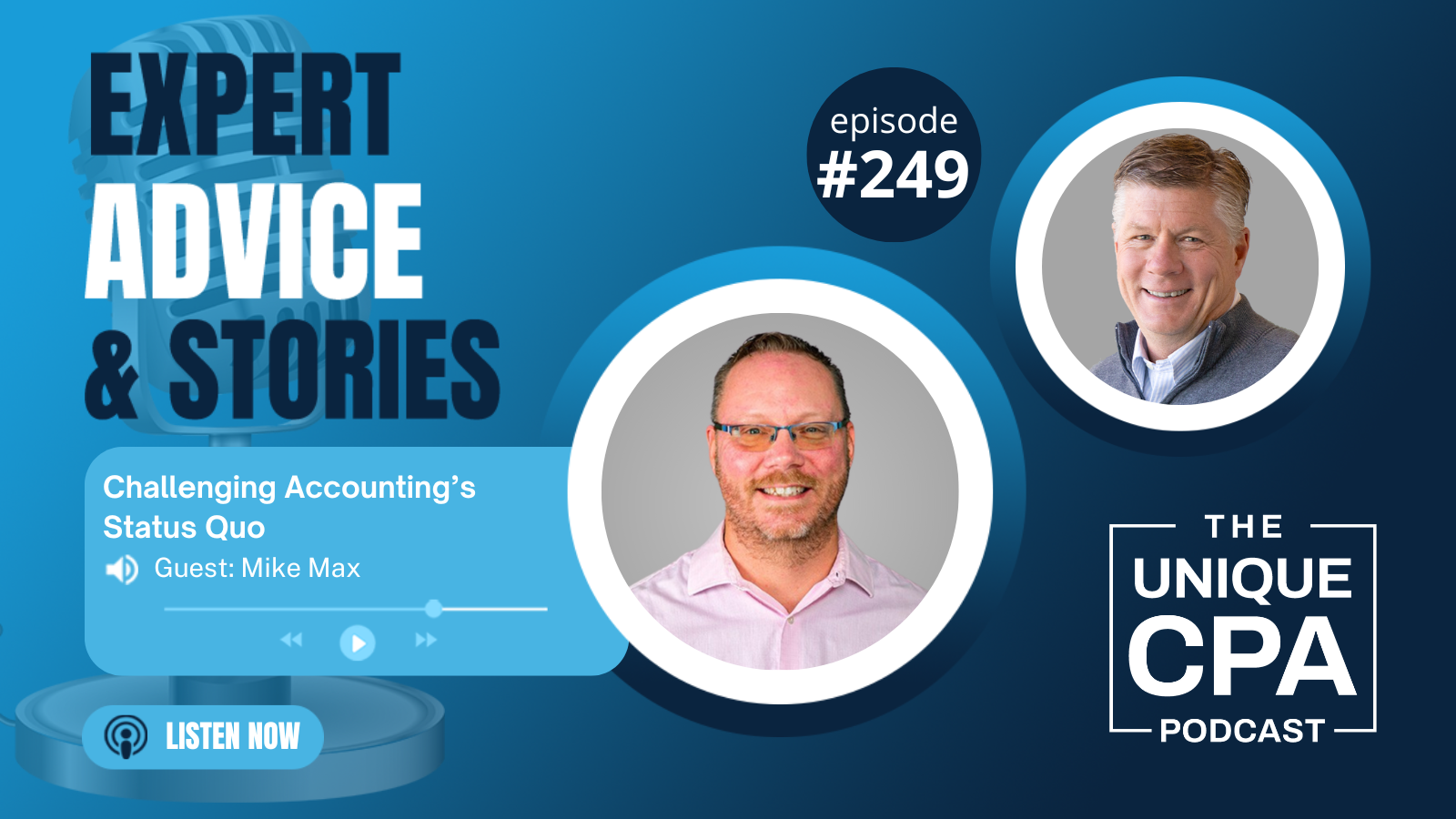
With Mike Max
Mike Maksymiw, better known as Mike Max, lives for change. On Episode 249 of The Unique CPA, he talks to Randy about how in a profession often defined by tradition, he’s been willing to “poke the bear” and challenge long-held assumptions. His leadership at Aprio Firm Alliance is marked by a drive to create real progress on issues like DEI, work-life harmony, and value-based work, and he shares candid reflections on what it takes to move an entire profession forward. Whether it’s questioning the status quo or finding creative solutions where others see roadblocks, Mike’s passion for helping others and his belief in the power of collaboration shine through, and this episode offers a glimpse into the mindset of someone determined to leave the accounting world better than he found it.
Today, I’m really excited to welcome Mike Max to the show. Maksymiw?
You got it.
Alright. Actually, technical name is Mike Maksymiw. Mike is the executive director of the Aprio Firm Alliance, where he works with forward-thinking CPA firms that are willing to challenge the status quo and rethink how this profession operates. Sounds like a great topic for The Unique CPA. Mike is also passionate about bringing humanity into the accounting profession, treating people like people instead of line items on a spreadsheet and questioning whether the way we’ve always measured success really makes sense, man. Mike, you are thinking exactly the way I’m thinking, so this is going to be fun. Things that we’ll probably talk about today are looking at value over time, inclusion, work-life harmony. Mike has made it his mission to help firms build better businesses and better lives for the people inside them. I think this is going to be a lot of fun. Mike, welcome to The Unique CPA.
Oh, it’s going to be a blast, Randy, thanks for having me. Seeing you at the last few Bridging the Gap conferences has been awesome. Being on the advisory board with you for Firm Growth Forum is amazing. There’s a lot of really good people that are disrupting everything we inherited. And every time I go to one of these events, I meet more of them and the army continues to grow, because we could do it better than it was. That’s the idea. Be a little bit better tomorrow than we were yesterday.
That’s definitely the plan, and I’m really excited about, I mean, obviously the way you’re looking at things, but I’m excited about, and I was just talking to my wife about this morning, this next generation that’s coming into this profession because I keep seeing really forward-thinking people that are challenging the status quo, that want to do things a different way, that are not afraid to say things like “work-life balance” or say things like, you know, what’s the term that I hear all the time now, “a lifestyle firm” or whatever. And you know what, that’s great because work is fun. I love this profession. I love the people in it. I love my family and the things I get to do outside of work probably more so. I shouldn’t even say probably, that was, wow! I think it’s because I love this profession so much and the people in it is why I said “probably.” But yeah, having that outlook that this work is work, you should enjoy it, you should have fun, get fulfillment out of it, but it’s not the most important thing in your life. So it’s pretty cool to see this next generation of people coming in, whether it is in the profession itself or a lot of people that are supporting the profession that I’ve got to meet in the last few years. It’s been a lot of fun.
Yeah, for sure. And one of the things that I want to make sure that everybody knows is nothing’s binary. It’s not like everything that we did in the past is terrible, and all the new ideas are the best things since sliced bread, right? It’s taking all the experience that we have in 125 years in the profession and then layering on the, does it have to be that way though? At least if we ask the question, right? We could say, oh yeah, that’s a great thing, we should keep doing it. And now we know we should keep doing it. But the idea of we have to work as much as we can, or we have to make the most money that we can and everything has to be the most. Like, not always!
Alright, so you just talked about the past and everything. I kind of want to talk about your past. I know you have a really interesting story, a cool story, a story you actually told at this last Bridging the Gap. But let’s kind of talk about your journey to who you are today, what you’re doing with Aprio, and how you got here.
Yeah, so I grew up in a house where my dad was a solo practitioner working out of our house. So I’ve been around the profession since I knew what my dad was going to work for in the basement. Started out at a local CPA firm, because Arthur Anderson imploded my senior year of college, and that’s where I was supposed to go work. Worked at three different local firms, worked my way up from staff through partner, exactly the same way that everybody told me to. “Put your head down, do hard work. You’ll get noticed.” But along the way, I kept running into roadblocks I didn’t expect, like one of my first reviews was I was great at either utilization, realization, charge hours, right? I was great at realization, great at charge hours, but my utilization was bad. And I looked at the guy across the table, I was like, “You literally can’t make all three go up. It’s mathematically impossible. The denominator of one is the numerator of the other. Like, you can’t, like if I’m really good at realization, my utilization will be lower. Like that’s just by definition.”
Right.
And he was like, what? I was like, “You’re telling me in a hundred years no one else has figured this out?” Like I thought I was pretty smart, but I’m not that smart to come up with a unique idea in a hundred years. So I ran into that. Then we go through a busy season or two and I look at him again and I was like, man, why does tax season have to suck? And he goes, well, we’ve got deadlines and this and that and this and that. I was like, yeah, but you’ve taught us that money is due in April and we can figure out what people owe in November and paperwork’s due in October. Like, what are we doing? And he was like, well, this is how we’ve always done it.
True, alright. So then I kept keeping that in my head, moved along to some other places, got my hands into a lot of different things in accounting, so I was able to purposely choose that I really liked local businesses and individual tax returns. So passed through entities, like that was my jam. I ended up being a tax leader at Filomeno in West Hartford. I was in the RSM Alliance at that firm and it was a really good alliance and cool thing. Now a lot of those people are now my colleagues at the Aprio Alliance. Wicked cool turn of events. Then our firm Filomeno, we ended up merging up into a national firm during the tax law change in 2017-18, which was great because I would have had to do that and learned like GILTI for the one client that we had at the firm that would have needed it, which would have been a terrible waste of my time, and zero interest to me whatsoever too.
So we got a whole team of people whose job was to know all those different nuanced rules and things, and then we learned how to apply them to our clients. I was like, oh, this is great. Like this is exactly what I was hoping for at a larger firm, like how do I get one of those roles in something else? Maybe not that super technical aspect. Then the CARES Act rolls around, and I raise my hand as someone that’s willing to go dive into this because nobody knew this, right? I didn’t have to fight 50 years of experience from somebody. We’re all starting at the same page. It’s like, alright, cool. Let’s go. And I knew it was all going to change. And one of the things that I’m pretty good at is coping with change and realizing that we don’t need to know everything now in order to move forward. We’ll guess wrong sometimes, but we’ll try. I don’t need to know all the right answers right now.
And over the course of about a year and a half, me and a couple other people ended up kind of being tapped as the national leaders just because of the time we were able to dedicate to it, the way that we thought about how the rules would change. So I thought I had a really good year. I walk into my partner review meeting. I say walk in, right? It’s during COVID. We’re on a screen like this and I’m really excited for it. I’ve got all my metrics lined up because I know what matters on the spreadsheet. I also know what I did that’s not on the spreadsheet and I’m really amped up. I told my wife, I’m really excited about it. Get into the meeting and they go, “So first question, how are you going to make up the 300 chargeable hours that you missed from your budget?” I was like, “Oh, okay. Well, I beat my revenue target by 50%. You wanted me to do 1.2 million and I billed 1.8 million.” They’re like, “Well, yeah, your revenue’s fine.” I was like, “Why are we talking about hours?” They go, “Well, if you work more, we make more.” I was like, “Two things: you do, I don’t. And two, how much more do you want me to make? I beat it by 50%.”
Right? Crazy. That’s insane.
Yeah, right! So then they go along with something else about the hours. I was like, “Well, I want to really leverage this leadership position that I just had into the next thing that you need led, it’ll take an hour to kind of offboard this. The people that are running my clients, they can keep running it. I could be a resource for them, like I have this plan to go lead something else.” And they were like, “No, you need a whole bunch of origination to do that.” I was like, “Origination and leadership are two totally different things, requiring two different skill sets, and I stink at origination. Everything I’ve got is because someone left the firm and they left it with me and I kept it, like, I’m good at that.” And then they said something else about workloads and whatnot, and about the 300 hours.
I finally got really frustrated, even more so than I already was, I was like, “Look, here’s what we could do. With the 300 hours that I didn’t do, how about you give me your 10 best senior managers that are going to be partners, And I teach them how to be 50% more efficient than they are. And then give me 10 more, and then give me 10 more. And in five years, we’ll have an army of young partners who are running their clients and running the firm in a totally different way than a firm has ever been run before. You can be the firm that operates differently, that lets people have a life, does great quality work, grows enough to be able to admit these new partners, brings people up behind them. Like we can set the stage and be like the beacon in the profession of doing this.” They were like, “No, we wanted you to go back to being a tax line partner.” I was like, “okay.” And they heard, “okay” as acquiescence. And I meant “okay” as we have two different views on what the rest of my career is going to be, we’re going to go be successful separately. Because to be honest, a national firm doesn’t need any one person in it to be successful. And I understood that. I wanted to do it there—I liked the people, liked the clients, but ultimately, no one needs me on their team to be super successful.
Yeah. That’s insane that 50% above your revenue numbers were through the roof, but you worked 300 hours less than they, or billed 300 hours less than they wanted, even though the numbers, it was more than that 300 hours was the revenue brought in was more than that 300 hours.
Yeah, it was, and kind of dovetails into some other things that I’m really on soapboxes about like value billing and efficiency and incentivizing innovation. So I might have been a little bit ahead of the curve there.
Yeah. Well, let’s go into those things then, because those are topics that I’m passionate about as well. So let’s go into, alright, let me write this down so I come back to them. Value billing, you said innovation. Encouraging or incentivizing innovation? Is that what you said?
Yeah, incentivizing innovation and efficiency.
And efficiency, yes. Which you were apparently very good at. And then was there another thing, or that was those two you mentioned, because I want to talk about just humanity in general in the profession, because I don’t think there was much humanity in the way that you were treated in those meetings.
You had written down value billing, which comes along with the biller recognizing the team’s efficiency versus staring at the same WIP schedules we’ve been looking at for a hundred years.
Alright, well, let’s start with value then, because that is such a topic that I think is huge. I think that’s a mindset issue. This is something that we’ve just, hey, like in the meetings that you had, we’ve always done it this way, so we’re going to keep doing it this way. And this is what we know as a profession, is billing by the hour, we’re worth the time we put in, we’re not worth the output that we give or the value that we deliver. And that makes no sense to me. So let me hear your take on it and what we can do to transition everybody to value billing.
Yeah. So it’s a journey to get to value billing, right? And the key is be willing to take the first step, and you’re not going to go from zero to a hundred on day one. So for anybody listening that wants to go that route, it’s okay, you’re going to mess it up, it’ll end up working. So here’s the thing with value billing, as much as it’s been a pain in the profession for a while, it’s going to get worse and exacerbated a lot quicker once we start using more automations, we start using more technology and we look at something that used to take us 80 hours and we do it in 42. And if all you do is look at a WIP schedule, you’re going to sit there and be like, wow, we’re going to lose money because we don’t change our billing practices.
Yeah! Yeah.
And the value to the client is the same this year as it was last year. And for most of the things that we do, we’ve already established with the client what they’re worth because the client has paid us about the same amount for a handful of years. That $4,000 tax return, what does the client expect to pay this year? Probably between $4,200 and $4,500 for it, as long as nothing changed. So if I look at a WIP schedule and it’s got $3,200 in there, I’m billing $4,200. Because we use the technology and our processes and all the things that we worked on to go provide the value to the client, that the client has already told us what the value is. That’s where the easy steps are, is take the repetitive work, start there.
And honestly, I would argue that the value is even potentially more than that because I think we undervalue what we deliver too. And I think our clients appreciate it sometimes more than we even realize. And that $4,200 bill, they probably pay $5,200 or something more because the value that you’re bringing to them. Well, you’re getting me on my soapbox now. I think we too often, we just want to give, which is fine. Being helpful, being givers, being there for our clients is important, but understanding that what we give to them, they truly value. I mean, there are stats out there that show clients will pay more for this value, for this advisory, for whatever you’re giving to them. We don’t deliver it because we’re just so concentrated on pumping out more work and more work. So the, I guess my whole point was there. I could argue that the value is even more than we think they think it is.
Step two.
Alright, good. Right!
Step two would be like, take that stuff that you did so that you can capture the efficiencies. Pick a percentage over last year for a no change. Right. Call it 6%. So we’re going to bill $4,240 for that tax return. Tell your admin, if the WIP is under $4,240, send the bill. I don’t even need to see it. Take that work off me too. Don’t let the biller write it down. And then you can put some policies in place, like the managing partner has to agree with any write-down that’s less than 6% of last year’s bill. And then the same thing when the managing partner does their billing? Make sure someone can do the same check. We did that here at Aprio. We piloted it with a couple offices, and I’ll say it, it’s working. I don’t want to say it worked because it’s a constant process, but again, there are steps in a journey, right? And then we start laying on more technology.
Or no, let’s skip the technology one for now. The humanity comment, right? I remember this really well: One of the reasons why I was able to be really efficient is, Randy, you’re on my team and I’m going to give you a project that’s a $4,000 tax return. You’re an up-and-coming superstar, I know that you can handle more. I want to give you those opportunities. So this year I want you to do the job. Your budget’s around 20 hours. For a $4,000 return. I’m going to check in at hour eight, hour 15, make sure you’re doing all right, give you all the tools you need to do it. But I’m telling you, I’m going to bill $4,000 for this tax return. If you get it done in 14 hours, I’m not going to give you more work to fill up the other six. That’s the promise I’ll make to you.
Yeah.
And I’ll also bill the whole $4,000. So your realization on that’s going to be awesome. So I’ll make you those two promises, and when you do your work well this year, next year, I want you to run the job and you get a staff and do the same thing with them, and I’ll be there to coach you through it and help you progress because I want you to get promoted within the next two years. And this is the way I think that we could do it. I did that for real at our firm and with three different people in three different offices. All of them were super busy, usually on the schedule. They all emailed me immediately after the first project and were like, this was awesome. Can I work on more of your stuff? Please load up my entire schedule.
Yeah!
And that’s how I billed 50% more by being efficient without putting all the hours myself, because I was doing my job as a partner of elevating people in the profession, of giving them the tools, of supporting them. And were they perfect? No, because three jobs later, that woman fell on her face and we didn’t have as great of a realization, but because I was checking in, like a 20-hour job took 27 hours. Well, if I wasn’t checking in and I found out at hour 27, it wasn’t right, it would have been 40 or 42. I just looked at it, I was like, look, my realization can handle it because you’ve crushed three other jobs. Like you’re still at like 103. Like look at everything. Right? And it’s always fun when those people that you work with, their peers start recognizing them. And then you see their name on the promotion list, right? And you’re like, alright, I’m going to go give them a call and say, congrats, I knew you could do it, so excited for you. Tell me what I can do to help you with the next one.
Yeah. Yeah. That’s awesome. I’m going to interrupt for a second because I’m going to go backwards, because the one thing you said when you were talking about someone needs to check the managing partner’s billing too. Now, I’m guessing like at Aprio itself, you must be talking about alliance firms at Aprio. I’m guessing Richard does not bill much or I’m hoping he doesn’t because he should be concentrating just on the firm. Richard Kopelman being the managing partner of Aprio. Is this what you’re talking about, the alliance firms when they, the smaller firms, when they’re checking their managing partners’ billings or what were you referring to there?
I was talking about the managing partners at alliance firms, not an Aprio-level firm, but even with an Aprio, and most of the larger firms, they’ve got the firm broken down into sections, regions, however they do it, you build up to the greater thing. So let’s call Charlotte, right? There’s an office managing partner of Charlotte?
Correct. Okay, makes sense.
She has billing responsibility, so somebody has got to be able to check her and be able to say like, hey Amanda, you have this write-down, just like you asked me for reasons when I have them, like I need a reason, not because I’m trying to be all negative about anything but policies are policies, and you stood up there and told us why this is really important and then you went and did the thing that was the opposite of what you told us was important. Sense. Hopefully that office managing partner is toeing the line and doing what they want everybody else to do as well. And if they see something, they’re like, ah man, I know, I’m going to write this down. So I’m going to go start by pinging Randy who’s going to review this for me and say, look, I know this doesn’t look great, but this is why I want to write down, you know, tell me if you agree or disagree because I’ve been you in this chair before. Like, let me know.
Yeah, that firm that you left probably misses you because this is all smart stuff. Let’s talk about the innovation or putting incentives on innovation too, because that’s what you did, you were innovative the way you handled the way that, you know, talked to people. I don’t think we look at innovation at all sometimes and we look at, hey, we can create new technology or we can integrate new technology in that, but just innovative in the process of the way we go through things I think is so important. And I do a lot of speaking on vulnerable leadership and there is a stat out there that shows if you’re a vulnerable leader, if you’re willing to take chances and make a mistake, because it’s hard to be innovative without making a mistake, because then you already know, oh, okay, this is the way it’s going to be, I think we get too afraid of, you know, oh, I don’t want to make a mistake because then that’s going to hit my hours or my realization or something like that. So how do we put this in place where we do put this incentive on innovation out there?
I think a big part of it’s that tone from the top that just like we learned coming up even the old way, I had bosses that say, look, before you come ask me a question, spend 20 minutes trying to find the answer. Like the WIP always has 20 minutes for you. Like that’s always going to be okay. If you’re not moving or moving it forward after 20 minutes, come ask me a question, tell me what you looked at so far. I’ll let you know what the answer is or I’ll point you in the direction because you’re close. So that’s how I got incented to learn is somebody telling me like I’m not going to be punished for it.
Right, right.
So that’s really important on the front end. I think with technology innovation, lean on the younger staff that are coming in. These kids are brilliant. They’re going through a very difficult degree program. They’re in constant technological evolutions, even in the four years of college, the technology changes. They’re accustomed to it. It’s okay to them. They don’t fear a software replacing a software or trying a new technology and six months later, like it’s not working, so I’m just going to stop doing it. They might get there in six weeks because they keep trying stuff.
So I would say we talk about it in the profession a lot like trade mentorship, you know, sit down with a couple of those really good people that you’ve got that have been at your firm a little bit, you know, two, three years maybe. And say, look, Amanda, Jake, Shelly, we want you to go run, how are we going to use ChatGPT in our office to make us better, not to replace what we’re doing. And every week we want you to do a lunch and learn on Friday, we’ll bring people in and tell us what you’re doing. They’ll give you more ideas, and we’re going to do that this year. And what we’ll offer you as your incentive is, we’re going to assign the three of you mentors from senior leadership so that we can help you progress your career faster and we could share our experiences that you’ll need, because if you start being able to do the work faster, you’re going to need the people and the experience and how to lead people, how to create great client experiences, how to operate an accounting firm. You’re going to need that, which we have in our heads. We’ll give that to you. How’s that trade sound? Tell me a 26-year-old that’s not being like, oh yes. And I’m never going anywhere. I’m going to call my three best friends and tell them to come work here too.
Right. Alright. Look at you. You just solved the retention issue too, so, well, we’ve got to get them on board too. Well, let’s transition a little bit because let’s talk about it. Because you just brought up this younger staff and what they’re doing and how they’re learning. It’s changing. Technology, as you mentioned, even in their four years of college. That’s changed. I mean, in the last four years, you know, just the AI that we’re at the tip of the iceberg has been part of it. So there’s going to be this acceleration of somehow the skills that they need, or the change in skills that they need coming in, what do you see in that? Do you see a, hey, you know, being able to balance a balance sheet is great, but being able to communicate with clients is going to be where your advisory, that’s where you’re really going to be needed or what do you see? Maybe a skill set? More important skill set needs today compared to, well, I’m older than you, but when you and I both came in, even though there’s a gap there in our ages?
I would say that probably the lowest hanging fruit one that doesn’t really have an age requirement is listening curiously, right? If you’re, no matter whatever age you are, if you’re sitting at a lunch meeting with one of the firm’s best clients and you can ask a couple of questions where you get to listen curiously about their business, then you could go figure out what their problems are and how to solve them later. A lot of people think that you’ve got to go solve problems at the meeting. You don’t, you have to uncover them, and it takes deep listening. It takes provocative questions that evoke a deeper response. To be fair, you can use technology to help you with that, right? If I’m going to meet with an aerospace client in New England, I can spend 45 minutes talking to ChatGPT or Copilot and just asking questions about, I’ve got a meeting with a $20 million aerospace client, they specialize in helicopter rotors. What’s going on with the government procurement, what’s happening with sourcing of the materials? Because they have to use a special kind of tungsten, and I’m making all this up. Like one of these things, and you could go into this meeting so prepared in an hour, because all this data is able to be accumulated by some of this intelligence that’s out there where you don’t have to go read industry trade books and have 40 years of experience to know these things. You can ask and get the answers. So you could go into that meeting and find a bunch of things that matter to that client and then come home on the ride back with boss and be like, alright, so we found six problems they have. I think we’ve got to find out what the priorities are for them and help them solve, you know, which ones could we solve and who do we know that can help them solve the other ones?
Yep. So there’s more of an advisory, the curiosity. I like the way you said that, the curiosity. Just listening and understanding what they’re saying and then, because a lot of times, and it’s just human behavior, but we go in with, okay, well we know what they need. Rather than listening to what they’re saying and hearing what they need, we know, because we have the answers. We’re smart people as CPAs, as accountants, as bookkeepers, as whatever we are. And we sometimes have this bias already that we know going in. So going in with curiosity, I think that is great advice. And I think something I’m better at than I used to be. But I’m not sure I did that years ago.
I know I didn’t. I grew up being a know-it-all, right? We’re supposed to have the right answer in accounting. We can always go find it. That’s why people hire us. Like it’s a mindset we go in with. I see my kids who are college-aged, I see it in other young folks that I see coming through the profession that because of all the change that they’re used to with technology, they’re okay with not knowing all the answers. And why don’t we lean on that personality trait that they have, right. If they’re comfortable not knowing, let them ask the questions. Because who better than the 25-year-old who doesn’t have 40 years of experience to ask a question that maybe we might sit there and go, man, I really should know the answer to this. Why am I asking it? A 25-year-old’s like, I definitely shouldn’t know the answer and I want to know, and she’s like, Brady, tell me about this thing. Like I read about it and I don’t quite get it, but it sounds super interesting. Tell me about this part of your business. That dude’s not even going to touch his food at lunch. He’s going to be so excited to talk to her.
Yep. Let’s again, I’m going to, because you just get me going on things here. I’m going to change a little bit again because that kind of ties in what you were just saying here, but you said it earlier about, you know, when you were at the first firm and, you know, hey, the new tax bill and I might have one client that I have to know GILTI for and spend time. And that, that you just said it. We have to have all the answers. We feel like we do. I’m out right now taking Bridging the Gap on the Road Show, and the sub theme of this one is “Community, Connection,” which I want to get into that a little bit too, but, “Collaboration” then is part of it too, and part of my collaboration mindset is that, yeah, no, I don’t have to know how GILTI works or whatever the example is, because I am going to have that one or two or three clients and it’s not worth my time to do that. I know there are experts out there in this accounting community that know this, and why don’t I just collaborate with them, which I think you probably agree, that is important. And then that kind of ties into what the Alliance is, because I’m guessing the Alliance has firms with different expertise that are out there helping each other as well. So I guess the question is collaboration in general. How do you look at that when the accounting firms are with each other, potentially?
It’s the future of a firm being sustainable in the profession. I think that we’re going to have clients sitting in the middle with two to five firms around them doing the different things that client needs. And each of those five firms will be absolute experts in that thing that they provide for that client. And they’re going to be friendly with one another because nobody will step on toes because you know, somebody’s doing nonprofit audit because that person’s on the board somewhere and someone else is doing manufacturing cost of goods sold, and someone else is doing a valuation and someone else is doing the accounting, like they don’t need to meet. And you could have those firms, whether they’re local or not, they’re going to be friendly, that will be able to serve that client. There’s too much work to do, there’s still not enough people to do it. That’s changing a little bit, but we still work a lot. Technology’s going to help out with some of that. But the question I ask our firms when we’re having this discussion is, where should you spend your time? If you need to do something once for a client, should you do that? If you have to do something for one client repetitively every year, should you do that? I’m not going to tell you that you shouldn’t do it. I’m going to ask you and make you think about it and answer me, because if it takes you 40 hours to figure out the GILTI thing on this client, you can’t charge that client for all 40 hours because you should be able to do it in about 20.
Yep.
But you only do it once, so it takes you 40. So you take your 75% realization on the overall job, and you’re like, okay, this is all right. It’s a large client, like we bill them $60,000, it’s okay. What else could you do with those 40 hours? Could you take that client out to lunch and find a different project that you know how to do? Could you help them grow their business where they want it to grow? What are their succession plans? Is it internal? Can you help their team learn more about the operations and the financial operations of the company? What are the things that you already know how to do that you can help this client with and outsource that piece to another friendly firm, who’s probably better at it?
Yep. And that’s not the mindset that I had when I was running my firm from 1988 to 2006, because I had to do everything. And then in 2007 when I started Tri-Merit, that’s what we are, that outsource partner. We are the experts in this very small subsection of the tax code that rather than somebody else wasting their time on it, they bring us in. And honestly, since now we talked about it, I’m going to bring it up because I can, because it’s my podcast: But my son is doing this now too. He started a transaction advisory business where he’s supporting other accounting firms whose clients, you know, whether they want to do a transaction in the future or be prepared for one or run their business like they want to be efficient, you know, increase their EBITDA for whatever reason it is? As accountants, we probably think we can do that or should do that, but that’s not the best use of our time. If we’re the expert at GILTI or at R&D or SALT or whatever, that’s where we should spend our time, because that’s where we have, well, assuming that’s our passion too, that’s where we should do it. So yeah, for me, collaboration and outsourcing and building relationships with people that can support you and your clients only makes sense. And I think, like you said, it’s the future. And I think we are going to be seeing more and more of that going forward. That was my rant. And I guess my commercial at the same time.
Even your commercials are for someone else’s benefit, Randy.
Yeah. Well, I’m very excited that I have a son who is not, well, I’m very excited that I have both my sons, both my daughter-in-laws, and now a granddaughter who was born nine days ago, I think now? So family is super important to me and seeing them having fun and being fulfilled in what they do is important as it should be for everybody that we’re managing or leading in this profession as well.
Alright, so we kind of just talked a little bit about the future of the profession, you know, touched on it and we’ve touched on it as we’ve gone. But when we’re looking, as people come in now, because we have a lot of, I’m very fortunate, I’m on the AICPA scholarship committee and I get to see some really interesting people coming into the profession. But if we keep tracking what they’re doing, like we have historically, I think superstars can get lost in that. So how do we identify these superstars?
Yeah. And you’re totally right because not everybody’s like you or me, Randy, where we start raising our hand and say, this doesn’t make sense, I’m going to go challenge it. So for those of us that do that, like what do we uncover to go help people after us? So one of the things that I’ve figured out that I’ve worked on the last few years is we’ve got all the metrics to figure out how much revenue someone generates for our firm. Which is a far better metric to track what they’re providing for us than their chargeable hours, which is our historical metric. Because what happens the first time you give a superstar a 20-hour job and she does it in 12, you give her eight more hours to fill up her week. Well, she’s brilliant. She’s smart enough to figure out if that’s the first time and goes, well, I guess that 20-hour job’s going to take me 20 hours next time.
Yeah.
And she sits in this space of not being totally engaged. She’s not disengaged, but she’s just there. But if instead, if we took this data, we said, alright, instead of only tracking your chargeable hours, we want to also experiment with this revenue metric. So we’re going to take the rate that we assigned you, the charge hours that end up on a time sheet and the realization from the billing, and that’s going to create the revenue that you generate. And yeah, there’s problems with that system because it relies on billers to actually bill some value that we talked about earlier. And how do you apply the realization to everybody? Keep it simple on step one, right? Apply the same realization to the job to everybody. And you know what happens? For anybody that’s totally middle of the bell curve anyway, they’re going to hit their chargeable goal, they’re going to hit the realization goal, they’re going to be above average performers. Nothing changes for them. The firm operates really well that way.
What you will uncover is that superstar who figured out how to tread water and stay under the radar, all of a sudden she starts popping up because the revenue that she can generate every month starts being above what everybody else could. And now you have options with this person. And these options can change depending on where they are in their life, right? Maybe they want to work more hours and you pay them more money because after they hit that revenue, they are literally free to your firm. They’ve covered all their costs, their overhead, the partner salaries, everything, because that’s what hitting your goals does. You could pay them more. Maybe she wants to make more money to pay off student loans because college is ultra expensive. I’m writing two checks right now. Maybe she wants to teach other people how to be more efficient, and you could spot bonus her. Maybe she needs to go home to take care of someone in her family, whether it’s a new child, whether it’s an aging parent, maybe it’s herself. Maybe they just want to go home and go do those things. Or maybe, you were talking lifestyle firms earlier, maybe they just want to go home because they just want to go read, or they want to go kayak or hike or go to pottery, like whatever their personal passion is, and then let them bring that whole self back into work the next day.
People will look at that person and go, man, how do I get to go do that? Well, you know, when she told you she could teach you how to be more efficient, pay attention. Go do those things. And then you get more time to go do what you would like to do. So again, steps in the process. And we worked on this at Filomeno when I was there, and we got to like step three before we ended up merging somewhere else. But it was really cool because I tested the metric intentionally once, right? I missed my charge hours for the month, and I killed my realization and I ended up making more money that month than I was supposed to. And I was like, alright, let’s see what feedback is. Like, am I going to get hammered again for missing my charge hour goals? And they were like, how’d you do this? Like, this is awesome. How do more people do this? I was like, alright, tone from the top works. Especially when we challenge it. It was awesome.
Yeah. I like how you don’t take status quo as the answer. And what do you see as the future of the profession? Do you see we’re going to have more people that think like you? I think it’s a necessity, but do you see it happening? Do you see it accelerating as fast as it should? What’s your opinion?
I think there’s already a lot of people who think differently, and with the barrier of entry to your own firm lowering every year, you’re watching more of those shingles come out where people start on day one with, this is what I do, this is how I do it, these are the clients I’m looking for, and they stick to it. Because there is enough work out there. So not only is the barrier of entry low, the work is there and they’ve built relationships and networks throughout their careers. So they could start out by collaborating with friendly firms. “Hey, I happen to be a SALT expert and I know that I can’t only be a SALT expert on day one, so I also have this general accounting and tax skillset. Does your firm need a little bit of help there during these winter months, and we can try to identify maybe a project or two on the SALT side that I could help your clients with?” You contract with firms that you know that you’re friendly with while you’re building up your business, and then as your business grows, you do a little bit less contracting and keep the lights on at your house, keep the lights on at your business, and you build a business that you want that you could thrive in.
Yeah.
I think we’re going to see more of that. If leaders at larger firms start understanding how to go find those superstars and elevate them into those positions to teach more people at the firm that innovation is what we’re doing, being creative is what we’re going to be doing, because it gives us more time to help our clients’ businesses thrive, not just get the work done that they need done, that will get done. It gives us the time to go use all the knowledge and experience we have to go really help their businesses be better, which drives more projects, which are usually cooler projects, which increases our learning and we usually love learning. Like it’s this self-fulfilling prophecy of advisor will lead to more advisory and trying will lead to more opportunities to go try new things and keep learning. It’s going to make a 40 or 50-year career in accounting be constantly invigorating because there’s always something to learn, like it won’t get boring.
Yep. It’s an amazing profession and it can be “amazing-er” if people start following the Mike Max rule of running an accounting profession. Well, we didn’t get to talk at all about the Alliance, but I assume within the Aprio Alliance you are promoting these types of ideas and helping firms get to the efficiencies that will create the firms of their dreams and what you think they can be at. Is that part of what you do? It’s the community aspect, the collaboration, all that inside there?
Absolutely. A lot of the collaboration is among the firms. We get them together and they start solving problems together that they each have or have had. It’s really great to see them be vulnerable leaders. And then I get to facilitate those and kind of stick my nose in sometimes and challenge them to go maybe to a higher level on their strategy, or have you really challenged that status quo item enough? And really like, where do you want to be growing? Like, I don’t want you to run my firm, I want you to run yours. So like, why do you do it? Like, what’s your aim and goal? The answers and where I’m trying to provide insight is aligned to their goal. So not everything I believe in on a soapbox fits with every single firm perfectly. But that’s okay, because it’s their firm, not mine. I’m just here to help. So my job is really to listen curiously to them, because these accounting firms are my clients and their opinion on where they want to grow matters more than mine. I can just kind of insert mine and say I know this works, I have friends that have made it work, I know it will be helpful to you, how do I help you go do it? And it’s a ton of fun.
Yep, alright. So that’s great. At some point you and I probably should spend a little more time talking about the alliance and what you’re doing there, because it sounds pretty cool. I want to be an Alliance member if I get to hear you talk all day long about stuff like this. Get me excited and amped up for the profession. But before we close up here today, one final question, actually, two final questions. The first one will be if people want to hear more about what you’re doing, the alliance, the mindset that you have, what’s the best place for them to look or get ahold of you?
LinkedIn is where I go to put all my ideas out there. I’m usually posting once or twice a week on things that matter to me or that just came to me while I was running. Maybe. I usually post about the Aprio Fundamental of the Week because we have 31 of those, and I’ll tell a story behind what it means to me. And then we have the Aprio Alliance page on LinkedIn as well, that’s where all of our news is. Upcoming events that we have, thought leadership coming either from other Alliance leaders, from Alliance members, from Aprio Enterprise. So those are the two places to go share or go find a bunch of stuff that we’re sharing around challenging the status quo in the profession, trying to make it better tomorrow than it was yesterday, around collaboration just like you were doing, Randy.
Nice. And then last question: As we talked about at the beginning, life doesn’t revolve around our work. Life revolves around our outside of work passions. And so for you, what are those outside of work passions?
I really like playing softball with my friends. Some guys that I’ve played baseball with in the past, I would have a softball team. I get to hang out with them. I’m the old guy on the team. I play first base, hit the ball to the right field. It’s a ton of fun. We shoot the breeze, hang in the parking lot before and after the games. It’s a great thing I look forward to in the summertime. I love running with my wife too. We both do that a lot. I’m actually running a race at Walt Disney World during marathon weekend, they call it the Dopey Challenge. So, yeah. It’s kind of crazy, but looking forward to it. A friend of mine, Alex Romero, she’s also running it down there, so I’ll get to see her too.
Nice. Well, that should be fun. Well, Mike, this has been a lot of fun. I love your passion for what you’re doing in the profession. I think you were able to find the role that was meant for you and it’s awesome that that has happened for you. So thanks for being part of The Unique CPA.
Thanks, Randy. Always love your passion for the profession too, and I’m so happy that our paths crossed a handful of years ago and that we’ve been able to stay in touch.
Important Links
About the Guest
Mike Maksymiw, known as Mike Max, is a transformative leader and change agent in the accounting profession. As the head of the Aprio Firm Alliance, he is dedicated to advancing diversity, equity, inclusion, work-life harmony, and value-based initiatives. Mike is recognized for challenging historical norms and inspiring others to find innovative solutions, always seeking ways to improve the profession. He is passionate about developing talent, fostering collaboration, and helping both clients and colleagues achieve meaningful progress.
Meet the Host
 Randy Crabtree, co-founder and partner of Tri-Merit Specialty Tax Professionals, is a widely followed author, lecturer and podcast host for the accounting profession.
Since 2019, he has hosted the “The Unique CPA,” podcast, which ranks among the world’s 5% most popular programs (Source: Listen Score). You can find articles from Randy in Accounting Today’s Voices column, the AICPA Tax Adviser (Tax-saving opportunities for the housing and construction industries) and he is a regular presenter at conferences and virtual training events hosted by CPAmerica, Prime Global, Leading Edge Alliance (LEA), Allinial Global and several state CPA societies. Crabtree also provides continuing professional education to top 100 CPA firms across the country.
Schaumburg, Illinois-based Tri-Merit is a niche professional services firm that specializes in helping CPAs and their clients benefit from R&D tax credits, cost segregation, the energy efficient commercial buildings deduction (179D), the energy efficient home credit (45L) and the employee retention credit (ERC).
Prior to joining Tri-Merit, Crabtree was managing partner of a CPA firm in the greater Chicago area. He has more than 30 years of public accounting and tax consulting experience in a wide variety of industries, and has worked closely with top executives to help them optimize their tax planning strategies.