From “Firm” to “Business”
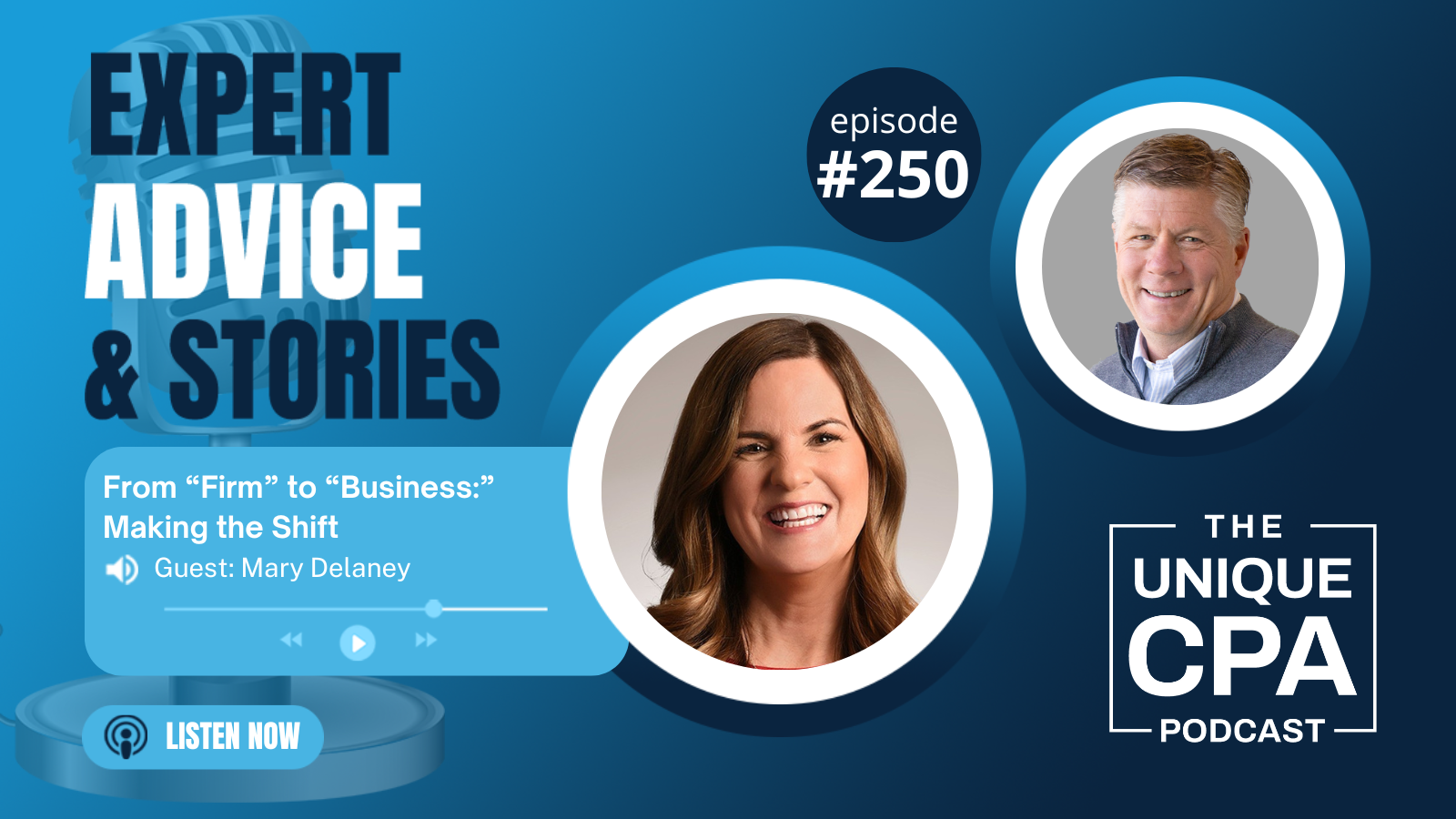
Making the Shift with Mary Delaney
Mary Delaney, CEO of Karbon, opens Episode 250 of The Unique CPA with a powerful story: she tells Randy about a neighbor whose accountant didn’t just crunch numbers but delivered life-changing advice that transformed his business into a legacy. That moment crystallizes what technology can unlock for the profession. Rather than something to be feared, it has the potential to grant us the freedom to focus on advisory work that truly matters. Mary explains how automation handles the mundane, potentially flipping the statistic that 80% of small businesses fail by year ten. With the right technology, every small business could access some level of advisory support. But accountants must make a critical shift: to stop thinking like practitioners and start running their firms as businesses. Mary shares her own experience growing a compliance-heavy services company from single-digit margins to 25%, emphasizing the importance of identifying levers, whether that’s increasing referrals, automating workflows, or offshoring strategically. Empowered people deliver exceptional client experiences, and it’s not people first or clients first, it’s both, simultaneously.
Today’s guest is Mary Delaney. Mary is CEO of Karbon, the global leader in AI powered accounting practice management software. With more than 20 years in global B2B software, she has scaled businesses, led major acquisitions—actually had one recently—and integrations, and driven international expansion. As a customer obsessed leader, Mary is passionate about helping accounting firms modernize operations through technology while building high performing people first cultures. Mary, welcome to The Unique CPA.
Thank you, Randy. So good to be on your show. Thanks for including me.
Well, thank you for agreeing to do this. I think we were at some event in the last few months and we talked about this and I’m glad we got it done, and it’s been fun to get to know you at these events over this past year. Before we get into what Karbon’s doing, what you’re doing, AI, one of the things we talked about in the intro there, why don’t you give us a little more background on yourself and obviously Karbon as well?
Sure. Well first on Karbon, because that’s what gets me really excited. And I want to tell you a story upfront because I think this shows the power of Karbon, and it is a story about a neighbor of mine who I saw make a career change probably 20 years ago, and then we moved away and we got back together recently, and he doesn’t know I work with accountants. And I asked him, “Hey Joe, what was it in your later in life? Did you do that pivot? Because I saw the pressure it put on you, but now I see your boys work for you, you’ve got a few dozen employees and you’re really making a huge impact in the world.” And he said, “Oh, it was my accountant.” He said, “My accountant sat me down and said, ‘Joe, do you realize the day you retire is the day your business ends because you resell other people’s? So you’re a manufacturer’s rep. If you want your business to last beyond you and have a legacy, you’ve got to make a change.’” And I sat there and I got goosebumps from head to toe at that moment because I thought, that’s what Karbon does. we empower, enable our customers, the accountants, to really do what they do best, which is the advisory side, And we automate and enable them to do more of that than have to do that oxygen taking mundane work. We automate that.
Yeah. Well that is awesome because that is the one thing I talk about a lot—sometimes people can’t stop me—but I talk about the fact that integrating technology into what we’re doing is so important. If we don’t, we’re just going to get passed by. And especially with where we are today with technology, we’re at the tip of the iceberg with what AI is going to add, not subtract. I know people are thinking, this is so crazy to me, but when people say AI is going to take our jobs, it’s not. AI is going to allow us to do what you were just saying is be that advisor, be that strategic partner with our clients to help them be successful. Like that story you just told. And so, but let’s talk about that, because there is misconceptions on AI in general, but what do you see AI doing? I mean, obviously you’re integrated, and AI is integrated to what you’re doing in Karbon already. And how do you see AI reshaping this profession?
I think AI will do the work that we really don’t want to do or don’t love doing, and it’ll enable us to do the work that only humans can do, that only accountants can do in the future. I also think it’s going to elevate impact and expand reach. When I think of SMBs around the world, the majority go unserved or underserved, both in CAS and in tax and other areas. There’s a lot of do it yourselfers out there partially because there’s just not availability from accountants to be able to serve or support them. And so when you think about eight out of 10 go out of business by year 10, what if we flip that? What if a hundred percent of small businesses had some advisory work, some insights from accountants, bookkeepers around the world, and then others could choose to get heavier support. But if all had some, I would guess that number would be 20% would go under, not 80%. And that’ll change the trajectory of the economy, of just the family success around the world.
Yep. And so I mentioned that at the beginning of that, the fear of AI of what’s going on. And so I think people are just overwhelmed because they don’t understand what they need to know. And what I really often will say, and I’m no expert, and so you’re the expert here, is they really don’t have to know. They just have to know that the people they’re working with, like Karbon or whoever else is doing the AI aspect of things for them. So is there some way that you, when you talk to people, alleviate any fears on what AI is and what they need to know on AI?
Absolutely. At Karbon, we do several things. First of all, we offer training, so come and get some training and support for you and your team—I think that’s really important. We’ve got just a whole slew of experts that we’ve hired both on the product side and on the resourcing side for our customers to make sure they’re educated. Do that with every one of your partners, though. I think every three months, AI is evolving so quickly. Every three months ask for a partner meeting, meeting with your success team, what do you offer in AI now, not only within the product, but training to empower my team to be successful? So I would say that’s one. Two is no question is a silly question except for the one that goes unasked. So ask! We’re all new in AI, and ask, “Where’s the data set? What model are you using?” The other thing, I think, especially in compliance-driven worlds, AI should have a human in the loop, meaning they should give you the opportunity for a human, an accountant, or other to review it and press the button, and it should show you its work. What did I look at and what decision did I make or action am I recommending taking and why? Just like teachers ask our kids to show their math, AI should do the same, and that allows you to get that confidence with that transparency. We’re a big believer in that.
Yep. And that’s good. Then the other thing that we said at the beginning too is that AI is not taking our jobs. It’s allowing us to do the thing that we’re really good at is the advisory aspect and what our clients really want. I mean, there’s surveys out there that show that clients will pay extra for this advisory type work, but we’ve been so bogged down in the compliance and the mundane work that we don’t often get to the advisory as much as we should. So I guess I want to ask specifically, what have you integrated AI in Karbon, that is giving efficiencies back, giving time, giving capacity back to the accountants so they can spend more time on that advisory end?
It’s a great question. I think a couple areas that we focused on. First of all, AI is not a general sport. It’s very specific and vertical, right? And so one is I would say make sure you’re choosing vertical focused partners who wake up and go to sleep thinking about bookkeeping, about tax and all the other—and advisory of course. And so that would be one. The areas that we have done, the first thing we did is we broke apart and looked at all the different services that our accounting and bookkeeping, tax and advisory customers do. And we looked and we broke apart all the stages, and we started to say and sit chairside with our customers and ask them, what are the mundane, the energy taking, the oxygen taking parts of this that we could automate? And we started with CAS and we made the acquisition you referenced upfront, Randy. We’re super excited about that. ADA had already built all the integrations with the GLs, with both Intuit and with Xero, and they had built advisory reporting post close that was really geared towards each of their customers, clients industries. What we’re building now is all of that reconciliation work and the hard work that goes into closing the month. And we’re working to automate as much of that so that you can get to month end close and get those advisory reports faster and get in front of each and every client to do what our customers do best, which is advice.
Yep. So let’s pivot a little bit now. Let’s talk more in general about the accounting profession, an amazing profession, as you saw when you became involved in this. But you saw when your neighbor talked about it too and what he said about his accountant. But sometimes what I’ve seen is that the accountants don’t realize that they’re running a business. This is something that they’re doing. So I know this is something you like talking about is the shift from accounting firm to accounting business. So what do you mean by that?
I see the accounting firms that are really pulling ahead today aren’t just focused on practicing accounting, Randy, but they’re running the accounting business. And what I mean by that—by the way, I think PE and AI have helped to drive this—and what that means is they’re running the business like the way they ask their clients to run theirs. They have key goals for the year, they have a long-term strategy, they have KPIs as a company, each team has KPIs, they’re measured against those, and they’re working to constantly improve those. I’ll give you a story real quick. I didn’t update you on my background, and there’s one experience I had that I really pull from often. I bought a small tech enabled services business and it was heavily in a compliance industry. It had few hundred customers, it was $10, 12 million and it had low single digit margins. And in three years time I grew it to $110 million, but I also grew the margins 3½x. And in that time it was all about how do we not only deliver consistent service to our clients that they expect high quality differentiating service in this compliance business, but also how do we run it as a business and figure out how to make this something that our parent company was really excited about, and that meant it couldn’t be 7% margins and it needed to be 25% margins.
And that was all about looking for levers. I use that word intentionally. I think about, I can’t lift a car, but if I have a jack or a lever, I can, and there’s levers within the business that will make the biggest impact. And the lever could be top line on how do we accelerate growth by adding a new service, it might be top line in how do we increase referrals by delighting and amazing our clients, it might be bottom line on how do we increase the velocity and productivity of our people by automating work, stopping some work, offshoring some work. So all of those things can be applied to this industry, and I use that playbook to try and share that with our customers and their clients on a frequent basis.
Yeah, I think that’s great advice. I think the problem—there’s not a problem, that is the way it has to be. It should be. The problem is I think a mindset issue where accountants in general are, “Well, I just, I help, I mean my clients need me, so this is what I’m doing. I concentrate on them,” which is great, concentrating on your clients, but you also have to concentrate on your business, and I think that gets ignored too much because your business, it is a business. You’re not just a helper. You are not just a psychiatrist out there talking to your clients, but you are out there running a business and you are supporting people within that business. And so that’s important.
I don’t know if you’ve seen this or not, but you think there’s a way to get past that mindset and start educating accountants on, okay, and I know it’s happening. I know you’ve seen it. I know I’ve seen it, but start educating more accountants on the fact that, let’s start running this as a business. And one of the key things, sorry, I’m going on a long question here, but one of the key things I think starts with the leader of the organization. The managing partner—depends on the size of a firm, but at least $10 million, maybe even less than that, $5 million, I’ve seen it in smaller firms now, where the managing partner doesn’t do any client work now anymore. Their client is the business, is the firm. But I think that’s a mindset issue that we need to get past. And this is my rant here on this from a mindset standpoint. I’m sure you’ve seen that, but is there a way to get past that?
I think you’re right that it’s more at the $5 million than the 10, first of all. And I think they intentionally have to say that’s the goal. I’ve not met one owner who regrets making that decision. I will say, if you’re thinking about it.
I agree.
Talk to others, they all wish they would’ve done it three years earlier. And if you don’t feel like you can, the other thing is hire an operational change agent who their full-time job is to work on the business to ensure that you are moving it forward, you’re automating, you’re enabling your team. I would start with give yourself a day, one day a week where you just say, “This is my day to work on the business” and time block and set goals. Because you don’t have to do it overnight. It’ll take time. You have big shoes to fill, and there are a unique set of folks who can build a firm or business, and there’s a lot of you that you will have to replace. So, that would be first a lot. Allot 20%. Allot a day, or a few hours of the day, and those are non-negotiable hours that you use on the business. Get analytics, have a partner, make sure you have technology that gives you a clear mirror of how you are doing. And that’s on the business side and the profitability and the productivity side. I’d also understand culturally how you’re doing, so make sure you’re doing an employee engagement survey or using that type of tool as well. But having that data is where are we now, what are my three levers I want to work on? And then go find a mentor or a coach. A lot of people, frankly, anyone in this beautiful industry, or profession I’ll say, beautiful profession of accounting, the generosity in which people share their time and their wisdom and their mistakes. I’ve never seen it in any other profession in my life in the way it is here. So go ask for help. Everyone’s willing.
Yep, so we just did our first BTG Roadshow this week in Philly, and the sub themes of the Roadshow are community, connection, and collaboration. And collaboration, you just said it: We are such a collaborative profession. There’s nobody out there that isn’t willing to share their knowledge and knowledge sharing, to me, is one of the most important things out there. We had two sessions on collaboration, and they just went over so well. I just love the fact that you brought that up because that is so important. And that’s again, goes to our mindset. Because often we were built to believe we have to do everything, we have to know everything, it has to be us, and that’s not how it has to be. That is that worst case scenario. You should rely on others, you should help others, be part, you have to have other people in your circle that you can lean on, that you can collaborate with, that you just can connect and ask questions or even just to ask for support if it’s a tough day, anything like that. But that’s what I love about this profession most, is that we are always there supporting each other.
I will say on that too, Randy, if anyone needs a connection, a best of who’s winning in a certain area, who have I seen really shine? Happy to make connections as well, and I know you are as well.
Oh yeah. I think what I’ve morphed into is a community builder. I guess that’s, if I had to say one thing, I was just thinking about this the other day. That’s really what I am through the podcast, through the conference now. The conference is great. It’s such a community. It’s unbelievable. And so, okay. Enough about me.
It’s a great conference, so I agree.
Well thank you. I enjoy it. That’s the other thing that I talk often about is do what you love. I know people like say no, do what makes you money. But you know what, if you can do what you love, your passion shine through, it’ll all come. Alright. Let’s move on—we’re going to run out time—but let’s move on to a few different things. Let’s talk about client experience. We’ve kind of built this in already, but I know you’ve talked about that and how that’s really a true competitive differentiator for firms in general. And then actually I kind of want to contrast that with, because at the same time, you’re customer focused, customer obsessed, but then people first. And so sometimes people think it’s got to be one or the other where we have to base it on the customer or we have to base it on our people. And so do you see a difference in there or how is this, I guess, a competitive differentiator, but how do you integrate both of those?
My people accuse me all the time of being an “and” person, not an “or.” So when they say, “Should we do this or this,” I’m like, “And! We’re going to do both.” I think this is an “and” one where, first of all, you have to empower your people. The best they can be to deliver for your clients. So you can’t amaze and delight clients without really empowering your people to be best in class. So I think it’s an “and.” On the client side, I’m going to take off my glasses and put them on for a second—I know they can’t see me—but we all have to put on our clients’ glasses. We’ve got to look at ourselves through the eyes of that client. So if you haven’t secret shopped through the eyes of your client, their experience, call and say, “I need something today.” Go onto your client portal or portals and see if you understand where you should go to understand what work you’re waiting on for me, and if I have a question, how I ask it. I have done this many times on the people that we meet with that aren’t using Karbon, and there was one in Texas I went on and there were not only 11 portals, but there was a manual in the top that said, “Click here to understand and get guidance on which portal you use for what situation.” And that’s the idea of what we don’t do.
I think in the future you should all expect to have one portal. In this world of an integrated solution, we should, your partners should do the work to make sure we’re all connected in this connected ecosystem, and your clients have this one portal, they click on whatever they need to do and it will take them wherever they need to go. They don’t need to know you use three or four or five technologies, based on different areas. So different one portal, I think is key. Understand their experience and ensure they’re delivering—your team and your technology is really representing you in that delight and amazed way.
Yeah, that understanding their experience or listening to them, I think we often too much miss—”often too much miss?” Yeah. I’ll go with, I’ll say that’s a real statement. We often miss because we have so much knowledge and we just jump to what we think they need rather than listening to what they need or what they believe they need. Now, sometimes what they believe may be wrong, but you’ll hear that in the statement and then you can go through it. But I love that being the, empowering your people, I believe that completely. People, if you treat your people the best, your clients are going to be treated even better. And then when they are being treated better, it’s because we’re listening. And that’s going to be a key as we really get more AI integrated and get all of this busy work out of our hands, that we can be this advisor and the best advisors in my mind listen, and then they react rather than, and then see what the client has to say. So I love that.
Agree. I was just going to share on the people side that I do think it’s really three things. One is the right culture, and culture is having the right people. So it’s in recruiting whether or not you have 10 people you’re behind, you hire like you only have one hire to make. One hire. And so it’s as selective as you were to hire the best person, the empowerment as a CEO or partner heading up the firm, I think reinforcing and living values is really key. Talking about them often, recognizing people for them, and living them. A lot of what we have to do as leaders is help people understand how to make decisions on their own. So helping them share your critical thinking out loud, why we made this decision, what our top three priorities are, allows them to make the right decisions as well. And then it’s all about focus. So we need to give them the vision, something to believe in, we need to talk about our top three areas and what we’re deciding not to do, and then we need to make sure we’re building their skills to enable them to be stronger, and then finally, it’s technology, right? Give them the tools and then teach them how to use those tools. So those are some of the things that I think make for a high performing culture. It’s the most exciting times, not only in the accounting profession, but frankly in the world of work, and we all have the opportunity to lead, make an impact. I guess that is truly, it is this time in our lives matters more than any other time, at least in the five decades I’ve been a part of the world of work, and so I look forward to partnering with people on that.
Yeah, so I was just talking the other day about how we are at like one of the most amazing times in our profession, but really in business in general, like you just said. And then I think, well, but we probably could have said that 20 years ago, we probably could have said that 30 years ago, but we probably did, but now is that time. Every time it gets, I think, exponentially more important or more amazing or more opportunities that come out. And so, this moment in time, people that are starting their firms today, and they started with the mindset of these things that you were teaching and talking about today? I mean, they’re just going to thrive. And on a selfish note, I wasn’t going to do this, but my son is one of those who just started out, just started his business a few weeks ago, a month ago now, and he is taking all of that to heart. Everything that you talked about. And so I’m so excited to see where he goes. But when we were talking, I thought, you know what he is looking at helping accounting firms with their clients, and really become the most efficient organization they can, and I thought, you know what? He should help accounting firms too when we talk about that transition from a firm to a business. So there, I put my plug in for my son. That was not planned today, but you made me think, I think he’s on the right track with stuff, so that’s great.
I want to hear more about that on the side too, and connect more. It’ll be good to spend time with him.
Yeah, we’ll definitely do that. So, okay. This was great. I love everything. I love what you’re doing. I love everything, the way you look at things, the way you analyze things, the way you look at everything that’s happening with not only inside Karbon, with inside firms, with inside the profession and the awesome stuff you’re doing. But when you’re not doing this awesome stuff, what do you enjoy doing outside of work? What are your outside of work passions?
One, family. I know that might be a boring thing to say.
It’s a great thing.
I do love spending my time with my immediate family and greater family. I love to garden. I love to golf. I love to walk. I love to be outdoors. I love to travel. Those are so—I love concerts and I love Broadway. Those are some of the things.
Well, that’s cool. And now last question. If people want to hear more about what Karbon’s doing, what you’re doing, where would they look?
First of all, we have a huge subscriber base to our Karbon newsletter, so you can come on Karbon and you’ll find it. And we deliver content every week, and we have I think 130,000 accountants around the world who have access and say it’s their go-to place for insights. And that’s not about Karbon, it’s about thought leadership. Our goal is to really help build community, elevate this community and profession and also provide best in class technology. So that’s where I go. And then follow me on LinkedIn or connect with me Mary@KarbonHQ.com. Send me an email and I’d be happy to make connections to anyone who I think’s a thought leader in the area you’re passionate about.
Awesome. Well, thank you for that, Mary, and thank you for being on this. It did not disappoint. I knew I would enjoy this conversation—I definitely did. So I appreciate you being a guest on The Unique CPA.
Thank you for having me.
Important Links
About the Guest
Mary Delaney is a visionary, customer-obsessed executive with 20+ years of expertise driving hypergrowth, transformations and award-winning company culture across domestic and international B2B software companies and marketplaces. Her recognized proficiency in defining innovative, AI driven and defensible product and GTM strategies, designing high-margin operational playbooks, and building industry-leading revenue engines are the foundation for her serving as Chief Executive Officer at Karbon since 2023.
Mary’s prior experience includes heading multiple strategic acquisitions, leading successful integrations, and scaling organizations across Americas, EMEA and APAC regions. A values-focused leader with an unmatched ability to attract and retain world-class talent and galvanize highly engaging culture based on inclusion, customer focus, and employee ownership mentality, Mary enjoys networking with other leaders on accelerating growth and results-driven leadership to move organizations to the next level of success.
Meet the Host
 Randy Crabtree, co-founder and partner of Tri-Merit Specialty Tax Professionals, is a widely followed author, lecturer and podcast host for the accounting profession.
Since 2019, he has hosted the “The Unique CPA,” podcast, which ranks among the world’s 5% most popular programs (Source: Listen Score). You can find articles from Randy in Accounting Today’s Voices column, the AICPA Tax Adviser (Tax-saving opportunities for the housing and construction industries) and he is a regular presenter at conferences and virtual training events hosted by CPAmerica, Prime Global, Leading Edge Alliance (LEA), Allinial Global and several state CPA societies. Crabtree also provides continuing professional education to top 100 CPA firms across the country.
Schaumburg, Illinois-based Tri-Merit is a niche professional services firm that specializes in helping CPAs and their clients benefit from R&D tax credits, cost segregation, the energy efficient commercial buildings deduction (179D), the energy efficient home credit (45L) and the employee retention credit (ERC).
Prior to joining Tri-Merit, Crabtree was managing partner of a CPA firm in the greater Chicago area. He has more than 30 years of public accounting and tax consulting experience in a wide variety of industries, and has worked closely with top executives to help them optimize their tax planning strategies.