People First and the Attitude of Gratitude
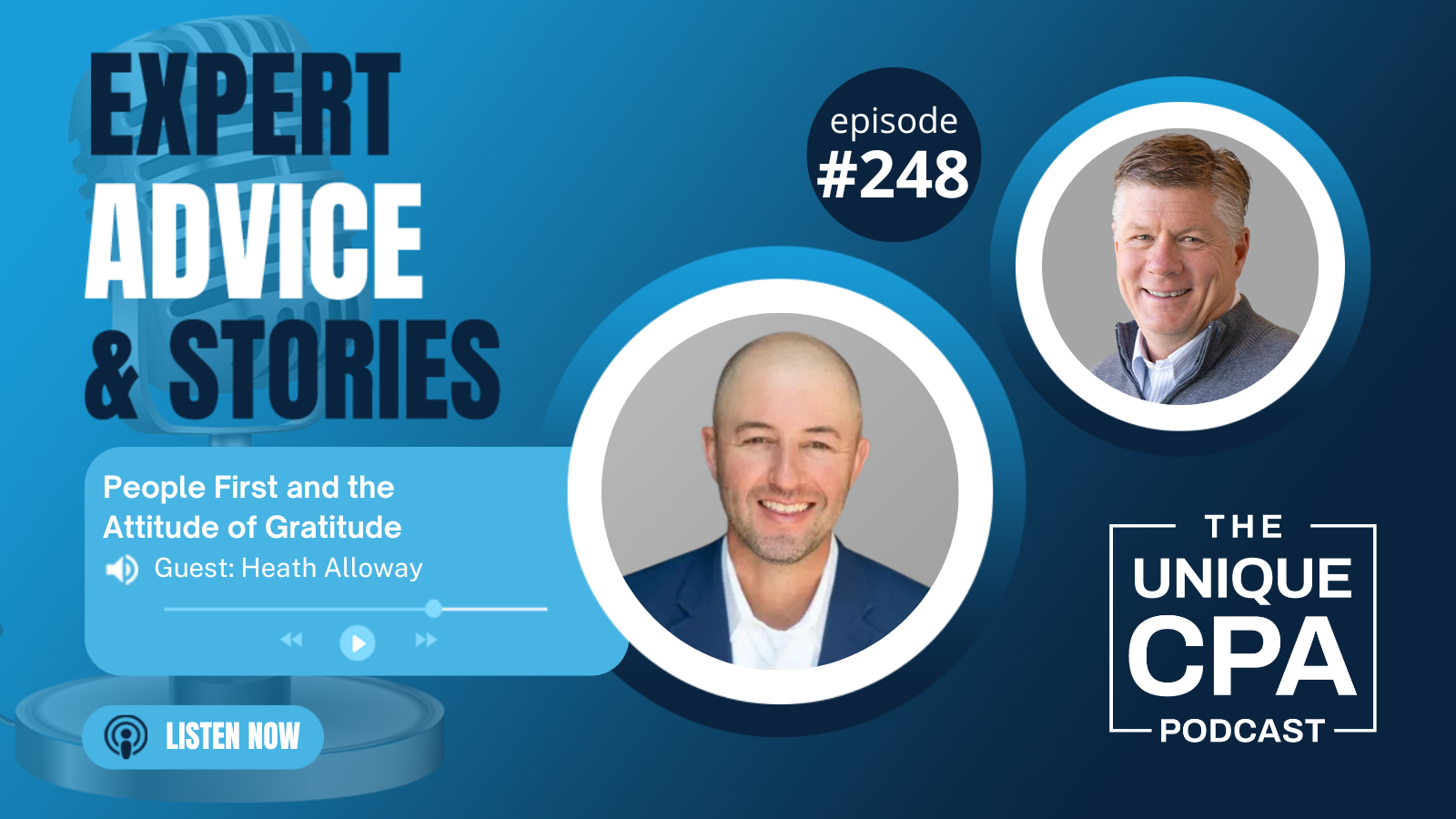
With Heath Alloway
Heath Alloway, growth partner at Sorren, returns to The Unique CPA on Episode 248 for a dynamic conversation with Randy about the evolving landscape of accounting firms and the power of intentional culture. Heath shares the story behind Soren’s formation, a merger of thirteen firms driven by a vision for people-first leadership and meaningful growth. Although heavily focused on business development in his own role, Heath’s focus here is on how advisory, leadership retreats, and an “attitude of gratitude” can sustainably transform both firms and individuals. Reflecting on the profession’s capacity to give back more than you put into it, Heath and Randy mull over the challenges of integrating distinct cultures as well as the importance of vulnerability and connection, with their unifying trait being a genuine passion for helping others thrive in accounting and beyond.
Today’s guest is Heath Alloway. Heath is Growth Partner at Sorren, and a true builder of people-first firms. Heath spent nearly two decades helping teams grow wisely, shaping culture, developing future leaders, and turning vision into action through his client-focused leadership programs, retreats, and strategic planning. I’ve got to firsthand be able to experience a lot of what he’s done in the past. And so, Heath, welcome back to The Unique CPA.
Thank you, Randy, as always. It’s good to see you again.
Good to see you too. It’s been a little bit. In person may have been Bridging the Gap of ’24, was the last time I saw you in person?
Possibly. I’m trying to think of the timing. I think there was another event, maybe in Puerto Rico, where our paths crossed, and then I think since then.
Oh, that’s right, that’s right. I forgot about that. Yeah, that was fun.
Yes.
That was CPAmerica Tax Conference?
That is correct.
Or Leading Partner? It was tax, okay.
Yep.
And actually, if we’re going to talk CPAmerica now, we’re going on tangents, which is what I do. I was just at the CPAmerica Leading Partner retreat in Napa. That was a lot of fun. We had a good time there.
Well, if you ever want to bring a guest, Randy, I’m always open to going to Napa.
You got it. I’ll remember. Although I don’t know the next conference there. If we have another one in Napa, it is probably the third time I’ve been there for our conference, so it’s a great place. Alright, let’s move on, let’s get on to what we’re doing here today, which is talking about a lot of the really cool things that you’ve been doing in the profession, that you’ve seen in the profession, that you’ve helped with in the profession. But before we do that, I mentioned at the beginning that since last time I saw you—approximately, it may have happened before that—you now have a new role and you’re growth partner at Sorren. Sorren is, you can say it probably better than I can, but I’ll say my version of it, a private equity firm that is invested in accounting firms for the past year. So let’s dig into that a little bit: Give us a little background of Sorren itself and then how you got involved.
So Sorren originated, there was a group of managing partners that met from time to time and that led to some of the discussions of what would it look like to come together as one firm and try to do something special together. And one thing led to another. And then this is the real short version, Randy. Okay. So if we need to go more detail, or questions?
Yep.
The initial rollout was May of this year. That was 13 firms merging together truly to come together as one firm, full integration. How I got tied into that was Harris’ Legacy Firm, they were big into Upstream programs. I knew their firm leadership for probably the last four to five years and thought very highly of the firm leadership, forward-thinking firm. And there were some things in the back of my mind, Randy, that have been living there for a really long time, even pre-Upstream, when I was in a firm. I had ideas of, with a non-traditional background, how could we take some non-traditional services in the profession and take those to our client base. That’s how my conversation with Josh originated, which led to a couple other ideas. I had some large firm experience, and so joining Sorren, when you think of that many firms coming together, these pockets of success, where’s our highest client concentration?
So part of my role has been really focused on developing our leadership teams around the core industries that we focus on; also identifying future growth opportunities in certain industries, getting our leadership team set up. I’ve also started the process of doing client strategic planning and retreats outside of the public accounting profession. So my first couple have been focused on a nonprofit, a general contractor. So taking some of the lessons learned from the public accounting profession and how can we apply that to our client base and from an advisory standpoint. Those are some of the things that I’ve been focused on that really drew me to Sorren and 13 firms coming together. I’m sure that is, most people know, it’s no easy task. And I love the culture. I love change. I love people development, so it’s really allowed me to focus on the things that I love the most, and maybe some people don’t enjoy as much, but it’s all the things that I love doing. End goal, Randy, three years down the road, five years down the road, looking at all the things we’re doing, looking back and saying, you know what, it wasn’t easy, but it’s been a lot of fun and it’s been fun putting something together with people I didn’t even know 12 months ago.
Right. Looking back and seeing a rewarding experience, I assume, is the goal that you’ve enjoyed every step of the way and some ups and downs, I’m sure. But let’s, I want to get a little more into the story because I think you told me this before, but firms that wanted, that talked for years, it sounds like, about, hey, what would it look like if we came together? Now, I assume it wasn’t all 13 firms that were having this discussion at the same time. Was it a handful of firms that it originated with?
I was going to say, “Don’t quote me on this, Randy,” but we’re on a podcast so you’re going to quote me on it. But I think there was, if I remember correctly, at least four, maybe five firms that were part of that group that started the initial discussions, which then led into other relationships and yes, one thing led to another.
Yep. So I assume though, there is a private equity part of this, so there was financial backing to be able to put this all together, correct?
So I think out of those initial discussions, when that idea surfaced around what would it look like for us coming together, I think that’s where the Harris legacy firm and Josh took the initiative to go back and look at what would this look like? And then that’s where the outside investor came in to help facilitate and accelerate that. That’s how that originated and got started.
Yep. So I have some friends who have become part of the Sorren family. Well, one of them went with and one of them kind of didn’t come with, but Matthew May and Kenzie Coronado from Acuity. They kind of let me into their journey over the last year and a half or so when they decided to look into options for them and they didn’t give me names, they didn’t tell me Sorren and everything else, but I know they evaluated a lot of opportunities to join another firm or private equity investment and so, you know, they told me in the past about how the process went, and when it came down to it, Sorren was the obvious choice for them. So I don’t know if you ever had to have, Kenji kind of is out doing his own thing now, but Matthew I think is a pretty high up leader in the organization at this point. Are you working with Matthew at all?
Yeah, Randy. It’s crazy timing of the recording of this. I was actually just at AcuityCon not too long ago, their annual conference, and then with Matthew and the CAS team and overseeing that aspect of it, the various service line leaders we meet on a weekly basis. Since I’m focusing on our core industries, I see Matthew, unless there’s a scheduling conflict, at least once a week, every Monday. So there’s a good amount of collaboration. Some of the Acuity team members, whenever we’ve been developing our leadership teams around our key industries, we’re trying to get a good mix of service lines, and some of that is CAS-related. So some of his team members from the Acuity side will be stepping in and taking some additional leadership opportunity within those key industries.
Nice. Yeah, he was just telling me recently too that there’s a key group in Chicago that he has been working with in the CAS area as well. So I don’t know if he’s coming up here, but if he is, I’m going to have to make sure he lets me know and we can go grab a beer. Okay, so there’s other things I want to talk about, but now I’m intrigued with this whole story of Sorren. Let’s go into this. So your title is Growth Partner. But when you were talking about that, you were saying a lot of things other than what I think a Growth Partner is. To me, a growth partner is, okay, you’re doing business development, but what you were talking about is leadership training and all that. What is, I guess, let’s dig deeper into what your role is?
Yeah. Randy, I would say it’s somewhat unique compared to some other growth partner, growth officer type roles. Whenever I say the word “growth,” and this was big, even in my previous firm and then at Upstream, when I look at any successful firm, we talk about their pillars or various areas for success, and I look at culture drives everything, and then our people, then our clients, and then growth. And when I look at growth, that really, from a revenue standpoint, that really fuels the firm culture, it allows us to reinvest in our people. I am looking at from an internal mix, so part of my role is internally facing, some of it’s externally facing. The internal part of it is building the leadership teams, building more expertise in our key industries, how can we continue to evolve there? We do have plans leading into next calendar year, you mentioned the revenue or business development side of doing a full-blown business development training program and implementation across the firm. So it will be geared more towards the revenue side of it.
But then from a service line, that is working more individually from a client strategic planning and helping with the implementation of that further down the road of developing a leadership development type opportunity for Sorren clients. I’ve learned so much from so many people around public accounting. I just see a demand and a need in other industries, other professions, and it seems like just early on, even our client base is hungry for those kind of opportunities.
Nice. Alright. Another thing that’s intrigued me that you said earlier, and I’m probably going to get this wrong, but you said you were facilitating retreats with a nonprofit or other types of organizations. What’s that? And is this Sorren related or what is this?
It’s definitely Sorren related and it’s a way to play an advisory role in guiding not just the tax or assurance or whatever the service line, but looking more holistically at the business. For a lot of family-owned businesses, I’ll just use that as an example, of, have they really stepped back and looked at the business? Sometimes they get so tied up in the business, not working on it. So going back to those four buckets of culture, people, clients or customers, and growth, what does success look like for them three years from now? How can I help them achieve those goals and grow their own organization and being successful? That could look anywhere from a day or two days, doing a lot of pre-planning, diving into how their leadership team works together, what are their obstacles, what are their hurdles, how can we help them be successful long term? So it’s really stepping back and taking that advisory approach of how can we help them run their organization or business better? I look to bring other service lines into the discussion, depending if it’s succession planning or maybe they’re looking to acquire or looking to exit the business down the road and having that kind of guided discussions from someone outside of their organization.
Alright. Is this an offsite event? Is it a Zoom meeting? Is it a paid event? Or how do your customers or clients or potential clients get involved?
Right now, I am focused more on doing them in person. It’s harder, you think of communication. What is it, like 70% of communication is nonverbal? So when you’re there in person, it is a lot easier to read the room, it’s a lot easier to build connections with the people you’re working with, it’s a lot easier to build trust. So my focus, I’m not saying we couldn’t do it remotely, but I am much more focused on the relationship and trying to be in person. They could be a day, I’m big on the day and a half or two days, because typically some people process information differently. When you come back the second day, those that need time to process are usually a little more vocal about their thoughts. It gives them time to sleep on it, share any concerns, questions that they might have the next day.
Alright. So now I asked all the things that you intrigued me with when you were starting to talk about it. Let’s get into a little of the ideas that we discussed prior to recording that we thought would be pretty cool to talk about. One of them, and this is something you sent over and I loved it, is you wrote this out: “You want to talk about a profession that can do more for you than you can ever do for it.” And this, I think, comes back from your background and where you came from, so let’s hear about it. What do you mean by that?
So I’m going to even take a step back if that’s okay, Randy, because I think what I just shared about retreats and facilitating and helping businesses… I grew up in a pretty small town, small family-owned business. Growing up in that environment, I learned so much about how a business operates, I learned a lot about relationships, I learned a lot about culture, I learned a lot about our communities and the impact that business can have on our communities, and that really drove my love, my passion for what I do. I don’t want to say it’s non-traditional because it’s kind of the American dream of business, running a business and doing all of that, but that’s where I learned a lot.
I went to college. I got a degree in just general business. I had no plans or expectations to get into public accounting. Candidly, Randy, I didn’t know what I wanted to do. I probably bounced around a little bit, probably more focused on golf and friends and other things, and not necessarily my career. A couple years after graduating, my dad might have had some hard conversations with me, and it was time to grow up a little bit and get my foot in the door and start building a career. I put out a ton of, you know, applied for a ton of different positions, had a lot of different ideas. One thing led to another, and someone that I played college golf with was at firm BKD at the time. One thing led to another, I got my foot in the door. It was not my dream job, Randy, by any means, but it was my foot in the door. Spent my first, I don’t know, 14 to 15 months making calls for our partner group to prospective clients, so trying to get a meeting set up. Learned a lot about rejection. I learned a lot about the different services we offered. I learned a lot about the profession as a whole, and so that drove a lot of that.
I planned to build my resume, I planned to leave in two or three years. Now, it’s almost 20 years later. That was 2006. When I say the profession could do more for me than I could ever do for it, a few months ago, I had a chance to go to Banff in Canada. It was like 12 or 13 US firms that were going there to meet. I had the chance to go facilitate a meeting. I took my family with me. We were out. I don’t know if you’ve ever been there, but we were out by one of the lakes and it was just one of those moments, taking a picture with my wife and kids and thinking, gosh, 19 years ago, never in a million years did I think that I would be getting paid to lead a discussion in Banff, Canada with several firms. That’s the real short version of it. But I’ve met so many people like you, just other people across the profession that, for the most part, Randy, I mean, yeah, there’s probably some firms out there that, whatever, you don’t really want to work with, but for the most part, you just meet a lot of genuine people that want to do well, they want to lift up their communities, they want to lift up their people, they’re trying to do what’s right. I guess my advice for people thinking about getting into the profession or thinking about leaving the profession is there is way more opportunity and more impact, things that you never will even imagine that will have a positive impact on you. It has just been a wonderful ride. I guess that’s my best way of summing it up, Randy.
No, I couldn’t agree with you more. It’s funny, I just had a question posed to me today, something I had to write a response to, and it was, if you go back, what was one thing you would change in your career? I went through this question. I get this question a lot. I get, you know, like you, I’m on podcasts a lot. I get interviewed and my answer’s always the same. I wouldn’t change a thing. Because this profession’s done so much for me and it’s got me to where I am today. And this moment in time, sitting talking to you right now, it doesn’t get better. I mean, we’re talking about this profession and how great it is and things that it’s done for us. So what I told them is, this is actually what I said: I wouldn’t change anything. I appreciate where I am and that’s thanks to every experience I’ve had. For others, I’d suggest prioritizing health, seeking your help early, building your role around your strengths and passion, investing in mentors, fostering relationships, that’s so important. Saying no more often, those are things, you know, hey, sure, would have made a difference if I had done that more often? Maybe. But I wouldn’t be sitting in this spot right now and I want to sit in this spot right now.
Including time for recovery, you know, don’t overdo things. Integrating technology more. That’s something, when I started in the profession, I just wasn’t that great at it. It wasn’t as big a deal, but all these things—man, you’re giving me goosebumps now—that the profession has given me, has just been amazing. I can’t believe the same thing you’re saying. I can’t believe that I get to earn a living just trying to help people in this profession that I love. So, alright, that’s my rant. But you got me going on that. I love that answer you had.
Well, Randy, I mean, I love the response of I wouldn’t change anything, so I think it’s a really great question, but that response is, that’s really good.
Yeah, well, I say that all the time because I do get asked that a lot and most people know, if you listen to this show, I had a stroke 11 years ago. I wouldn’t change that. And it sounds almost guilty—I feel guilty saying that because I’m very fortunate physically to have recovered. But again, I wouldn’t be in the spot I am right now without having that stroke. And so, less that I can say I wouldn’t change anything, I know sometimes that’s hard for people to believe or for people that aren’t happy with where they currently are. I just try to live with a, it’s a cliché, but an attitude of gratitude. I’m very happy for everything I have and everybody that I have in my life.
Randy, you’re not going to believe this. I wish—my handwriting’s really bad, but, because I was jotting down notes and I wrote “attitude of gratitude” down here and I was going to ask, it’s almost more of a mindset of we’re bombarded with the negatives. We naturally tend to think more towards the negatives. And now that attitude of gratitude or the abundance mindset, for me, you talked about stress, burnout, all those things. Sometimes that mindset kind of is a skill. We have to focus on that because we’re constantly bombarded with everything that’s going on in the world. It’s a different mindset of I’m here because of that attitude of gratitude and I wouldn’t change that. So that’s, in a lot of ways, I think that attracts people to you as well when you have that kind of mindset. So kudos to you. I can’t make this up of writing it down. That’s pretty crazy.
Yep, that’s cool. Well, I think you and I think a lot alike in that way, so that’s why I always enjoy these conversations. Alright, let’s keep going, because there’s some other things that you had brought up that I found very intriguing as well. I want to touch on a lot of things that you mentioned earlier, but one thing that you did say pre-taping was talking about growing wisely and what that means and how people—is there a mindset to growing wisely or what is growing wisely?
I definitely think it’s a mindset. Before I get into the mindset, one mistake—and again, we can’t change the past—but one mistake that I made early on, probably not fully understanding how a firm operated and the impact that growth had, and I hate to admit this, Randy, on a podcast, but it was almost this mindset of all growth is good growth. Not the case—not all growth is created equal.
No.
When you talk about the mindset, I have met very few people that get into our profession to say, I’m a salesperson, or I love business development. So I flip the question and the two questions I ask are, one, why did you get into the profession? And then two, what do you love most about the profession? That second part about what do you love most, it tends to go back to one of two things. It’s either, “I love working with my clients, I love seeing them be successful,” or “I love working with my people in the firm, my teammates. I love seeing them be successful, growing in their career.” And when I look at growth and growing wisely, that kind of growth fuels the fire to create opportunities for your people. It creates ways to reinvest in your firm to bring new services, develop skill sets, and serve our clients in a better way. So that’s the foundation of that mindset of how do we grow in a way that’s healthy for our firm? Some may not agree with this, or they may say it’s not possible, Randy, but who knows? Some may not agree with it, but it’s this mindset of how can you work less and become more profitable? That may sound capitalistic, but I don’t see it that way. We all have limited time. It’s how do we use our time in a way that’s healthy for us, our firm, our clients, our communities.
No, that’s perfect because I think we do the exact opposite way too often. We don’t value our time because, and again, I rant on this all the time, but because we’ve been taught that our value is in the hours we put in rather than the outcomes we deliver. We have to figure out a way to get out of that mindset. I think there’s firms doing it. I think it’s going to, it was funny, I was just talking with Alan Whitman two days ago, and he was a managing partner at Baker Tilly, we were talking about that, our mindset, and he mentioned him talking to a friend of his who is a leader at one of the Big Fours, and he said, this is how this gentleman said it, that the person that figures out how to bill on outcomes rather than hours is going to win. Now, I don’t look at business as winning, but that’s how he put it: “is going to win.” Figure out how to do this profession right. For me, I’m going to take winning to mean being able to have our people be the best, healthiest, happiest that they can be. So that has to happen, and I think it can.
Yeah, I do too, Randy. I think we’re making progress. Honestly, I think post-COVID forced us to take some of that action that we needed to grow wisely. Hopefully some of that will continue to move forward. One other thing I would just mention on the mindset too, you look at, I’ll go back to what, 2008, 2010, when the economy was doing well, firms were growing double digits and all of a sudden, downturn, firms were scrambling, you’re kind of seeing a little bit of that again. It’s somewhat cyclical and reactionary instead of being intentional and proactive. So when I think about that mindset, it’s how can we embed this into our culture? It’s not just partners, by the way, Randy, I think everyone plays a role in a firm on growth—I mean, it’s client retention, it’s are we looking for the cross-serving opportunities, better ways to help them. So that’s part of the mindset as well, is how is this a proactive, intentional, not cyclical driven.
Right. Okay. So earlier on, that just made me think of something you said earlier. Earlier on, you said you started this training program on business development firm-wide. What does that mean?
So firm-wide, we’re still in discussions on what that means, Randy, but at a minimum, we would look at some of our people owning client relationships. That would probably include several of our partner group. Will there be a trickle down to other levels, even in the first one to three years of the firm? I could absolutely see that down the road. Because I think the earlier you start in someone’s career, building that business mindset, when they hit the manager level or whatever level, they’re going to be required to start doing more of this, it’s not going to be some big surprise of, “Oh crap, I’ve got to do what?” kind of deal. So to me, if you start there, you’re embedding it into your culture and then 5, 10, 15 years down the road, it’s just something we do. It’s not a surprise. You’re being asked to do something that, I don’t want to be part of that kind of deal. So it’s still in discussions, but that’s what we’re thinking through.
No, that’s great. I think just the word selling is hard for CPAs in general. It’s hard for me, so I don’t look at it this way, whether I’m selling or not, I’m educating, I’m finding solutions or listening for needs of people and then seeing if we have solutions for that. For me, it’s as much of that as just building relationships, but the relationship itself isn’t enough. I know that you have to then ask for the business, or at least show that you have a solution that’s going to be valuable to them. Maybe it’s words, maybe we have to figure out different words to say when we’re talking about selling or business development.
Yeah. Well, Randy, one of the examples I use, hearing you talk about the helping versus selling mindset—a couple things: If you went to your general practitioner, you went to a doctor and they started to prescribe you something before they ever ask any questions to understand your health, you would probably look for a new doctor. Or, say you’re a doctor, that you’ve found a cure for cancer, wouldn’t you want to tell people about that because you know you can help them? We have people that maybe they’re not curing cancer, but they’re experts in what they do and they have an opportunity to help nonprofits, construction companies, manufacturers, family-owned businesses. I almost see it as a responsibility, not as something they have to do.
See, that’s words. So we have to say it that way rather than it’s all about words. Another thing. I’ve been recording so many podcasts lately. I keep getting new ideas from new people, which obviously I’m getting from you today. But that was on another podcast recently where somebody was talking about just the words that we say sometimes have to be intentional to get the right point across or to communicate more appropriately. So that’s been in the back of my mind lately.
Alright, I want to make a little pivot because you’ve mentioned the word culture about six times, and it’d be really hard for me not to talk about culture. So I want to ask specifically, kind of going back to the beginning at this point, but specifically about you’ve got 13 distinct firms that at one moment just smashed together. I may be exaggerating this. And each one is going to have their own culture. I mean, they’re not going to be the same. So how is that integrating these separate firms going and culture integration? Because there’s going to be different things like just, hey, terminology is different in what we do or practices are obviously different. Not even just culture, but even just titles, job titles, whatever. So how have you helped facilitate the integration of these 13 firms into one cohesive culture?
Yeah. Culture’s always a work in progress, Randy, for, I think, every firm, it’s intentionally or unintentionally created each and every day. So I think it’s not just a one-time event. It’s how, what things we say, things we do, all the time. The good news is, whenever I joined in April, there were already efforts in the works to help with this. Some of the things that we went through as a firm, it started with a firm survey, everyone in the firm, so all the legacy offices, all the different service lines, and there was a very high response rate around what they truly loved about their firm and getting feedback on the cultural values. Then they came out of that, there was a big focus on cultural workshops, so that included people at all various levels in the firm, from new partners to firm leaders, different offices.
When they facilitated those workshops, one of the things that came out of that was we realized that there are people like we are, so there were a lot of those barriers breaking down of, it’s not the legacy firms, it’s people coming together of what matters the most to us as we come together as Sorren. That led to a recent rollout of our firm “mission, vision, and values.” And that part of the rollout, which I love, and the Harris Legacy Firm was doing this beforehand, but it’s called a thematic goal process. Each of the offices, each of the service lines, are now going through a half day or a day thematic goal workshop of coming together in that office, focusing on one thematic goal from our mission, vision, values, and a project to implement it in their office over the next several months.
So it’s a lot of intentionality around culture. We’re also, big focus, we’re having first annual partner meeting as Sorren, so we’re looking to blow that out of a really great experience, focused on culture, relationships. We’re launching an internal podcast that is really just a chance to get to know our people around the firm, sharing some of their life stories, sharing their leadership journeys, sharing where their area of focus and their passions are, just getting to know. So those are some of the things we have in the works, but I don’t think we can let our foot off the gas pedal. I think it’s something we’re going to have an ongoing focus. Communication. I know that’s a canned answer, but in a time of change, I don’t think you can under-communicate. So looking for ways to continue the intentional communication around the firm.
The intentional communication—I was just writing down, look at us! I was writing down intentional when you said that, but then also transparent, I mean communication, but being honest and transparent about what the goals are, where you’re going or what stumbling blocks you run into. I think that just helps build trust levels, which are going to be so important when you’re trying to integrate all these firms together. One last question on that, then. I assume staying with the 13 firms is not the goal? I assume that continuing integrating new firms is something that’s looking to happen?
Yeah, Randy, I don’t think it’ll be another 13 firm kind of deal. I don’t think that’s the case, but it’s more of going back to the culture aspect of the right cultural fits, geographic markets, the service lines or specialty expertise or specific industries, and being very thorough about that and making sure it’s the right fit for us, it’s the right fit for them. So I anticipate there will likely be more, but it won’t be a 13 at one time rate. Who knows? I could be wrong on that, Randy, but I don’t see that being the next step.
Alright, so before we wrap up, because I don’t want to wrap up because I enjoy talking with you so much, but kind of a play off that question I got earlier about, hey, what would I change in my past? Let’s not even look at that. Let’s say somebody is struggling with something, because I struggled with stuff all the time, and I learned from that, but not soon enough sometimes. So if you were looking at somebody maybe struggling with something or having issues with something, what’s one thing or two things or three things that you’ve learned from your past that you would like to be able to give people advice on to help them as they’re moving forward?
Yeah, Randy, it’s a powerful question because one thing I’ve learned, and I’ve seen this in quotes, but Sam Allred was also someone that, early days of Upstream, he said something to me that just really stuck with me. He said, with our line of work, someone told me at one point that at least half the people you’re going to meet are going through something you never have any line of sight to. He said, after doing this for years, it’s probably closer to 80%. Maybe even closer to 100%. So that just always resonated with me. I’ve always tried to approach people before being professionals, knowing that who knows what people are going through when they show up in an office or they show up at a conference or whatever it may be. So just knowing that as a starting point, that likely, if you’re going through something, you’re probably not the only person that’s going through it.
So a couple things I would leave the group: don’t silo yourself, connection with others. Reach out to me, reach out to Randy, reach out to someone you’re close to, knowing that you’re likely not going at it alone. I’ve also learned, Randy, that through sometimes those hurdles or those struggles you mentioned, like your stroke that you went through, you wouldn’t change that depending on how you view things. There are going to be learning opportunities, things that you go through that will guide you in the future. I’m a big believer that there’s always a plan and that we all are going to go through struggles. Sometimes those greatest struggles are going to lead to your greatest learning opportunities, or a better future. So if you’re going through it, stick through it. There are always ways to come out and you’ll learn and you’ll grow from that.
Yeah. I think that’s great and I don’t want to steal your thunder, but when you were saying that, it reminded me of when I was at an Upstream conference on stage, actually being interviewed about my stroke and the struggles I had afterwards. To this point, you sharing what you’ve gone through, you sharing your knowledge so people don’t feel like they’re alone. After this specific session, somebody came up to me and said, it’s going to make me cry right now. Everybody probably knows I cry a lot. But this person came up to me and said, “I just thought this was the way I had to be. I’ve been struggling for a long time and I thought that was just me. After listening to the conversation you had on stage, I realized I can do something about this. I don’t have to feel this way. I can make changes in my life.” That for me just made everything worth it. If one person feels like they can do something better than they were doing yesterday because of something that you were able to share with them, that’s a moment I’ll never forget. So yes, I completely agree with you.
Well Randy, I know we’re wrapping up. I hope we have time for this, but when you say that or hear that, I see you talk about that, that to me, is going to be greater than any financial gain or winning a client or a title in a firm or anything like that kind of stuff iss going to lead more of an impact, not only just you, but to everyone you come across. I can vouch for you in that session because it wasn’t just one person, that was the only time that I’ve seen in a group setting like that where it wasn’t just that one. I saw people tear up. Who knows? I might even have teared up a little bit. I had multiple partners, managing partners come up afterwards and say, you know what? I needed to hear that, or I have someone in our firm struggling with that, they need to hear that. So yeah, the more you can share your story, I think the more of an impact, and sometimes it’s against what we think of. We have to act like we have it all put together, but you don’t. If someone says that, they’re probably lying to you, Randy.
And like you said, and like Sam told you, everybody’s dealing with something. Honestly, you just don’t know what impact you can have, but you can’t have any impact if you don’t try, if you don’t share, if you don’t show what you’ve done through. So, alright. You and I could go on this forever. This has been fun. I love the impact that you’re having on people and the firm, but people and the passion you have for people, and how you feel that’s the most important thing, because I completely agree with you. So before we wrap up, Heath, a couple last questions. You were on the show before, so you’ve got both of these. But when you’re not helping people, when you’re not helping Sorren, when you’re not sitting at your desk, working outside of work, what are your passions? What do you love doing? What defines who you are outside of work?
Well, I’d say what defines me, and I’ll keep that pretty straightforward and direct, and then I’ll share what I’ve been doing with my time. But I go back to some core principles of faith, family, country. I mean, that’s big to me. That ties back into, I try to go through the lens of all of my actions through that, you know, my decisions. But from a time perspective, I have an 8-year-old and 13-year-old, and I don’t even, I was going to say part-time, I think it’s more full-time, but they’re in sports or in soccer, just wrapped up baseball, getting into football. It is a blast, and I catch myself complaining from time to time because we travel quite a bit and stuff like that, but it is so much fun seeing it, the life lessons, the growth. That’s been a lot of fun just doing that.
Yep. I can vouch that as some of the greatest things ever, even if it does feel like a lot. When our kids graduated college and we no longer had any sporting events or events to go watch, that was like, wow, do we miss this! Okay, then last question. Great answers—there are no wrong answers, by the way, but those were great answers. Last question: If people want to hear more about what you’re doing, what Sorren’s doing, where’s good places for them to look?
LinkedIn’s always good, Randy, easy to find in LinkedIn.
And then just email address is HAlloway@Sorren.com and that’s on our website as well. So, I mean, those are two pretty easy ways or other connections through you or others in the profession. Although it’s a big profession, it’s still somewhat of a small profession, and we’re all connected in some unique way. Unique CPA? Maybe that’s where that comes from, but we are all connected in some form or fashion throughout the profession.
Yeah. Well, this has been great. This has been awesome. I appreciate you being on the show again, Heath.
Well, Randy, I appreciate you having me on a second time and always good to catch up and always enjoy the conversation.
Important Links
About the Guest
Heath Alloway is a Growth Partner at Sorren, driven by a deep commitment to building a thriving culture, developing future leaders, and helping people and organizations leave a lasting legacy. His work centers on cultivating meaningful careers, fostering client success, and creating impact that extends beyond the business into communities. With a focus on empowering others to reach their highest potential, Heath leads initiatives that elevate professionals and unlock long-term growth. He is currently spearheading a client-focused leadership program designed to develop the next generation of business leaders. He also facilitates client retreats and strategic planning sessions, helping teams turn vision into action.
Heath brings nearly 15 years of experience from a top accounting firm, where he led multidisciplinary teams, developed industry verticals, and implemented firm-wide healthy growth strategies. Prior to joining Sorren, he was a director at Upstream Academy, advising firms across the U.S. and Canada on leadership, strategy, and sustainable growth.
Meet the Host
 Randy Crabtree, co-founder and partner of Tri-Merit Specialty Tax Professionals, is a widely followed author, lecturer and podcast host for the accounting profession.
Since 2019, he has hosted the “The Unique CPA,” podcast, which ranks among the world’s 5% most popular programs (Source: Listen Score). You can find articles from Randy in Accounting Today’s Voices column, the AICPA Tax Adviser (Tax-saving opportunities for the housing and construction industries) and he is a regular presenter at conferences and virtual training events hosted by CPAmerica, Prime Global, Leading Edge Alliance (LEA), Allinial Global and several state CPA societies. Crabtree also provides continuing professional education to top 100 CPA firms across the country.
Schaumburg, Illinois-based Tri-Merit is a niche professional services firm that specializes in helping CPAs and their clients benefit from R&D tax credits, cost segregation, the energy efficient commercial buildings deduction (179D), the energy efficient home credit (45L) and the employee retention credit (ERC).
Prior to joining Tri-Merit, Crabtree was managing partner of a CPA firm in the greater Chicago area. He has more than 30 years of public accounting and tax consulting experience in a wide variety of industries, and has worked closely with top executives to help them optimize their tax planning strategies.