The Readiness Divide
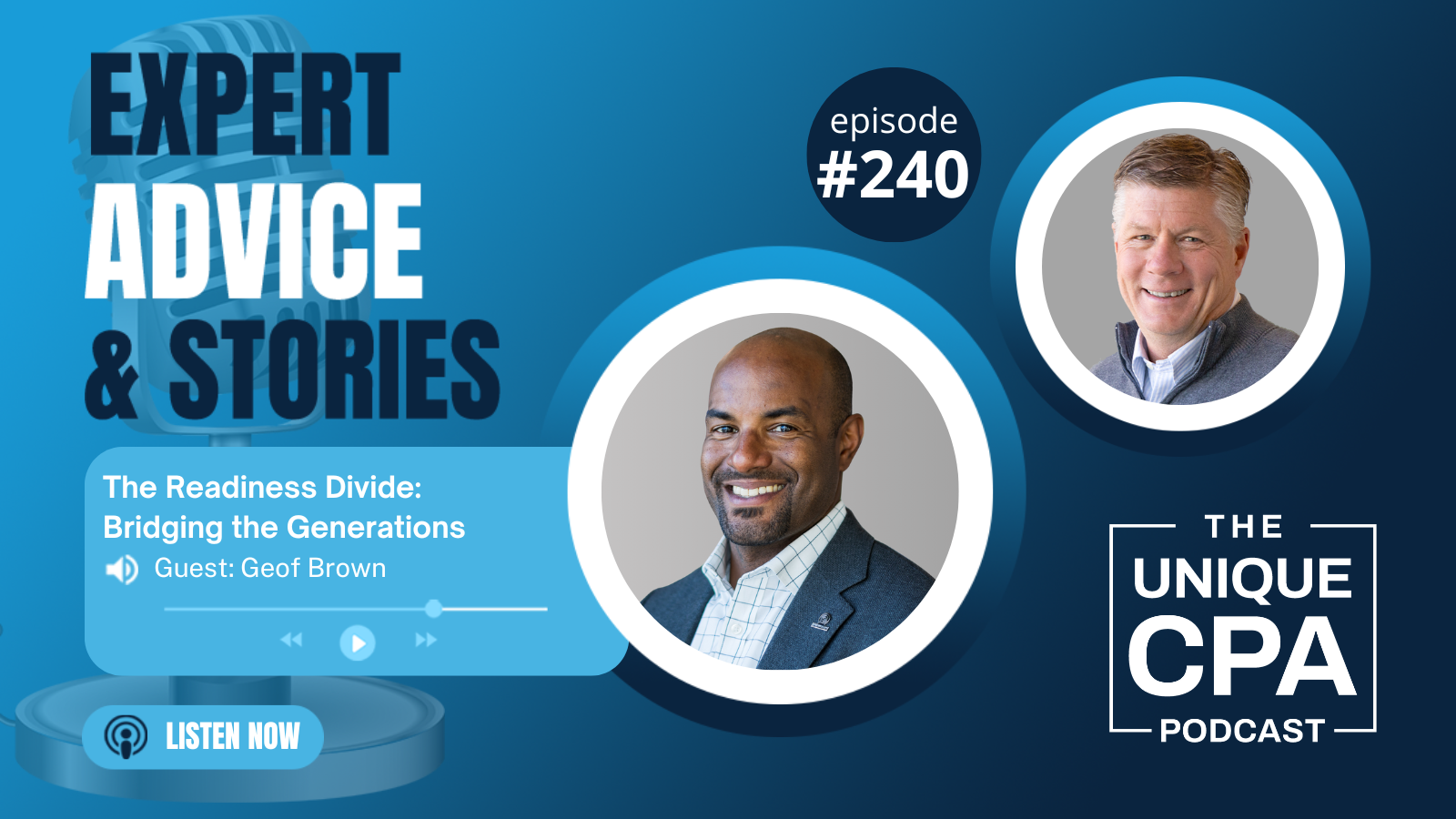
Bridging the Generations with Geof Brown
President and CEO of the Illinois CPA Society Geof Brown returns to The Unique CPA for Episode 240, bringing with him the results of a bold research initiative that set out to map the “readiness divide” between new accountants and their managers. Geof describes the moment when scattered frustrations from firm leaders, young professionals, and academics converged, prompting his team to launch a survey to cut through assumptions and capture real, useful, hard data. The results reveal a landscape where early-career accountants overestimate their skills, especially in communication and professionalism, while managers struggle to deliver feedback that is actually feedback and not just criticism. Generational friction, missed signals, and the surprising gap between digital fluency and workplace tech are at the forefront of Geof’s findings, and he explores how mentorship, intentional onboarding, and a shift toward real-world skill-building can transform the profession, offering a blueprint for growth that’s as much about empathy as expertise, particularly as “soft skills” become ever more important tools.
Today I’m excited to have Geof Brown back on the show for, I think this is the third time. Yeah, we did one tape like this, we did one video version at the conference, and then we did this. Alright, I’m already breaking from my intro, but Geof is president and CEO of the Illinois CPA Society—very fortunate to become good friends with Geof over the last few years, great guy. The society, we call it—I never know which state is called what—the society does awesome things, and one of the awesome things they did was a recent survey called the Readiness Divide: It’s kind of showing this gap that exists between early career accounting professionals and their managers and highlighting those disconnects and figuring out ways that we can bridge, if I want to steal from a conference that I know, we’ll bridge the gap of those differences. I’ll stop rambling. Geof, welcome back to The Unique CPA.
It’s great to be back, Randy. You know, I had to talk the team out of using the phrase “bridge the gap” in the writing just for that very reason.
Well, I did see on the last page there was a bridge and then my mind automatically fills in “the gap.” But they did not use the gap version of it.
Bridging the divide was the term Derek used.
Okay. Alright. And you’re more than welcome. I don’t own the rights to “Bridging the Gap.”
It’s really good to be back, you know, this has been an exciting research project for us for so many reasons. When we conceptualized it, we were hearing a lot of data points from different audiences, and we knew that there was something to this. We were hearing from firm leaders and people managers that, “Hey, what’s happening on college campuses? “How come our entry level folks just aren’t ready to go?” We were hearing from entry level professionals that they weren’t getting the feedback that they needed to even start careers on a successful foot, and what help could we provide? And then we were hearing from the academic community, “Hey, why do firms and employers want us to do everything for their new hires? We only have so much space on the shelf in terms of what we have to teach, and they want us to get them CPA ready.”
And so with all those data points, we knew we had to dive into this. We went to a couple of different audiences just to figure out, what are we looking for here? And it was really around just uncovering those gaps, where the expectations and experiences didn’t align and any additional support that the early careerist would need, and we really wanted this to be one where we informed action. You’ve seen some of our other research reports where we throw a grenade into the profession and walk away. This was one where we wanted to kind of start a conversation, and we went into it intentionally with the focus that all of the audiences—so firms and employers, professional organizations like ours, the academic community, people managers, and especially that early careerist—everybody has a role in righting this issue.
Yep. When did you run the survey? Was it just recently? Was it in ’25? Was it a multi-year thing? How did this work?
So we started doing kind of focus groups late in ’24, early ’25. Put the survey together over the spring. We worked with Josh Herbert down at University of Illinois. He just happens to be a member of our board, really connected to next gen issues. He really helped us to get it research ready just so it could stand up to that rigor just in case we found an academic home for it. And so we launched the survey in the spring, it was open through mid-summer, and then we published the findings in mid-September and we’ve just been trying to socialize it ever since, and really looking for ways that we can insert the findings into the programming that we offer for young professionals.
That’s awesome. That is awesome because that is—I can’t help but use “gaps” now—that is a gap that we definitely need to bridge. Man, I’ve got to stop this. Because there is one, there’s a changing need in this profession of the skill sets that you bring in, and if we don’t start to identify that and find where we are short on it and how we have to get people to a level that they need to be, to really move forward, because we’re in an area now where with AI coming—I’m going on my rant right now, Geof. So with AI coming in and everything, a lot of these things that people were learning on, they’re not going to need to learn on anymore, or they’re not going to have to because that’s going to be automated for us. And so how do we accelerate that skillset that they’re going to need, identify what they’re going to need and then accelerate those. But that’s something obviously we’ll talk about when we go through this. Let’s talk about—that was just my rant, unless you want to comment on my rant.
No, I think you’re spot on. That was definitely one of our hypotheses when we went into this was that technology is definitely impacting the business in a way that those early career activities aren’t going to be there, so that young professional better be client- or senior business partner-ready at an earlier point in their time with whomever they’re working with.
Yep. So let’s go backwards now. So let’s just talk about key findings. Was there, I mean, can you break these into, you have like six sections, ten sections, or…?
Oh, sure. So we tested 37 skills with both the employers and the employees, and the employees consistently rated themselves much higher than their managers. So just some of our quick takeaways: The early careerists consistently estimated their readiness across all skills—overestimated—which somebody would say, that’s not new. In fact, a member of one of our boards said, “Hey, I started in this business 45 years ago and my managers told me I didn’t know anything and I thought I knew everything.” So not a new problem, but one we have to solve for now. I think the biggest place where we saw an issue was around their perceptions related to communication and professionalism. As we started to unpack that a little bit, the communication piece was really around not just what medium to use, but just form, function, comfort, which, not a new issue—if everybody were a good communicator, we would be in a very different place in this world. So it’s a place where we need to invest.
The professionalism one really kind of caught us off guard. And I think really what we’re dealing with here is some of that generational friction. We have five different generations effectively in the workplace together right now, and some of those definitions of professionalism kind of morph as you move through the decades. So I think there’s an opportunity for a hard reset, or at least some expectation setting, just so that early careerists, their managers, everybody knows what’s expected of everyone in each setting, and I think that’s a challenge that we haven’t even talked about with some of our early careerists. You could work at one firm, but report to several different people depending on what job you’re working on, what project you’re working on, and being able to shift your mindset at such a young age in the workplace is incredibly difficult.
Yeah.
But one that everybody wants to talk about is critical thinking and problem solving skills. Not new, but definitely exasperated. I’m not going to go on my AI rant, but I think that has definitely highlighted some of the shortcomings and being able to dissect information, deliver good insights, understand repeatable processes, things of that nature. The one thing we heard from managers was, “Hey, I have a new employee. They’re working on something. They could do it nine times, and then that tenth time, it doesn’t turn out the same way and they can’t tell me why.” I think that’s going to be an issue that we need to figure out.
Couple quick ones: Technological proficiency being low. We talk about this generation and them being digital natives. Yes, they’re adept at adopting new technologies. But when you think about the tech that they’re using in the workplace, for a lot of them, they’ve never seen some of these things before, and so, we’re not just talking about Excel proficiency, we’re talking about some of the tools that they use in the audit process, the tools that they use in the tax process, it’s going to be very difficult for them. So we need to level set and help them get up to speed as quickly as possible.
And then, the managers really thought that their early careerists, you could just dangle a dollar in front of them and performance would change. But for the early careerists, it’s really about “How do I learn and build new skills so I can have a long and sustainable career?” So that said to us that the profession, we need to invest in their development, make sure that they have the opportunities to build skills in a credible way before we put them to work. And I think that, given this post 150 world that we’re marching into and expanded experiential opportunities, it’s a great opportunity for the profession to lean back into that apprenticeship model and really create the capacity for people to learn on the job versus being put to work from day one.
And then I think the last one will be near and dear to your heart because of your focus, is this feedback loop. We heard from the managers, “Well, I’m telling them what they’re not doing right. I’m helping them develop.” And then the young professionals are saying to us, “I never got any feedback until I was getting marched out the door.” So that says to us that we need to step back and really think about how feedback is being delivered and creating some meaningful expectations so that people can grow, develop together. I think that’s how we’re going to make this relationship sticky. I think you remember we did that report writing retention a couple of years ago, and that was one of the findings from that as well. So we really need to dive into what this feedback loop looks like.
Yeah, a couple comments on those things: We do this survey too, the satisfaction survey in the profession, and we found the same thing with the dollars not being the incentive. And we did find that professional development was one of the highest satisfaction creators. So people want to learn these new skills, they want to be taught, they want to have this education part of what’s going on. So that tied in pretty well with what we found too.
I want to go back to a couple things: The one thing, it’s all these really, but communication. How important communication is, I think that’s one of the skills that is probably weak in general. And that’s one of the skills, especially if we’re going to go on our AI rant again, which I won’t. But now what we’re going to be tasked with doing is communicating the findings that we have and having these advisory type discussions with our clients, and so that communication is important. Is there a way to help? Are we coming up with solutions to increase the communication skills that people have coming into the profession or develop in the profession?
Yeah, I mean I think we’re seeing it on all sides, we’re seeing definitely in the academic community that they’re leaning into more kind of case study, presentation type scenario-based education. I know firms are definitely doing a lot of role play, case-based education and development early on. We think they need to start doing it as part of the internship process. Maybe giving them fictional client cases to talk through, role playing a little bit. How would you deliver that news? Just so that the young professional or potential young professional gets an idea of, “Hey, I’m not just going to be sitting behind a computer and looking at big data sets, I’m going to have to talk about the data sets.” And then I think for us, we just had our Young Professionals Conference last week, and the whole focus was supercharging your voice: Talking to young professionals about how do you deliver news, how do you manage across, up, down, and around the organization, but just letting them know that communication and being a good communicator is going to be a central component to their career advancement.
Yeah, I think that’s—I’ve been on a few podcasts as guests recently, and people ask me this question, what are the skills we need going forward? Communication, strategic thinking or critical thinking like you had in your report, I think are two of the keys. So let’s go on from communication—professionalism. How do we define professionalism? Do we have a definition for that?
It really, for us, we were thinking about it, it’s how do you show up in the workplace, how do you show up for your coworkers? We’re in this digital world, so I think there might have been, a lot of managers were like, “Hey, they’re late to meetings. They blow off deadlines. They jump on a Zoom, they don’t turn on their camera, and if they do turn on their camera, they’re sitting there in a hoodie, they may not have showered.” So it really has morphed a little bit. I was thinking back to my first job back in, you know, 25 years ago and I wore jeans to the office one Friday and an older coworker pulled me aside and she was like, “John is going to lose his mind when he sees you.” He was a Green Beret, former IRS guy, sure enough, he came in, saw me in those jeans and he did lose his mind, and he let me know about it. From that day forward, I knew what to expect. He knew what to expect from me in terms of how I was going to show up for work. So I think now we owe those early careerists a service. Let’s tell them when, whether it’s appearance or communication, whatever it is, work style, doesn’t meet the level of professionalism that we expect in the workplace. It’s going to vary team to team. It’s going to vary organization to organization. But if we don’t call it out, then they’re never going to know.
Yeah, and that goes back to communication in general or intentionality, letting people know, not assuming people think the same thing you’re thinking or understand what’s going on. I find more and more when I’m talking to people is that if you don’t truly communicate and understand that you are on the same wavelength when you’re talking, because you can have this one conversation that people look at two different ways. It’s just really digging into are we talking the same thing? Are we on the same page? Do we understand this? And this, it goes to communication. Because me as a 63-year-old boomer and someone else coming in at Gen X or something, you have different ways of saying things, so different ways of understanding things, and so figuring out words are important and figuring out that you’re using the words the same way. So communication, I can see that for sure.
No, I agree. We have a few Gen Zers on our team and occasionally I’ll go sit with them and just talk a little bit about, “Hey guys, what’s going on?” And the words we use are different. The mediums we use are different. I’m like, “Okay, if you send me a Zoom chat one more time, this long, we’re going to have a problem.”
Alright, so communication. Alright, so let’s… We talked about dollars and everything, but one last thing I want to talk about before we get into what do we do is the critical thinking or I think strategic thinking is the way I look at it. I think we’re talking the same thing. That’s a skill that’s needed, but there’s a gap there right now between where we expect these new hires to be and where they really are.
And you know, that’s one where we had to step back a little bit. We know where the profession is going and we had to say, firms and employers, slow your role a little bit. It’s not there yet. The academic community hasn’t invested enough in how they would help to develop some of the advisory skills on campus to get someone to quickly bridge that gap from college to career. So I think there’s an opportunity in the internship process, definitely in some of the programs that we’re doing from a student perspective of being able to highlight, okay, in the past you might have needed to be technically proficient early on and you would develop those advisory, strategic thinking skills over time. Well now, you need to be technically proficient and yes, you’ll be able to lean somewhat on technology, but you definitely need to understand some of that coaching, providing good data insights, drawing conclusions. And then I think the last one is part of being a good strategic thinker is asking good questions, and I think that’s an area where we can help young professionals develop very quickly.
Yeah, when you were saying this, I was thinking back to myself at whatever, 30 years old or younger, and I’m like, I never asked any questions. I never, I mean, I’m just like, “Okay, tell me when I’m supposed to do it. I’m going to do it.” The reason I was thinking that is because both of our kids, they’re in their early thirties now, 30 and 32. For the last five plus years, early on in their careers, they were asked to give presentations to the whole team. I never remember doing that when I was that young, and I was just impressed that, wow, that is amazing because I would not have felt comfortable doing that. So I think more of that is what you’re talking about. We just need to do, we need to challenge them to be, that’s their communication skills, theye’re showing their strategic thinking, it’s a great way to start getting this moving in the right direction.
Yeah. I think this audience really needs to take some career ownership and just really scan the landscape. A good place to start is with this report because it really does give them a blueprint of, “Okay, here’s what employers are looking for. Here’s what I know I’m going to get in the classroom. Here’s what I might get in an internship. So here’s the divide and I can focus on these things and find the places to get those skills, to develop those habits, those traits, and then, just find a mentor or a coach.” That can really help you navigate and understand, “I’m going to join Toastmasters” or, “There’s somebody in the business who is just a really great advisory focused professional. I just want to shadow them a couple of times to the extent that I have the opportunities.”
Right. No, that’s great. So let’s talk about then, how do we, I mean, you just said there’s some ideas, we shadow, schools are starting to change how the universities and how they educate and prep. What are things that we can do as a state society, as people out in the profession, as a manager, as an employee coming in, how do we start to… man, all I can think of is “bridge the gap,” but I’ll try to think of different words. How are we going to get the way people are looking at themselves and the way their managers are looking at to be more in line with where we need to be?
Yeah. I think for us, we’re really going to be focusing from a state society perspective on just that upskilling and learning component—that’s been our bread and butter. So I think we’re going to evolve our young professional programming from quasi-social to more, “Here’s an opportunity for you to get career ready or career enhancing, and we’re going to focus on these five areas.” And it’s going to be strategic thinking, it’s going to be diving into some of the advisory skills. You and I have talked about this, playing in that compliance education space is kind of boring these days. I want to make sure that our team understands that relative to this audience, let’s identify those career enhancing opportunities.
Then we need to make the case to firms and employers because they’re coming to us and saying, “Hey, our people don’t have these.” Well, guess what? We can provide it, but historically, you’ve only wanted to pay for technical education. You know what? Now’s the time to invest in your future workforce. We want to be a partner for that. We can also dive into the mentorship and coaching piece. Most firms and employers will say, “We’ve got a mentorship program.” Well, you might have one. But typically it’s performance-based and slightly corrective in nature, so it may not be that safe environment where that young professional can just open, expose themselves if you will, and say, “Hey, I’ve got some shortcomings. I need your help.” We want to make sure that we’re providing those opportunities.
For the last couple of years we’ve been running a fellows program with some alums of our Mary T. Washington Wiley internship prep program. We’ve been testing some of these things out, just how do we put them in situations where they can test their communication skills? How do we put them in situations where they can have mentors and coaches that aren’t from their organization so that they can be vulnerable and get experience asking for feedback when they may not be comfortable receiving it? Things of that nature. And then, I definitely think that employers need to rethink onboarding experiences, to focus more on, “Here’s where the bathroom is, this is your insurance program,” to really setting those expectations, building confidence in their new hires from the start, making them understand that, “Hey, this is a place where you’re not only going to contribute to organizational success, we’re going to invest in you as well.” I always say around here that no matter how somebody walks through the doors of the Illinois CPA Society as a staff member, when they leave here, whether they leave on their own or because we ask them to, we want them to be a better professional when they go out the door. So I think every firm and employer needs to take that same mindset.
I think that’s a great mindset. I was just going to ask you about onboarding’s role in this process. So it looks like this is an area where we obviously can set the right stage of expectations and also openness, because I think sometimes part of it’s just openness, people, new staff don’t feel comfortable asking certain questions or they’re afraid to look like they don’t know something, you know what I mean? “Oh, I can’t ask that. I think they think I know this already, so I’m just going to have to figure it out myself.” For me, and you’ve heard me talk on things, but vulnerability in leadership is so important. If you have vulnerable leadership, it really will increase every aspect of what we need to do when we’re doing this. That’s one of the things, because if I’m not willing to say I made a mistake or I don’t know something, why would anybody that works with me want to say, “I don’t know this,” or “I made a mistake?” So for me, that’s one of the key things that can come out of changing the process of how we bridge this gap—I can’t help myself—bridge this gap here.
I really do think there’s a real opportunity for the profession. You spent a lot of time in public, at larger firms before you started your own shop. Not everybody should be a people manager. There are a lot of professionals out there that will excel professionally because they are so technically adept that they’re indispensable to the organization, indispensable to their clients, but that may not make them the best people manager. We’re also at a weird point where I think we might be asking a lot of that first level of management. A lot of them started in firms during the pandemic, so they may not have gotten the support and the training or the experience that they needed to pay it forward the way they should be right now. So one of the things that we’ve been toying with is, we talk a lot about how do we do programs for partners, how do we do programs for our early careerist. We need to do programs for that first level manager. Yes, most firms do a great job of giving them Management 101, but I think we can go a little bit deeper, and it’s probably some of the same issues of, “I don’t want to sit in this room with everybody else that’s in their first management role and ask the question that’s going to expose me as potentially not being ready for this.”
Oh yeah, nope, that’s for sure. I recently had Alan Whitman on, and Alan was talking about the management training they did for pretty much everybody in that organization. They were a big organization. I don’t think we do that. That’s so important because, yes, like you just said, “Hey, I’m great at tax returns,” that doesn’t mean I’m great at leading people. It doesn’t mean you can’t get there. But how do you know how to do it unless there is some kind of program in place or watching a mentor. So I think putting those programs where everybody gets leadership training is super important.
Now we’ve got this, we’ve got the data. We know where these differences are. We know where people need to increase their skillset, or at least their ideas of where their levels are compared to where their managers think. What’s the outcome? What do we get when we fix this? What are we trying to solve then?
I think this is going to forever be a work in progress, until we have the systems and structures in place where this becomes the norm, not the exception. For now, the best first step for us is that each of those audiences accepts the shared responsibility for closing the readiness divide. That means that we look at our own organizations, we look at the experiences that both our people managers and our early careerists are having, and understand where we have opportunities for growth, change, and development. For an organization like ours where we don’t have the early careerist, how do we insert ourselves into the conversation?
So for me, when I’m sitting across from a managing partner or a controller or a CFO, it’s going to be like, “Hey, we’ve got this blueprint for how we can help your early careerist really understand where they fit relative to that peer group and how we can have some developmental experiences to help them excel.” Same thing with that early management group: “Here’s some things that we’re hearing from the people that may be reporting to you. We don’t know if they actually responded, but I guarantee you have someone who is feeling this way. Maybe stop and have this question instead of doing this, do that.” So it’s just really highlighting where our opportunities for change are, and we want to do that just by being a catalyst for conversation. That’s really our objective here.
We’ve got a great team that helped me bring this idea to reality. They’re all bought into it, every group that we’ve had a conversation with—back in September we had a group of managing partners, people managers, and early careerists that just came together for a great conversation around, “Here’s what we learned. Is this your reality and what are you prepared to do?” There were a couple of things from that stood out for me that I’ll share with your listeners, Randy. One, this young man said, “Hey, when I was an intern, they told me I was the greatest thing since sliced bread. And then when I got into the firm, they told me I couldn’t breathe right.” So it’s really, how do you unpack that?
Then this one young woman said, “Don’t they even remember what it’s like to be new?” So instead of doing what we observed, let’s put ourselves back into their shoes and think about, how do we help them progress in their careers, build the skills that are going to be essential for the future, and just really thrive? Because everybody remembers the manager that took the time to invest in them and to help them think about being intentional in their careers, and that’s what we want all these people managers to be.
And I remember that person or persons for me too, so I completely agree on that. I think this is great. I think what you’re doing is amazing: Multiple surveys in the last few years, you’re coming up with some great data. And what it’s going to do ultimately is, I think what we all want is we want this profession to be the greatest profession it could possibly be. This go-to profession when people are in high school, they think, “I can’t wait to be an accountant, this is what I want to do.” Just changing that perception in general is important, but we have to start by fixing the realities of the differences, the readiness divide. That’s what I should have been saying the whole time, the readiness divide. So I appreciate that. Any final thoughts on that before we close up with a couple things?
No, this was just a great opportunity for us and thank you for highlighting the research that we’ve done. The team did make me promise that this would be the last one for the year, and since it is, we’re late in the year, we’re definitely not doing any more for 2025, but we’re already starting to formulate the things that we want to focus on in 2026. It’s really just about how do we make this workforce and the future workforce the best that it can possibly be. Careers in accounting can be huge difference makers for anyone that wants to take on the challenge and accept the opportunities.
Yeah, I’ve been saying this a lot lately. A friend of mine, Jennifer Wilson, at our conference called us, and I think it was when you were there, called accountants “The Guardians of the Galaxy’s Economy.” I just love thinking about it that way.
She’s full of one-liners!
Oh yeah. She definitely is. But if you look at the profession that way, it’s like, wow. That’s a cool profession. I want to be part of that. Now I’m stealing Bob Doyle’s “coolest profession around.” But it can definitely be that. So, before we wrap up then, we did this on the first episode you were on, not the second time because that was a video version. But I always ask our guests, we talked about all the cool things you’re doing in the profession and helping, but when you’re not thinking about the accounting world, the CPA world, what do you do for fun?
Oh wow. Now I’m really focused on spending as much time with my family and friends as I possibly can. I’m late 40s, my parents are getting late 70s, I have one grandparent left. I’m pulling back from a little bit of the career focus to spending a little bit of family time and then still like diving into travel. I just want to see a lot of places—my dad said to me and my sister and my brother, “Don’t wait until you retire to experience life. You all have the resources, hopefully you can find the time. Some of the things that you would’ve said you want to do in retirement, do them today just so you can enjoy it.” So those are the two big ones. Still taking a break from marathoning, my body said, “Hey, dial it back a little bit.”
I was wondering!
I sat Chicago out this year, but I’m plotting my return for 2026.
Alright. Well, nice. And then if people want to find out more about the survey or download it or about the society, where would they look or you personally, where would they look?
You can find us on our website, www.icpas.org, and this survey and the report are right on the front page.
Alright. Awesome. Well, Geof, thanks again for being on The Unique CPA. It’s always a fun conversation and appreciate everything you’re doing.
Alright. You too, Randy. Thank you.
About the Guest
Geoffrey “Geof” Brown, CAE, is president and CEO of the Illinois CPA Society (ICPAS), one of the largest state CPA societies in the nation. Geof also serves as president and CEO of CPAs for the Public Interest and ex-officio board member of the CPA Endowment Fund of Illinois. In 2024, he was named to Accounting Today’s Top 100 Most Influential People in Accounting list for the second year in a row. A seasoned certified association executive (CAE), Geof has more than 25 years of experience as an association professional. Before joining ICPAS in 2022, he served as CEO of the National Association of Personal Financial Advisors (NAPFA), the nation’s leading professional association of fee-only financial advisors, for nine years. Prior to NAPFA, Geof was an account executive with Sentergroup, an association manager at SmithBucklin Corporation, and held multiple positions with North-American Interfraternity Conference.
Geof served as the board chair for Association Forum and is an active member. He also serves on the American Accounting Association Foundation Board of Trustees, is an active member in the American Society of Association Executives, is a member of the Certified Association Executive Commission, and is a board member with the AIDS Foundation of Chicago and HR Source. Geof earned his bachelor’s degree in government and politics from the University of Maryland.
Meet the Host
 Randy Crabtree, co-founder and partner of Tri-Merit Specialty Tax Professionals, is a widely followed author, lecturer and podcast host for the accounting profession.
Since 2019, he has hosted the “The Unique CPA,” podcast, which ranks among the world’s 5% most popular programs (Source: Listen Score). You can find articles from Randy in Accounting Today’s Voices column, the AICPA Tax Adviser (Tax-saving opportunities for the housing and construction industries) and he is a regular presenter at conferences and virtual training events hosted by CPAmerica, Prime Global, Leading Edge Alliance (LEA), Allinial Global and several state CPA societies. Crabtree also provides continuing professional education to top 100 CPA firms across the country.
Schaumburg, Illinois-based Tri-Merit is a niche professional services firm that specializes in helping CPAs and their clients benefit from R&D tax credits, cost segregation, the energy efficient commercial buildings deduction (179D), the energy efficient home credit (45L) and the employee retention credit (ERC).
Prior to joining Tri-Merit, Crabtree was managing partner of a CPA firm in the greater Chicago area. He has more than 30 years of public accounting and tax consulting experience in a wide variety of industries, and has worked closely with top executives to help them optimize their tax planning strategies.