The Power of Pay Transparency
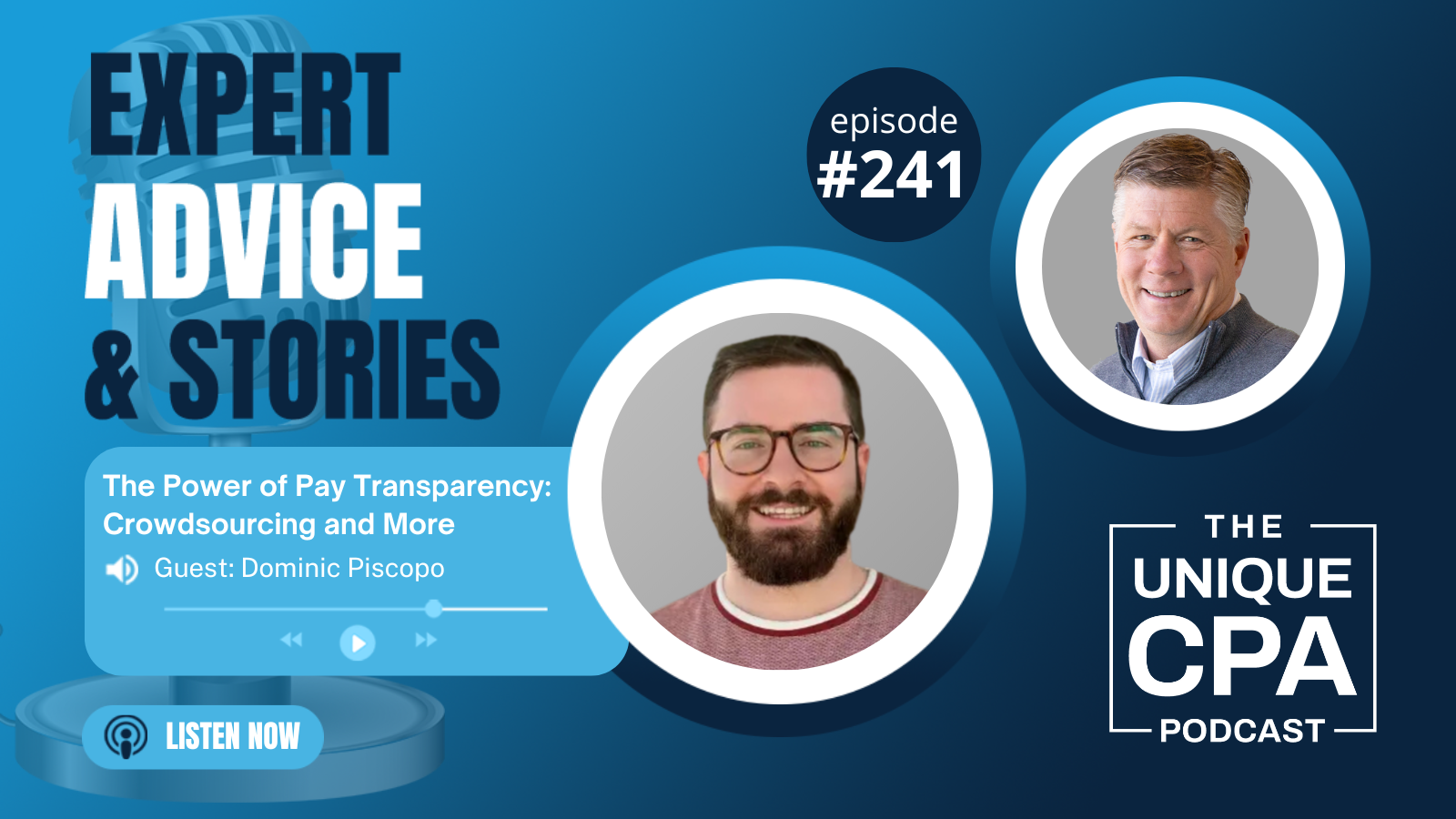
Crowdsourcing and More with Dominic Piscopo
Dominic Piscopo didn’t set out to disrupt the accounting world, he just wanted to know if he was being paid fairly. That simple question led him from pen-and-paper salary surveys at Deloitte to building Big 4 Transparency, a crowdsourced database now relied on by countless people in accounting. On Episode 241 of The Unique CPA, Dominic talks to Randy about how a weekend project snowballed into a vital resource for accountants, empowering individuals to advocate for themselves and helping firms confront the “loyalty tax” that drives talent away. He outlines the surprising power of open data, with openness a key to why he refuses to put a paywall between accountants and the information they need. Dominic has pushed through the challenges he’s faced in the project with trust and accuracy in the data and has ultimately forged a truly useful tool for the profession.
Today’s guest is Dominic Piscopo. Dom is founder of Big 4 Transparency and the host of the Big 4 Transparency Podcast, which I was a guest on in the past, which was a lot of fun.
An early, pivotal guest.
An early pivotal guest? Oh, wow, I get pivotal? That’s pretty awesome, thanks for that. In just four years, he’s built a crowdsourced pay database of over 20,000 records and has become the place over 300,000 professionals go to for compensation data. Dom, welcome to The Unique CPA.
Yeah, thanks for having me! It’s a pleasure being here and you’ve given me some opportunities to speak in the past, including Bridging the Gap, which I appreciate as well. So thank you for everything, Randy.
Yeah, I was just going to mention that it was pretty cool having you at Bridging the Gap. We did a couple things there: You were on our lunchtime survey data release panel with Seth and Hank, and you had some great insights to add to that, so I appreciate that. Then you were on another panel. What was that panel you were on?
It was a very confusing layout, but I was super happy with how it went. But it was like, return on relationships, and I was representing the return on investing in the relationships that you have with your employees, both financially and from a lifestyle perspective. So we did return on relationships with that, return on relationships with your clients, which is Rory’s area of expertise, and then we looked at an operations lens as well with Ashley.
Yeah, that’s right. I jumped in there for a while and saw what you were doing. That was pretty cool. That was a powerhouse panel there, so thanks for doing that. Alright, so let’s get into this today, because this is pretty cool what you’re doing. I’m still learning about it, so the fun part about this podcast is I get to learn as I talk to people. So let’s go into the whole, obviously I know there’s a database, I know it’s pay data, but before we get to the mechanics of it and everything, just the origin story, the history, how did this come about and what was that need you saw out there?
Yeah, for sure. From the get-go, I was probably a little bit of a rambunctious CPA. I was working at Deloitte in tax. Pay, right off the start for me was a bit of a sticking point. Throughout university I was making a lot of money as a university student. My first summer before university, I had done credit card sales, I was working at a very, very trendy bar where I could do quite well, I was DJing weddings and special events. And so I was going into this career, right as a co-op student, thinking, “Oh my God, I’ve made it. This is cool,” and I found myself making less doing that than any of those other things I had been doing. That really freaked me out in a pretty big way. Honestly, I had a great team. I liked the work. It was interesting. Pay was a huge sticking point, and it was kind of a crushing thing. When I got my full-time offer, I was really freaked out—and I’m in Canada for comparison’s sake as well.
We can hear!
Where salaries for CPAs are quite a bit lower. And so I was really freaked out about that, I was always pushing the envelope of that, and eventually I found out that we had fallen behind what the starting offers were for basically everyone else in the city. I found that out just by asking everyone, pen and paper, and I presented that to the managing partner who, to his credit, he really took that seriously, brought it up the chain, and we actually got an adjustment to our whole cohort, so we got a pretty decent percentage-wise salary increase. I realized, hey, comp information and advocating for yourself and just knowing what’s out there is super important, and that was at one of the places where they’re the most on top of that—the big firms with the big resources, they have people who are monitoring that, and it still kind of fell through the cracks. It wasn’t even an intentional thing. As soon as they realized we were under market, they were like, “Oh my God, we need to address this.” Which again, a huge shout out to the partner in question for being open-minded and not taking that the wrong way and actually having a real discussion about it.
So that was always in the back of my mind. I stayed at Deloitte for a couple of years, and then after I left, I was working as a controller for a small startup with quite a famous entrepreneur where I’m from, and the job was not for me at all, but I started getting inspired and really interested in the world of entrepreneurship. The no-code movement was picking up at the time, which is the ability to build all these tools and websites as a non-technical person. I was looking at what can I build that people actually need or will want? A huge issue is people build these exceptionally cool things and they just launch them into the void and then they never get used. So I was, “Okay, no business plan, but I just want to build something people are going to use.” On Reddit, I was always seeing these discussions, Reddit and Fishbowl, of, “Hey, am I underpaid?” and there would be a bunch of responses that weren’t necessarily one-to-one comparable, and then those discussions would just disappear, and the next day there’d be a new thread of, “Hey, am I underpaid?” It seemed like something we should really just centralize, and instead of having all these one-off discussions, why don’t we put it all into a database?
So I built that. It was just a weekend project and it got some pretty decent traction right off the bat from people on those platforms. Ultimately, what really kicked things off was a month or two in, some people had tried to access it from their networks at work and found that the website was blocked. Some people shared that was the case and that seems to have kicked off a real nerve and a sense of “us versus them,” which is never actually what I wanted out of this website. I just wanted to build a cool tool. But that fueled this urgency of, “We need to do something about this,” and that really blew it up. After that happened, I’d log into the spreadsheet, there’d be 80, 100 people concurrently in this spreadsheet looking at data, and I was like, “Wow, okay, we have something here.”
For about a year and a half after that, maybe two years, I just maintained this as a community tool, free access, there was no means of monetization. I had no idea what to do about it as a business either. Then, there was a critical mass reached and there were enough people coming to the site that I was like, okay, let’s try a couple things. There was a job board, which I eventually killed off, a newsletter. Then I started having firms reaching out to me, asking, “Can we download this? Are there ways that we can manipulate the data that might be more effective?” That was the obvious signal to me that I should start building some tools around this. We started off with a very small firm out of Quebec was my first client ever. Brandon Hall, whose firm later came on as an investor, was an early supporter of this. And my third or fourth client ever was one of the Big Four. When I onboarded the Big Four, I was like, “Whoa. This has now become a real business. I have to pay obscene insurance premiums to get this crazy business insurance to be able to work with this big of a firm, at their request,” and I was like, “Well, I’m already paying this much for this crazy business insurance. Let’s try and keep this ball rolling. Now I have the structure in place.”
Since then, I’ve been working on it. In September of 2024, I was able to leave my job. I did a very small fundraise to help support me, bridge that gap of where I needed to be financially to work on this full time. I haven’t really looked back since. Then we launched the podcast because I realized I wasn’t connected to people in the community, and I was in the Big Four silo for sure when I was there. These big firms have so many resources and they’re exceptional that you basically don’t ever look outside of what they’re feeding you, so you really lack the broader understanding of the industry. The podcast helped me understand, oh, this is actually what’s going on in accounting. So that’s been my journey so far.
The podcast, since you’re bringing that up, you’ve had a lot of really good guests. I’m not saying that just because I was on it, but every time I see another post out there, it’s like, wow. So you’ve really ingrained yourself into this community outside of the Big Four where you were siloed. Are there episodes that really helped you with this business, that fueled the growth, the passion, or just memorable episodes you had?
Yeah, there’s definitely a few. Brandon Hall, initially he was a client, and I brought him onto the pod as an early guest, and that one helped me get a lot of traction. He’s a pretty big name and people really liked to hear what he has to say. That started this ladder of, when you ask someone to be on your podcast, I’m sure you get requests all the time. It’s kind of like, “Is this a serious podcast? Is this going to get listened to three times” or whatever? So it’d be like, hey, we’ve had guests like Brandon Hall, and then later it becomes, we’ve had Randy Crabtree, we’ve had Frank Longobardi, and you can keep booking exceptional guests because you’ve had these exceptional guests and it’s like a proof of concept that it’s worth your time to come on this podcast. That was really helpful. The episode I did with you was super helpful, genuinely, because I feel like it unlocked this world for me. I didn’t know all the things you had going on. I didn’t know all the things Seth Feinberg had going on and it was like, oh, you’re in this little bubble now, and you can be more meaningfully connected to these people and get involved in the things that they’ve got going on as well.
Those were big ones, and then there are a few that really opened my mind to firms and how interesting that is as a business model. Sometimes I could see a next chapter for me being to start a firm one day, but I had a couple people that I managed to catch in the first three months of starting their new firms and talk to them all about that—that was really cool, actually. I found it really interesting and then expanding the horizons even beyond, you don’t just need to do accounting. I had Craig House on, who does accounting plus wealth advisory, then I spoke with Rory and an increasing number in that space and you’re like, oh, accounting can actually be a wedge into other business opportunities as well. So it’s been really cool. A lot of these episodes, I learned a significant amount of things about accounting.
Nice. Well, let’s go back into Big 4 Transparency, ‘cause I’ve got a lot of questions about that. It’s crowdsourced, so the data you get, where are you getting the data, and then what data do you collect? I’m guessing there are multiple things that you ask about, right?
Yeah, a ton of things. The way I built the flow of submissions, it’s completely anonymous. The test was if someone gave me a million dollars to hunt down who put something into this, would I be able to find them? And I wanted the answer to be no. There’s a whole cycle that removes the trace of the Google account of who put it in and everything gets registered under my Google account basically, and then is submitted to this. I’ve changed this a little bit at the beginning; it was just, go to the website, here’s a link to the spreadsheet. Now I go to the website, you can view it a certain way, but if you want the full view access, you need to make a submission. We collect the data that way. Just from having all of this data, people want to see it in their chosen format versus just the built-in search functionality on the site, and being accountants, that format is generally they want to see a big spreadsheet of everything and just filter it that way.
So it’s been like that, and there may be a lot of people who might be quite informed independently of compensation and they just want to share on here to help drive the profession forward, help people advocate for themselves, help people understand. Again, I never want this to be an oppositional thing, I don’t want this to be, “Oh, he’s exposing the secrets of the accounting firms.” No, I think it’s good for everyone. I’ve jokingly used this line before, but, “Get more partners on jet skis, let me see that the pursuit of that is worthwhile.” I can do the math, I’m a CPA, I can do the math of, does this actually pay off? Is it worth the long hours? Is it worth the lower starting pay? Is it worth it? So I think having clarity on this stuff actually only benefits literally everyone on all sides of this.
Yeah, I agree. The transparency aspect of the name and what you were just saying, I think we’re so bad as a profession of showing what it means to be a partner, not just from the work side of things, but from the pay, because the pay can be very large. I don’t think most people understand that. I mean, you probably know better than me, but in larger firms, having pay over a million dollars a year is not unheard of. It’s probably common in a lot of places.
Yeah, it’s absolutely possible for sure.
So let’s go back to the data real quick. These people are anonymous, you’re not getting names or anything. Is the only thing going in salary or is there additional information?
So that’s evolved over time as well. There are a lot of fields, but we try to be quite selective and make sure it won’t take you more than two, two and a half minutes to fill this thing out, because otherwise there’s a pretty big drop-off rate. But yeah: Salary, bonus, with the advent of ESOPs in firms, we started collecting data on equity grants as well, whether people are in office or remote or hybrid, which has been really interesting to look at industry trends. For example, over the last two years, full in-office has overtaken remote roles—remote roles are on the decline, quite significantly, being replaced basically entirely by fully in-office roles, whereas hybrid has been steady.
We have whether this person’s an internally promoted employee or an external hire, which is one of my favorite topics that I harp on. With that we can look at trends of the loyalty tax. There’s this phenomenon in the accounting industry that’s a big lose-lose for everyone, in my opinion, where you can get paid a lot more if you leave firms. I think that all boils down to not having confidence in the data that you’re using, which obviously is a great sales angle for me, but I think ultimately, this is a really bad thing, where you’re willing to take candidate feedback or pushback or whatever that is during the hiring process and increase their salary, but then what happens is they become very dissatisfied over the next two to three years as you try to bring them back into salary band, and they get really bad raises over the next little bit. Other employees who are working at your firm who have been loyal employees are probably going to find out about that and be upset about it. This all comes from adjusting salaries as part of the hiring process, but not keeping up with market salaries internally. That’s a huge issue for retention, and so the employee finds themselves underpaid, and the incentive is for them to leave, which is bad for them, and it’s bad for your firm because you’re losing great talent who might otherwise be completely happy.
And these aren’t small spreads, it’s like 10.5% for a first-year manager or something like that. At a certain point you’re like, at the stage of life you’re at as a manager, maybe I’m looking at buying a house, maybe I’m looking at getting married, maybe I’m looking at this or that, and hey, an extra 15 grand a year in my pocket, I might be willing to just leave this place that I otherwise love for that, and in the process, firms are bleeding money through recruiter fees, they’re losing money through training. I think training and the cost of change is probably just increasing because tech is playing a much larger role in firms. When you change from one tech stack to the other, it’s not just that you’re filling out the same form in both places, no, there’s a whole process flow you have to learn. You have to get used to that. I think the whole industry would benefit a lot from more confidence in your numbers and reducing that loyalty tax. But the trend is that it’s actually just been increasing.
Has it really? Yeah. I’ve talked about this before, but we don’t have much turnover in our organization, and I don’t know if we specifically do what you’re saying, just make sure that the salaries are in range. I think it comes down to the culture aspect of things as well. The positive aspect of it is that the cost of turnover is outrageous, and so to be able to keep somebody, and you may have to up their salaries to be in line with what they get somewhere else, but if they’re happy there and that’s the only reason they’re leaving, there’s no reason. The cost to you as an employer is going to be a lot less than replacing that person. So getting that in line, that alone, I’m subscribing today. Give me your subscription code, I’m going there.
Perfect! Yeah, and we’ve spoken in the past, your firm’s a little bit different where it’s like, well, I can support you on the accounting side, but you hire a lot of non-accountants, which is a little bit tricky because again, that’s the beauty and the drawback of being such a niche offering is, oh, I want to know what to pay my salespeople, and that’s something we might work on in the future, but I want to be exceptional at the accounting part of it, so we’ve really prioritized that.
So let’s go, and I’m glad you brought up that loyalty tax because that is a big deal. If you can solve that and fix that for firms, that’d be huge. But let’s go back into, now we got the data from the employees. One question on that, because it is all anonymous: How do you verify the accuracy of what’s being put in?
Yeah, that’s where I talk about the critical mass of data. You need a lot of data to be able to trust crowdsourced entries, and once you have a very large corpus of data, it’s possible to—and we do this before we push any of the data to firms—but we subject it to statistical analysis. Anything that’s beyond a certain range in terms of being an outlier, we’ll remove,. And we try to explain the outliers, like for example, for tax, people with a JD are their own category. You’ll have a tax analyst making $115,000 and you’re like, I don’t know about that, and every time you look, they have a JD and you’re like, oh, that makes sense. Once you have enough data, you can do quite in-depth analysis on it to validate it. Most people are truthful just on account of, you can look at this data without making a submission. I think that’s a huge mistake some of these crowdsourced platforms make, they’ll unlock by making a submission and it’s like, well, I’m just going to punch in whatever. For us, there is an opt-out where you don’t have to share your data. That’s a huge help already. Because we have so much data, we’re able to go through and be like, okay, this one doesn’t really make sense, whether it’s real or not, it’s not going to be helpful to people to look at this, so we’re going to remove it, things like that. A lot of work goes into standardizing everything as well, because we wanted this to be inclusive to people at smaller firms or smaller communities and things like that, so you can’t just have a dropdown of, “What’s your firm name?” You’ll get KPMG, KPMG LLP, KPMG Tax Group, and you have to standardize all of that to keep the data searchable. Definitely a lot of work goes into maintaining this database for it to continue to be usable and helpful, but once you have enough data, you can really subject it to analysis and remove data.
Makes sense. The people that are putting their data in, there’s no fee to them to do this, right?
No. No, no, no. So everything’s free from a user perspective, and that to me feels like my duty back to the community. Without the accountants who are willing to share, to build up this database, and I’m like, this’ll be whatever we make it to be, but without them, there’s nothing. When I mentioned I had done a fundraise last year, some people were like, “Oh, just paywall this and this’ll be a huge revenue generator.” I was like, “I can’t do that.” That was the end of the discussion. They were like, “We’d be interested in investing if you’re willing to do that.” I was like, “That’s okay. On to the next,” because that’s a hard stop for me, because I kind of owe it to the community to help them. I’ve just facilitated this, I’m not the only reason this exists. It’s very much a community effort.
Okay, so you are doing this as a living now, so there has to be revenue somewhere. How does that end of things work? I assume firms subscribe to the data? Give us more information on that.
There is an advertising element on the newsletter with about 7,500 readers. The podcast has sponsors as well, most of the time. Not all the time, but we try to.
Well, look at you. I haven’t had a sponsor. Well, Tri-Merit’s my sponsor of this podcast. But, yeah, that’s pretty cool.
Yeah, no, I’ve had some really great recurring, super supportive sponsors, which has been awesome. And then in terms of monetization through the data and through the platform, you can open this spreadsheet, and then we have this thing called temporary filters that you can do to access the information you are looking at, but you can’t generate a report, or download the data and do super in-depth analytics of your own—which is essentially what I share on the newsletter. I’ll do the analytics for the people and I’ll share it that way, but you have limited access on that front, and that’s a paid subscription for firms. So when they subscribe, they get access to this dashboard that sits on top of the data that’s not otherwise available that makes navigating the data super easy.
You just select what you want in terms of a sample to be benchmarked on, and then it’ll auto-update all of the tables, all of the charts to give you the 25th, 50th, 75th, 90th percentile of every range of experience, then you select what stream you want to look at, what time period, what geography, and then it’ll do the work for you of setting up your broad salary ranges, and then from there you can go, “Now give me first years of each level. Now give me second year, now give me the third year of each level,” and it makes it a lot easier. If I’m an individual and I’m in Parsippany, New Jersey, and I want to understand what I should be paid, the temporary filters are enough because you can go in and look. But if you’re a firm and want to understand what’s going on in the market, it’s going to be challenging, intentionally so. And these tools help.
You also get access to the raw data in a downloadable format, so you can do your own in-depth analysis on it. Then there’s the talent pool, because so many accountants come to the site, we’re kind of like, I’ve hated the recruitment process in my experience. It just feels like recruiters calling me, trying to convince me that I’ll never do better than this role they’re offering that’s not at all what I’m looking for and maybe has terrible compensation, so I kind of flipped that model on its head. I said, why don’t we just fill out this other spreadsheet? Basically it’s an intake form and it just says, “What would you be willing to leave your job for, essentially?” They fill in a bunch of fields, takes about a minute, and I have about 450 candidates in there as well. We cross-search that against opportunities with the firms that we’re working with, and we will only contact the person if we have a match, so if we have something that matches all of the criteria they’ve put in, and then we’ll charge a 6% placement fee if the hire is successful. So that’s also part of how we monetize this as well. When the PWC layoffs happened, there were a ton of people coming to the website for that, and we were able to make some good introductions on that front. A lot of them didn’t necessarily result in a hire, but the whole point of this is, this is no obligations deal flow, and you’ll only pay if it works. So that’s part of it as well.
Nice. Alright, so then obviously there are going to be more benefits out there than I’ve already asked you about. What else are you seeing? Are there things that you’re seeing this type of data help out there in the field?
One of the biggest things about wiping out that information asymmetry, where historically these HR tools have only been accessible on the employer side, but because employers can access this and the employees are already accessing some version of it with the same data you’re looking at, there can be a lot more alignment of expectations, which I think can lead to much better discussions when it comes to performance evaluations and compensation time. I’ve actually written about this, but to me, in the past, compensation discussions have usually just been an upsetting thing by all accounts where, “Here’s what we’re giving you,” and it’s just in a vacuum. And it’s like, “I’m not happy about that number,” and it just ends there where “I’m not happy about it, they’re worried that I’m going to leave,” versus if that discussion can take a different shape of, “Here’s what we’re offering you. We’ve done the homework, this is at the 75th percentile.” Then the discussion becomes, if someone’s not happy about it, “Okay, but I think I’m a 99th percentile employee. Let’s talk about that.” There might be this disconnect in how I view my performance and how you view it: “Is there something that I’m not communicating properly to you? Are there weaknesses in what I’m bringing to the table that I should be working on between now and the next time we revisit my compensation that might get me to that point I want to be?” Or again, “Here’s what we’re offering you. That finds you roughly at the 50th percentile or the 40th percentile,” and if the conversation just ends at the number, you might not be uncovering certain things. Whereas if it’s, “Here’s how we’re benchmarking you, it’s around the 40th percentile,” it’s, “Okay, that’s not where I want to be. Are there things I need to be working on? Is this a company performance issue? Are there things that I can spend time on that might be a bigger driver of value to the company and can justify me moving up that scale?” But there needs to be that mutual trust and understanding of, this is actually where you stand in the order of things of relevant samples of salaries to you. And I think that can drive much better, much more productive discussions rather than, “Here’s your number, I’m not happy about this, I might leave and that’s it.”
Alright, so at the beginning we did talk about the panel we had at lunchtime at Bridging the Gap where we were sharing data that we’ve collected, but you had some amazing data that you were able to share. Do you actually do a survey to collect that? Or is that data you’re just collecting already through this process of crowdsourcing?
Pretty much everything is based off of what I’m already collecting on crowdsourcing, and sometimes you need that kind of inspiration or the “spin” on what you’ve collected to result in that being an actual finding. So again, the loyalty tax stuff took a bit of digging, but as I was going through the data, I noticed these external promotions seem to be making more, which is kind of odd, or they seem to be an outlier when compared to the overall population, but then amongst themselves, they’re all consistently high. And that’s where you can find these conclusions from digging a little bit deeper in the data. I actually, this morning, just had something come to me that I was like, “Oh, I’m going to look at,” and that is, “Is the industry pay bump dead?” When I left the accounting firm I was at for an industry role, I got a 40-ish percent increase in salary at the time. But public accounting salaries have moved up pretty massively in the interim, and I feel like industry salaries have maybe stagnated.
So we collect a little bit of data on industry roles as well for accountants, and you can cross-reference those and come to those findings of, oh, interesting, you used to be able to jump as a senior to industry for a 40% pay bump—that’s actually maybe now 15%, and it actually makes a lot more sense now to stick it out in public accounting and things like that, right? So that’s what’s really nice about collecting a wide array of data, and as things change, you start collecting new fields. We had a client come on who specifically recommended that we should start collecting data on billable hour targets for the year, because they’re like, “Well, we feel like we’re really good on this front, but we’re not 100% sure. Our compensation philosophy is we’re going to pay maybe around the 50th percentile, we’re not going to be excessively competitive on pay, but we’re pretty sure that we put much lower demands on employees, but we need the data to be able to hypothesize that or to prove that out properly.”
So that’s what’s nice about having very rich data, you can go in and sample these. I have done a couple one-off survey polls on the newsletter, but it’s tough to find strong conclusions if you have 100 responses or whatever that might be. So what’s nice is when you’re on an ongoing basis collecting all these fields, at face value, it might not seem like there’s that much you can do, but I’ve done probably 25 deep dives on this of what’s going on? Or as fields maybe even take shape, like as all these private equity deals are happening, I might have a before and after picture of the firm who did the private equity deal and I can go, did salaries move up considerably, did bonuses change, did the hours work change, did job satisfaction change? You can create these things, and that’s where the podcast has been super valuable too, is idea generation. Because someone will throw out this theory when I’m talking to them, “Private equity is bad because…” and I’m like, “Huh, I wonder if that’s true.” I’ve done the analysis, for example, on private equity, and the numbers are actually really not that bad. The hours are, I think it was 2% higher. The job satisfaction was 2% lower, but the pay increased at a higher rate at most levels. So it’s like, this might actually be a much more nuanced story than we think.
So as people throw out these claims or theories, it’s really fun to then just be like, “I’m going to make that a newsletter topic and I’m going to actually do the deep dive on the data that we collect.” And every once in a while there’s going to be a super interesting theory thrown out that I maybe don’t have the field for, and so that sometimes is where you go, “Maybe I’ll start collecting this data point.”
I’ve got one that we did in our survey this year that we didn’t do in the first year, but I think we could dig deeper into that as well, and that’s on having a niche practice. And we did it based on what it determined satisfaction levels—were people happier if they get to concentrate on a specific niche. What we found out is that, not surprisingly to me, because my thesis was it did increase satisfaction levels and it did quite a bit. People are much happier when that happened. But what we didn’t do is, when you have this niche expertise, are you more valuable from a firm standpoint and a salary standpoint? So I’m curious, is that something that you’ve dug into at all or thought about?
I might be able to do that to a degree if I really dug into the substream data that we collect. It would be a difficult analysis to run. Or if there were enough firms that I knew that this firm will have employees in a niche area specifically, versus this firm doesn’t.
Like Brandon Hall.
Yeah. I could split it up that way and just be like, these are all of the firms in the real estate space. Are people on average making more money there? Are they happier? Are they working more or less? That’s something I could do for sure. And that’s the thing: There are a million ways to chop this up. It’s not obvious on its face, but you can dig really deep and find these things. So interesting thing. that would be tricky to pull off, but I might see if I can dig into that a little bit.
Nice. Well that was my, I had talked about that for a while, just assuming that that was a satisfaction creator and it appears it is. Now I’m curious about, I’ve always talked about if you do have this niche expertise, your knowledge shows through, your passion shows through, probably your rate of charging your fees, whether it’s hopefully value-based or something, is going to be greater. Everybody that I know that’s run their niche practice said that they… Josh Lance, who I think I’ve talked about on the show before, he would tell me he could charge three to four times what someone else would charge because he just dealt with a niche and they were such great experts at it, people saw the value in that. That’s always my theory.
From what you’ve shared and my own knowledge from speaking with people, I would definitely be inclined to agree, so.
Yeah. Alright, we are about out of time and so before I ask you a couple final questions, in fact, no, I’m going to wait on that. First I’m going to ask you a question everybody gets, and I know one of your answers should be that you are very happily newly married, which I know is the case. I know you’re married. I’m sure it’s very happily. That was just what, last month?
Yeah, it was basically a month ago from now, when we’re recording,
Well, congrats.
Thank you.
The question though is, when you’re not gathering all this data, analyzing and helping firms and employees, what’s your outside of work passions? What do you love doing?
I definitely like connecting with people in one way or another, that’s huge for me. Whether that’s golfing with friends or something, it’s more about the connection than it is the activity. I’m very okay at golf, I’m not great. And a lot of these things, or just going to a patio or something. Fitness is super important to me, I took a pretty big hit during COVID, but finding room for that, I think amplifies every aspect of my life. When I’m doing these things, if I am alone and not connecting with people, I still get some of that element through podcasts a lot. We’ve spoken about this a bit, but I owe a lot of things in my life to podcasting and it’s something I genuinely enjoy. So you can find this circle of people that you maybe don’t have direct access to, but the podcast can be a proxy to it. So a lot of my interest in entrepreneurship was very much fueled by podcasts in that space and people that I can learn from. So I’m very curious and I think I’m very much an audio-based learner, so I spend a lot of my time doing that. Yeah, so those are the main things. I like to do a little bit of this and that. Last night I got back into hockey for, it was my third game in 10 years. I’m hoping to get more into that again, and reopen that door. Just exploring things with people and activities that make you happy.
Nice. I want to close with two things. One, we’re going to ask for contact information, how people get ahold of you or look at this data or put in their data. That’s what I want to ask first. What would be your call to action to people? I’m assuming, hey, go in and fill out the information.
Absolutely. This is a tool that is what we make of it. So I always ask, if you’re willing to, if you’re comfortable sharing your salary data as well as a couple other things on job satisfaction, all that, it helps us find a lot of very interesting trends in the industry that I hope can help transform it, but it also helps the next person who’s in a similar role as you, advocate for themselves, plan their career, figure out if this makes sense for them. So again, the more people share, the better this resource becomes for everyone involved in the process. That would be greatly appreciated. If you don’t know what’s out there as much, I would highly encourage you to go check that out. Maybe you’re worth a lot more than you think, financially speaking. That actually happens pretty frequently with candidates in the pool. Someone will be like, “Hey, I’m looking for this.” I was like, “Do I have some good news for you, actually? ‘Cause if this is your expectations, I think first of all, you need to never tell that number to anyone and you need to spend some time in the data.” So again, go get informed. Free to do, free to use. Check it out.
Where is that at?
Got it. If they want to connect with you or see what you’re doing, a podcast or personally, what’s the best place to look?
Yeah, LinkedIn’s a great place. I’m very active there. I try to always answer any messages I get on there as well. Dominic Piscopo on LinkedIn. I also share clips from the podcast. That’s a good way of, if you’re limited on time, I know some people that just every week they’ll listen to the episode the day it comes out, that’s awesome. But for a lot of people, it’ll be like, hey, one out of six podcasts are great for you, so you’re connected to me on LinkedIn, you’ll see all the clips and if something grabs your attention or is more relatable to you than some of the other episodes, maybe that’s something you can get a lot of value out of. So LinkedIn’s a good place.
Well, great. Dominic, it was great to have you on. I’m very intrigued by what you’re doing. I think it’s great and I think I might need to have to go on and put my data in there.
Perfect. So go check out what Randy makes!
Wait, my name’s not on there!
No, no, no, but I mean, yeah. Thank you so much.
Well, thanks for being here and thanks everybody for listening today.
About the Guest
Dominic Piscopo is the founder of Big 4 Transparency, which aims to bring salary transparency to the accounting profession and facilitate conversations that move the overall industry forward. To individuals, it provides a free resource where they can find answers to key questions about their careers by answering the question of “how much should I be getting paid” better than anyone else in the accounting industry while providing additional career support along the way. For accounting firms, Big 4 Transparency provides in-depth analytics to allow them to answer the question of how they should be setting their compensation and pay philosophy by giving them the information they need to execute on that strategy effectively.
Dominic worked as a tax analyst at Deloitte and a financial controller and senior financial analyst at local firms before founding Big 4 Transparency.
Meet the Host
 Randy Crabtree, co-founder and partner of Tri-Merit Specialty Tax Professionals, is a widely followed author, lecturer and podcast host for the accounting profession.
Since 2019, he has hosted the “The Unique CPA,” podcast, which ranks among the world’s 5% most popular programs (Source: Listen Score). You can find articles from Randy in Accounting Today’s Voices column, the AICPA Tax Adviser (Tax-saving opportunities for the housing and construction industries) and he is a regular presenter at conferences and virtual training events hosted by CPAmerica, Prime Global, Leading Edge Alliance (LEA), Allinial Global and several state CPA societies. Crabtree also provides continuing professional education to top 100 CPA firms across the country.
Schaumburg, Illinois-based Tri-Merit is a niche professional services firm that specializes in helping CPAs and their clients benefit from R&D tax credits, cost segregation, the energy efficient commercial buildings deduction (179D), the energy efficient home credit (45L) and the employee retention credit (ERC).
Prior to joining Tri-Merit, Crabtree was managing partner of a CPA firm in the greater Chicago area. He has more than 30 years of public accounting and tax consulting experience in a wide variety of industries, and has worked closely with top executives to help them optimize their tax planning strategies.