CPA: The “Coolest Profession Around”
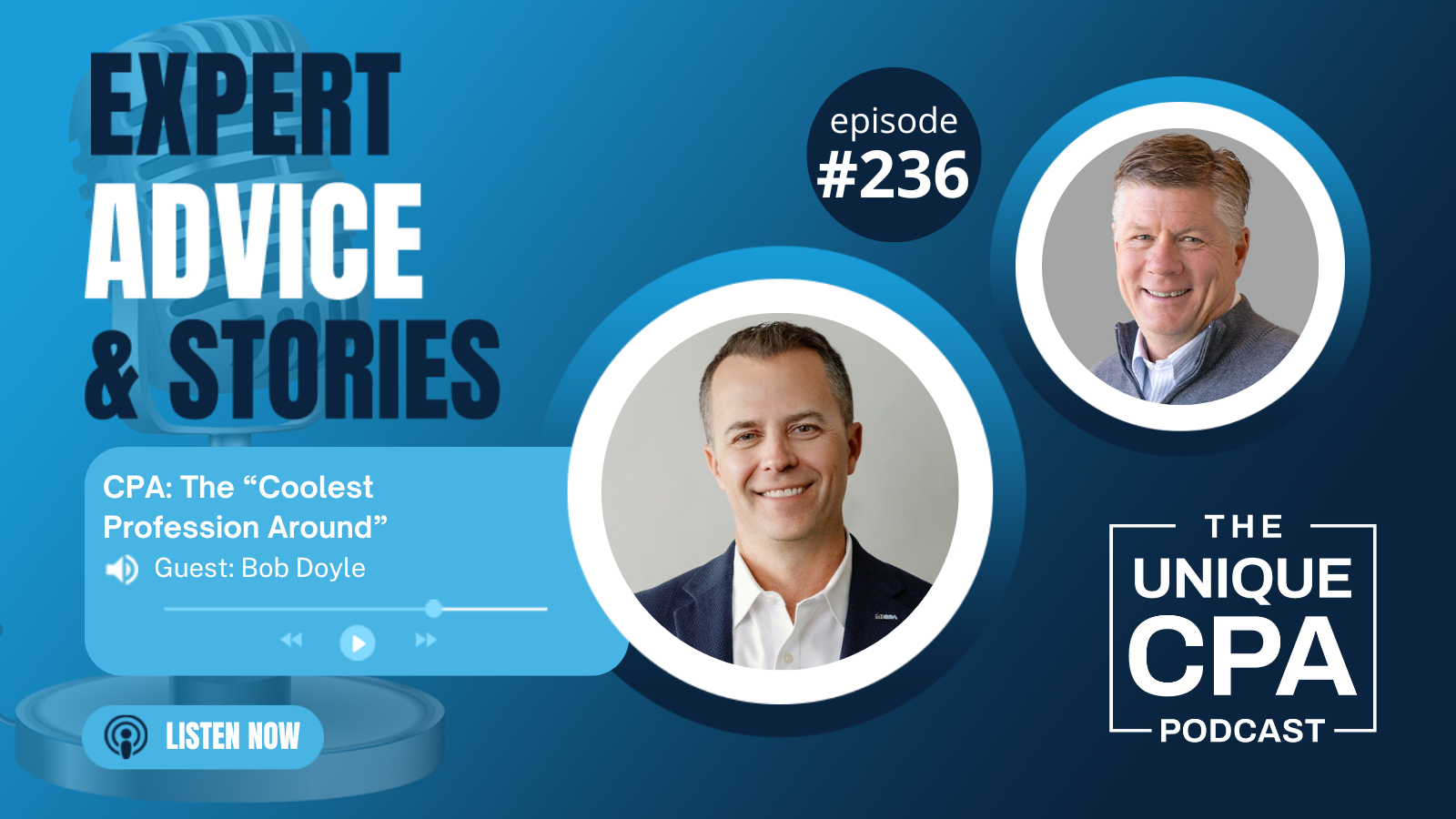
With Bob Doyle
When Bob Doyle stepped into the role of CEO at the Michigan Association of CPAs, the world shut down three weeks later. Instead of retreating, Bob drew on his background in engineering and association leadership to reimagine what it means to be a CPA. On Episode 236 of The Unique CPA, he tells Randy he subsequently borrowed a pair of white sunglasses, embraced the “Coolest Profession Around” mantra, and set out to shatter the stereotype of accounting as dull. From Bob’s sneakerhead sons helping him appeal to high school students, to ice rinks in Michigan backyards, to the real impact of private equity and AI on the profession, Bob and Randy explore how trust, joy, and innovation are keys to the future of accounting.
Today my guest is Bob Doyle. I had the pleasure of meeting Bob a few months ago at one of their association events in Michigan. Bob is the CEO of the Michigan Association of Certified Public Accounts and has been since 2020, and a really cool guy, which we’ll talk about a little bit as we go here. But Bob, welcome to The Unique CPA.
Thank you, Randy, pleasure to talk with you, and we’ve already been having a great conversation. So I’m looking forward to this conversation on your podcast today.
Yeah, we should’ve hit record 14 minutes ago and started splicing some of that into it. So one thing real quick, I mentioned your role and who you are, Michigan, and that I had the pleasure of speaking at your—what was the event called?
Elevate Conference back in June.
June, the Elevate Conference. I thought it was June. Look at my memory. That’s amazing. It was a fun event. It was nice to meet a lot of people that I’ve not met before, and it’s the first time you and I met, which was a pleasure for me. So that was a good time. You run a nice show there.
Thank you very much. Yeah, we kind of rebranded that show as Elevate, it’s like elevate your learning, elevate the profession, so we bring a lot of speakers, a lot of different tracks. Actually, next year, we’re already planning for next June. And AICPA CEO Mark Al is going to be there as our keynote. So we’re already looking ahead to June 2026 for that. So it’ll be great to have him in town.
Well, I’ll cross out my hopes of being your keynote next year.
Yep!
No, Mark’s a good guy. I’ve known Mark for quite a while. Actually, he’s going to be on the podcast again coming up soon, he’s been on once before, but he’s also offered to speak at our conference next year. So it’s pretty cool to see that he is out and about, trying to be out there as much as he can.
Oh yeah, he gets around for sure.
Yeah, I was just actually in Napa with him a couple weeks ago at a conference as well, which is not a bad place to be. So before we get going, I did a quick intro: You’ve been the CEO since 2020. Maybe give us a little background on how you got to that spot.
Sure. Yeah. I started in late February of 2020. I was blessed and honored to be selected as the next CEO of the MICPA. I followed the footsteps of a longtime leader, she had been CEO for 23 years, so it was a really exciting opportunity for me. And then the end of my third week was when the world shut down because of COVID, so certainly things changed quickly, and it’s been a wonderful ride. Now here we are five years later. I joke, like I still pretend like I know what I’m doing, but it’s been a lot of fun and working in the accounting profession has really been a joy.
But my background actually, I’m not a CPA, I did not come from the profession. My bachelor’s degree is in engineering. I worked in the automotive field for some time and decided I didn’t want to do that for the rest of my life, so I went back to school and got my master’s in public relations and marketing. So my career kind of went more in that path. Then I found myself working in the association space—I worked for an association in the robotics and automation field that was based here in Southeast Michigan, in Ann Arbor. That’s kind of how I learned how associations work and how they’re run, board governance, advocacy, membership, and all that. I learned a lot there and always had the goal of leading an organization one day. When this position opened, I jumped for it. And like I said, here we are five years later. It’s been an honor.
Been a pretty interesting five years too in the profession. Things changing, starting with COVID, to PE now, to pipeline issues, to relationship to all these things. So you’ve had to, I’m sure, deal with a lot in the last five years.
Yeah, there’s definitely been a lot going on. I have a wonderful team to work with, the MICPA team here at the office and hybrid, remote, we work all over, go all over the state meeting with our members, learning from our members, but then also the strong network of my state society colleagues. It’s just an awesome network that I’ve learned so much from my friends that work at all the different state associations. From the largest in California to Christa in Alaska and everyone in between. Anytime we get a chance to get together, whether it’s virtual meetings we get a lot on, or at conferences, it’s always a pleasure to work together and learn from each other too.
Yeah. So I’m in Illinois. I’ve known the Illinois society for quite a while, but the last few years I’ve got to meet a lot of the leaders at the state societies, and it’s really cool just to see what’s going on and what they have to deal with. Before we went live here, you and I were talking about some of the societies. Jeff Brown from Illinois has been on the podcast before. I actually think you are the second person from a society association. Jeff, I got to know him pretty well over the last few years. He spoke at our conference a couple years ago too, really good guy. In fact, I had a phone call with him and a few of his people yesterday. So a good group. I want to go back into one thing I said at the beginning, calling you a cool guy. When I was at your conference, Elevate, I saw these T-shirts and I had to buy one, and it was “CPA: Coolest Profession Around.” I want to know where that came from. Was this your idea? And then how do you play off that for your members?
So first of all, I need to make sure it’s clear. It wasn’t my idea or our idea. It actually first came from California.
Oh, really?
Yeah. The CalCPA, they kind of developed this “Coolest Profession Around.” Our state societies, we joke that we borrow from each other. Oh yeah, a lot. I do that all the time with full support because we’re all working together, especially when it comes to promoting the profession and pipeline and everything. So we just kind of embraced it and came up with this logo, we have a great graphics person here at MICPA who developed that and we put it on stickers, we put it all over. I try to, I guess, personal brand if you will, and actually it kind of came on a whim. I was speaking to a group of high school students through our foundation, the Michigan Accountancy Foundation, we do these high school leaders programs a few times a year at college campuses where we bring in a hundred high school students. We have speakers that talk about the profession, and then we have CPAs sit at every table at lunch and just demystify what being a CPA is, what accounting is.
We had our new “Coolest Profession Around” branding, this was probably two years ago now. I went out to my car and I grabbed my sunglasses. I was like, maybe this will work, I don’t know. So I put on my sunglasses and since then I now have a pair of white sunglasses that I put on and I take selfies. I learned that from a new mentor in Carla McCall and some other AICPA friends, taking selfies and posting them on LinkedIn. So I was like, yeah, I guess I could do this too. Anywhere I go now, I was just up in the Upper Peninsula in Michigan a couple weeks ago, visiting with students, visiting with members, and I take my selfie, my sunglasses, and post it. I really, I kind of make fun of myself. I don’t mind doing that and it’s fun. So, yep. It’s the coolest. Being a CPA is the coolest profession around.
And you know what, just things like that are so important because the perception of the profession is that it’s not cool, it’s not fun. The perception, which is not reality by any means, is that we’re sitting at our desk, it’s a boring profession. I actually saw a survey out, I don’t know how old it was, but it talked about the most boring professions and from people’s perception, they said accounting was number one. This is crazy! They need to go hang out with Bob Doyle and see that this is completely wrong.
I mean, I wear Nike Air Force Ones also wherever I go. Actually, this again was on a whim because I got out of my business casual comfort zone. It actually started with my kids, I have two boys who are now 13 and 11, it was a couple years ago. Like most kids, they have no idea what their dad does, but they knew, I was like, oh yeah, I’m going to speak to high school students. They were sneakerheads, they said, you should wear sneakers, not your boring loafers. I was like, eh. So I got a pair, I started wearing them and it was great. It was a great way to spark conversation, and I tell the story, because the founder of Nike—and actually a lot of kids don’t really know the founder of Nike anymore—but that movie about Phil Knight, the founder of Nike, you know how he started his career?
Accountant, CPA, I assume?
He was a CPA. That’s really how we bring in the “Coolest Profession Around,” because, and that’s kind of our message, particularly to high school students, college students, depending on the age of college, whether they’re freshmen or getting closer to their senior year: It’s such a cool profession because you can go in so many different directions. Maybe traditionally, you graduate, start in public accounting, you can work in public accounting for the rest of your life, you could become a partner at a major firm and have a great life, and frankly make a lot of money. You could go off and work in business and industry and become a CFO or a controller, you could go into nonprofit work, you could go into government, you could become an educator, you could start your own firm, you can be an entrepreneur. Or not even necessarily own your own CPA firm, but what if you start another business, but you know accounting, you know the language of business, right? That’s what I tell students. You want to be an entrepreneur, learn the language of business. Become an accountant first. So that’s why being a CPA is so cool.
Yeah. When you were just talking there, you made me think about this. My, neither of my kids—we, I have two boys, my wife and I have two boys, and neither of them became accountants. One’s a software engineer and doing great with that. The other has been in investment banking for the last six years doing M&A transactions. He is now—and it’s okay if I say this on this—he’s decided he’s going to transition and he wants to work doing M&A consulting for a CPA firm, not for firms to buy other firms, but with all the opportunity in M&A for the next 10 years with boomers having to transition their business, whether it’s just advisory on how to get to the next generation or if it’s a transaction or if it’s having to do with the newfound cash and investing. So it looks like in the next few weeks, my son might actually be working with a CPA firm. So it’s pretty exciting to see that it wasn’t the idea at the beginning, but it brings a big smile to me that he is probably going to be working in public accounting here shortly.
Oh, that’s great. And it was because of you, Randy. I mean, it took him a minute, but he saw you, and he made his way back into accounting. That’s awesome, yeah.
Well, and the thing is, he doesn’t have to be a CPA to do this role. And he says, no, I’m going to be a CPA. I want to be a CPA. I want to do that. So it’s pretty cool. I’m pretty excited. I’m pretty proud of that.
Yeah. Congratulations!
Yeah. And so he’s seen the fun side of the profession. I think if what I did was so boring to everybody, I don’t think he would have gone into it. So he understands that. Well, let’s transition from there into the pipeline, because that’s an issue that everybody’s dealing with. Is there something specific you’re doing with the association to have a positive impact on—we were talking about high school students and college—what are you doing to try to solve the pipeline issue?
Yeah, I think there’s been a lot of effort nationally. The National Pipeline Advisory Group started it, a lot of state societies, I mean, frankly a lot of us have been doing this for a long time as far as getting into high schools, talking to college students, talking about the profession. I think really the last couple years, we’re starting to see it turn around. You saw the enrollments in undergrad, colleges and universities across the country had increased last fall. We’ll see. It sounds like we’re hearing the same thing, at least anecdotally, I’m sure, I’m going to be interested to see when the numbers come out for this school year.
Yep, me too.
I think kind of demystifying it, getting in front of the students is so important. We’ve been encouraging our members, like we want to get out as much as we can as far as our staff, but we can’t be everywhere. So all of our MICPA members, they all graduate from a high school or they have a connection with their local high school, like, hey, get in your high school. Hopefully if they still have an accounting class, go in, do a career day, or even if it’s a business class or whatever, and we have, and the thing is, we have tons of resources. We have PowerPoint presentations, we have a lemonade stand example, how you can go through debits and credits and everything, and that’s why we encourage, like, hey, reach out to us. We’d be happy to provide this to you. Or when we do get requests, then we’ve got a bank of individuals who we love to send out and talk to students. So that’s a lot of it. We’ve been doing a few other things like the additional pathway to licensure, I know we’re, I think we’re up to 25 states or so who are in some process of passing the change to the law to allow the bachelor’s plus two years pathway. Here in Michigan, we’re very close. Actually, the bill’s been introduced, we’re close to finally getting it through the process, hopefully still this year, and we’ll be able to start licensing CPAs with that bachelor’s plus two years experience in 2026. We’ll see where that goes.
I think there’s also, with the change to the CPA exam with CPA Evolution, which is now, I guess it’s been over a year and a half, what can we do? How can we better support candidates to get them across the finish line? I mean, I think we being the association, we being the profession, we being firms—I know a lot of them already have great programs where they support them with their exam prep materials and everything. But there’s a delta of the number of candidates who start but don’t finish. What can we do to better support more of those candidates, get them across the finish line? So I think all that working together. I know also in the education field, the colleges and universities are looking at how can they create more engaging, particularly some of those more entry-level courses, rather than weeder courses like they always used to be, can we make them more like pull-through courses—let’s pull these students through the courses so they can be on that pathway to becoming a CPA. So I think all these things working together is certainly helping, but it’s a challenge that all of us want to continue to work on. But a lot of professions are experiencing challenges. My old association of the robotics industry, there’s not enough people going and becoming robotics technicians and things. So we’re competing for talent for sure, and that’s going to continue in the coming years.
Yeah. How about from a conference—Elevate or other conferences—have you considered or maybe are doing already, like having a space where college students can participate within the association’s conferences?
Yeah. We have a college student membership for MICPA, it’s free.
Okay, nice.
Typically it’s more focused on exam prep and changes to what’s going on in the profession. But also, yeah, we offer—they can attend our conferences, they can learn, they can network, collaborate. We actually have our Celebrate Awards dinner coming up. That’s more, we typically have a couple tables full of college students as well as new CPAs that recently were licensed, last year we invited them to attend. So just any way we can try to bring them into the mix and allow them to see the profession, allow them to network with others in the profession. It certainly helps, especially those that are newer in their careers.
Yeah, that brought up a question in my mind. Before we went live, I mentioned to you, I was out at CalCPA a few weeks ago meeting with them and one of the topics that came up was membership overall. It sounds like every association or society is having a drop in membership. So how do we have an impact on that? One of the things that specifically came up was, yes, students get a free membership. How do we get them to continue that when they get out working? Because what seems to happen is that once that free is gone, it’s harder to keep them involved, especially if their company is not paying for it, and a lot of our other firms. Have you been trying to figure out that role of the association, creating that buzz about membership?
Yeah. It’s really about the engagement piece and what can we provide, particularly those newer CPAs or younger CPAs that, especially if they work for a big firm—I mean, let’s be honest, they don’t necessarily need their state association. They’re getting plenty of support from the big firm, they’re getting their education, they’re getting resources, and they also have a lot of ways to engage. All big firms have their different kinds of employee groups and things. So, yeah, I’ll admit it’s hard. We have an emerging leaders group and we have a pretty active group now. It kind of died off during COVID, frankly, and we’re trying to reinvigorate that. We’re finding it used to be like, oh yeah, let’s have a happy hour, and a lot of people would come. Well, guess what? People don’t come to happy hours anymore, so—
I’ll be there! I’m going!
I mean, I’ll be there with you, Randy! Like at our Elevate reception we did.
We did have that one, yep.
Yeah. That was very nice. But, you know, it’s somewhat a broad stroke or somewhat a stereotype, but younger generation, they want to feel like they’re giving back. So, yeah, we’re coming up with ways to volunteer with MICPA, whether it’s—we just did a volunteer day at Junior Achievement of Detroit. So how can we engage younger people? But, you know, at the same time, depending on where they are in their career, they may need us more later in their career. Meaning if they work for a smaller firm and they rely on their state association for a lot of knowledge, networking, learning.
So, yeah, that’s one of the things that—I’m probably speaking on behalf of other state societies—we have such a range of members from the largest firm to the smallest, to business and industry. We’re all trying to figure out how to engage and how to provide value to all of them, and each one kind of needs us differently. One of the biggest things is advocacy. So we’ve been trying to talk about that, like advocating for the profession, changing the requirements for licensure, but also being there if there’s an attack on licensure, which has been happening in certain states recently, Florida being one of them, my friend Shelly Weir—just what they went through earlier this year and looks like it could happen again. Maybe not necessarily in Florida, but in other states. Those are the things that are super important, and then we try to get that message out. You may not realize what we’re doing for the profession, but this is what we’re doing and this is why it benefits you and your career and your profession into the future. So that’s one of the key messages that I think we’re all working together on, because I think advocacy used to kind of be our best kept secret. Someone once told me, if your members aren’t mad at you when it comes to advocacy, that means you’re doing a good job. But also at the same time, that means they don’t really know what we’re doing. So we’re all trying to figure that out and certainly this additional pathway to licensure has helped somewhat with that.
Yeah. What Florida went through was crazy. I think I heard recently that could come up again in Florida, which is—we won’t even get into it. That’s just too insane to me. So you’ve talked about licensure a couple times, and I know you’re going through the process right now. Is this something that—I guess the one thing I keep hearing, whether—is portability. Is there a way everybody’s working together from all the state levels to make sure that this is not an issue? How does that happen?
Yeah, mobility was certainly one of the key—I call it a sticking point in all these conversations that took some time. Now the new language that was passed in May, I believe, now goes to this individual practice privilege that was able to protect mobility. So no matter where we’re at in states licensing, the 150 hours licensing, bachelor’s degree plus two, we’re able to protect that mobility. So that was a very important piece that now states hopefully will be able to adopt. I know every state is on a different timeline, but I think eventually, all the 54, 55 jurisdictions that license CPAs will be on the same with the additional pathway and the mobility language.
Okay, so that shouldn’t be an issue. We should be past that. I’ve heard that often in the past. Alright. There’s been a lot, and in your five years now, there’s been a lot of things going on, as we mentioned at the beginning. I think I want to touch on a couple other of those. One is PE into the profession. Five years ago there was no, really, PE when you started and now private equity has become very prevalent. Is there anything that the association’s doing specifically around that, or how are you managing the PE inflow? I guess not managing is maybe not the right word, but does it impact how you’re working with firms?
I don’t know if it necessarily impacts the day-to-day. We have great relationships with firms, of course, all over Michigan, and some who have had investments with private equity and some who have either not—I might say not yet—or those who have also specifically stated they plan to remain independent. So I think all those firms, they kind of all work together, they’re all members of ours and we want to continue to provide value, provide resources, and it’ll just be interesting to see. Certainly some of those that have had the private equity investment, they’re growing pretty quickly. They’ve had the opportunity to add on more acquisitions. I actually had one firm here in Michigan, medium-sized firm, who was acquired and then within like six months acquired again. So they literally just changed the sign on the door. And then they had to change it again.
Wow!
So a little bit of upheaval for sure. How that impacts leadership, how that impacts culture, I think is still a little bit wait to be seen. It’ll be interesting to see how these deals may start to flip. I think there’s already been one—I don’t think any offices in Michigan, I’m trying to think of the name of it right now—but we’ll see how this cycle continues and the impacts on the profession. I think it’s here. It’s not like it’s going to go away. So how do we adjust? I know I’ve been on different webinars recently about the alternative practice structure, how those are set up and potential impacts on that, that we’ll have to keep an eye on how it might impact peer review and things.
Independence, and yeah.
And keeping the independence for sure. So that’s obviously ensuring we protect the profession there. I think, well, it’s a little bit of a wait and see, but it’s definitely been interesting for sure.
Yeah, I keep saying, well, it’s inevitable? It’s past inevitable. It’s here, it’s part of it, it’s a major part of the profession. I’ve had a few of these firms reach out to me just as an advisor to them. I keep saying, well, if you’re going to do it, I think I’ll be most impactful if I can advise on the culture end of integrating things. So, I’ll probably get involved from that standpoint, we’ll see. As you mentioned before we went live, there was a podcast that came out today, I think, where I had a VC-backed company that is investing in smaller firms and I did sign on as an advisor to them. It’s a little bit different model, but you and I talked about this—if we can have an impact that makes sure that these go as smooth as possible and have the positive impact that they can, that’s the way I look at it.
Yeah. I think succession is obviously super important and that’s really, hopefully, leaders and owners and partners of CPA firms are considering that. I think, unfortunately, sometimes one of the worst things that can happen is when we don’t have a succession plan. Private equity or looking at M&A is certainly an option for that, if that’s what they’re looking for. I think that’s somewhat of just the natural continuation of business, and these business owners who have had, at this point, pretty long, successful careers—they deserve an opportunity to hopefully retire and enjoy life. Sometimes a lot of CPAs, they struggle with that.
They do!
But I think maybe we can work together and help encourage those to retire and enjoy their career. Actually, I think this is something else we were talking about—as I see it, it’s a great opportunity for younger CPAs or those who have some experience that are maybe a little bit entrepreneurial to go out and start their own firm. There’s great opportunity there to create these, like the way they want to do it. If they want to—not necessarily just the transactional 1040 firm anymore, they’re doing advisory, they might get into some financial planning, and they’re these lifestyle firms that tend to be working out really well. And I see a great opportunity: You talk about firms getting acquired, bigger firms are going to continue to get bigger. Maybe the medium-sized firms, there may be fewer of them, but there’s still going to be such a need for small firms and I think even greater need, because they’re the ones who are going to be taking care of their small business owners and their doctors’ offices in their hometown, and there’s a CPA in every town. So they’re going to be necessary to support their communities. I think because of the impact of private equity, that might even cause greater opportunity for the small firms.
Yeah, I think it will. We do a survey for the profession on satisfaction levels. What we find is that the satisfaction levels are actually higher in larger firms and smaller firms, and it’s those mid-size firms where satisfaction levels are not as great because they’re competing against the small and the large, I think is one of it. But those small firms just have that—it seems like more freedom, like you just said, that lifestyle, they can design the firm around their lifestyle. So it’s a pretty cool, I think, opportunity as well.
Yeah, absolutely.
Alright, so there’s one other, at least I can think of off the top of my head, major thing that’s happened in the last five years. And that’s AI. We’re just the tip of the iceberg on that. That’s the beginning, but it’s what everybody wants to talk about, too. So, does the association have tools or advice in place on how AI is integrating into the profession or should be looked at, at all?
Yeah, we do, we offer a lot of learning, a lot of speakers. We just had a great AI speaker at our small firm practitioners conference. It was kind of just demystifying: this is what it is, this is how you can utilize it. So let me just straight out say, AI will continue, has and will continue to have an even greater impact on the profession today and into the future. But then also, I’m not a skeptic by any means, but AI has been around for 40 years, and that’s one thing people kind of think, like it’s brand new. Yes, there are a lot of fantastic companies and everything out there, but it’s kind of funny because, you know, I mentioned I came from the robotics association. In the robotics industry, they’ve been saying that robots were going to take jobs since the first robot went into a GM plant in 1957. As I mentioned earlier, there’s not enough people to take the advanced manufacturing jobs that there are today. Jobs change, jobs have been changing since the dawn of the industrial revolution. So if I hear another headline that says, “AI’s going to take all the accountants’ jobs,” I mean, it’s ridiculous.
Yep, I agree.
AI’s not going to take all the accountants’ jobs. There’s still going to be such a need for customer interaction, client interaction, the ability to take data. Believe me, the AI can take the data and drive results from it, but you still need to interpret the results. You still need to present that information. I heard someone once say—I’ve heard it enough times now, I’m not sure exactly who the first person was—but they said, “AI’s not going to take accountants’ jobs, but accountants who embrace AI are going to take the jobs of the accountants who don’t.” So I think that’s certainly true. I think it’s something that CPAs and firms and businesses need to understand—what’s out there, understand the technologies and how to adopt it and what they should adopt. But it’s not going to take all the jobs, and it’s going to create ones,
It’s definitely going to create new ones, and it’s going to free us up to do the things that are the most important for clients, like you just said—interpret it, advise it, have that communication. Maybe there are some new skills that we need to have, maybe communication skills are going to be more important than our technical skills or something like that. But it’s definitely going to help the profession, I believe. Alright, so before we wrap up, the other thing that we talked about briefly before we went on, but you were very proud of the culture that has been created at MICPA, so around joy and trust and innovation. So expand on a little bit how the culture is going on there and why that’s important to you.
Sure, yeah. I like culture, and I think it’s something that you’re always building, always developing. The three words of our culture here at MICPA are centered on “joy,” “trust,” and “innovation.” I always start with trust, because trust is the base. Trust is the middle. In order to build culture, community, you need that trust. We’re in the trust business, right? They say being a CPA is the most trusted profession. Our members trust that we’re going to do whatever we can to serve them—we do it through advocacy, collaboration, education, but also us as an MICPA team, we need to build that trust with each other. We do that in a variety of ways: A lot of it is very open communications and that kind of thing. Trust is like a currency—you can quickly lose it, you can build it, so it’s something that we always like to focus on, particularly in the profession.
The innovation piece—you hear innovation, you think, oh, it’s like AI or startup companies, or it’s in laboratories, but I like to think of it as everyday innovation. We’re always creative, we can always be innovative. Let’s try new things, let’s try different things. I think we really saw that, particularly during the pandemic—suddenly had to basically become a virtual organization overnight. Certainly tons of ways that we all were creative and innovative, and the firms, the businesses, how they’re all creative and innovative and driving that innovation. So, yeah, that’s why I encourage our team. Even if maybe it’s not as successful as you want, you learn from it. I don’t like calling anything a failure—you learn from it. Then finally, the first is joy. It’s my favorite word. Joy is more of a spirit, it’s kind of like your inner peace, being content. So we like to talk about joy inside the workplace, we like to share our joys, we do team builders and things like that. We just went to a Tigers game a few weeks ago. We do culture days and things, but also joy outside of the workplace, ensuring that we have that work-life—I don’t like calling it balance, but our work-life integration—that we can have that joy outside of work too. Those are the three things that I talk about a lot.
And that ties into—I saw a friend of mine, John Garrett, was out at one of your conferences recently and the What’s Your “And,” that joy coming outside of work and how important that is.
Yeah, I learned that from John actually. I do one-on-one meetings every quarter or so with the staff. Our topic this time is “What’s Your And?” And actually it’s doing great, because I realize even before we sit down, I typically think I know what their “and” is, but sometimes they’ll surprise me too, which is awesome. But yeah, John’s the best and I’ve learned a lot from him. He’s got a great podcast also.
He does. Have you been on it?
Not yet. I’m waiting.
We gotta, I’ll text him right now and say he’s got to do it.
So I can’t tell you what my “ands” are because I need to save them for his podcast.
Well, I’m going to ask you in a second, so you’ll have to at least give me one. So, yeah, John’s been out at our company outings in the past and spoke to our group and he’s been on this podcast a couple times too, and I’ve been on his, and yeah, he’s just become a really good friend over the years, so I love his whole message. So with that being said, that is the final question, and I don’t call it “what’s your and.” I was asking this question before I met John, but I’ll give him credit. So I always like to end with—well, before we get your contact information, I’d like to end with: What are your passions outside of work? What do you love doing? What lights you up? Obviously working with the CPAs seems to—I can see your passion coming through. But there are more important things outside of work that I’m sure you’re passionate about.
So I love to coach, so I coach my son’s—well, now 12U—baseball team. When I’m on the baseball field with my team and my son’s team, I don’t think about anything else. It’s great, in practice and even during games, I’m not the head coach, but I’m the coach who kind of sets the lineup and is more the strategic coach. I love doing that. I love thinking about next steps and everything. We’re now in, of course, we had a fun season, a little bit of a break in the summer, and doing a little fall ball, but next year we’re doing the big Cooperstown, New York tournament, which we’re already excited about. So I not only coach my son’s team, actually both my boys have now really gotten into golf, so I love golfing with them. I’m definitely not a golf coach by any means. I’m not very good at golf, but I just love being out on the golf course as well. Also coaching the MICPA team here too.
But then probably my unique passion, which is only a winter passion, actually, I told John Garrett this. So my kids also play hockey and I put in a backyard ice rink. It basically fills my backyard. Build it with boards, put a liner down, watch the weather. I become an amateur weather person all winter, fill it with water and then make ice. So you’re basically at the whims of Mother Nature, right? I just love not only preparing it, but also when we have great weather—which last winter was fantastic, we had over 40 skating days. I have a “Home-boni” where I resurface the ice and it’s super satisfying. I call it my ice therapy. I just love going out on the ice, skating with my kids, bringing the neighbors’ family over, and we skate and build a fire, might have a beer or perhaps a bourbon while I’m out there. It’s a lot of fun. We have lights out, so we play at night. So that’s definitely my winter joy that I look forward to every winter. When people complain about the winter in Michigan, I’m like, I want it to be cold, because that means I’m going to have good ice. So, yeah, that’s definitely my winter passion.
Nice. That’s cool. We have a cabin in northern Wisconsin and we go up there after Christmas every year for the week between Christmas and New Year’s, and we just clear the ice on the lake and we’ll skate up there. But I think I’m not skating anymore. I’m getting too old, because the last time I did it I fell and broke my wrist, so we might be doing boot hockey instead of skating up there. Maybe that’s safer for me. Okay, and then last question, if people want to hear more about what MICPA is doing or be in contact with you, what’s some good places for them to look?
Sure. Go to micpa.org, which is our website. They can reach out to me. My email is bdoyle@micpa.org and I’m pretty active on LinkedIn, so please reach out to me on LinkedIn and, yeah, love to keep the conversation going.
Nice. Well, it was a pleasure, fun conversation. I appreciate you being on the show.
Absolutely. It was fun. Great to see you and I’m sure we’ll see you again soon.
Important Links
About the Guest
As an association leader, communicator, strategic planner, and relationship builder, Bob Doyle serves as President & CEO of the MICPA, the Michigan Association of Certified Public Accountants. With the fantastic MICPA team, he serves the organization’s members and the entire accounting industry in the state of Michigan.
Bob formerly spent over seven years as the Director of Communications and Vice President for Marketing, Communications & Advocacy at The Association for Advancing Automation.
Meet the Host
 Randy Crabtree, co-founder and partner of Tri-Merit Specialty Tax Professionals, is a widely followed author, lecturer and podcast host for the accounting profession.
Since 2019, he has hosted the “The Unique CPA,” podcast, which ranks among the world’s 5% most popular programs (Source: Listen Score). You can find articles from Randy in Accounting Today’s Voices column, the AICPA Tax Adviser (Tax-saving opportunities for the housing and construction industries) and he is a regular presenter at conferences and virtual training events hosted by CPAmerica, Prime Global, Leading Edge Alliance (LEA), Allinial Global and several state CPA societies. Crabtree also provides continuing professional education to top 100 CPA firms across the country.
Schaumburg, Illinois-based Tri-Merit is a niche professional services firm that specializes in helping CPAs and their clients benefit from R&D tax credits, cost segregation, the energy efficient commercial buildings deduction (179D), the energy efficient home credit (45L) and the employee retention credit (ERC).
Prior to joining Tri-Merit, Crabtree was managing partner of a CPA firm in the greater Chicago area. He has more than 30 years of public accounting and tax consulting experience in a wide variety of industries, and has worked closely with top executives to help them optimize their tax planning strategies.