Beyond the Bottom Line
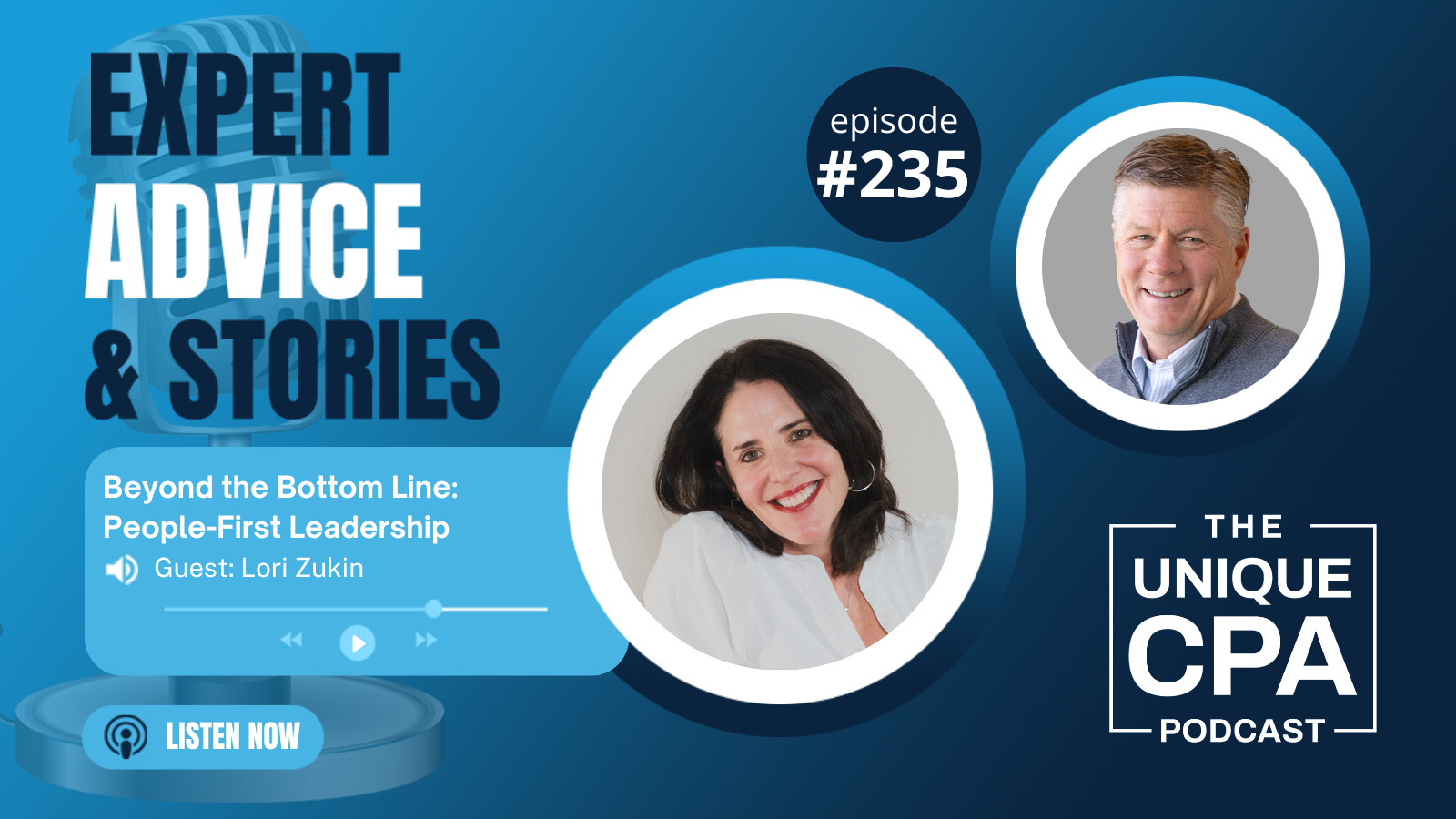
People-First Leadership with Lori Zukin
Lori Zukin’s path began in a small-town family drugstore, where work and love blurred together behind the counter. Years later, after earning a PhD in industrial and organizational psychology, she found herself coaching leaders at Booz Allen Hamilton and, eventually, guiding the transformation of Baker Tilly’s executive team. On Episode 235 of The Unique CPA, Lori shares how a single phone call, received in the shadow of personal loss, sparked a partnership that would reshape a major accounting firm’s culture. She reveals the real impact of trust, particularly given the hidden costs of the stories we tend to tell ourselves when we don’t have all the information. Randy and Lori trade insights on vulnerability, missed opportunities, and the courage to lead with empathy, and along the way, Lori’s passion for mental health and her belief in the intersection of passion and skill shine through, offering a rare glimpse into the heart of modern leadership.
Today’s guest is Lori Zukin. Lori is CEO and founder of Zukin Leadership, an organizational psychologist and executive coach, with over 20 years’ experience helping leaders and teams thrive. Lori, I’m going to let you go deeper into that, but first, welcome to The Unique CPA.
It is a pleasure to be here. I’ve heard several of your podcasts, and I’m honored to be a part of it. Thank you.
Well, thank you. The one thing that I did not mention in that brief intro is that you are a PhD that we actually just talked about offline a little bit, but I’m curious, what’s the PhD in?
It is in industrial and organizational psychology, and to put it simply, it is the study of people in organizations and predicting how well they’re going to perform on the job, training them to do well on the job, training leaders to do well on the job, managing performance, transition—all of those types of things related to people in organizations. And that was, I got my PhD in the year 2000, so it was a long time ago.
Honestly, the year 2000 doesn’t seem that long ago to me. I don’t know what happens, it feels like it was yesterday. That’s awesome.
It’s a great field. It’s a wonderful field because it brings together my interest in business—the bottom line—and people. And you need both.
Yeah, and I think I’m really good at the people part. I’ve realized that the bottom line is someone else’s expertise. I think I try to help the top line, but other people are involved in the bottom line. So, a little bit deeper into, give us your background: We got a little bit of it there, but a little more. And then I want you to expand, if you could, on Zukin Leadership and what you’re doing with that organization.
Absolutely. Well, I want to go back to actually something you just said about your focus being on the people and not as much on the bottom line, and I would say actually good leaders hold both of those things, and my sense is you’re doing both because you’re focusing on people and then you’re bringing other people in to maybe do the details associated with the bottom line. So a good leader recognizes where their strengths are and where to bring in people to do those things that maybe they’re not as good at, number one, and number two, people and profit are needed for successful business, and you’re holding both of those. So I’m wanting to give you more credit than you’re giving yourself.
Well, and I appreciate that. I did have an epiphany, let’s say, years ago, where I realized that there were things that I wasn’t passionate about. There were things that I felt were not in my realm of expertise and realized that I needed to change my role so that I can concentrate on the things that I feel that I was good at, but that really, that I’m passionate about. People have heard on the podcast before, but for me, I call it “the intersection of your passion and your skills:” Find out what you’re good at, find out what you love doing, and if you can live there, it’s an amazing place to be. But then you do have to find the people, put the people in the right roles where they have that same passion and skills that align with each other.
That’s it. That’s leadership, yeah. Self-awareness. Also, you were self-aware enough to know to do that, and then you executed on that, so—
Wow. You’re giving me way too much credit.
No, it’s nice to see it. I love to see it and I’d love to talk about it.
Well, we can talk more about that, but let’s get a little more on your—
Yeah, let’s get to Zukin Leadership. So, I’ll just start with, I grew up in a small town that’s gotten a lot bigger in the last several years—West Chester, Pennsylvania. My family owned the local drugstore, and that was before CVS and Rite Aid were big, so I would work there all the time after school. We’re a Jewish family, we would give all of our help off during Christmas, and the whole family would come in and work that whole week. It became every single year, it was just a family event, and I learned that work was love, and love was work, and we made it a lot of fun and it helped to pay for college ultimately. I began to learn a lot about roles and responsibilities, commitment, and how to love your work, really. So I learned a lot from my dad and his passion for not only the business, but also the community, and that led me to wanting to study industrial and organizational psychology, so people in organizations.
Fast forward, got my PhD and then worked for a number of years at Booz Allen Hamilton, doing human capital consulting, but always in that work, loved the realm of leadership development. After my first promotion, I had the opportunity to work with a coach, and it was just something that Booz Allen offered, which was wonderful. The coach actually said to me, “You know, Lori, you would make a good coach. There’s just something about you.” I took her advice and went to Georgetown University’s coaching program and it was transformational for me. It helped me to get more in touch with my passion and my desire to help people see things in themselves that they might not see otherwise, and to do something with it. So I enjoyed, after that, really working one-on-one with people as well as building broader leadership programs. Fast forward, left Booz Allen in 2016 because that was all I wanted to do: I wanted to do leadership development, team development, one-on-one coaching work, and that’s what I’ve been doing for almost 10 years now.
Wow. So one side note, Booz Allen Hamilton interviewed me back in 1986… or 85?
Is that right?
Yeah, I got through a couple rounds of interviews, but I did not get picked, so—Hmm. So I am very mad—no, I’m not mad with them, but I was pretty interested with what they were doing, and it was pretty cool to see. I actually graduated with a computer science degree, so it was something to do with programming. I don’t remember what they would’ve been doing with that, but I haven’t heard that name in a while, so I had to bring that up.
Ah, okay. Well, I learned quite a bit through working there, even things that they call “unconscious competence,” things that you don’t even realize that you learned. I’ll partner with other people who are former, Booz Allen, we call them “boozers,” but not in that way. We’ll just start talking about a project and we’ll have this language that other people aren’t understanding simply because we just learned it through working there. So it was a great experience and I’m loving being on my own now and really focusing on what I love to do.
Yeah, and so let’s go deeper into that and before we even do that, I guess this goes into it together, but this is The Unique CPA, so we talk about the accounting profession. Let’s find ways that we can have a positive impact on people in the accounting profession. You do have a history working in the accounting profession. So can you give us that, and expand on what you did?
Yes! So several years ago, I got a call from Alan Whitman. It was actually… My father had just died and I was not my best self.
Yeah.
And I got a call, and for some reason I didn’t have the phone number to call back. He had called me, so Alan Whitman was the CEO of Baker Tilly at the time, and I sent a note to the head of HR saying, “I got a call from Alan Whitman at Baker Tilly. I don’t know who he is, could you…?” So that’s a pretty bad mistake to make. I clearly was not at my best at that time.
Yes, understandable.
And I called him back and somehow he had known about that, but he was incredibly understanding. Years later I did a lot of work with him, so he did not hold that against me. I got on the phone with him and he first hired me to coach someone who directly reported to him. After that engagement ended, I actually worked as a coach for Alan as he was transforming Baker Tilly. I think you have a podcast about that.
Yes.
So I was his one-on-one coach supporting him in many of the shifts that he was taking as an advisor and coach that he could go to without judgment. There were times that it was, you know, things that he just couldn’t talk about with people in the firm about decisions, tough decisions he had to make, or how to have interpersonal interactions or—and he’ll share this with people—or when he was presenting. I’ll never forget one time there were about 30 “ums” in the first three minutes of his speech, and helping him to be aware of that and then, he was pretty impressive, a few days later, maybe there were five.
Wow.
So it varied. After that, he brought me on to coach the senior leadership team in aligning on the purpose of Baker Tilly, so I would bring in tools to help them get better aligned. Sometimes those tools might have been as simple as a clear request and a clear agreement: How do we run an effective meeting? So those, I would call more on the task side. What are our roles? Let’s clarify roles. And then some that were more on the relationship side. How do we build trust more effectively? How do we interact more effectively? How do we communicate more effectively? Did that for a while, and then ultimately he hired my firm, so I brought in some other people as well, and I did this, and this is one of my favorite things, is a two-year leadership immersion to look at the leaders who would be the next senior leadership team and how to develop them to be ready to handle the complexity associated with leading a firm like Baker Tilly. So my colleagues and I designed and facilitated that two-year immersion, and I call it an immersion because it wasn’t sitting in a classroom looking at PowerPoints, it was, how do I get to know myself better as a leader? How do I interact better with others, build interpersonal relationships, and then how do I take that and look at the complexity of the system more effectively? So it included coaching, it included peer mentoring, it included in-person experiences, but very immersive.
Yeah. I love what you just said there about just the whole, you know, the communication, getting to know people, the interpersonal, the relationships, because for me, whether I’m right or wrong, one of the key things I think in leadership is just getting to know the people that you’re leading or working with on a level that’s deeper than their job title, because I feel like when you know somebody at a more personal level, there’s just so much more connection. And people, like you mentioned, trust. I think trust levels go up when they feel like they’re known by you. I was looking on your website, you have a line here that says “connection is the foundation of leadership.” So I was hoping that you could expand on that.
Yeah. I’m pausing because sometimes there aren’t words for it, you know?
Yeah!
I think just like you said, just taking a moment and looking someone in the eyes and checking in on them helps to build connection and helps to build trust. So I think that’s absolutely critical, and checking in to make sure that your people are okay is key. In terms of trust—and I’ll get back to this in a second—but in terms of trust, I get calls all the time for help with, “Oh, my team, we just don’t, there’s a problem with trust, or there’s a problem with trust in our organization,” and I think it’s helpful, and maybe this is helpful also in the accounting profession to think about this: There are dimensions of trust. There’s a book called The Trust Equation, actually, so there’s an equation for it. I like to think of it as three components. It’s capability—do you have the ability to do the thing that you claim you can do? Consistency—are you consistent? If you said you were going to do it, are you actually going to do it? And then, is your intention good? So I think it’s good to think of it as those three things, not just, “Oh, I don’t trust that person.” Then break it down and think about, are you a trustworthy person in those dimensions? And then can you trust others? If you do that, it can also strengthen that connection. So it isn’t just the look people in the eyes, which is important. It is thinking about those dimensions as well.
Capability, consistency, and intention. And then when you’re looking at that from a trust level, is that what I’m looking at when I decide if I’m trusting someone else? I guess it goes both directions, right?
It exactly goes both directions, and it is also your mindset. There’s two parts to it. I think in general, I don’t think this has been studied, but there are individuals who just tend to be more trustworthy, and that can be good and bad. If they’re overly trustworthy, they can get taken advantage of, but if they’re under-trustworthy, they’re going to view the world as, “Oh, I can’t trust anyone,” and then they might have a hard time building trust. And then also, even someone who’s very trustworthy, if they’re, as they say, below the line—if they’re upset, if they’re angry—they’re going to view the world through that lens. Did that make sense?
It does, I’m trying to—
I mean, it’s mindset. It’s personality and mindset. Do I have a mindset of, “I’m walking into this room, there’s people in here who I can trust,” and then what do I put out based on that? Do I put out like, “Mmm, I don’t like these people?” Then you’re not going to build trust with people.
So here’s how I—because trust has been something I’ve been starting to talk about. Not that I know the science or anything. I have looked up some studies on trust. This is actually a line from Jacob Morgan, he’s written multiple books, but the one was, I think it was Leading with Vulnerability. He talks about going into a situation with a level of trust: “Hey, I’m not going to come in here and make you earn my trust. I’m going to trust you. I suppose you can lose my trust. But I think if we start—for me personally, that positive attitude that, ‘Hey, I’m trusting you at this point, and then we’ll see what happens from there.’” I guess everybody’s different, but is that—am I going to get taken advantage of if I go in with that trust level like that?
No, I think that’s—I tend to think that is a good approach and then yes, are they consistent? Are they doing what they said they were going to do? What is your sense of their intention, and do they have the capability, based on whatever your agreement is?
Well, I just got a couple new lines I’m putting into my presentations when I talk about trust, so I appreciate the information. So I hijacked where we were going with Baker Tilly, and so I don’t know if you wanted to continue down that road of what you were doing with them.
Yeah. So a number of different areas of work, and what I appreciated about Alan’s approach and others’ at Baker Tilly, was that the message was able to scale and cascade. So an individual who may have been a part of the leadership immersion that we did was able to take that information and then share it with his or her team, and not just the cognitive information, but that way of leading. So it did help to shift things at the organization. That was neat to be a part of, and I would say one of the biggest things that we saw from that work—a group of people who may not have trusted each other because they were from different organizations that had merged in—built these trusting relationships so that if there was an issue in Texas that affected someone in Pennsylvania, rather than have to go all the way up the chain and over and talk to these five people, they could just pick up the phone and say, “Hey, let’s fix this now.” Instead of telling themselves stories about how the people over there are doing it wrong, they could just figure it out together, and have a quick conversation, and they shared with us that they were able to do that. I know a lot of times these things are difficult to measure, but that’s money. It reduces a lot of drama, it saves time, it doesn’t bring 20 people into a meeting when you can just pick up the phone and call the person in that other department over there, rather than make assumptions that that other department stinks because that thing happened.
And that’s what happens, like mindset, you were saying. If you don’t really have that open dialogue or communication or intentionally sharing what’s going on with an organization and the role, people make up their own stories of what’s happening. I’ve seen that. I think we have a very good organization from a communication standpoint, but I’ve seen where we made mistakes before, where we allowed people to make up in their heads this mindset of wild stories of what’s happening within the organization. So having that open dialogue and having the ability to just call and ask and feel like you can do that, that to me is so important. For Baker Tilly, I assume that was a—you know, in Alan’s leadership reign, they went from, what, $500 million to $1.5 billion? I’m guessing that leadership style had a big impact.
I think he had a little bit to do with that, yeah, I’d like to think. I mean, and what you were just saying, the term that many use in leadership is the ladder of inference, we don’t have to get technical, but it is a normal human behavior to see something, make an assumption about it—in other words, tell yourself a story about it—and then act based on that story. Good leaders recognize that they’re telling themselves a story and can pause and check in on, “Okay, do I have enough data there to move forward in that way, or should I check with that person before I talk negatively about them?” So good leaders will make that distinction between a fact and an opinion, or a fact and the story I tell myself about that fact.
Yep. There was a learning, and this was just this past May. It was a very good learning experience for us because what we had done is we normally—we’re pretty much a remote organization. We have 80 people and they’re all around the country, but we get together as an entire organization twice a year. We skipped that in ’24, and when we got back together in May of ’25, you just started seeing all these stories people were telling themselves of why we skipped ’24, and why we didn’t do this. The negative impact that that had—or potential negative impact that could have had—on our culture was huge. Luckily, people felt open to discuss that in the main meeting and we got back on track and we got back to fact rather than these stories we made up. So that was a great learning experience for us. Honestly, I wish we didn’t go through it, but at least it ended up with a positive outcome.
Yeah, and also just a great leadership lesson in that, okay, if we start to tell ourselves stories, let’s check in. Because if I have a story and I’m a senior leader and I start sharing that story with two people, then they’ll start sharing it with two people, so the impact of that negative story is not so good. So I’ve got to check myself as a leader before I start creating this ripple effect, yeah.
Alright. So, believe me, this has been amazing so far where we’re going, but I wanted to go more into the things that you see, the tools that you use, and I know you’ve talked to me briefly and I don’t know what it is—the state of mind tool. So if you’d like to expand on that, I’d love to hear what it’s about.
Absolutely. As I think I mentioned before, mindset is so much like the lens that we view the world through. It affects how we lead, how we see the world, what we do, etc. One of the tools that I teach quite a bit, and I like this especially for accountants, is called state of mind. If you imagine a line, this is your neutral line, and then you have a line above that—call that plus one, another line above it, plus two, up to plus three. And in between each of those lines, you have different words to describe your state of mind. So plus one might be, “I am pretty happy.” At plus two, “I’m energized.” And plus three might be “ecstatic.” Then below the line you have your minus one, minus two, minus three. So your minus one, tired, minus two, I don’t know, sad. And minus three, depressed.
So what it does is it puts numbers to feelings, and I’ll work with a team to have them think through what are those words that go with those feelings. At a meeting, we might check in at the beginning of the meeting and say, “Okay, what’s your state of mind? I’m a plus one. I’m a plus two,” etc., and you can do all kinds of things with that now. You can see where the team is, check in on the team. “Oh, most of us are a minus two. What does that mean? What’s going on? Should we take five minutes and talk about why we’re a minus two? Because if we’re all a minus two, we’re going to view this budget decision through that lens, and I don’t want us to view it through that lens, or we’re going to view that decision we have to make about the merger through that lens.” So there’s so much more I could continue to talk about.
No, believe me, I did my keynote for our conference this year. A big part of it was mindset. That’s a little different than state of mind.
It is, yeah. But there’s a relationship.
Right. So what I was thinking when you were talking, that we integrated EOS into our leadership a few years ago. That is not a skillset I really have, but I now understand why we’re doing this. The one thing we do in these L10 meetings is—I think this is standard across EOS—at the end you rate the meeting. I’m like, well, why don’t we start the meeting with this?
Exactly.
And then we know where we’re at. So I would love to integrate that. Do you know if EOS does something like this?
I don’t think they do this, but I can’t speak definitively about that, but it’s easy to add, and I’m happy to share it with you. So we check in at the beginning of the meeting, you could check in in the middle and after various times. Again, it’s the lens that you see the world or you see the meeting. It also affects how you interact with others. So if a leader comes into the meeting as a minus two, that’s not so great, so being aware of that is key.
Yeah. So you think I’m lying to myself if I always feel I’m a plus one, plus two, or plus three? I mean, right now I’m plus three because I’m having such a great time. My state of mind in this conversation. Maybe it’s just finding what you love to do and doing it, because if you’re doing that, I think that helps your state of mind.
I agree. I think it’s very possible that you hang out above the line. I think there are people who hang out in certain—I’ll call it, hang out in certain places—and something might shift them in the moment. Or, you know, if there’s a really bad piece of news you get, it’s being aware of it and then aware of the impact on it so that you make a decision based on that awareness.
I agree with that. It’s the state of mind, but then it’s the mindset you choose to have about something. What I see all the time is that, hey, a flight gets delayed—because I travel all the time—and people just go crazy. I’m like, hey, I’m not going to change it, why worry about it? I’m going to go in the club lounge and have a sandwich while I wait for the flight to be later. I think you can choose that. Again, I’m no expert, but that’s how I feel at least, that you have the choice and you can choose to be in the negative state of mind often, and you can choose to be the positive. I feel like I want to try to choose to be the positive. Live with an attitude of gratitude, I guess.
I agree with that a hundred percent. That’s the part two of what we teach. If you find yourself below the line, what are things you can do to get above the line? An attitude of gratitude is one. It might just be simply taking a few slow breaths. It might be recognizing that you can just go to the lounge and get a good sandwich. So there’s that. We also say, sometimes you’re below the line and you can’t get above the line, and it might be a matter of just sharing with your team, “Hey, we just got some really tough news about our quarterly results, and I’m upset about it, and I’m just sharing that with you, that I’m below the line right now and I might not be my best self, so please, excuse me.” Could be as simple as that. So it’s just a way to put some numbers onto emotions and help people become aware. If there’s one thing I would say to leaders about how to be most effective, it’s self-awareness, because once you’re self-aware, then you can make a choice to shift or not.
Yeah. Which goes back to some stuff we were saying at the beginning about the self-awareness of who you are and what you’re good at and what you love doing, I think leads into so much, with just your state of mind, but also I think your leadership, your leadership type, I believe. Oh! I’m going to go completely back to the beginning now.
Go for it.
Because, I mean, you are a leadership guru. You know so much more than me, and this is such an amazing conversation to me. But I had mentioned off air before we started recording that I just have a hard time with the word “leadership” or the definition of leadership.
Yeah, I do too.
Okay, well, good, then I’m not alone. But do you—can you define it, or do you—can you define why I, and you, have a hard time with the word?
Well, first of all, I’ll start with I don’t think anyone is a leadership guru. I’m saying this with respect to you, because it’s something that you’re continuously learning as a leader. So I would say leadership development is personal development.
Mmm hmm. I agree.
And I do like how Brené Brown defines it, though I don’t think it’s complete. So I’ll start with, it’s a person who takes responsibility to find the potential in people and processes—and I modify it a bit—and builds the courage to develop that potential. So I think that’s a good start. I would add that, and she might say this too, but it’s not about position. I also think that spreading that way of being that you just shared about hey, something happened that is causing us to be below the line, but we can have a positive attitude about it and get above the line, is a critical part of leadership. So it’s leading with hope, it’s leading with joy—even in tough situations—and it is okay to do that. I know it’s hard now in the world, it’s hard in organizations, it’s hard with layoffs, and there are things to be thankful for and appreciative of in moments, and a leader can help us to see those with empathy.
Oh boy, you just said a word—we could go on, empathy, vulnerability, those two things I could go on forever. I don’t know if we have time for that.
If I do a whole workshop on empathy, it’s six hours. But yeah.
A friend of mine just wrote a book about being an empathetic leader, Dawn Brolin, who I love. Dawn does a great job on that. I was lucky enough to write the foreword in her book. It’s phenomenal.
Aw, that’s nice.
Which is cool. She and I have discussed both empathy and vulnerability as key leadership traits. Again, I don’t think we have a ton of time, but would you agree with those two? And are there other traits you would add?
Yeah, the ability—so as you get more senior in a leadership position, we’re talking about position now—the ability to hold two perspectives that seem to be opposite. So holding paradox essentially, “navigating polarities” is what we call it. Structure and flexibility. People and profit. Black and white. Headquarters and local. Being able to find ways to merge the two things that might seem opposing, and if you have a perspective on something, listening to the person who might have a different perspective for the nuance, and still being able to make a decision? That’s a good leader.
Yeah. And you just made me think of something else and, man, I can go on tangents all day long, but those are sometimes the best. I was just at a—I don’t know what you would call it. They didn’t call it this, but almost like a think tank meeting for the California CPA Society. They brought in a bunch of people and we just brainstormed about the future of the accounting profession and their role in it and what needs to happen, and they kept stressing, while we’re here today, while we’re having these conversations—and the cool thing is they moved us around the room so it wasn’t just with the same people all the time—try not to come in with any preconceived ideas or, this is how you think already, and try to be open to new ways of doing something. Because, you know, I have my passions: vulnerable leadership, mindset, not fearing change, all these things that I already talked about, right? It was difficult, but I tried to be in that moment, think about, “Okay, are there things that I should learn in this?” Man, that was so tough to do, but it was worth it. It was a great day for sure. There’s no question there, there’s just a comment, I guess. So have you seen, I guess, leadership built into that in the past?
That’s fabulous. I think what I’m hearing you say is you have a perspective of—yes, your perspective is around people and relationships, and you were invited to think about a different way. So let’s call it more task, and you realize that that’s something that is valuable, so you are challenging yourself and, yes, it is hard, and the fact that you are willing to think it through is good. Again, I think good leaders can recognize you need people and profit. You need task and relationship. And holding both when they seem contradictory is a leadership capacity that we need to build more of, not only for leaders, but also for the world.
Yeah. Let’s talk about building that, because with Zukin Leadership then, I mean, you go in and you do one-on-one coaching, you do group coaching. Give us a little idea of the services or the offerings you have through your leadership organization.
Sure. One-on-one coaching with C-suite leaders. Team coaching, team development with teams who want to improve their performance. Usually I’ll be doing one-on-one coaching with the leader of that team, so I’m observing them in action, and then I can give them feedback privately while also working with the team, giving them some tools to improve, but also supporting them in their processes. If you think about a soccer coach on the field, they’re doing their practice and I’m sort of on the side noticing their process and saying, “Okay, here’s, you interrupted five times. What might you be able to do differently to make that better?” Or, “There were five soft asks. How might you be able to shift that into a clear request to make there be more accountability?” So that’s very briefly some of the team development work I do.
And then, as I mentioned earlier, the work that I did with Baker Tilly, leadership immersions. So if a company really wants to build that next level of leaders, whether it’s a three-month, six-month, twelve-month, or in the case of Baker Tilly, two-year program to prepare people for that. I also do workshops on specific topics as well.
Yeah. That immersion, I think, is so important because I think we just assume people become leaders and there are skills and ways that we can teach them in that six-month, twelve-month, twenty-four-month immersion. It’s a commitment on the organization, but I’m guessing it pays off in the long run, which is—yeah, I’m not guessing, I know it would pay off in the long run. So I love that idea.
Yeah, it was fabulous to see the shifts in people’s mindset, ways of being, ways of leading, and the trust that was built, and like I said before, the cascade that happened throughout the organization.
That’s great. Alright, so we’re about at the end, which has been amazing. The one topic that, just because I went on so many tangents, because this is exciting to me, we did not get to, so I think briefly I’d love to get into your passion on mental health awareness. So can you give us how that plays into your leadership and why that’s so important to you?
Sure. So the why is two reasons. Number one, I do take a whole-person perspective in leadership, and so taking care of yourself at work—your mental health, your physical health—makes you a better leader. As far as personally, I lost my cousin to suicide in 2014, and that got me even more interested in mental health and mental illness. Since then, I have thought about, well, how do I bring that into my work? It’s something that is just a part of me, and a part of how I check in with people on how they’re doing. And it gets back to the question you asked me before about connection. Are we truly connecting with people? Because that can make all the difference in the world.
I also have a monthly meeting with leaders in the mental health space who want to make a difference and aren’t sure exactly how to do it, because there are boundaries in terms of how we can talk about it. So it’s really just an open space for us to share our desire to be able to talk about it more and support people more, and give each other tips and tools. So that’s some of the work that I do in that area. As well as I do an overnight walk every year to raise money for suicide prevention. It’s a fabulous way to raise awareness and meet people and support people and get support. So thank you for asking about that.
No, thank you for what you’re doing on that. That’s, to me, that’s a passionate area for me as well. I like to see anything we can do. We do a survey on satisfaction levels within the accounting profession, and when there are programs in place and they are destigmatized, satisfaction levels go through the roof. When they’re just in place and it’s like, “I’m not going to talk about that because I’m going to show a sign of weakness,” then satisfaction levels go through the floor.
Exactly. We just have to talk about it more.
Yep. I agree. I’ve been talking about this for about five years now, maybe six years, and in that time it feels like it’s becoming more open to me.
I agree, yeah.
Alright, so before we wrap up, before I ask for contact information, there’s a last question everybody gets. The last question is, we just talked about all this amazing leadership work you’re doing and helping organizations and individuals and coaching, but when you’re not doing this, what are your outside-of-work passions? What do you enjoy doing?
I absolutely love the outdoors. I love hiking. I was just in Bend, Oregon and took a hike with my husband where we actually had to rent a four-wheel drive to get to the hike, to then hike five miles to see gorgeous glaciers and then hike back. And scuba diving, which, it scares me every single time I do it, but then once I’m down there breathing slowly in and out, it is a wonderful way to see the beauty that exists in this world that we don’t see much.
Right there, you just did an example of state of mind. Here you are, it’s nervous, you’re fearful, but you go through that, you change your state of mind, you enjoy the beauty. You’re living what you talk about, which is amazing.
Getting over our fears can help too. That was a thing I had to do.
Yeah. Alright, so if people want to hear more about what you’re doing, see what you’re doing, connect with you, how can they reach out or see what’s going on with Lori?
Well, thank you. I do love to talk about leadership and continue to learn about it. I think we’re all students of it. My email is Lori@ZukinLeadership.com—Z-U-K-I-N—and my website, the same, ZukinLeadership.com. Feel free to reach out. I’m also on Instagram and LinkedIn, and thank you so much, Randy. This has been a lot of fun. I feel like we could have talked for a few more hours.
We could. Well, believe me, we could have kept going. We might pick a topic and do this again just on one topic, rather than me taking us on all these tangents. But, man, what you talk about is just so energizing to me to hear what’s going on. So I appreciate you being here.
Oh, I appreciate it too. Thank you so much.
Important Links
About the Guest
Lori Zukin, Ph.D., is the CEO and Founder of Zukin Leadership, with over 20 years’ experience as an organizational psychologist, executive coach, and leadership expert. Formerly on the faculty at Georgetown University, she now facilitates with Simon Sinek’s Optimism Company and has coached for the Presidential Leadership Scholars Program. Lori spent 17 years as a Principal at Booz Allen Hamilton, leading large teams and managing multimillion-dollar portfolios. She holds a Ph.D. in Industrial/Organizational Psychology and is an ICF Professional Certified Coach, trained in multiple leadership assessments. Her clients range from the NFL and USTA to Chevron and WebMD, reflecting her people-focused approach. A passionate speaker and mental health advocate, Lori finds renewal in movement and lives in Northern Virginia with her husband and two adult sons.
Meet the Host
 Randy Crabtree, co-founder and partner of Tri-Merit Specialty Tax Professionals, is a widely followed author, lecturer and podcast host for the accounting profession.
Since 2019, he has hosted the “The Unique CPA,” podcast, which ranks among the world’s 5% most popular programs (Source: Listen Score). You can find articles from Randy in Accounting Today’s Voices column, the AICPA Tax Adviser (Tax-saving opportunities for the housing and construction industries) and he is a regular presenter at conferences and virtual training events hosted by CPAmerica, Prime Global, Leading Edge Alliance (LEA), Allinial Global and several state CPA societies. Crabtree also provides continuing professional education to top 100 CPA firms across the country.
Schaumburg, Illinois-based Tri-Merit is a niche professional services firm that specializes in helping CPAs and their clients benefit from R&D tax credits, cost segregation, the energy efficient commercial buildings deduction (179D), the energy efficient home credit (45L) and the employee retention credit (ERC).
Prior to joining Tri-Merit, Crabtree was managing partner of a CPA firm in the greater Chicago area. He has more than 30 years of public accounting and tax consulting experience in a wide variety of industries, and has worked closely with top executives to help them optimize their tax planning strategies.