Reimagine Growth for Your Firm
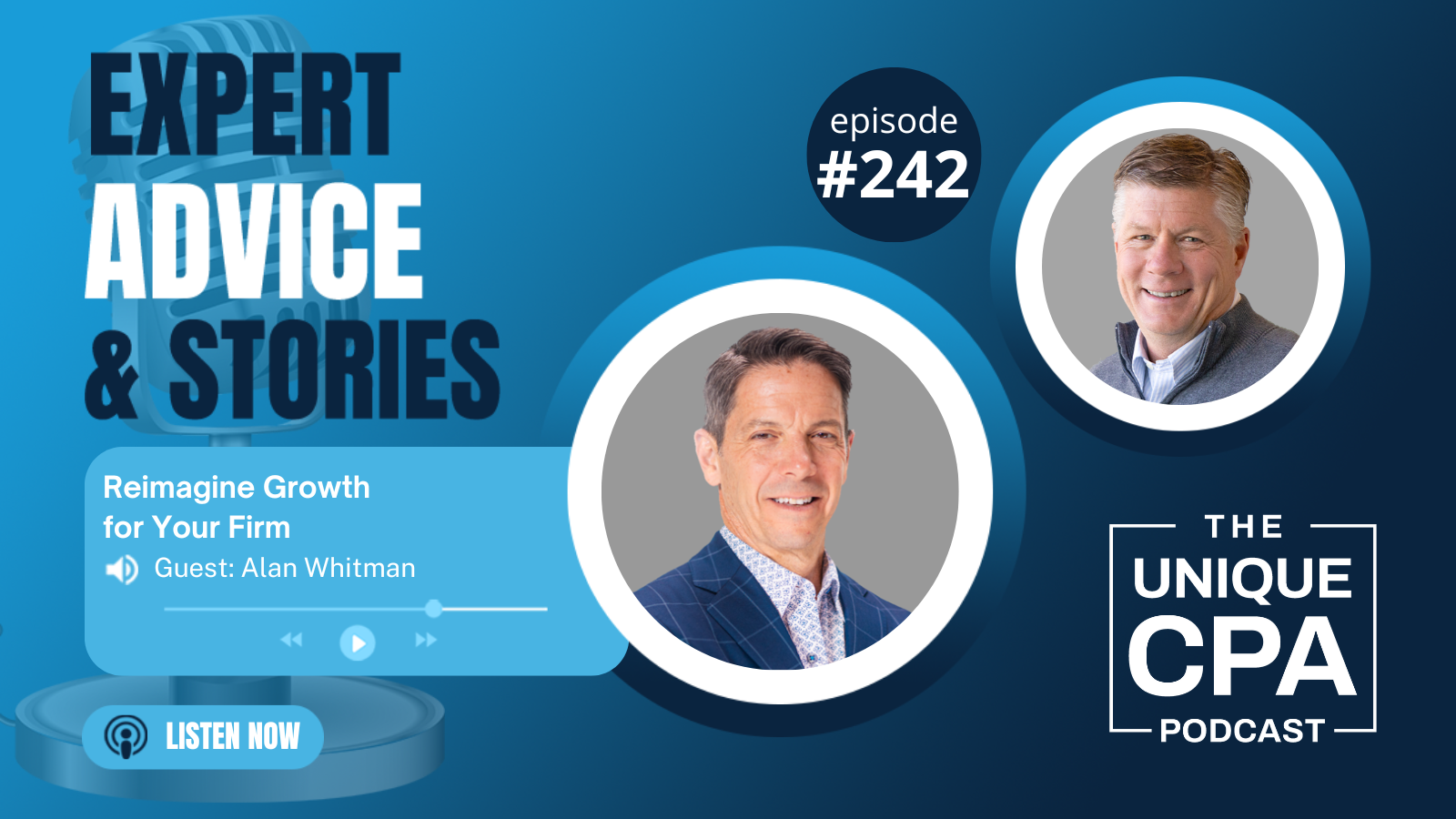
With Alan Whitman
Alan Whitman, former CEO of Baker Tilly, returns on Episode 242 of The Unique CPA to share the hard-won insights behind his new book, Break the Mold: How to Achieve Transformational Change, Scale and Grow Simultaneously. In a candid conversation with Randy Crabtree, Alan unpacks the real challenges of leading a firm through rapid growth and cultural reinvention, where trust and transparency mean everything and can ultimately make or break a vision. He reveals why strategy must be more than a buzzword, and how shifting from vertical silos to a unified, horizontal organization unlocks potential. “Cross-selling” is such a limiting concept, and Alan stresses that delivering true client value is what firms need to be focusing on. His stories, from tough retirement plan decisions to building engines for organic growth, offer a rare, practical roadmap for leaders ready to reimagine what’s possible in the accounting profession.
Today’s guest is Alan Whitman. Alan is a repeat visitor to The Unique CPA. His first episode was probably about ’22 or ’23. We’ll put it in the show notes. We’ll reach back and look at that. But as you’ll recall, Alan is the past chairman and CEO of Baker Tilly. And on today’s episode, we’re very excited—I’m very excited—we’re going to discuss his new book, which is Break the Mold with the subtitle of How to Achieve Transformational Change, Scale and Grow Simultaneously. Alan, welcome back to The Unique CPA.
Thanks Randy, really happy to be here. It’s going to be fun to spend a couple minutes with you, it always is fun and looking forward to sharing my thoughts on the book that’s coming out soon.
Yeah, it’s pretty cool. Because when you and I originally talked, you mentioned the term, the phrase, “break the mold” to me. I didn’t know at that time you were turning this into a book, but that’s pretty cool. So why don’t you give us an idea of what is this book, what’s it about? I mean, that’s deep. Obviously you can go on for an hour, or more. But start with the summary and then we’ll dig into certain aspects of the book.
Yeah, thanks Randy. Look, the scaling and transformation of Baker Tilly is a great story. It took a lot of people, took a lot of trust, took a lot of people having blind faith, and it took a lot of re-imagination of what CPA firms have been known to be and that are slow moving, kind of looking out the rear view mirror and very slow to change. We did all of that and we scaled and grew and transformed simultaneously. And look, there’s a lot of great stories out there. Baker Tilly is one of them, yet there’s not a lot of books. A lot of people talking about it, soundbites together, but there’s not a lot of books out there. And so I wanted to share the story. I wanted the things that we went through, the challenges that we had overcome, the mistakes we made, the pain that it took, let’s say, to be out there so that people can read about it.
And this isn’t for necessarily the large firms or the firms of Baker Tilly size. It’s for everybody. It’s for frankly every aspiring leader to think differently: How can you individually break the mold? I get asked that all the time by people that are not CEOs: what does that mean to me? And so I wanted to give people a real life account for what we did, and in the back of the book is a workbook of sorts of things you can do to quietly think about how you transform to scale and grow a firm. So this is for everybody’s benefit who don’t get to talk to a lot of leaders that have led these transformations. You know, it’s a pretty private brotherhood, sisterhood, if you will, so this is an opportunity to share with as many people that are interested in learning how to, as I say, break the mold, reimagine the future.
I love that. And you and I talked about this on the first episode. I can recall that conversation. I didn’t listen back to it, but I know we talked about things like that because I found it so refreshing that somebody who built a $1.5 billion firm was looking to not do the selling method and do things differently and reimagine the way a firm can run. And I know you and I have been fortunate enough to talk to you quite a few times since we first met, and honestly, I don’t remember, ’22 or ’23.
’23 I think, yeah.
Yeah. And so it’s always refreshing to hear what you say about this. And so let’s go into some of those things you talked that the book is going to help people with and just the pain points you went through, the mistakes, the challenges. Is there, before we even get there, is, let’s look at the outline of the book. Is it broken down by like those sections or where would we see a good summary of that?
Yeah, so if you think about the chapters, there’s a chapter you know of, okay, how it all started? There’s a chapter on building because you’re going to have to have trust if you’re going to go on this long journey, you’re going to have to have a lot of trust. If you’re going to go in an area, you just don’t know what’s what, what’s on the other side. There’s a chapter on, as I like to say, “all roads lead to and from strategy.” Many firms, they just accumulate clients, accumulate revenue, and they don’t do it with a strategy. So all roads lead to and from strategy. There’s a chapter on “words matter,” what you say and how you say it matter. And there’s a ton of examples on words and phrases that I use to depict the “future” and “progress” versus “change or upheaval or transformation.” There’s a chapter on building engines to do things with people for people. And this is where some of my former colleagues didn’t like what I said, despite people, because at the end of the day, people are our biggest asset and unfortunately, they’re our biggest obstacle—we don’t like to change. There’s an entry in the book that says human nature is undefeated. Somebody I work with in a former gig of mine shared that with me, I thought it was brilliant. Human nature is undefeated. Human nature is just human nature, and it’s really hard to change it. Right? And so there’s a chapter on building engines to do things with for.
So the organization is pushing itself forward versus it’s not just a sum of the parts organization, it’s a whole made up of its parts. There’s a chapter on M&A, strategic M&A, not just accumulation M&A. There is a chapter, I couldn’t finish the book without writing a chapter on PE, because that’s the fun buzz word, and I take a different view on PE than some. And then there’s a chapter on commonalities. What I’ve learned, Randy, since retiring from Baker Tilly, as I’ve worked with $30 million firms, $70 million firms. I was just talking just before this call with a $50 million firm and the CEO was like, oh, I think Alan we’re too small for him. And it’s like, no, because Baker Tilly was made up of $50 million firms. If we did 21 or 22 deals during my tenure, the lion’s share was between $20 and $50 million. So some say that’s a small firm. I say it’s a big company. It may be a small firm in the profession. So again, commonalities. Everybody is talking about the same stuff, dealing with the same stuff, which is why I thought, or I was convinced, or I am still convinced that the principles in the book could apply to a $5 million firm, or a $500 million firm, or a $5 billion firm.
And so those are the different chapters. And there’s some others as well. There’s a workbook in there at the end. Those are the chapters, the kind of the themes, strategy, words, language, engines, the trek towards maturity. What do you, how are you as a small firm versus how are you as a mature organization? I didn’t say bigger, I said mature. So that’s the roadmap of the book.
Okay, nice. So the book, obviously a subtitle, How to Achieve Transformational Change, Scale, and Grow Simultaneously. And one of the words you said at the beginning when talking about chapters was “trust.” Is trust one of the first things you think you need to build in when you’re trying to do this transformational change? Or where does trust fall into this equation?
Oh, it’s huge. It’s a non-starter as much as strategy is. Look, when I became the CEO of Baker Tilly, we were transforming, my predecessor, Tim Christian, a goat in his own right, was building the firm, was acquiring a number of organizations, scaling it, accumulating things. And he had a group of partners that had built the firm from the past, and that was changing right before their eyes. And so they had their own issue of trust that the organization was changing from what they built to something new. You had people coming in that were promised something, and they got to the organization like, well, wait a minute. That’s not what you told us. It was like, I know we’re trying to move the organization. So we had, we had kind of, I say war in camps, but we had two groups, and so I had to build trust. We had to build a bridge between the two, at least to connect us and then build trust that it wasn’t going to hurt, it was going to be painful, it was going to take a lot of focus and a lot of discipline. But they needed to trust the vision, they needed to trust the evangelizing I was doing. They needed to trust to get on the bus, so to speak. And so trust is enormous, in order to be able to successfully transform. Not just grow an organization.
Yeah, it’s so when I talk about trust, I think some of the things, so I love starting at a level of trust. Sometimes you have to earn the trust. But some of the things that I think when you’re out there and you’re doing this and you have this vision and or the whole organization has the vision, you’re the leader of it. When you’re talking trust. I mean, some of the key things I think is that, you know, you’re intentional about cultivating trust. You have to be transparent in everything you’re doing, because if people don’t see the vision that you have or it’s top secret and all of a sudden you’re just saying, okay, here’s where we’re going next without any warning, that trust level is hard to maintain. But then also just vulnerability, like, Hey, no, we’re all in this together. I don’t have all the answers. I need your help. And so, I mean, one, do you agree with those three? Are there additional ways that you can keep that trust level high?
Well, you used a really important word, and that’s transparency. And then I’ll add to that: communication. It’s, you’ve got to say the same thing over and over. You’ve got to commit it to memory, you’ve gotta be rote, you’ve gotta have your “isms,” which throughout the book you’ll see I’ve got a number of “isms,” my way of communicating. And you’ve got to be very, very deliberate in the communication. And then you’ve gotta recognize, listen, you’re not going to like everything. Frankly, I didn’t like everything. We had to invest and that was taking money outta my pocket, so to speak. And so you’re not going to like everything. And I had a phrase, you’re not going to like this and it’s okay not to like it. I just ask you that you respect it because we’re doing it on behalf of the organization. At the end of the day, everybody was much better off financially than had they just sat where they were. But it’s okay! It is okay not to like it. And once you tell somebody they can dislike or hate, even hate something, it kind of takes the air outta the balloon in the room. Like, “Oh, so there’s no argument here.” I’m like, no, there’s no argument. I get it.
I remember one story, Randy, quickly, we were changing our retirement plan. Our retirement plan was as an equity based plan. Then we went to an income based plan, a multiple of earnings, you know, compensation. And we were at like three and a half. And this is, this is public. Everybody knew this. We were at a three and a half times earnings and I said, listen, it’s too rich. It’s going to spiral even though Mercer every year said our model worked well. Yeah. If the interest rate was this, and the growth rate is this, you can mathematically calculate anything. It’s like going into an auto dealership and saying, I want to buy that car. Well, what payment do you want? Well, don’t solve for the payment. Solve for the purchase price. And so I remember I was sharing with the partners that we were going to change the retirement plan and everybody had hit, you know, or a bunch of accountants. We had done our calculations, we had had our spreadsheets. I said to the partners, I said, listen, I know you’re not going to like this. I’m one of you. I don’t like it either. And we need to do this to save ourselves $75 to $100 million. And once I took the air outta the balloon, it was like, yeah, I hate it, but it’s the right thing to do. And so it passed unanimously.
So look, I think that trust is one where people, even if you don’t know where you’re going. Here’s a quick story: I remember we did our strategy session in 2018. Great work. I said, listen, I want to be $1.5 billion by 2025. This was back in 2018, and the mathematicians of my leadership team, the two of them went in the back room and they did all sorts of math and they said, Alan, it is impossible for you to get to $1.5 billion by 2025 unless you do this, this, this, and you know you have to do it. And I said fine, let’s go. We’re going to go do it. I don’t exactly know how, but we’re all going to do it together, and we accomplished it two years early. Because everybody trusted that we don’t have it all figured out and we’re going to do it together. And that’s, I knew we had something special when people were ready to jump on the bus and we really didn’t have that trip tick to take us down to Florida. We were going to get there, and head south, but we were going to have detours along the way.
Well then I think that probably ties into it. I know one of your fun things to talk about. You enjoy a strategy, and so why don’t we dig into strategy and how that plays into this transformation.
Yeah. To me, an organization needs to be a whole made up of its parts versus the sum of the parts where every partner, every person has their book of business, my book, my client, and you just add it up at the end of the year. And that’s by and large how smaller firms are, because they’re just racing to make a number, whatever the number is. I said, listen, if we’re going to shift from being a vertical organization where everybody’s doing their own thing to a horizontal organization where people are working across the organization, we needed a framework. We needed a strategy. And so we spent a lot of money with a very talented firm building a strategy, and that gave me the framework to, and us, not just me, us, the framework to make sure that people weren’t off doing their own thing; no, we want you to build your plan, individual plan, to enable your practice’s strategy, which enables the firm strategy. It’s the old phrase, “discipline equals freedom.” If we have the discipline to know that we’re going to do this and not do everything, that actually gives people the freedom to explore. Because we know that we’re executing plans to enable that strategy. Jocko Willink, I think it was out of the book, Extreme Ownership, he coined that phrase, “discipline equals freedom.”
Now, a lot of people were like, well, you know, kind of, you’re ruining my entrepreneurial spirit. This is not, I’m like, no, I’m not. I’m giving you us a framework so we know how to gauge each other. We know how to gauge what we’re doing, and it enables us to make decisions, Randy, of what not to do. We can’t do everything. I remember when I was thinking about how the firm was made up and I asked finance to give me a spreadsheet or a picture of all of our service revenue. And we had two really tall Lego bar graphs, two tall bar graphs, audit, tax. And then we had all these other small little lines, 2 million, 5 million, 6 million, 12 million, and we were a large firm at the time. And I said, man, this is making me really, really nervous because we’ve got too long of a tail. We’re doing too many things. We’re not building scale, we’re not building businesses within the business. We’re building practices, partner practices. Yeah. And that’s no way to build a $1.5 billion organization. And so I looked at that picture and it just dawned on me: We needed a strategy to enable us to build a few things, not everything. And it gave me kind of the rules of the road and gave everybody else the rules of road of, okay, this is where we’re headed and this is what we’re going to achieve. And now build the plans to achieve that.
Yeah, and one of my favorite episodes of The Unique CPA ever was one of the, I think, top, you know, maybe it was fourth or fifth where I talked to John SBA. I don’t know. Do you know John at all?
I know of him, yeah.
Yeah. And he talked like that and, you know, his firm, it was at the time, $14 million or something, and now it’s over $100 million. But that was the same concept he had. And so to your point, you know, this is not just for a $1.5 billion firm. They were a $14 million firm at the time and have grown because of that type of strategy. So I’ve seen it work in real life from that. I want to see how this ties into what you just said because, hey, there’s certain things we got to concentrate in these areas. You also have a newsletter, Break the Mold, same name, and I think it was this, was it this week where you talked about getting rid of the term “cross-selling?”
Yep.
Okay. And so how does that play in, because one, if everybody’s not siloed, doing their own thing, at least you’re horizontal and everybody can see what the client needs. So how would cross-selling play into what you were just saying there? Or not cross-selling because we’re going to get rid of that term!
Right, right, right. Look, I don’t think it’s selling. When you bring a client into the organization, your job is to solve their issues and deliver as many solutions to them—not just the solutions that you do—but the solutions that Randy does, and John and Sally and Sue, the entire organization, bring the entire organization to them. So to me, cross-sell, I mean, that’s, I don’t see how that really fits. I understand the terminology, but it just never, it never triggered with me. Look, I believe I’ve seen this vertical organizations: my client or my book, my practice, right? And early on I said, we need to become a horizontal organization, like you said, and that is we need to work across the organization. Years gone by when I, you know, back in the 80s when I started, we did everything. We did federal, we did state, we did estate planning. You know, everything was much more simple than it is now. And now with specialists and what have you, you become more specialized to make it simple. And you need to realize that you are acting on behalf of the firm to solve a client’s needs and to deliver solutions. And the only way you can do that is to work with the organization, with your colleagues. And so, to me, this is less about cross selling. This is about delivering value to a client by unloading the bus, so to speak, with them. And so, you know, look, cross sell, which has been the coined phrase, is nothing more than making sure you’ve got three or four services that you’re offering to a client. Because it’s all about, it’s, it’s frankly, Randy, about what they’re getting rather than what you are doing, right?
We in our profession define ourselves by what we do: We’re technicians, we’re subject matter experts versus, and this is what was taught to me when we went through our strategy build back in 2018. You need to take an outside in view, outside in client, what is the client getting, not a word, are, what are you doing? What is the client getting? The client is getting, I don’t know, value enhancement services or they’re getting peace of mind. Okay, well then how do you do that? And if you keep your eye on the ball of what are they getting, that will keep you focused on saying, well, in order for me to execute the strategy of delivering peace of mind solutions to them, well, in order to do that, I’ve got to bring Randy in, I’ve got to bring Sally in, I got to bring Barbara in, because I can’t do it by myself. So that’s where strategy and the ultimate mission of what your strategy says is so important. Don’t just think about yourself as an auditor.
I’ll give you a quick example. I was helping a $70 million firm. They brought me in to help them design strategy and one of their goals was to enhance the amount of advisory solutions they’re going to bring to their clients. They wanted to break away from being basically compliance-driven. And I was talking with a partner, very successful partner, who had built a book of business on what he can do, audits. And I just watched how his mindset shifted, when he said, “Well, I can’t deliver advisor services. I don’t have the skills. So what you’re telling me is I’ve got to bring all my partners in to work with me to bring those solutions to the client.” Now, some of us would think that that’s basic. Mut he had never thought of it that way because he had defined himself as, I’m going to build a book of business for audit. But when he, all of a sudden the light bulb went on, he’s like, whoa, this is a lot easier than I thought it was. I just got to bring my colleagues with me and they do the work. It’s a beautiful thing. I’m like, yes. And so people need to get out of their own suit, their own uniform, you know, and bring in the team. Then you’re delivering services versus cross-selling.
Yeah. I don’t know if this is in the book, but you’ve just made me think of this, and I’m pretty sure we talked about this last time, but I can’t help myself but bring it up again, customer on what the client’s getting and to me, starts thinking about what the value that you’re giving to the client, you’re giving them what they sometimes don’t even know they need, but they’ll see it when you go to it. But, I have to up pricing then, does that you talk about that at all in the book or no?
I don’t talk about pricing. It’s a sensitive subject as you can imagine. It’s a challenge, right? It’s a challenge. But no, I didn’t address it because it’s, I think it’s a lose lose, lose-lose chapter, frankly.
Oh, I know. It’s a tough one, but it’s things. At some levels are changing on that. I think there more and more firms are going away from the billable hour and, and honestly, I think you and I have talked about this in the past, I think that is something that has to continue and we have to solve for that at some level. For me, that’s what creates burnout in the profession is just selling our time rather than selling the solutions or the value to the client.
Oh, without question. Look, I was having dinner with Mark Mendola, and Mark was the US managing partner of PwC under Tim Ryan. Mark and I would go to dinner three or four times a year, and it was uncanny how the things that he was dealing with, with a $20+ billion firm, the same things that I was dealing with, with a $1 billion firm. And he said to me, he said, Alan, the firm that shifts from being a production firm to an outcomes firm will win. And look, there’s a lot of firms out there doing this. A lot of smaller startups, right? The subscription based organization, tech enabled. What’s not happened is it’s not been done at scale. That’s a huge challenge and, and look, getting into having an investor and financial reporting makes it even more difficult because they have to understand pricing and volumes, etce. We’ll get there. It’s just going to take a lot longer than we, than many of us want.
Yep. Well, maybe AI will help with that. Maybe there’ll be other ways to value what we’re doing. Alright, so we’ll get off of hours or billables right now, even though that’s a pet peeve of mine. And we’ll move on to some things in the book then, because I was very intrigued what you said about words earlier and using the correct words. So can you expand on that for me?
Yeah. I mean, here’s a great one: Why do we call it change management? Change depicts something happening to you. Why don’t we call it progress management? Progress! Progress management. I mean, it’s so silly. Okay, here’s another one: Staff. Why do we call people staff? They’re not kitchen staff. They’re not janitorial staff, and that’s no disrespect to the kitchen staff and… They’re CPAs. They’re four year degree people. Why aren’t they just team members? Well, I don’t get why we use the word staff. They’re not my staff. They’re a team and they’ve got a job and I have a job.
Look, I don’t ask the question any longer, “Can I do this?” Well, I might ask my wife, can I do something or another because she has the veto power. But outside of that, I don’t, I, here’s a, here’s a story, and there’s a lot of them in the book. Early on in my tenure as CEO, I had a managing partner meeting, and we weren’t growing very fast. We had lost our way with organic growth. I generated the idea of engines, and I can explain that if you’re interested. I was with, I don’t know, 15 or 20 managing partners, and I said, what will it take to grow at 10% organically? And they said, well, we can’t. We’re only at three or four. I said, I didn’t ask if we could, yes or no, I asked, what will it take? Well, we didn’t know at the time. We didn’t know. That question. Shift of not asking binary questions to asking open-ended questions generated so many new ways of doing things because people are challenged to come up with a solution. Tell me, is it $1 million? Is it $10 million? I don’t care what, tell me what it will take, even if it’s going to be crazy, I’m not going to like it, we’re not going to like it, but at least then we know what the stakes are, what the investment is. And so words like that, you know, I don’t like the word, “but,” you know, either/or. I like both/and. You know, it takes time to change your mindset and your vernacular, your lexicon. They matter. They do matter.
So there’s a number of examples in the book of if you’re trying to take somebody on a journey that they’re a little bit nervous about or they’re uncertain about, what have you, words and your themes and your messaging, they matter. For instance, there wasn’t a presentation or a gathering that I was a part of where I didn’t remind everybody what the mission and the vision of the firm was. And I used to laugh at that. I’m like, ah, you know, he’s just, just, he’s blowhard. He’s just, you know, I used to laugh at my leaders that did that, and then I realized, wait a minute, words do matter. The message does matter. It needs to resonate. You needed to hear it seven or eight times before you can commit it to memory. And so I do believe that the way you say things is extremely important. And some of them are simple and some of them might be corny. They matter.
Nope, I agree, I agree. My last keynote that I put together, I spent so long on just, was that the right word? Did I say that right? Is this really what I mean? So I’m no expert, but I agree completely and had somebody working with me on that, so that helped a lot. Alright, so you mentioned we could go deeper into engines and I do want to hear more about that.
So, professional services firms are storied for individual partners or professionals doing everything right. As my father used to say, they’re the chief cook, they’re the bottle washer, the maitre d’, they do everything. And in today’s day, you keep pushing, do more. You need to sell more. And you know, eventually it’s like they can’t, they run out of steam. They’ve got to sleep. They gotta take a break. And oh, by the way, they gotta do client work. And I remember we were struggling with growth. Because we were an individual contributor type organization, and we were the fastest growing firm. Baker Tilly was under Tim’s leadership from 2000 to 2010, and then when the great financial crisis hit, we just, you know, the spigot just turned off. We didn’t have, we didn’t know what to do.
I remember talking to Joe Adams, remember Joe Adams, right? He used to, I think I mentioned him to you. He was two CEOs ago maybe, of RSM, and I marveled at how RSM was growing as fast as it was being a large organization. I asked him, he said, well, you know, you get to be our size and you get to build engines that just do things regardless of what the people are doing when they sleep. And I’m like, wow, that is brilliant. It’s complicated, not very complex, but it’s complicated. And that’s when I said, alright, we need to build something that does things with our people, for our people when their heads down, serving clients and what have you. And then in spite of people who don’t want to sell, because you get to be $700 million, $800 million, $900 million, you think about 10%: $70 million, $80 million, $100 million. And that’s before you even count the work you lost. And so, so you need an engine. It reminds me of the generator we have behind the house that just keeps running and running and you don’t even know it’s there. Pretty quiet. And so we need to build the generator, the engine of organic growth to do things whereby the organization is pushing the people and pulling the people forward.
Because at the end of the day, there’s just only so much individuals can do. They can’t work 24/7. And so you need data analytics, you need messaging, branding, need SEO, you need all, you know, data, materials built for people, research done, knocking down the obstacles before you get into a meeting—all the things that go into promoting a company rather than the individuals just trying to promote themselves. And when we finally built the engine, we went from 4% growth, three to 4% growth to 12% organic growth. Because we were working together and we were working together to achieve our strategy. Which means we said no to a lot of things.
Yep. So the engine itself, a lot of it sounds like the behind the scenes marketing? Or am I misreading it?
It could be marketing, could be sales, could be tech enablement, could be, you know, all the things that I need… Let me, as simple as, alright, give me a suspect list. Give me the research on these companies. Run the analogies between companies so I can see similarities. Go do the data for our clients that are similar to this one. So I know what to go talk about. Yeah, build awareness. Somebody once said to me. a former partner of mine said, you need to generate unaided recall. How do we generate unaided recall when something comes up, oh, I should go to Baker Tilly for this, or, I should go to XYZ Company for this. Because I’ve seen them, they’ve communicated with me. I know they can do this work. Unaided recall. So it could be marketing, it could be branding, could be communication, could be a, it’s a number of things.
Yep. And when you were just saying that, what I thought of is, okay, going from concentrating on, you know, you had that long tail to, we’re really good at these certain things, I think probably assists in those engines, being able to get that out there.
Without question. Without question. Randy, we even consolidated different practices. We said they were different because one focused on municipal advisory or state local government, one real estate and one, I don’t know, healthcare, but the underlying service was the same, so we would consolidate them to build scale. We could have an external communication to the different industries, but we shouldn’t be building three different practices, we should be able to be one business that has capabilities in this industry, that industry and so on and so forth. And so that’s the transformation.
Because as you know, you’re in this business and you know how we think the leader of that industry practice and the leader of that industry practice say, well, I got to, I got to practice. I’m a, I’m a practice leader. What do you mean you’re going to consolidate us too? And there’s going to be one leader. I’m different than them. No, you’re not different than them. You’re really not. You guys are all the same. And we need to build scale. And that’s where people got, they got nervous and they didn’t like the fact that they’re, you know, I guess as you said, that cheese was moved. But in order for the organization to scale at the high rate, it was, we needed to reimagine how the organization operated, the practices operated, and how we delivered our message externally.
Nice. That’s where strategy comes in then.
Exactly. Exactly.
Nice. So. Before we, I want to get to a final like, you know, discussion of, you know, what you expect people there, what you hope people to get out of the book, but before we go there, there’s a couple other things you mentioned that were some chapters. M&A, which has been happening for a long time in this profession as long as I’ve been part of it, but then PE as well, which actually happened a long time ago, but is very prevalent right now. So let’s get into the chapters on that and what you talk about with M&A and PE.
Yeah. So M&A is a really interesting topic, because it can be viewed as something to accumulate just more, more revenue or pins on a map. Or the way I view it, it can enable your strategy. And there’s three legs of the M&A stool: One is geographic. And that doesn’t mean you need to be everywhere in every one stoplight city, unless you’ve got a strategy to do that. And I think like a CLA may have had that strategy to be everywhere. Okay, that’s fine. Then two is knowledge, that’s industry, and the third is capability. That’s service. And in my mind, sure, you want to acquire services to be able to deliver value to clients, right? You want to acquire knowledge to be able to deliver differentiated service to clients. The geographies are distribution channels, and that’s really where the brand is known also, where the brand is known. So to me it’s strategic M&A.
Look, I’ll give you an example, and this is in the book. An MP of mine, when I was Baker Tilly’s CEO came to me and said, we want to, I want to acquire a firm. And we were already pretty large in that city. And I said to him, I’m like, well, why? He goes, well, we’ll be fifth on the ranking table. So I’m like, why? I mean, for what? Well, we’ll be fifth. That’ll be better. I’m like, why? I said, unless you’re able to grow faster or you’re able to make more money, there’s no reason to go buy that. It’s expensive to buy it. Then just grow it organically. And so the strategy just didn’t, you know, bigger isn’t better, as my predecessor said, Tim, my mentor Tim, said, “Better is better.” And so will this make you better? Not just bigger. Now, in today’s day, and we’ll lean into the PE space, it’s all about EBITDA, right? It’s all about the financial aspect of this and EBITDA and multiples, so. If you’re able to buy EBITDA at a lower multiple, it could be very good financially. I don’t know if it’ll make you a better firm, but it’ll certainly make you more EBITDA and the valuation could go up. So, you know, there’s a balance there.
Look, I believe, shifting into PE for a second, I think PE or any external investor—PE, ESOP, family office, whatever it is—they are enablers. I’ve often said, I’m not so sure a mediocre to less than mediocre firm taking on PE is going to make them a better firm. It could make a good firm better, it could. But at the end of the day, they’re investors. They’re external investors. They’ve got a lot of resources, they’ve got a lot of subject matter expertise, they are investors. And I believe the biggest shift that people need to realize when taking on an outsider is the lifestyle business is gone. A lifestyle business, it’s not about having a lake home or having an extra car or anything. It’s about good enough is good enough. You run through a year, you achieve what you want to achieve or what you achieve and you’re like, ah, we didn’t meet the numbers we wanted to, ah, it was good enough. We had some headwinds. We’ll try again next year. And now, I’m not saying that bad things happen if you don’t make your numbers, but it’s much more intense to achieve a financial result or a strategic result when you have a third party inside the henhouse. And so to me, the lifestyle business aspect of the CPA world is vanishing because we’re becoming professionalized organizations, not suggesting that’s a good thing or a bad thing. I believe it’s a good thing regardless of whether it’s outside investors are in our space. because whether we admitted it or not, we were building businesses, not just building practices.
Yeah, we didn’t know that though, often.
No, you’re right. And now it’s coming to light. It’s like, oh my gosh. I was just on the phone with a $50 million firm that’s going to go to market in January and I said that that’s your biggest challenge. You won’t be able to be a lifestyle firm anymore, you’ll be a business and you’ll be building businesses within the business. Interestingly, Baker Tilly got that. We understood that and we executed very well. The team executed very well. Now, I’m sure that Helman and Friedman or their current sponsor took them to a whole new level, yet we had already adopted that business mindset, which enabled us to scale really, really fast—faster than most other firms.
I think it’s a good thing. I think maturing organizations is good. You know, whether these firms are ultimately succeed or not, I think a lot of them will. I think some won’t, but guess what? That’s going to happen whether PE was in the space or not. There have been a number of firms that have not made it, or that have decided to merge up, or that decided to disband that had been going on gradually over decades. We just didn’t focus on it. But now, my guess, message to the listeners is, PE isn’t the culprit. It’s people’s willingness to transform themselves. If something doesn’t work out, it’s not, it’s not the investor.
Yep. Change is scary for most people, so.
Yeah, it is.
Alright. So we went through a lot of the aspects of the book of what’s going on, but I think I want to kind of wrap it up with the workbook because the workbook’s obviously going to walk somebody through these processes to get to where they want to be. So give us a summary or, or not even a summary, you can go as deep as you want on what the workbook is.
Well, if you think about the chapters that I outlined earlier, you know, trust and all roads lead to and from strategy, words matter. There’s a part of the workbook that associates with, okay, what’s a workshop or a session to dive deeper in each of the chapters. You know, one of the chapters I didn’t mention, and shame on me, was the importance of building effective leadership teams. I spent a lot of time on that at Baker Tilly, and a lot of time we go very, very deep in what that means and objectors to progress, etc. And so there’s a part on that, there’s a part on M&A, there’s a part on strategy. So each of the chapters has a corresponding exercise, if you will, questions to ask, things to think about, which is what I’m using now with firms that I’m advising their leadership teams and the broader, I guess, their core leadership or their senior leadership and their broader leadership to actually take them through, okay, well, you know, because they’re asked, well now what do we do? Alright, well let’s pull one thing out of the workbook and let’s do it. Let’s ask some questions of what will it take, what will it take for us to be a horizontal company? What will it take for you not to be P&L driven? What will external view on outside in view.
I mean, really, you know, it’s the old adage of young kids ask why you say something? Why you say something? Why, what will it take? Because here I’ve got a company that I’m advising, we’re a little short on growth. We’re growing nicely year over year, but we’re short on our financial plan. And I said, so what are we going to do? What’s it going to take? And the answer was, well, we got to sell more work. I’m like, well, that’s not the answer. The answer is, what are we going to do where results result, where we generate more revenue? Well, we’re going to convert our pipeline. What are we going to do to convert our pipeline? And so you really got to get down very granular, you’ve got to go down a few floors in the basement to really think about, okay, wow. So we need to do this. Yes. You need to do that. Oh, that’s going to be hard. Yeah, it’s, but at least you know now. And so there’s a variety of things. You know, M&A, there’s a part of M&A, there’s a part of people development and leadership development or team development in there. And so they’re practical, not tricks, but they’re practical sessions and exploratory sessions that you can use to experience the first 11 chapters in the book.
Yeah. So that brings up a question to me. So when you look at the book, and you look at the workbook now, and you look at all the different aspects of what you did when you did this growth at Baker Tilly, and what you want to help people do if they’re looking to do this transformative change in their organization, is this a step by step, or can we go, hey, this is what we need help with now. Let’s go to this part of the workbook and this chapter and let’s integrate this. Do you envision one way or the other?
Yeah. Look, you know, what’s that phrase? You eat at something, one bite at a time, right? You can’t just do everything at once. And we were on an eight year journey. You know, I had been in the organization for a long time and realized that we needed to transform a number of things. I shared the entire story with my audiences. Mostly it’s the biggest shift is going from a vertical organization to a horizontal organization, meaning you’re not the sum of the parts anymore, you’re a whole made up of the parts. That’s one. And two, really three things. That’s one. Two is all roads lead to and from strategy, what does that really mean? And the third is M&A. What does M&A really mean? And understanding, and it’s really the decision: M&A, PE, merge up, you know, because people, they can’t get that out of their head. They really want to study that.
A company I was working with was like, we’re adamantly against this, we’re going to do it ourselves. And well, how do you know? Well, I trust my partners, we’ll grow at 10%. I said to them, I said, well, John, you’re not growing at 10% today, this year. So what’s going to change next year? He said, well, I know we can. Okay, alright. You know, and look, I don’t, I don’t force it. But we were not allowed to talk about PE and at the last session, one of the most cautious guys in the room looked at me and says, so do you think we’re crazy for not considering PE? And I’m like, Joe, no. I don’t think you’re crazy. I don’t think you’re crazy. You need to consider all these other things, because they’re here whether you know them or not. And so again, it’s vertical to horizontal. It’s strategy, of course, the engines. You know, look, we invested a lot of money in coaching and external facilitation that a lot of people just don’t have the stomach for.
No, and I knew you did that.
Yeah. The effective team thing. In fact, you talked to the woman, I don’t know if you’ve spoken with her, you talked to, to Lori, or you were going to talk to Lori Zukin, who led it.
I did.
She was instrumental in what we became and how we worked together. It’s expensive, you know, and it’s nerve wracking because you really got to peel back the layers of the personal onion, so to speak, to understand who you are and where you want to go.
Yeah, I think it’s important. I think it’s something that’s completely ignored in a lot of organizations, if not most. So I applaud for you for what you did, and yes, Lori and I talked recently and actually we recorded an episode of the show, which will be out probably in the next month or so. So she’ll talk a little about what she did with you.
I figured knowing who you are and what matters to you, you would enjoy meeting her.
Yeah. No, I appreciate the introduction. Well, Alan, this has been great. I’m really looking forward to digging deeper into the book. I didn’t get to do that before we talked, so now I got educated, now I got more excited, so we get to spend some time on it. But before we wrap up, and we talked about this last time you were on the show, I love talking about the fact that, you know, you are more than just what you do in the office. And so when you’re not in the office, when you’re doing, what do you do for fun? What’s your outside of work passions?
Thank you. We’re huge water people, so we’re boaters. And the summers we’re up in the Great Lakes, up here in Detroit, and as of Monday we’ll be down in Florida. So we’ll be in saltwater. We live in Florida in the winters. I just got a, had a wonderful week in France with my love of my life, Kim. We ate great food and drink. We love wine, so we collect wine. And I now have a new hobby and that is visiting my adult daughter in New York City. She’s working there. Nice. So I’m going to actually take my adult daughter out to dinner Wednesday night when I’m in New York for a board meeting. But it’s mostly, we’re on the water, with all of our toys and on our boats and we enjoy the water. It’s very, very rejuvenating.
Well, we’re going to have to get together and have a glass of wine one of these days, because I’m no expert, but I belong to a lot of wineries, so I’m starting to understand wine a little bit better. Mainly—not mainly—all California. So if you know your French wine, I’ll have to learn something from you on that.
We had wonderful French wine this past week. So it was really a joy.
Well, Alan, thanks for being a repeat guest on The Unique CPA and we will have in the show notes where people can get the book and get contacting with you, which we had on the last episode, so I’m assuming LinkedIn. Probably a good place for people to look.
If you want to know what I stand for, just go to LinkedIn. It’s all out there.
There you go. Well, again, thanks Alan.
Thank you, Randy. Appreciate it.
Important Links
About the Guest
Alan Whitman is a seasoned executive and highly recognized leader known for his ability to inspire and navigate people around bold ideas and uncomfortable change.
During his nearly decade-long tenure as Chairman and Chief Executive Officer of Baker Tilly US, the CPA and accounting firm grew revenue by 3x, went global for the first time while expanding into 15 new domestic markets, and successfully completed over 20 mergers & acquisitions in a matter of a few years.
An advocate and catalyst for change in the accounting profession and in the professions generally, Alan now operates an advisory business where he shares his experience to help CEOs and their key stakeholders Break the Mold of conventions to inspire and navigate intentional change, with Break the Mold also being the title of his new book, released December 14, 2025.
Meet the Host
 Randy Crabtree, co-founder and partner of Tri-Merit Specialty Tax Professionals, is a widely followed author, lecturer and podcast host for the accounting profession.
Since 2019, he has hosted the “The Unique CPA,” podcast, which ranks among the world’s 5% most popular programs (Source: Listen Score). You can find articles from Randy in Accounting Today’s Voices column, the AICPA Tax Adviser (Tax-saving opportunities for the housing and construction industries) and he is a regular presenter at conferences and virtual training events hosted by CPAmerica, Prime Global, Leading Edge Alliance (LEA), Allinial Global and several state CPA societies. Crabtree also provides continuing professional education to top 100 CPA firms across the country.
Schaumburg, Illinois-based Tri-Merit is a niche professional services firm that specializes in helping CPAs and their clients benefit from R&D tax credits, cost segregation, the energy efficient commercial buildings deduction (179D), the energy efficient home credit (45L) and the employee retention credit (ERC).
Prior to joining Tri-Merit, Crabtree was managing partner of a CPA firm in the greater Chicago area. He has more than 30 years of public accounting and tax consulting experience in a wide variety of industries, and has worked closely with top executives to help them optimize their tax planning strategies.