How to Streamline the New Partner Experience
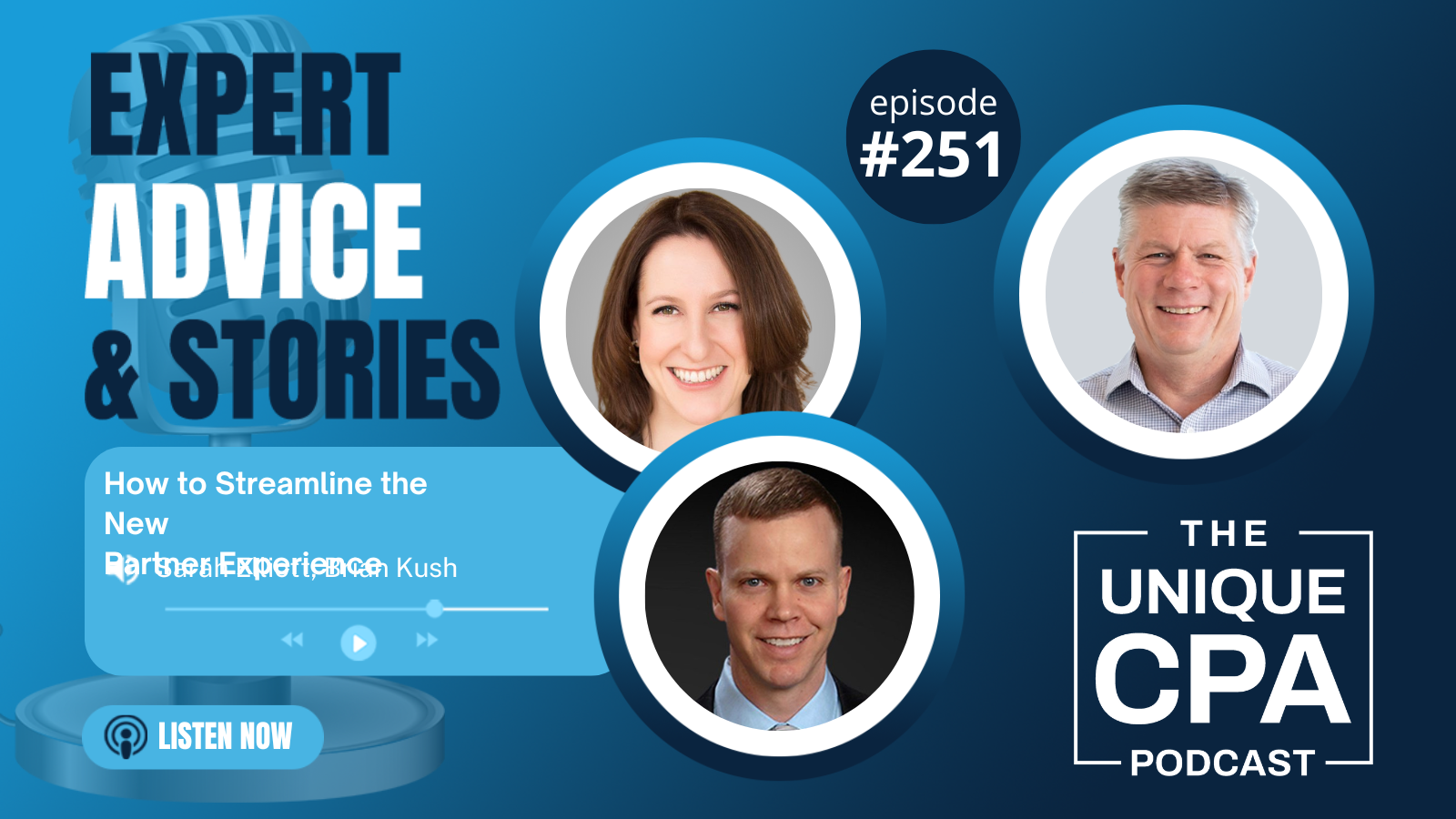
With Sarah Elliott and Brian Kush
Making partner should feel like a triumph, but for many CPAs, that first year becomes the hardest of their careers. Sarah Elliott and Brian Kush from Intend2Lead surveyed new partners across the profession and uncovered a troubling pattern: 70% aren’t working more hours, yet the intensity feels crushing. On Episode 251 of The Unique CPA, they tell Randy that the culprit isn’t volume, it’s the abrupt shift from technical expert to strategic leader, not to mention firms that rarely prepare people for what partnership actually entails. As it turns out, nearly half of new partners earn less than expected, and the profession’s problem-seeking mindset undermines leadership development. Randy even mentions how one first-year partner who exceeded revenue goals by 50% was immediately questioned about unbilled hours instead of celebrated for his achievement. Sarah and Brian make the case for vulnerable leadership, transparent goal-setting, and intentional development programs that treat partnership as a transition requiring real support, not just a title to celebrate and move on from.
Today’s guests are Sarah Elliott and Brian Kush, co-founders of Intend2Lead. At Intend2Lead, Sarah and Brian work with accounting firms to develop conscious, self-aware leaders—pretty cool—who build healthier, more intentional cultures—even more cool—especially at critical career transitions. One of those transitions is becoming partner. Through their coaching work, they keep hearing the same challenges show up again and again, which led them to create the New Partner Experience Survey. Today we’re going to dizg into what the data revealed, what’s missing in how firms support new partners, and what both firms and individuals can do differently. Sarah, Brian, welcome to The Unique CPA.
Yeah, thanks for having us, Randy. Excited to be here and share with everyone.
Yes. Thank you, Randy.
And Brian, I should have said, welcome back to The Unique CPA for you—second time visit for you.
Wow. I feel honored. Yes, this is awesome. I’m excited to be back.
Yeah, excited to have you. I’ve told you in the past, before we jump into this, I’ve told you in the past that I’ve quoted you often when I’m out speaking or at webinars. So if anybody’s listening to this and have heard me talk about Brian Kush and his three-step process on shutting down at the end of the day, this is something that has really stuck with me over the years, so thank you, Brian, for sharing that with, you and I did that both on this and on our webinar together, so thank you for that.
Thank you, yeah, thanks, Randy.
Alright, so let’s get into the survey, because it’s pretty cool. I love surveys in this profession. We do one for the profession and it’s just, when we see these surveys, we just find such excellent data that we can use to help support the profession and help the profession be the best it could possibly be. So when you were trying to decide, or when you did decide that a survey was something you needed to do, what caused that? What were you looking to discover, or what was the problem you saw out there that you needed to get data on to figure out how you could address?
Yeah, I guess I’ll start out and just say that Sarah and I have done a lot of work over the years with new partners, Randy, and what we found, and it’s been a strong finding, is that first year of partnership when you become a new partner in many ways can be, for a person who grows up in the CPA profession, grows up in public accounting, it can be their hardest year of their lives, of their professional career in a lot of ways. We’ve uncovered that through our coaching and working with firms and we realized there needed to be more to support them and to uncover the areas in which they needed to be supported. So Sarah and I have done a lot of work. We’ve done a lot of coaching in the area, and we decided, hey, let’s do a survey to really uncover the data and really get to what is hard about that transition to partner and being that first-year partner.
Yeah. And I would add, Randy, I think Brian and I have many years’ experience working with this group of folks, and so we had the anecdotal data, right? We knew it in our gut what the challenges were because they’re telling us every day, but we know our profession loves data, and we love the numbers. So we thought, okay, can we really dig in deeper and put it together in this report and really put data around what our intuition was telling us, because we really believe, as Brian was just saying, how critical this career transition is and how hard it is.
I remember it from my own promotion to partner years ago when I was still in the profession: It is tough because you feel like you are at the top of your game, and then you get promoted and you’re excited, you’ve climbed to the top of this mountain and you get there, and so often you feel like you’re starting over and you don’t know what you’re doing, and it’s this whole new world out there. It can be very confronting and we just feel like we need to support this group more, because this group I think is critical to the sustainability of our very profession, because if we don’t have these younger partners coming up and feeling confident and supported and wanting to make the impact they really need to make, we won’t be able to face the challenges that we have ahead of us.
Yeah, I agree with that completely. You know, I’m old, so I’ve been around this profession for a long time and the last 10 years or so when I’m up and talking to people, I mean, I’ve been talking to people in the profession for a while, but it’s become more of my job now, it just seems like there is confusion on what it even means to be a partner, and there’s a lack of transparency. And just, I mean one of the biggest things is just what the income potential is as a partner and I don’t think people know that. But before we even get to that, I know there were some key challenges that you kind of highlighted that happens in that first year, and I just want to go through the list real quick. The first one that was highlighted was making space for increased responsibility and self-care. So that’s, okay, I got increased responsibility. But now I’m supposed to take care of myself too. We don’t think about that in this profession. It’s like, I’ve got to work, I’ve got to put my nose to the grindstone. So what was that challenge and what did you learn from it? What are we trying to solve now with this information we discovered with this first challenge?
Hmm. I guess I can maybe start with this one, Brian, because I speak about this one a lot. What was interesting that we found in the survey, Randy, was when we looked at actual hours, around 30% of respondents said their hours went up, 60% said they stayed about the same, 10% said their hours actually went down. So if you think about that, they are feeling the stress and the intensity of those additional responsibilities, but 70% are not actually working more hours, right? If we follow the math on that. So it’s interesting, what is going on. That transition feels so new and different, because your day-to-day looks different as a new partner, so again, I think it’s the intensity of your hours feels different rather than the volume, right?
So they’re responsible for growing the business now, more firm administration, leadership. It’s hard for them to let go of the work that they’re used to doing, right? What got them here to partner won’t get them where they need to go as a partner. They’ve got to shift from the doing to leading, shift from tactical to strategic, so that’s just a lot for folks to handle. And it’s, as you said, Randy, it’s really easy to just sacrifice ourselves and say more hours, just all burn out, and we all know that’s not the answer. So we’ve got to support our new partners, they have to support themselves, and we have to give them permission, I think, as leaders, and remind them how important it is to do that.
Yeah, the self-imposed responsibilities and the way that they look at, now I’m a partner, I’ve got to be able to do all of these things. And so like Sarah said, it’s not even always that the hours are going up. It’s the intensity of the hours that they are working and putting that pressure on their shoulders, right? Saying, now I’m a partner, I wanted this for so long, now I’m doing this, now I’ve got to excel in it. And the idea that, hey, you know what, maybe I need to step back and ask myself, how can I excel in it physically, mentally, spiritually, all of the above, right? And like Sarah said, really prioritize self-care when, unless you’re intentional about it, you’re not going to do that in that first year because you’re putting so much pressure on yourself.
Yep. And so that goes back then to that, you know, do we prepare people to become partners? I mean, are we really, I mean, hey, we’re hoping you come into this organization with this goal of becoming a partner, but do we ever tell them along the way what that means? Because it sounds like often they’re just thrown in blindly to this position and like, okay, now you’re a partner, go do your thing, and make sure you still bill your 2,000 hours or whatever, but now you’re going to lead too. And so is there more management training skills or leadership training skills that need to come in so that they are more prepped so they don’t put this extra stress? What do you see as the solution there?
Yeah. Gosh, I have a few thoughts on that, but one is absolutely we should be preparing folks on the path to partnership, right? With leadership skills, management skills, letting them know what the expectations are. But what’s interesting, Randy, is we’ve worked with clients who do that and who do that well, but I still think folks just aren’t going to know what it’s like till they get there. So yes, we should prepare them, do everything we can to support them so they’re as ready as possible, and then I think our new partners still have to give themselves the grace to say, it’s still going to be probably harder than I thought it was going to be, because you just have to live it and do it.
And I’ll say something else is, people who are already partners, I’m not sure they always do a great job of modeling and sharing what they’re really going through with those on the path to partner. So you talked earlier, Randy, just about sometimes a lack of transparency that we can have in this profession, and I think sometimes we think as leaders we’ve got to hold information back, or not share some of the struggles or challenges. But then I think we’re doing everyone a disservice because then people get there and they’re surprised, right? Because, oh, you never talked about this, I just thought the partner life was glorious all the time. So I think it’s, yes, we need to prepare our partners with training and leadership and skill building, but also modeling and sharing more about what is it like to actually be a partner.
Yeah, I was going to say there’s a good distinction there. We spend so much time trying to climb the mountain to become a partner, but that’s different than actually being and sitting in the seat of a partner. So like Sarah said, we’ve coached many people that when they are a little more intentional and they think about not just making partner, but what’s the lifestyle I want when I sit in that seat? They’re going to probably do better, but also, like Sarah said, they also need to realize that first year is not, it’s not predictable in a lot of ways. One thing I will say, Randy, is that we’re excited for people to read the survey before they become partner, right? And to learn from it. That’s one of the big benefits. When you become a manager and you just think about becoming a partner, maybe it’s five, seven years off. We think it would provide you a lot of planning opportunities if you read the survey early.
Yeah. And I’m sure this data and the survey in general is, I mean, I can see this becoming this workbook for partners. I assume, I know you might have ideas already, but this is the path to partner, this is what you need to know, these are the things that are going to help you survive, especially that first year. But Sarah, I want to go back to one thing you said: I think too often, leaders—partners—in organizations, are afraid to show that vulnerable side of them, afraid to show, “I have to be stoic. I have to show that I’m the strong leader. I can’t show that I make any mistakes. I can’t show that I don’t have all the answers. I can’t show that I struggle with something,” whether it’s in business or personally, and that is, I think, completely backwards from what leaders need to be. I’m going to go on my rant here for a second. But for me, vulnerable leadership, and I’ve studied this not as deep as I want to, even deeper, I want to go into it. But the bottom line is when you display vulnerable leadership within an organization, it increases positively just about everything within that organization. You can’t be innovative and creative if you’re afraid to show you made a mistake. And so if we could, even before we get to those first-year partners, if we can just start training people and organizations the importance of vulnerable leadership, you’re both shaking your heads, so I assume you agree. I’ll let you jump in on how you think this could have an impact on organizations, firms.
I mean, we want you to rant away on that, Randy, just keep going on that. Yeah, we couldn’t agree more. You know, we’ve learned over the years the power of being vulnerable, of being vulnerable first as a leader, what it means to be a leader who does that. And Sarah and I have actually found in a lot of our training programs, and a lot of the ways we work with firms to help people prepare to become partner, and then when they sit in the seat of partner, that the idea of developing your vulnerability skills is such a big part of that, right? And what we found is, if you can support your people in a way where they’re able to be vulnerable—and especially in a peer group, right? If you have a new partner group, it’s a couple people at your firm or maybe it’s a large firm and there’s lots of people in that cohort, and you can get them into a safe space where they can share and relate and sort of normalize what they have to go through and how hard it is, that can be extremely empowering. We found, not only is it empowering in terms of confidence, because I’m not the only one going through all this tough stuff, but it does help them develop those skills, those relational skills, and those vulnerability skills that are key in today’s profession that we couldn’t agree with you more on that.
Yeah. Something that’s really amazing to witness is when, as Brian’s saying, in these cohorts, these cohort groups that we create, and in the small group coaching that we do, it actually builds their confidence to share their challenges. They can’t even fully tackle all the challenges and solve them, but there’s something about, wow, by sharing them and knowing, like Brian said, that that’s normal and other people have that as well, they leave feeling more confident. And I think it’s really interesting because we tend to compare ourselves, what we know is on the inside, kind of our messy insides, to everyone else, what they show the world on their nice, clean, polished outside, and then, you know, Brian and I are privileged to do a lot of coaching for some amazing leaders in this profession. And I don’t know about you, Brian, but I always say, I haven’t met one yet who thinks they have it all together. But yet we all look at each other and think everyone else does, right? So that vulnerability, it’s this connective point, it helps us normalize our experiences, connect with one another on that human level. Like you said, Randy, it fosters more innovation and creativity because we’re not so afraid or pressured to be wrong or to look bad. It’s like, “Oh, I put so much energy into putting the mask on for work and looking a certain way and making sure people think a certain thing about me” versus, “Wow, if I actually use that energy instead to tackle a challenge or solve a problem,” that just shifts everything.
And this really shines through in the new partner experience because think about it, “I’ve now made it to new partner. I’ve got to look good to everyone. I’ve got to show that I belong.” Sometimes what we found is there might even be people that get promoted to new partner, and they’re like, “Wow, I don’t want the other partners, they shouldn’t have invited me to this group, right?” So there’s a lot of like, “I’ve got to look good, I’ve got to look professional, I’ve got to be the strong leader that everyone else sees,” when in some ways it can actually be the opposite. When you’re more vulnerable, when you’re more apt to ask for help from others, that’s the leadership that you need to use and model for others. So it is, it goes against each other.
Yeah, that’s one of my, if not top things that more people need to do in leadership is show their own vulnerability because that just, I can rant on that forever, so I’m going to stop. But there’s another thing that I’m really interested in, and this is something I’ve been starting to study up on a little bit—I want to write a new keynote on it. And this is this whole like, stages of your career, like, you know, you start in your career and you know you want to be the best technician, whether you’re audit or accounting or tax, whatever, and you really dig into those skills. But then as you grow, you become this person that’s gained so much knowledge and you’ve seen so much and you have these leadership abilities that you don’t even really know because you’ve just concentrated on this technical. I know one of the things that you found in the survey is that this whole transition from what your prior role is, which is probably a lot more technical, maybe some business development in there too, as you’re coming up to partner, but into this more strategic leadership role, which I think is so important and we often ignore that. That was a challenge you found that was facing new partners. What did you find around that?
Yeah. If you think about it, Randy, just to go back to some of the things you just said there, in a lot of ways the reasons people get promoted, espec ially early on in their career in this profession is because they’re good technically, right? They’re able to get the stuff technically accurate and right, and all of that. And so they are patted on the shoulders, promoted for those reasons. When you become a partner at an accounting firm, there’s more responsibility on you to not just be working on your engagements, but to be working above them, and to be thinking about what are the strategic things I need as a business owner now. And so that’s a big shift for people because they’ve been rewarded, they’ve been promoted, they’ve received positive feedback for all of the work that they’ve done in the past, and now—and Sarah and I say this a lot—they’ve got to stop doing the work and making it alright themselves and instead getting all the work done through other people. That is a big transition. Being a leader of leaders is a huge transition.
What that does is that allows them to do more strategic work, more strategic priorities within the firm. So that is a huge transition, that’s hard, it’s hard to give up the stuff that we’re good at. Think about it now, they’re going to be doing new stuff that they haven’t done before, they haven’t sat at the seat with the other partners. And so what we tend to do is when we struggle with new things, let’s go back to the stuff that I know I’m good at and people reward me for. So it can be very much a challenge for partners who want to contribute at that higher strategic level, but they’ve been good at and rewarded for the other work they’ve already done. Sarah, do you want to add anything to that?
Yeah, I’ll just add that it is hard to let go and what we hear a lot is, “but it’s not going to be done as well if I let someone else do it.” And so there’s a lack of trust there, and I think there’s also unrealistic expectations. Because of course it’s not going to be done at the level you’re doing it because they don’t have your level of experience. But again, when we shift our mindset to more of that beginner mindset, we shift our expectations of ourselves and others and say, “Okay, I’ve got to stretch out and try new things, and I’m not going to get it right the first time, and I’m not going to be perfect at that, and I’ve got to slow down and learn. And then I’ve got to remember that my people are doing that right when they’re taking over the things that I used to do. And can I have more safety for them to fail and safety for myself to fail as well?” And that makes our accountants who are such high achievers, they got to partner because they’re very high achievers. They don’t like that at all. So just again, like it’s a mindset shift.
Sometimes I feel really good movement in that area of their mindset when they realize that, you know what? There was someone in their career that let them struggle a little bit, right? That let them fail. There was someone in their career that gave them trust that maybe they hadn’t totally earned, right? And so they have to sort of go back to that instead of just focus on, oh, I’m a partner now and everything’s got to be perfect, think about the growing that we all go through and the struggles and the failures to get to where they are. When they remember that and realize that the people that they’re trying to lead, they do a better job of letting go of some of that.
And I think part of that is on themselves, obviously that mindset, but it’s also, it’s leadership above. It’s these partners or the leadership in organizations that were there before they became partner that maybe has set this expectation that this is what we’re going to do. And I’ll give you a quick story on this because I just talked to somebody recently: This was a first-year partner, this individual became a partner. He told the story to me and I was like, in shock when I heard this story. Became a partner, first-year partner, had a goal—let’s just pick a number, a million dollars of revenue to be, to generate from, I think it was his group. So whatever the number is. But we’ll just say there was a million dollars. End of the year, hit $1.5 million. Was super excited, and he did that by empowering others. He had his group, he told them, “Okay, this is what I need you to do, I don’t care if it takes you twice as long as it’s supposed to. You’re going to learn from that. We’ll talk about it. I’ll help you through it, and you’ll get better and faster.”
Went through this, 50% above his revenue goal, went into that partner review, the first partner review, and was super excited, “look what I did.” I mean, he felt so good about what he did, and the first question that he got in that partner review is, “Well, how are you going to make up that 300 hours you didn’t bill?” I’m like, what? He just crushed the numbers you gave him and that’s your first question? And so I guess my point is, I think there’s a, you said “mindset.” Both you and I love talking about mindset. There’s a mindset in this profession that I think we are only worth the hours that we put in, and he just proved the difference there. How do we take this, what you’re doing right now, and make sure it’s not just new partners, but these partners that have been leading these organizations for a while realize the mindset that they’ve used for years is antiquated and we need to rethink these things?
Gosh. So what’s interesting, one thing I’ll mention about mindset, actually what stood out to me in that story was how interesting you have someone who performed and blew their goal out of the water, and the first thing you’re going to do is pick on a “problem?” So I think one of the things we see in accounting is we have this mindset of looking for the problem, right? We’re always seeking out the problem, the error that’s got to be fixed, and that makes us really good at our jobs technically, but when it comes to leading people, we need to shift that. We need to look for what is working and what can we celebrate here about ourselves and one another. And wow, for that person to go into that review and feel really honored and acknowledged, like, you blew this out of the water, way to go, what did you do, what worked? Like there’s so much missed opportunity in the learning and the growth and the support of somebody. So I think one big mindset shift in our profession is, hey, let’s just quit seeking out all the problems when it comes to our people and look at what’s working and appreciating that and learning from that because there is gold to be had there, right? Like that person was doing something that others need to learn from.
Yeah, and he was bringing up this next generation too. He was training them, he was giving them all the tools that he has been wanting to share with others, and then he just got shot down. It was crazy to me.
Right. One thing, Randy, just to work off of this is that we did learn in our survey is that formal and transparent goal setting, where it’s highly transparent: “Hey, how are we going to measure success for our new partner,” right? And we really encourage the partners to sort of take control of that process and say, “Hey, here’s what my goals are. Creating your goals, being intentional about it. What are my full goals? Not just billable hour goals, but all my whole life goals, my lifestyle goals,” all of that. But also having transparency and being on the same page with the firm, so you don’t get to a place that you just described where it’s like we’re measuring apples over here and you’re doing awesome with oranges over here, yes.
I will say this also, the idea of a billable hours lifestyle, the idea of what we value at a firm, that is a traditional challenge that we have, and again, points to why we need new, evolved leadership in our profession, and we need our younger partners to challenge the status quo on that. I’m sure we could do a couple podcasts just on that topic, you know, and get all fired up about what we always value or what we should be valuing in our profession. And again, not to say that’s the wrong value, just that we need to challenge what’s working for everyone.
I agree. I agree. Because if we just start talking about hours now, you won’t stop me. So I think billable hours, I think that is the thing that creates the, you know, when we talk about burnout in this profession, I think that’s number one is I’m only worth the number of hours I put in. If I need to, if I want to get ahead, I’ve got to put more hours in. And that’s just…
Yeah, if that’s what you see around the office and that’s what’s being modeled and that’s the one way to be successful, I can see how mentally that can burn people out for sure.
Yep. So, alright, so let’s go, there’s actually, it’s funny that the challenges you have found in this survey that really tie into what we were just talking about, and one is that this could be part of it is navigating firm politics is one of the biggest challenges they found. So what were you seeing in that challenge that new partners were dealing with?
I mean, I can start on that one. It’s very intimidating in general, right? Just generally speaking, what we see with our new partners is you are now sitting at the table with people who used to be your bosses and you’re wondering, “What is my place? I have things to share. When is it okay to share? Sometimes I don’t even know what they’re talking about at the table, and there’s context I’m missing from years before I was here,” maybe there’s some business experience and savvy that the other partners have that they haven’t quite gained yet, because they don’t have the experience. And you know, Brian mentioned this earlier, there’s pressure they put on themselves of not wanting to look bad or ask a dumb question because I don’t want those people who promoted me to regret that, so I want to show that I know what I’m doing, but I don’t.
And oftentimes too, what we see is there is a real desire to make change; they wanted to become partner because they want to make a difference and they put this pressure on themselves to say, now that I’m in the seat, I’ve got to make change like yesterday. And wow, that’s a lot. When we just talked about all the changes they’re already making with day to day and getting the work done, and getting work done through others and having more leadership responsibilities and strategic mindset, and now you think you’ve got to change the firm?
Right, and Sarah, they’re the bridge, right? They’ve been the manager in the past and they’ve been part of the people down there, and they see all the change and now they’re in the partner seat, so they put that pressure on them. “Oh, I’m going to be the bridge between the change that the younger people want and the maybe the change that the partners are resisting, and once I’m partner, I’ll be able to make that change and I’ll be able to make it, you know, quickly, because I know what I want and then I’ll be a partner and I’ll get all the authority I need.”
Yeah. Well, the other thing that’s happening too is since they are that bridge that Brian mentioned, they are hearing the things that people that are on their teams, they’re coming to them because they feel more comfortable as a newer, younger partner, most likely. And so they’re sharing things and they want to help and make the change, but then oftentimes they’re not even privy to all the information when firms are making decisions. And so they’re trying to be a bridge, but sometimes there’s a disconnect and that is really challenging in year one, two, three, first five years, it’s challenging. Especially, you know, like I said earlier, when you’re navigating all the other things that are required of you in that transition.
Yep. Alright, so one last thing I want to talk about in the challenges that you saw, and is that we talked about lack of transparency in general, but what really about just partner compensation as well and the unknowns going into that. What have you found in that with the survey?
Yeah, so I’ll actually share some of the numbers first, Randy, and then some of what we hear behind the numbers. So the survey found that a majority of new partners, so almost 60%, receive higher comp upon promotion, 25% said the same comp, the rest make less than they did the year of promotion compared to the year prior. But here’s what’s really interesting: Almost half reported that their comp was less than they expected.
Oh, wow.
So we have this expectation gap here. So what is going on? You already said it, Randy: Oftentimes there’s a lack of transparency around comp, confusion around even how you’re paid, what shifts, especially if you become an owner, you may have draws, distributions, you have capital contributions, things just change. You have tax implications around that. So you go into your promotion to partner thinking, I’m in the money. I’m so excited, I’m doing it, and then you have to make these contributions and then you have tax implications and it’s just different than what you expected. And oftentimes firms are not alerting their people to this before.
The other thing we see is when you get to partner, oftentimes the variable part of your comp, there’s not a lot of clarity on what you need to do to get that bonus: What is expected of me? How can I excel here? And so that really makes people feel this lack of agency or control over their own comp. “Well, I’m doing as well as I can, but I’m not sure how you figure out my comp.” So there’s a big disconnect there and that’s very challenging. And what kind of makes us laugh is most of us in this profession, we like numbers, we focus on money. Hello? It’s what we do day in, day out for our clients here. But yet, when it comes to ourselves, why are we not asking the questions, why are we not planning for ourselves financially and why are we not having those conversations? It is just wild to me. What, we do it for all of our clients and everyone else, but we don’t do it with each other and for ourselves? It’s wild.
So it can create real stress for people. In their first year, most partners are the breadwinners in their family, right. And if they don’t have it planned, how it’s going to affect their family and their plans and all of that, it can just bring an extra level of consternation that they have to navigate and educate themselves on in that year.
It’s defeating, right? You get here, you’re so excited. And then if you’re not making the money you thought and you sacrifice to get there? I mean, that can become, and what we see too at the new partner level sometimes is a bit of an existential crisis. Like, why are we doing this? I thought it was going to be this and it’s not, and now what do I do? And this is why there’s so much opportunity for us to make a change in the profession with more transparency, more support, more development on the path to partner during that transition to partner, to normalize all of this and say, if you’re doubting, if you’re questioning, don’t be afraid of this. Let’s lean into that and say, okay, why does this really matter to you? Let’s tune into that to move you forward. And we’ve seen our new partners that we support go through these challenges, these big questions. And when we give them the space to do it and they get on the other side, they are more committed, more confident, better partners because of it.
Yep. So let’s transition to that then, because, okay, now we talked about the challenges, which is great, but now we’ve got this data, we’ve learned what these challenges are, and now you guys have, and you’re sharing it with the world, which is awesome. And now what can we do to create this better experience from, you know, becoming this first-year partner and beyond? What are these key things that we need to start to structure differently so that we can create success for these people becoming partners?
Yeah. Well, I think it depends where we are in the journey, but there are opportunities to support those on the path to partner, and we’ve already talked a bit about that, developing them with the leadership skills, strategic thinking, helping make that mindset shift of what does it really mean to be an owner before they get there. Having the conversations—I think more senior partners modeling, what are they sharing about their own experiences, what are they modeling culturally, the vulnerability that we talked about earlier, Randy, that you’re very passionate about, we are too. So what are we modeling? So part of it is, as a firm, what is our culture? How are we supporting this? How are we creating a space where we are learning, we’re growing together, we don’t have to get it alright or perfect, we’re all learning and developing as we go.
And then I think where we have seen huge impact is on the path to partner with formal development programs, training, coaching, mentoring. They all, as we would expect, had huge results on new partners’ level of confidence and effectiveness. But it’s not just supporting on the path to partner, it’s supporting them with coaching, training, development, mentorship after they get promoted to partner, because as I mentioned earlier, we can develop them all the way and that’s wonderful, but what we see is there’s still that big expectation gap when they get there and they need to be supported there. So what are we doing? And that cohort model that Brian talked about earlier, we think is critical to normalizing the experience, to creating the connections, and what we love to see there, Randy, is that those connections continue well beyond whatever formal program structure there is, right? So you’re getting people in a room, what we’ve heard is, “Wow, one of the greatest benefits of this program is that I’m getting to know other partners from other lines of service that I never would’ve known, and we’re learning from each other, and we have deeper relationships.” And when you think about long term leadership, these are the future leaders of the firm, right? And they’re the ones growing the firm. So that’s really exciting to see.
Yeah, I think firms need to decide that they are in the business of making new partners, right? So that is part of what they do, which is that creation of new partners. And as Sarah said, the idea of being intentional about what are the structures of support that we’re going to provide them during this, what can be the toughest transition? And some of it’s education. Some of it needs to be done internally. What does the compensation system look like? How do you calculate all of these things? We’re always surprised, you know, when Sarah and I ever sit down on this, when clients are doing it, when we’re there, right? How partners are just not that educated on how taxes work when it comes to this stuff, you know, even though they’re CPAs and so forth, they need to learn about how it’s going to impact them.
When we’ve been a part of robust programs, there’s an education aspect of it. What we found is there can be some really great knowledge transfer and vulnerability transfer when you can do things like, hey, let’s invite some partners back and do a panel where they can talk about what their hardest challenges were when they were a first-year partner. And so the new partners can go, “Oh, those partners that I really admire, they had it really tough too, and they were struggling, and they didn’t know what to do as well!” And so the idea of actually creating a program, a structure of support for them, that can include coaching. Like Sarah said, it can include mentoring. And what we found in the survey is mentoring is really important, especially informal mentoring within the firm. And people actually do better when they have good external mentors. So firms need to encourage that, where they can be really vulnerable in doing that.
So, yeah, to create a path to partner and a partner program where the firm is participating, where you may have outside coaches participating that are supporting them. Like Sarah said, the benefits that they’ll see will be years into the future because they’re creating real trust, cross-selling, making decisions as partners. “Oh, I was part of that cohort with them and, you know, we’re the only people in the world that went through that experience together, and now we’re just more bonded together and the firm is better for it because the firm invested in them.”
Yep. So being intentional about this whole process, vulnerability is key as we talked about. Transparency, education, coaching, mentorship. A quick story: So I recently had Alan Whitman on the podcast, he’s been on a couple times and we, he was talking about when he was growing Baker Tilly, you know, when he took over at $500 million, became $1.5 billion. And he said one of the key things he did is basically started a management training program for pretty much everybody in the organization. Everybody was being trained to be a leader at some level. And so that’s the thing I don’t think we do that well. So being intentional about that I think is important. But yeah, I love everything about this. Being intentional about this, not just assume everybody knows what it means to be a partner. Don’t throw them into this thing and say, “Okay, you’re a partner, go do it.” Be proactive ahead of time, be training. I love everything you’re saying. We’re about time to wrap up before I do. I think we kind of did there, but any last touches on this before I ask a couple last questions?
I just get excited about the possibilities for our profession, when we can show up more for our new partners because they are the future, they are modeling new ways of doing things, they have new ideas and opportunities for us. And yeah, I just, I think sometimes, again, I mentioned earlier, accountants, we can be so hard on ourselves and look for the problems. And I really want us to look for the possibilities here, right? What’s possible for us when we show up for our new partners.
And highlight the positive, not the negative like we heard in that story. Highlight the positive, what’s going right.
Not what’s wrong, but what’s possible, yeah.
Right. Yep. So that’s good. Alright. So before we wrap up a couple of things, first is, and Brian, I think you probably got this question before, but you’re going to get it again. So I love what you’re all doing with Intend2Lead and the survey and everything, but when you’re not out making the accounting world a better place, what do you love doing? What’s your outside of work passion? Sarah, I’m going to start with you.
Oh gosh. Well, I have my dog right here who’s jumping up and pawing at me, so love supporting my dog. My son, I have an 11-year-old son. He just had a birthday. That’s really fun. We’ve been watching Stranger Things, only season two, because it gets pretty crazy after that. Yeah, just taking care of myself, community. One of my favorite things in the world is community, Randy. I think we’re just all better off together, so yep, right. My community, whether it’s through my kid, my friends, my family, the people. That’s a whole long list there.
Yep. People we’re doing, like I mentioned before, we went live, we’re doing a Bridging the Gap Roadshow right now. And the subtitle of that is, “Community, Connection and Collaboration,” because I agree with you. Beautiful. The community is so important and we can learn so much from just hanging out with others that the vulnerable side, hey, this is what they’re struggling with, this is how they overcame it, I can take that now and share it. We’re such a, we are a very, I think, collaborative profession that gets me excited because people are willing to share. Alright, Brian, you then, what’s your passions outside of work?
Yeah, Randy, I’m 53 years old and I still think I can become a professional athlete in some sport. I just, there’s—
Pickleball, right?
You know, I started out in soccer. I broke my leg maybe three or four times in that. I played tennis. Now I’m onto pickleball and I am on the shelf for about two months because I had a high ankle sprain going up for a lob. So, like my wife says, I feel like I’m 25, but I have the body of someone who’s a little bit older there, so I tend to get injured more than I can actually play. But I do love the sport of pickleball and tennis, that’s my drive. It’s fun when I’m allowed, when I’m able to play it. And I love to read as well. I’m always reading a new book, fiction, nonfiction, all the above. And I love talking to people about books and what they’ve read. And so that’s the other part for me, yeah.
Well, I’m just getting into reading more business books. I never really have, but there’s some pretty cool stuff out there and I’ll give you this advice. About a year and a half ago, at age 62, I decided to go back out and play basketball again. It gets harder because I still think I’m 30 and I’m diving for balls, right? And you can’t dive for balls at 62 years old. It just doesn’t work, so.
Yeah, Randy, my wife says, why do you have to go after every ball? Like it’s just programmed inside. I can’t not do that. And that becomes an injury, yeah, there you go.
It does. So, alright. And then last, if people want to hear more about the survey or get a copy of it or find out what the both of you are doing, where’s best places for them to look?
Yeah, our website, Intend2Lead.com, it’s right there. You can download it and really recommend it. It has a ton of information, it’s free, and obviously we’re happy to have conversations, again, free conversations with anyone who’s interested in learning more.
Alright. Well I want to thank both of you. This has been so much fun and educational to me. I’m excited to see, is this going to be an ongoing survey or are we one and done? What do you think?
That’s a really good question. You know, as you can probably gather, running a survey is not easy. We found that out the hard way. we are committed to doing it again. We’re just not committed to when yet. Is that right, Sarah?
There will be another.
We’ll keep our eyes out. Maybe we need to talk because we got our third survey, we do it annually coming on satisfaction levels within the profession. Maybe there’s a way we can kind of support each other and our survey needs there. So. Alright. Well, again, thank you so much for both, for being here. It’s been a pleasure. And look forward to next time we talk.
Same here. Randy. Thanks so much.
Thank you.
Important Links
About the Guest
Sarah Elliott, PCC, CPA, co-founded Intend2Lead, a leadership development firm that specializes in leadership coaching, consulting, and group learning for those in the accounting profession. Intend2Lead stresses cultivating a sense of belonging and love for people and work. Sarah formerly spent over a decade in public accounting, including ten years at PwC where she performed a two-year rotation in their National Office. Most recently, she served as the national audit partner-in-charge of a high-growth, regional CPA firm. In 2017, she founded the Ellivate Alliance to elevate women entrepreneurs during the critical start-up phase.
Sarah earned her BBA in accounting from Texas A&M University and is a licensed CPA in Texas. She holds a Graduate Certificate in Executive and Professional Coaching from the University of Texas at Dallas and is a credentialed coach through the International Coach Federation.
Brian Kush, PCC, CPA, co-founded Intend2Lead with Sarah. Brian formerly spent over a decade at AuditSense, where he provided leadership, professional, and other critical skills training and consulting to hundreds of CPA firm clients across the United States. He formerly served as Vice President of AuditWatch and was a senior auditor at Ernst & Young at the start of his career, where he developed his foundation in public accounting and client service.
Brian earned his bachelor’s in commerce and accounting from the University of Virginia in 1994. He holds a leadership coaching certificate from Georgetown University (2010) and is a credentialed coach through the International Coach Federation.
Meet the Host
 Randy Crabtree, co-founder and partner of Tri-Merit Specialty Tax Professionals, is a widely followed author, lecturer and podcast host for the accounting profession.
Since 2019, he has hosted the “The Unique CPA,” podcast, which ranks among the world’s 5% most popular programs (Source: Listen Score). You can find articles from Randy in Accounting Today’s Voices column, the AICPA Tax Adviser (Tax-saving opportunities for the housing and construction industries) and he is a regular presenter at conferences and virtual training events hosted by CPAmerica, Prime Global, Leading Edge Alliance (LEA), Allinial Global and several state CPA societies. Crabtree also provides continuing professional education to top 100 CPA firms across the country.
Schaumburg, Illinois-based Tri-Merit is a niche professional services firm that specializes in helping CPAs and their clients benefit from R&D tax credits, cost segregation, the energy efficient commercial buildings deduction (179D), the energy efficient home credit (45L) and the employee retention credit (ERC).
Prior to joining Tri-Merit, Crabtree was managing partner of a CPA firm in the greater Chicago area. He has more than 30 years of public accounting and tax consulting experience in a wide variety of industries, and has worked closely with top executives to help them optimize their tax planning strategies.