From IT to Empowering the Accounting Community
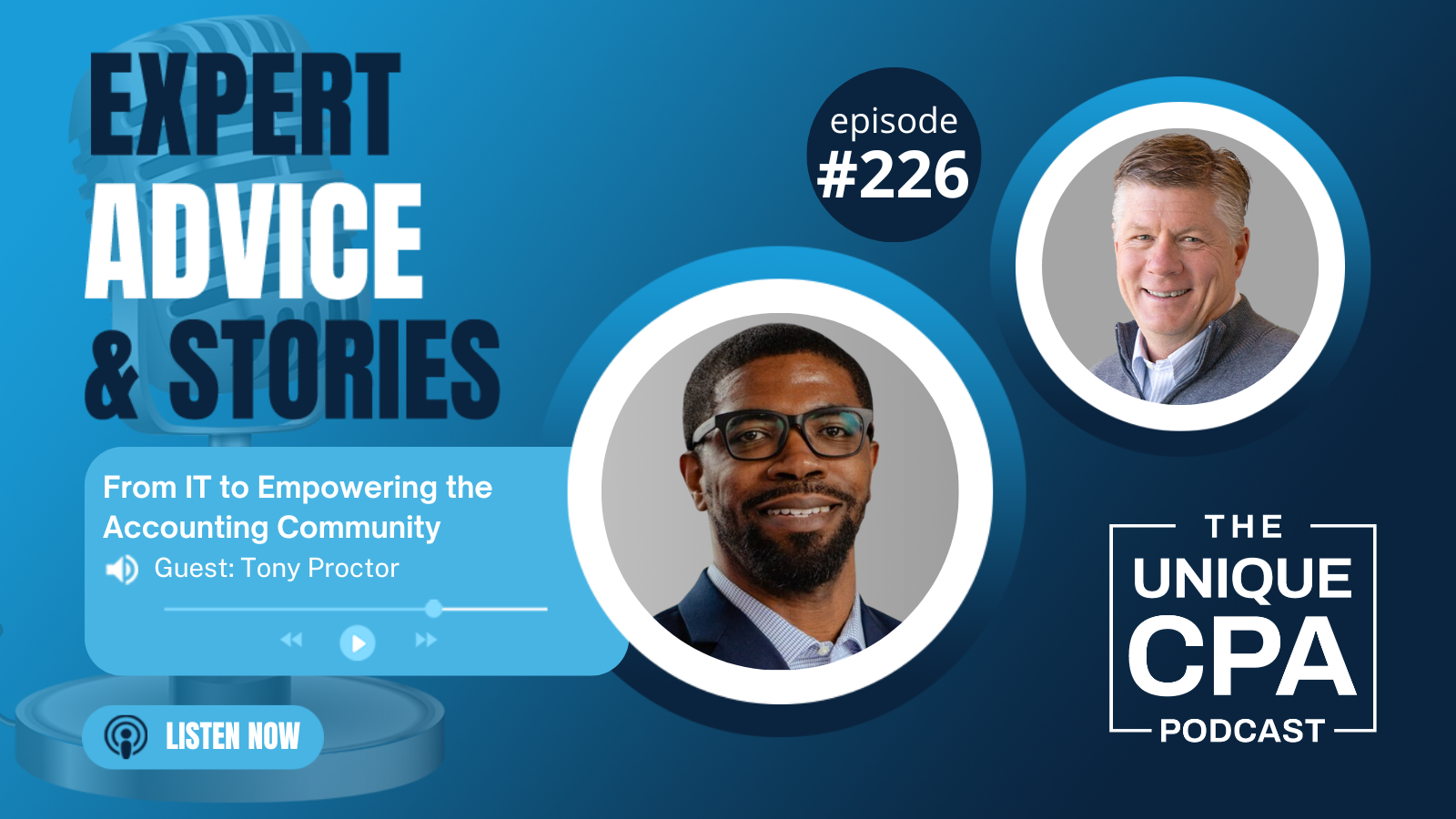
With Tony Proctor
What happens when an IT pro with an entrepreneurial streak transforms a side hustle into a thriving accounting firm? On Episode 226 of The Unique CPA, Tony Proctor, founder and principal of Proctor & Associates, talks to Randy about how he built Proctor & Associates from the ground up, navigated the high-stakes acquisition of a legacy practice, and brought tech-driven innovation to traditional accounting. Discover Tony’s passion for financial literacy, his candid take on firm leadership, and the lessons he’s learned empowering clients and communities. Tony shared his wisdom, humor, and inspiration at Bridging the Gap 2025, and you won’t want to miss this episode whether you were fortunate enough to see him speak there or not.
Today on The Unique CPA, we have the pleasure of speaking—actually, I have the pleasure of speaking—with Tony Proctor. Tony is the founder and principal of Proctor Associates, a firm specializing in tax, accounting, and payroll services. Tony actually has a unique background that I think probably ties into the things he’s doing, the way he looks at business. I’m sure I wouldn’t want to put words in his mouth, but I’m guessing that we’ll talk about that a little today. His firm is committed to empowering clients through financial literacy, which is cool, personalized solutions, which is cool, and by learning values of education, relationship building, reliability, and drive—all cool. Tony, welcome to The Unique CPA.
Appreciate it, Randy—thank you, sir. Thank you for having me.
I think that’s the most “cools” I’ve ever said in even one episode. I got it all in the first sentence.
I’ll send you 20 bucks via Zelle.
Alright, thank you! Oh yeah, you know what? Let me give you my QR code. So, alright, I did the quick intro there. I want to get into your, as I mentioned at the beginning, a little bit of your path to accounting. But before we do that, anything you want to add? The one thing I didn’t put in there is he’s also a speaker and a very good speaker. So anything you want to add to that intro?
No, I’m good with the intro, so I appreciate that, Randy.
Alright, no problem. Well, let’s get into the whole, what I was saying, because it’s interesting. I personally—accounting was my third career, but my first two were very short: A year in IT and a year in sales before I decided accounting was my career. You actually had a long time in IT and some other areas before you got into accounting, so let’s talk about that path.
So interestingly, and I know we don’t have 45 minutes for me to do a whole keynote here, but my mom actually, when I was probably in my teens, maybe even just before I got into my teens, actually started doing taxes, like tax returns. It was her and a couple other relatives, and I remember seeing them get all the 1040s and all the W-2s, and they—I mean, this is back in the day when you were doing it by hand. So I remember seeing that, but in that moment I was like, “Oh, okay. It’s cool, Mom is doing something extra, you know, so we can eat the cereal that we want to eat.” And so I thought nothing of it.
Then, kind of fast forward, I’ve always had an entrepreneur’s spirit within me. I mean, you name it, I done sold it—candy at school, the little frozen Kool-Aid cups, back in the day when Napster was big, I was selling CDs and copies. It’s just been in me. So continuing to fast forward, I was in IT, and I was loving IT, and while I was in IT, I decided, “You know what, let me start doing something on the side.” So I started doing some tax returns actually in undergrad for friends, things like that. But I also was working for a limousine company—we’ll have to do a whole other episode of all the jobs that I’ve had, my goodness.
We can get into it now. Maybe we’ll see, but I want to hear this story. Go ahead.
Yeah, so I’m working for a limousine company and doing some tax returns just for, I say friends and family, but none of my family was in New Orleans. It was all friends. Maybe I’ll call them “framily.”
There you go.
So I remember very vividly, and this is, shucks, 25, almost 30 years ago. The owner of the limousine company was like, “Hey, I see what you’re doing. What would it take to make that official?” I was like, “Well, I need a laptop. I’m gonna need some software.” We had a joking relationship, he was like an uncle to me. I was like, “What, you gonna buy me a laptop?” He said, “Well, if I do, will you?” I said, “If you’re gonna buy it, then yes, absolutely.” So that was kind of the planting of the seed—I did it for a couple years. Then, you know, life went along, married, kids, moved to a whole other part of the map.
But then in ’07, I decided, “Oh, let me help out and do some tax work.” Volunteer tax VITA site, I was doing some work with a VITA site, and I had several people that were like, “Hey, can you help me on the side?” I was like, “No, I can’t do that. It’s against the rules, it’s a violation, and I’ve got a whole IT job. I’m just here to have some fun.” Well, the second year of that, somehow somebody had gotten my contact information and was like “Hey, I can’t go to that site anymore because I’m outside the parameters and yada, yada, yada, but I need you to help me and you’re the only one that I trust.” I’m like, “I’ve only known you for one tax return, it’s not even like I’ve known you for a year. I did your return last year and you’re like, you’re the only one that I trust.” So I appreciate that, I respect that, and I said, “Well, fine, I’ll help you out.” I have been doing it in the past anyway, so I decided, sure, why not? I’m not sure if I’ve ever shared this story publicly. But that continued to grow, Randy, and more and more people were like, “Hey, can you help me? Can you help me?” So I was like, “Well, I guess I’m starting a tax side hustle.”
I made some cards, which probably was the gift and the curse. I made some business cards and somebody got a hold of my cards and said, “Hey, I’m gonna hand them out to a friend.” Well, what they did handing them out to a friend, they actually put them on the table in the lobby of the VITA site. At this point, second year, I’m a site coordinator. So, I’m not just one of the preparers, I’m a paid person of this program now. They were like, “Hey, you can’t be soliciting business,” and I’m like, “I’m not soliciting business.” She said, “Well, here’s one of your business cards that we had.” I was like, “I don’t know where that came from, I handed them to someone that I was engaged in a separate relationship with—they were doing me a favor,” and what they did—watch out now—this is, they did do me a damn favor, because my calling and my purpose was to do this, but not in that capacity. Wow, Randy, that just hit me.
Yeah! So this is a revelation to you?
Yeah. Like I, you know, again, because I’ve never really shared that part about how someone left my cards on the table, and then all of a sudden they decided they wanted to kick me out from being a site coordinator and a trainer. I was like, man, I didn’t do anything. I was helping somebody out and they put my cards. I wasn’t going down the line and saying, “Hey, come see me out the back door.” Anyway, wow, that was a revelation.
It was meant to be!
I was like, okay, well, I guess VITA is done now. And I just continued to build the firm—client three, client four, client five—and I just continued to build while I was still in IT. So during tax season, I was working. It wasn’t even my five to nine, it was the rest of my time—I was in support management, so I was going all day and then I would go to my office at night and continue to just build and grind and build up the book of business. And I continued to do that while I was still in IT management and user training. Numbers have always been cool to me, just in general.
Yeah, I know what you mean.
The major milestone was 2015. So, started officially—it was probably early 2000s, but on paper, I got started right around ’05, ’06, ’07, somewhere in there. So 2015, I was in IT management, and there were some, we’ll call them interesting changes happening in the corporate space, and I decided, “it’s time to go.” Left my corporate gig in June, went full time into my firm, and six months later, I was closing up on an acquisition of a firm.
Oh wow, okay.
And that acquisition essentially doubled the size of my firm. And at that point, I was like, “Well, okay, I guess this is what I’m supposed to be doing,” especially because when I left corporate, I told my wife, “Hey, I’m leaving on good terms. I’m not going to flip the tables or anything. But in six months, if this thing is not working out the way that we need it to work out, I’m going back. My name might still be on the wall for all I know, I’m going to go back and we’ll go back to business as usual.” And in six months, I was actually going deeper into being full time in my firm by way of this acquisition, and that’s how I got into it.
That’s how it started. Well, but like you said, they did you a favor by putting your cards out because you realized this is your calling and your purpose. You gave yourself six months—in that six month time, then this happened. It was like everything was meant to be and you, I mean, you feel like you are—here’s one thing. And I’ve been saying this a lot on the podcast recently, it’s a saying that I made up—I think I made up, I don’t think I plagiarized it—but I feel like I live at the intersection of my passion and my skills. It’s like, I am where I’m supposed to be right now. And I get this impression that you feel that way too.
A hundred percent.
Yeah. Is that not a fun place to be?
It is. Absolutely. It’s a great place to be. I love it.
Yeah, I do too. Alright. So, well, that’s a cool origin story. Technically, it started when you were a toddler with your mom doing this and then officially, 2015, June, start, December, or whatever, you know, buying the practice. Is that what it was? Was it December that you bought the practice?
So as crazy as it may be, the closing date was officially March 1st.
March 1st, okay, so were you working on those clients during that tax season already before closing?
No.
Oh wow.
3/1, I signed the papers, and I realized, “Oh, all that money just got wired over to her.” I drive to the office, which is about 35–40 minutes from where my legacy office was, and I walked in—I walked in probably 15 minutes after she had walked into the office to announce to her team that she had sold the place. And then here I come in behind her 15 minutes later saying, “Hey guys, new sheriff.”
Wow!
I mean, there was no—it was literally a cold transition. She didn’t communicate to her staff, she didn’t communicate to her clients. And one of the staff, I put big old air quotes on “staff,” was her daughter. And so her daughter wasn’t even aware that she was selling the practice. So I was the big bad wolf.
That was a story! So how did that, well, that next whole year, but even that next month and a half of tax season, I mean, that had to be insanity.
It was complete insanity. Number one, I’m taking a technology-centric firm, because that’s my background, so everything was techie, paperless, like everything was on the web, to a firm that they had two and a half computers in the office. And everything is paper, it’s written, I mean, there’s legal pads, everything is all written and paper clipped in a bunch of manila folders. And I had to figure out that part for, I mean, I say 45 days, but the reality, Randy, is that we are nine years—it’s been nine years now, I just celebrated that last weekend—I still have file cabinets in that office of stuff, that hopefully, the 10-year retention policy that I have in place will be done next year and I can finally just have one big bonfire, but yeah, it was an adventure to take tech and non-tech and continue to operate them in some level of parallel.
Yeah, I want to get into that whole transition to the, well, the parallel, but the, I’m assuming we’re complete transition to tech at this point. Okay, let’s hold off on that a minute because that’s going to be interesting because that I’m sure it built a lot of efficiencies into what was going on there. But I want to talk about that takeover then, client-wise and employee-wise, if you don’t mind getting into that. How did that go? Was there a retention of both or?
So, yes. The staff hung out for a while, even the daughter, she hung out for a little bit. The staff was, they were okay, and I think because they knew that she had to make a move, so they were okay with that. The clients, different scenario. Again, she did not preheat anybody. She had had the firm for like 35 years.
Oh wow.
And so, imagine the middle of March when tensions are already high across the board, we’re having joint meetings with the clients where she is saying, “Hey, I sold the firm, here’s the new owner”—that’s the easy part of the conversation. The challenging part of the conversation is that essentially she has transitioned her baby after 35 years. So she is visually emotional. You know, some of the clients that had been with her for 30 years, she is in tears. And I respect that a hundred percent. Not mad about that at all. But the optics of that is “Here’s a new guy. Boo hoo.” And again, I don’t want to make light of her boo hoo, but “Here’s a new guy. I’m visually emotional. Y’all have a good time now, you hear?” And so clients are looking at me like, “You big bad wolf. Like, why would you take this lady’s firm from her?” I’m like, no. “Believe me, there’s paperwork and money that shows I didn’t take it from her.” So that was indeed one of the hardest pieces of that transition, and then the unspoken part of the transition is that I am a, at the time, younger African American male. She was an older Caucasian woman.
Yep, I was wondering about that. I’ve heard you say this before, so I was wondering how that went.
And so, you know, I remember a conversation with one of the clients, he said, “Well, what gives you the right to buy the firm?” “What gives you the right to buy the firm?” I said, “I challenge you to ask her what gave her the right to sell it, because this, we’re asking the wrong questions here, buddy.” But there was indeed a—again, the dynamic of that, especially in those meetings where she’s saying, “Hey, here’s the new owner,” she’s visually upset, and I’m sitting here trying to smile, but not have like the Ronald McDonald grin on my face thinking like I’ve come in and, you know, I don’t want this to be a hostile takeover, but it is prime time, and so we have to do some things, we have to do things fast. Like, we don’t have time to woo, woo, woo. Like, “do you want to continue or do you not want to continue? Because I don’t have time to babysit this situation.” So it was an adventure for sure.
And how long do you think, I mean, come next tax season, did you feel like everything was in place? Policies, procedures, technology, or how long did that take to get things going?
If I can be transparent, it’s still going.
Okay. That makes sense.
It’s still going. And the reason that it’s still going is because I have been trying my best to keep the lights on in both places. So my legacy book of business, there’s been no issues. With the other book of business, it’s a situation where, I mean, and we did good from an attrition standpoint. A lot of people didn’t really leave, but—and this is for anyone who’s thinking about buying, one of the things that I had no idea, because I didn’t have any support going into it, I was like, oh, it’s an opportunity, let me see what it’s gonna do—but the average age of the clientele in that acquired firm was probably about 66, 67 years old.
I guess it kind of makes sense with her age and how long she’d had it.
Yeah! So, you know, they were like, “Well, hey, I’m at the end of my business life, like I’m planning to get out of this thing the next two, three years,” and I’m like, “Oh, okay. That’s cool. Wait, hold on. That’s going to be fun.” And so, yeah, I’ve been trying to keep the lights on, and where both of the offices are, it’s probably about 25, 30 minutes in between them, but there’s not like a sweet spot in the middle to have a physical location, and we are indeed physical. Like we have virtual relationships across the board, but the bulk is brick and mortar, and so that does bring a different layer to things. And so, yeah, I am still like, I still go back and forth between both locations every other day. Been doing it now for nine years, my goodness. Like, I don’t even know what I would do if I wasn’t doing it anymore. It just, it would be weird to not be like, oh, I’m going here versus going there.
I mean, from a technology standpoint, technology is fully integrated now from a technology standpoint, but I laugh, I mean, I have three paper checks sitting on my desk for people that have paid today. They wrote their check right in front of our credit card processing machine, but that’s what they are accustomed to. And I’m okay because you saved me the processing fees, whatever, but it’s funny to me that you could do all of this virtually, but you wanted to drive to the office to drop off a check, which I now have to go drive to the bank and deposit. So even as small as a payment piece, it’s still paper, but we don’t—yeah, the only paper that we have in the office now is all of the legacy files. Like today it’s PDF, and if you bring me paper, I’m going to make it a PDF and then we won’t give you the paper back. Because we don’t want it.
Nice. Nice. And then going back to the original transition from her to you, and you said there’s paper, they’re keeping paper copies. I mean, you say we’re fully integrated now. What was that journey like to get from her non-technical aspect of running a firm to your…?
It was actually pretty easy. And the reason for that is because she was only around for 30 days, literally 30 days. I think I’d had her hang out for until April 15th, and according to our contract, she had to be paid an hourly rate after 30 days, and she meant every part of that. But anyway, because she was out of the picture, it was like, “Well, hey, this is now my show. This is how we’re going to do it,” and so that was a route that we went. So it was easy because I have an IT background, like, it wasn’t a heavy lift for me to make that conversion over to being more paperless in a very quick turnaround.
And how about pricing? And was that an issue?
Pricing is still an issue. This is like a therapy session. Pricing is still an issue because where she was priced, I mean, it was still as if she was operating out of her basement. And so again, because I didn’t want to run everyone away, I still kind of kept them within range of where they were, but I did start making stair step increases year over year to kind of get them closer to where our legacy folks were. And people were complaining about, “Oh my gosh, you went up $25.” “You’re $175 under market rate and you’re complaining about 25?”
Right. Right. Yeah. I mean, that’s actually, and you know this, I don’t have to tell you, but that’s one way to get rid of clients too that, you know, are going to be the pain in the ass clients. That’s right.
Pain in the anatomy is what I call it.
There you go. I know. Hey, we’re going to have to cut that out. We’ve never had to bleep anything. Is that something we’d have to bleep? I don’t know. Justin, we’ll cut that out. We’ll go with your version of it. Actually, one time we had to bleep and that was Scott Scarano. That’s the only time we ever had to bleep.
Oh I’m not surprised by that at all.
Yeah, me neither actually. Alright, so I get curious when I talk to people, and especially like this, the whole takeover and the transition from one firm to the next, and then you’ve just given me some ideas too. And when we’re done, then we’re going to talk about these ideas off the recording. But, from a pricing model then, it sounds like it was probably, she was probably fixed fee it sounds like already, is that what you have always been, is that what you’ve continued, or how’s pricing work for you?
Oh yeah, it was fixed fee, she did have an hourly rate that I think was a little ghetto, but it was mostly fixed fee, I was already fixed fee as well, and so it was easy to hang out in that space and, you know, the clients were okay with it. And it definitely made it easier from a transition standpoint where we didn’t have to say, “Well, pricing used to be like this, but now it’s this.” So that did make for a seamless transition.
Okay, and then one last thing on pricing before we move on, because again, I get intrigued with these conversations. I know a lot of people have gone to the “pay before tax season” model. It sounds like, I don’t know, yeah, I won’t put words in your mouth, but I know at least some people are paying you during tax season because you said you got these paper checks. Have you looked at that? Have you thought about it? Are you doing it? What’s your model of when you bill?
So we receive payment upon completion. So far, we haven’t had a lot of a challenge with folks not doing what they’re supposed to do. However, I’ve also had to share with myself and with my team that we are an accounting firm, we are not a collections firm.
Right. Yes.
And so, I have been considering like, what does it look like to collect before the party gets started? I mean, one of the things we did do, just to make sure we didn’t get completely shaftedlike if anyone has multiple years, we need a 50 percent deposit before we get the party started, just so that, you don’t have us do four years of returns and turn up missing. But outside of that, right now, it’s still on completion.
Okay. Nope, that’s cool. And this is, we’ve done episodes like this before where we just kind of dig into the whole, and we didn’t, you and I didn’t plan this ahead of time, but hopefully you’re, you’re having fun, because I get, like I said, three times, right? I’m intrigued with stories like this. So let’s get into then the whole philosophy of Proctor Associates? The whole, you know, what’s your vision, your mission, your—I mean, I know when I read it, the intro, we talked about, you know, empowering clients through financial literacy, personalized solutions, embodying values of education, relationship building, reliability and drive. I mean, how do you, I guess, is that how you would describe Proctor & Associates, like I did?
100%.
Okay, good.
Yeah. 100%, 100%. One of the biggest things for us is we want our folks to have some level of understanding of what’s happening. Are you going to be a tax person? Are you going to be an accounting person? Are you going to be a payroll person? No, that’s not what you’re going to be. But I do want you to understand, like, what is on my 1040? What is on my S Corp return? What’s the difference between employee tax and employer tax, and then why do I think that I paid income taxes? I want you to have some level of understanding around that, specifically on the accounting side. You know, we do the numbers, we do your books, we give you all your financial statements, but then you take those financial statements and you give them to your lender, and then the lender asks you questions, and you’re like, “I don’t know, I gotta go”—no, you need to know, like, why did we spend X amount of thousands of dollars on advertising, like, you see that, and you be prepared, “Oh, by the way, your advertising was like, 45%,” so, they may ask you a question about that, so now you are equipped, when they ask you a question, you can fire right back and say, “Well, here’s the reason,” and now it increases their trust in you that you at least have an idea of what’s going on. So that, that education piece, I want folks to know, to have an understanding of, you know, what’s happening and feel good about it.
So education sounds like a passion, not just with clients, but overall, I know you speak at conferences and I’m transitioning here—we can go back to the firm—but you are out speaking and you and I, you were out at Intuit Connect. You and I talked there. You were speaking there. Are you speaking at accounting conferences only? Are you speaking at accounting conferences only, are speaking at conferences that’ll educate the client base? Where did the speaking part come in and what do you go out and speak about?
So apparently I like to talk. And so for me, I think it really started when—it started with this business. I mean, me having conversations with people and like the right person was like, “Hey, can you share this with, like my friend group, it’s like 10 of us, can you just talk to us about what the heck a P&L is?” But the accounting conference circuit, I think for a long time has been—people are probably going to send me hate mail—boring?
Yeah, I can see that.
It’s been a little dry. And so, for me, I’ve had an opportunity to speak and people are like, “Oh my gosh, like, your personality,” and I’m like, I mean, I recognize that I have some personality.
Yes, you do.
But I think, you know, that energy and that vibe, people want to feel, they don’t want to feel like they’re getting ready to go to sleep. And not that you’re putting on a performance, but I mean you’re putting on a performance. But how do you make sure that you’re getting across valuable content, but then maintaining everyone’s interest? And so for me, again, I think that’s part of my purpose, and when someone left my cards on the table way back, like, that was setting me up to be in a position where I could share what I have, and make it able to be relevant to the folks who need to hear it. And so, accounting conferences, yes, business ownership, yes, leadership development—I have a heart for kids, the youth. And so even talking to the youth about financial management.
Oh, nice.
Because we know it’s different today. Like you just, you earlier in the call, you said something about you have a QR code for me to send you some money. Like they, this is how they pay and receive. They use QR codes. It’s no longer taking cash out of your wallet and feeling, you know, that $20 bill leave your hand. It’s, oh, boop, I just, I scanned the QR code and money is gone. So how do I manage that? And so talking to the youth, I love that.
Oh, that’s awesome. I love that, doing that, and you may be doing your small part to get people excited in accounting and help us with the pipeline issue.
Pipeline, yes, because we need some folks to come on in. Come on. We welcome you with open arms.
So before we wrap up, because I’m, honestly, I don’t want to wrap up because I’m enjoying this so much, but before we do wrap up, I got a handful. Let’s go with three final questions and we’ll go with this one first: You know, you’ve had obviously a very interesting journey, you know, starting with seeing your mom doing taxes when you were growing up. Starting in IT, but then doing this on the side, even in college, and then this transition to 2015, you know, going full time with Proctor & Associates. Do you have any advice for anybody that may be thinking about this field, this profession? You know, we’re just talking about you mentoring kids, you know, advice for anybody that’s aspiring to maybe go into tax and accounting that you would give people, like do this, do that, think about this, don’t do this?
Even with the level of technology that we have, this is an industry where you have to have an understanding of, I guess what they say, how the sausage is made, because technology, and we say, I mean look, AI is all over the place, and AI can shift your life to the good or it can flatline you. So come on in. Come into the industry, come into, you know, having a firm, but don’t only rely on, “Oh, technology’s got my back.” You have to be able to understand behind the scenes, the mechanics of what’s going on. And so if you can understand the mechanics, then it’s going to strengthen the technology because you still have to double check and like, did the technology do what it was supposed to do? And I know today, everything is tech for crying out loud, but don’t come in here and think that tech is going to just continue to accelerate you, because you have to understand behind the scenes. That, like, right out the gate, that’s my first thought for someone that’s interested in coming in.
The second thing, really quickly, it’s not get rich quick. Like, this is definitely a relationship industry, and so if you come in, you’re going to have to put in some work to build it. Now, you can put in work, and you can build this thing in 12 or 18 months, or 12 to 18 years, but you will have to put in work. But it will yield some pretty good results for you as long as you’re willing to put in the work.
Yep. And there’s so much opportunity with just, accounting isn’t just one thing. I mean it’s, tax isn’t just one thing, it’s multiple things. And so, if you can find, well like you found your calling and your purpose with your firm, you can find your calling and purpose within a firm too. There can be other areas that, “Hey, I’m doing tax right now, but I really like the accounting side of things.” And so you can transition. “I love doing advisory work, not the compliance work.” So if someone could do compliance, you could do the advice. So there’s so much opportunity within just the word “accounting,” going into accounting, that that’s the one thing I think, to add on what you said.
Alright. This has been a great conversation. Two final things before we close out, we got your story. I think we know who you are. No, we don’t know who you are completely, but it was cool to get to hear the story from your birth to the firm birth to the maturing of the firm. And now, yes, we know you have a passion for what you’re doing, but when you’re not working, what’s your outside of work passions? What do you love doing when it’s not work?
The answer that I was supposed to say is kicking it with my kids.
Yeah, well.
But I do actually enjoy hanging out with my kids. My daughter is the oldest, she’s a spoiled brat, I created the monster, I take accountability for that. But then my boys, I mean, my boys are both teens and just, you know, just hanging out with them, having conversations and doing that. The kind of fun element is that I actually have a red sports bike, motorcycle. And because these calls are recorded for quality assurance and training purposes, I stay within five miles of the posted speed limit 10 percent of the time. And so, that, I enjoy being on my motorcycle and just, you know, being out and taking in the scenery.
Yeah, it just, I had a motorcycle growing up as a kid, dirt bike, you know, and it was out there all the time, but man, I just, as I get old now, motorcycles scare me.
Yeah, they are scary. I’m scared of driving, shucks, nowadays.
Well, it’s not even you though, it’s everybody else that can’t see you.
Everybody else around.
Yep, yep. So, okay, motorcycles. And, and I did get a little cheat sheet. I don’t know where I saw this, but bowling?
Bowling is my thing. I haven’t been as active as I would like to be or as I have been, but yeah, I enjoy going bowling. Bowling and motorcycles, those are my things. If anyone invites me out bowling, I will be there. And yes! I am going to show up with my own bag, my own shoes, and I have two, three different balls that I can use to get the job done on the lanes. Yes, sir.
Nice, alright, well, that’s cool. And then lastly, if anybody wants to find out more about you, Proctor & Associates, what’s going on, where would they look?
Yeah. So the social medias, I always like to say that. On Instagram, IAmTonyProctor, the firm is ProctorTaxCLT. LinkedIn, I’m there, and I love to engage with folks. So you can find me on social media. You can also find our website, ProctorTaxPrep.com. We are located in Charlotte, but we have folks across the map and so we’d love to have conversations with anyone.
Alright. Awesome, Tony. Well, thank you. Thanks for being here. Especially, I should say we’re recording March 7th. So you took your time out of eight days before business turns, corporate returns are due. And I appreciate you taking the time.
Absolutely. Love it.
Important Links
About the Guest
Tony Proctor is the founder and principal of Proctor & Associates, a Charlotte-based firm specializing in tax, accounting, and payroll services. With a unique background in IT and a lifelong entrepreneurial drive, Tony built his practice from a side hustle into a thriving business, eventually acquiring and modernizing a legacy firm. He is passionate about empowering clients through financial literacy, ensuring they understand their finances—not just the numbers. Tony is known for his engaging speaking style on the accounting conference circuit, and delivered a keynote at Bridging the Gap 2025. His commitment to educating both clients and the next generation about financial management is a driving force behind his success.
Meet the Host
 Randy Crabtree, co-founder and partner of Tri-Merit Specialty Tax Professionals, is a widely followed author, lecturer and podcast host for the accounting profession.
Since 2019, he has hosted the “The Unique CPA,” podcast, which ranks among the world’s 5% most popular programs (Source: Listen Score). You can find articles from Randy in Accounting Today’s Voices column, the AICPA Tax Adviser (Tax-saving opportunities for the housing and construction industries) and he is a regular presenter at conferences and virtual training events hosted by CPAmerica, Prime Global, Leading Edge Alliance (LEA), Allinial Global and several state CPA societies. Crabtree also provides continuing professional education to top 100 CPA firms across the country.
Schaumburg, Illinois-based Tri-Merit is a niche professional services firm that specializes in helping CPAs and their clients benefit from R&D tax credits, cost segregation, the energy efficient commercial buildings deduction (179D), the energy efficient home credit (45L) and the employee retention credit (ERC).
Prior to joining Tri-Merit, Crabtree was managing partner of a CPA firm in the greater Chicago area. He has more than 30 years of public accounting and tax consulting experience in a wide variety of industries, and has worked closely with top executives to help them optimize their tax planning strategies.