Building a Growth Culture in Your Firm
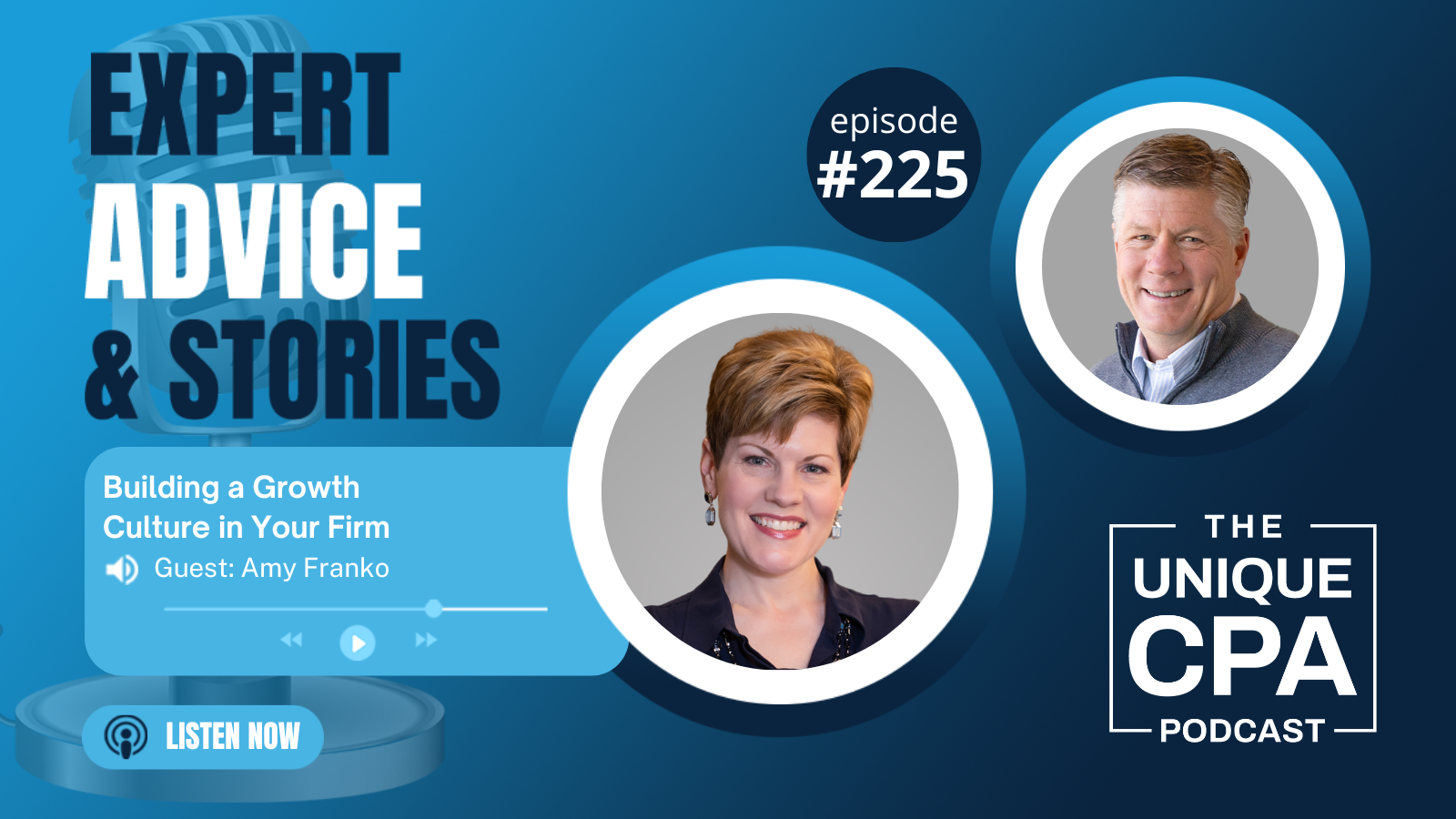
With Amy Franko
Episode 225 of The Unique CPA features Amy Franko, the author of the Amazon Bestseller The Modern Seller and a leading expert in sales strategy for professional services. Though covering a broad range of topics, Randy dives deep with Amy into the challenges and opportunities accounting firms face when building a strong sales and growth culture, noting that sales is often an afterthought in the profession, and how this can stunt the growth potential of firms from the very start. They look at the impact of private equity and mergers and how to approach them as a likely long-term fixture in the accounting space. Amy also stresses the importance of energizing your team through skill development and positive firm culture, sharing actionable insights on compensation, training, and leadership, as well as her own journey of staying motivated and evolving in her career.
Today on the show, we’re diving into a topic that many accounting firms wrestle with, and I’ve seen this often: how to build a strong sales and growth strategy inside the accounting firm, which is super important and, I think, ignored too much. We have a great guest to talk us through that today: Amy Franco. Amy is the author of The Modern Seller, an Amazon bestseller. She has been recognized by LinkedIn as a top sales voice. She’s the founder and CEO of Amy Franco Associates, where she helps mid-market organizations, including accounting firms, elevate their sales results through strategy and skill development. Amy, welcome to The Unique CPA.
Randy, it’s great to be here. I’m really looking forward to our conversation today.
Oh, I am too. I’m very excited to talk about this because this is a topic I think is often ignored, or at least the emphasis on it isn’t what it should be at times. So let’s just jump into that a little bit. You work with professional service firms, accounting firms, and what I see—this is my personal observation in accounting—is that sales is often an afterthought, sales is often… You know, Tri-Merit, the firm I started 18 years ago, I think we do things a little differently. Our third hire was a business development person, so we put intentionality around that. But it’s often a, “Hey, to be a partner, you have to sell,” or, “You bring in new business,” but there’s no training or what I see, no game plan around it. So, being that it’s an afterthought, and that accounting firms probably don’t put an emphasis on it because they focus on their technical skills, how do you deal with that? How do you help firms actually build the sales strategy?
Yeah, this is a great starting question for our conversation. If there are two things I could point to around that, from what I’ve observed in my work with professional services and in public accounting specifically, the first is on the strategy side of things. Especially more in the mid-market space, I’ll call it, there’s an overwhelming number of firms that either don’t have a growth strategy that they are following through—they’ll often say “we’ve been successful in spite of ourselves”—or they have a strategy that hasn’t been visited in a long time or hasn’t been implemented to the degree they’d like to see implemented to get the success out of it. So that’s one observation I’ve made in the space.
Then the second piece, very specific around skill development, is that for all the structure firms put into the client delivery side of the business—all the service lines, go-to-market, all the boxes checked on deliverables—there often isn’t the same rigor or discipline when it comes to the sales or business development side. There either isn’t the strategy or the skill development, or, like you’re saying, it’s either you have it or you don’t, you’re either a natural or you’re not. I wholeheartedly believe, and I’ve vetted out, that there are skills we can build, and when we put rigor and discipline behind those skills and make it part of firm culture, and then combine that with strategy, that’s where you see those two things come together and really take off.
Alright. In your book, The Modern Seller—which is awesome, congratulations on the Amazon bestseller—side note, I’m putting pressure on myself because I keep saying on the show that I’ve got a book coming out, so if I say it on the show enough, it’ll actually come out. There. That was just a side note to put pressure on myself to make sure there’s a strategy.
Public accountability! I can talk about that in a moment.
Okay, let’s do that. So in your book, you explore what it takes to succeed in today’s sales landscape. So what are some of the shifts in sales that accounting firms need to be aware of?
Yeah, thank you for asking that. On the topic of putting a book out into the marketplace, I am someone who thrives on public accountability. I’m a pretty self-motivated, self-disciplined person, but when it came to writing the book, I actually hired a bookwriting coach as part of my publisher’s process. We would meet once a week, and every week I needed to show up with a certain amount of the book written, and for me, that public accountability made all the difference because I wasn’t going to show up not having the pages written—that’s what helped me push it over the finish line. So for everybody who’s watching and listening, when you think about how you like to be held accountable to a goal, that’s just one idea that has worked for me that I’ll share with everybody.
That’s awesome.
Yeah. But back to the question around some of the trends—and full disclosure, I don’t have a background in public accounting whatsoever. My background’s in technology, and my career has taken a winding path. Over the past, let’s call it eight years or so, I’ve developed this niche in the public accounting space, which I absolutely love working in the space.
It’s a great place to be.
Yeah, I really enjoy it. I love working with and helping these firms figure out their next growth trajectory. But if I were to point to maybe two or three things that I’m personally seeing that are specific to public accounting, the first one I would say—maybe this isn’t specific to public accounting—but it’s the ebbs and flows of the focus on sales and business development. This is very specific, I’d say, to professional services, where we go through seasons where we have so much business that the emphasis on business development and sales can be de-emphasized, and then we get into these cycles where wow, we’re hitting a trough, if you will, and need to rev up business development. So I’d say the trend is the up-and-down cycle that we want to try to even out. We want it to be more consistent over time, which is to my earlier point about rigor and discipline—if we inject some rigor and discipline into business development, that can help to alleviate the observation around feast-or-famine: it’s either great, or we need to get out and develop business. So that’s one trend I’m seeing.
I would say the second trend that I’m seeing is the private equity piece and the outside investment coming into firms, and firms having to rethink: “Am I going to take on private equity investment? Am I going to merge with another firm? What does that mean, and how, for the purpose of growth, does that have big impacts on firm culture, sales culture,” I’ll call it, “and also the thinking around how we go to market?” That’s one thing we could probably spend an entire podcast unpacking that, but that’s certainly a trend that is here to stay. And it’s certainly, firm leaders have to be really cognizant of it, whether or not you go down any of those paths, but to be cognizant of it, and even if you don’t go down the path, how do you think about it, and how are you strategic when it comes to your own firm growth?
Yep, and so I want to go down that path a little bit.
Let’s do it!
‘Cause I’m super interested in the whole private equity coming in. I want to learn—I’m trying to, and I’ve said this recently on another podcast—I’m trying to be open-minded about it, and I think there are very good points to it, but when that does happen, how does private equity affect your business development process, or theme, or goals, or strategy?
Yeah. If I were to put that into a couple of categories—and maybe just a little bit of context on my background—I do work with public accounting firms, but I also work in other industries, manufacturing, technology, where some of this private equity acquisition type of activity has maybe been more common. It’s a little bit newer in the public accounting space, so if I take some of those experiences and overlay them on top of public accounting, there are probably two or three areas that I would focus a firm leader’s attention on.
I think you hit the nail on the head, which is to become better educated about what it all means. If it’s something that a firm leader or a firm in general doesn’t have direct experience with, to find industry associations or to find other firms that have been on the path or are considering the path, to become and stay educated on what’s happening in the space. That would be the first lane of thought. The second lane of thought in bringing that around to a sales growth type of conversation, is, what are the impacts of a merger or some type of private equity injection on the way we think about sales culture, the types of clients that we’re going to pursue, and also how we actually skill people up to be out in the marketplace selling? How someone is compensated and how a firm measures its growth becomes really critical there, because it’s different to measure on, say, revenue, top line, versus bottom line profit—and then what’s the ultimate end goal of the private equity or the merger, whatever that scenario is. That’s kind of a big bucket there, but how do all of those things play a role in impacting your sales culture, your go-to-market, and ultimately how you build out the sales piece of your firm.
Got it. And a couple times you’ve mentioned culture already, which I love talking about in general, but culture can be defined in many different ways. I want to talk about positive culture in general. But you talked about that and you talked about staff and sales. So, when you’re talking sales and business development in accounting firms, are we talking everybody from top to bottom, are there specific people, or how do we start to educate everybody within the firm to have maybe a sales mindset?
There are a couple of different ways to look at that, and then I’ll share my philosophy around it. There is the model that says “We are going to, to a degree, have everyone or certain individuals in the firm responsible for growth and finding new clients, finding new activities. We don’t have dedicated sales or business development people to do that.” Then there’s the other side of the spectrum that says, “We are going to hire and build out a sales-specific function, where we have a team of people whose entire role is to be out in the marketplace—selling, uncovering opportunities, bringing opportunities to closure,” which I put in the category of a more traditional sales team in other industries.
Yep.
I am of the mindset that there’s a middle ground, because I’ve observed across a lot of industries that one extreme or the other is really difficult to manage for the long term. But if we take a bit of a middle ground approach, where perhaps in some firms it makes absolute sense to have individuals who are dedicated to selling, and we also need to have people that are not in sales roles, but they’re with the client, they’re in the industry, where they also have a responsibility to uncover new opportunities as well. So that means, as you think about that from a firm leadership standpoint, if you are going to be “yes and”—if you’re going to build a team and you’re also going to ask people in delivery roles to be responsible—that can be two different lanes of strategy and also two different lanes of skill development and compensation to consider.
Yep. So, what you said, those two different models of a sales team, I think we lean towards that second one, where we do have a dedicated sales team, we do have a dedicated marketing team. For us, we decided that early on, as I mentioned earlier in the podcast, but we do equip everybody, because what you said, and I think that’s super important: you’re out, you’re dealing with the client, you see their needs, you know what they need. We may have services that we can offer them that they don’t even know about, but when you’re out there and you’re in the middle of an audit and you realize that they have whatever, need help with financial investment type work, and, oh yeah, we just happen to have an arm on that, why don’t I connect them there? I think that’s important.
But when we have that, then, you mentioned compensation earlier—obviously there have to be specific compensation plans in place to have incentives out there for people to do this, other than just their salary. Salespeople are probably paid maybe a base and commissions, production people are probably just paid their salary, but if they’re bringing in business, there has to be something. So is it easy to set up compensation plans, or what do you see? What do we need to do to make this—to incentivize—people to do this?
Easy? I don’t know about easy. If we had an “easy button” for it, wouldn’t that be great? I would say we can make it simpler…
Nice.
But it might not be easy to set up, right? I see this in every industry. Lots of industries have this challenge of finding the right blend of what you call base pay and variable pay, which would be your commission structure, and what are the different levels of incentivizing somebody? For example, if we play out that role, somebody who’s in a pure sales role is likely to have more of their overall compensation at risk, you would call it, that’s variable pay. Because they’re in a role where they’re expected to be out in the community uncovering opportunities with clients or new prospects. So it makes a lot of sense, because that’s their sole job, for them to have, say for example, 50% of their pay as base and 50% as commission, and those numbers might fluctuate a little bit.
Whereas with somebody whose primary role is client delivery, they will likely have a much higher percentage of their compensation to be their salary, but if they uncover opportunities or there is an incentive to uncover opportunities, there might be a smaller percentage of their compensation that has a commission piece to it—or some other kind of bonus structure. It doesn’t have to be a commission; it could be a bonus structure type of situation. I would say generally speaking, when I take clients through compensation planning conversations or workshops, it’s about keeping it as simple as you can, in a way that somebody understands it. Somebody should always be able to understand how they’re paid and what the expectations are, or the activities around—I’ll use sales as our lens here—but what am I being compensated on, and can I understand very clearly what the structure is? And if I bring in a new client, can I tell you what I’m going to be paid? Is it simple enough? And a lot of times it’s not simple enough, or people are compensated too highly on the salary side of things, the base side of things, and there isn’t enough of that variable pay, at-risk type of commission pay, and that also creates behaviors. What are your intended behaviors, and what might be some unintended behaviors based on how you’re structuring the pay?
Okay. Let’s go backwards a little bit, just talking about this whole, you know, everybody maybe being part of the sales process, or at least a significant number of people, how do we train that mindset that this is something we should be looking for when we’re out in the field or talking to a client? Are there tricks, tools, skills, ways to train people that this is something that should be part of what we’re thinking?
Absolutely. If I were to give you a couple of structures to think about, or our listeners a couple of structures to think about, I’ll use a couple of my clients as an example: I have created a curriculum called Strategic Selling for Professional Services. It’s a framework that I bring to professional services organizations to skill-equip. Typically, when I’m working with firms, they will select people to go through the program, so there is a bit of exclusivity to it, if you will, where somebody has to demonstrate or be nominated for this program. What I find highly successful with that is I will get teams of people that have raised their hand, they’ve been nominated by a partner because they’ve demonstrated some of those attributes or some successes already, and they are seen as future leaders in the firm. And sales and business development is a skill set that’s required to continue to be successful. So, there is a subset of a firm where you might nominate people to be part of a program. What makes that successful is there is a level of exclusivity where people are tapped and a firm makes an investment in those people. That’s one lane of thought, or one approach that a lot of firms will take with business development sales skills.
The other approach is the more generalized skill sets across the firm. Maybe somebody that isn’t going to need that skill set all the time, because they will stay in a staff delivery type of role, which is critical—we need great people to deliver our services in order for us to continue to grow, right? Or perhaps they’re younger in their career and they just haven’t had those experiences yet, but we want to expose them to those experiences. So, there are a couple of structures that a firm could consider for those two groups of people. The first is more firm-wide education, which teaches a more generalized set of skills. So for example, a lot of firms participate in associations, industry-type associations, or they ask people to be out in the community meeting people—general networking, centers of influence type of skill sets. What can I be looking for in a client scenario or at an event scenario? Those are things that are more general skills that we can help people to create awareness around and practice out in the marketplace or with a client.
There’s also the internal structures around: Do we have a CRM? Do we do client planning? Do we have industry focus where somebody can participate and learn and is part of a growth path? You can do some things internally on how you structure the way that you pursue opportunities and include people that may be younger in their career or might be part of a delivery team, but their input is still really valuable.
Alright, and I think that’s great information. That brings me to something you and I talked about before we went live, which was staying energized in your work and your life, and evolving in your work and your life, and how important that is. For me personally—I said this when you and I were first talking—I kind of get bored easily, so I need to make sure that there’s something new, something else to do. You find this important, obviously, so why don’t you expand on this for us?
Absolutely. I have found for myself, as I reflect on my career journey and life path thus far, I’ve developed a lot of interests, and similar to you, I can get bored easily, which has its pros and cons, right? But I’m very energized by new ideas, pursuing new paths, and I do get a sense of boredom after a while. I have been in the sales lane for pretty much my entire career. There’s also a leadership lane, a learning and development lane—they all kind of come together. So because I pursue different ideas, different disciplines, I guess would be the way to describe it, it’s easier for me to find ways to stay energized, even though I’ve been in the sales lane for a long time. I’m still very energized by it.
Outside of that, I try to find other things, but not too many things. I don’t know about you, but I can say yes to too many things, and then I have too much on my plate. That’s been a learning process for me, to be selective about the things that I want to pursue and get deeper in. For example, I get my leadership fix by volunteering for the Girl Scouts, and I was the board chair for the local council here, so that energizes me. I’m an angel investor, and that’s something that I’ve always been interested in, and I don’t have a financial background, but I’ve always been interested in investing and how I can support more entrepreneurial organizations, specifically women-owned enterprises, so I have pursued angel investing over the last couple of years. I’ve always wanted to learn another language, so I’m a beginner Spanish student. I’ve always wanted to learn, I’ve talked about it for years and years, so now in the last year I have finally made progress on that. I’m probably, at least for the time being, at my maximum of different things I’m pursuing, because if I start getting too far beyond that, I have too much on my plate.
But it does keep you energized, I believe. You and I might be the same person. Just this past year, I started angel investing in tech startups in the accounting industry—something I know, obviously. Not tech, although I do have a computer science degree, but that was a long time ago. But the accounting profession I know. So, I’ve been doing that. I am on—today day 460 of Duolingo, learning Spanish, so that’s my method of learning Spanish. And from a volunteer standpoint, just like you, I’ve been president of different organizations, well, whenever you’re a CPA, they want you to be the head of the finance committee, which is not my skill set, honestly.
How many times have you been a treasurer of an organization, right?
I think at least three. And I’ve decided that is not going to happen ever again. I’ve been president of two different ones, and that I enjoy because I’ve learned the skill of delegation, which I use all the time now, and that’s helped me. How about in your leadership with Girl Scouts? I assume you’ve learned things that you’ve been able to translate into your business life?
Absolutely. I have found for myself, these different experiences—it’s being able to take the learnings from all these different experiences and apply them to personal life, business life, absolutely. Probably one of the more recent experiences with the Girl Scouts is we are in the tail end of a capital campaign. The capital campaign started back, well, it started before my board chair service, but I was the board chair from 2019 to 2023, and for that entire time, we were in the midst of the capital campaign, during COVID, which is probably a whole other conversation, but I had never been through one. And to lead a board through one has been such a valuable, rewarding experience. So fast forward, last year, we did a ribbon cutting on a beautiful STEM Leadership Center and Makerspace on one of our “prime campuses,” if you will. What I’ve learned and been able to be a part of—there’s no way I could have predicted that, and just having said yes to being part of the organization and then saying yes to being the board chair just opened up so many avenues for me. It’s been just an amazing experience.
And I think that kind of, to tie things together, that really comes back to learning these skills of potentially being part of the business development team or strategy within our firm, because it can be an energizing thing for you. It’s not just—not that accounting is bad or taxes are bad—but it’s something different. You’re adding variety to what you’re doing. So for anybody out there listening, I would think, just give it a try. Learn these skills. Go out and talk to somebody like Amy and learn things that you can do to help energize even further the energy you have in the firm. Alright, Amy, before we wrap this up, why don’t you summarize or give us an idea of what are the key takeaways people should get from this discussion we had today?
I have a couple that I’ll share, and I’ll take the firm leader approach first: If you are a firm leader, a growth officer, CEO of a firm, and you are considering the growth trajectory of your firm, being mindful and intentional around the sales culture that you’re building and the skills that you’re building in the firm—regardless of whether you are going to take on private equity or not, you’re going to merge or not—this is such an important topic that every growth officer, every firm leader wants to be considering. I would say that’s the first takeaway.
The second takeaway, from more of an individual standpoint, is on the business development or sales skill standpoint: to stay open-minded about how meaningful those skills can be, not only for you professionally, but for you personally. And if we keep our clients as the north star of how to help our clients, really fantastic business development skills help our clients to be better. If we look at it from that standpoint, that’s very energizing to me. How can I help my clients to be better? Business development and sales skills, when I cultivate those in myself, have that effect on my clients.
The last takeaway is always to be looking at the things in your life, the things that you’re doing, or, to your point, deleting or delegating, what energizes you? When we’re mindful of what energizes us, personally and professionally, that just has a ripple effect on everybody around us—the people we work with every day, the clients that we work with, our families, our friends. It’s really meaningful and important to know what energizes us and to make those decisions around that.
I think that’s great advice. Alright, so, great conversation, but two final questions: Outside of your passion for sales strategy and helping people find energy in what they’re doing and leadership, what do you do for fun outside of work?
Two things I love to do outside of work, besides studying Spanish—which to me is fun, that’s not work—I love to travel, and I love fitness. So those are two areas I love to spend time in.
Yep, well, again, same thing with me. We’ve been on the road for two months right now, traveling, my wife and I, and I pretty much try to work out every day. On the road it’s been hiking, but when I’m at home, I have a really nice home gym and, yeah, exercise. Talking about energizing yourself, that’s one thing that does it as well, and I assume you believe that.
Absolutely.
Okay, and then last thing: if people want to find out more about what you’re doing or connect with you or get a hold of the book, where should people look?
The two best places to find me: first, please feel free to connect with me on LinkedIn—Amy Franko on LinkedIn. You can also go out to AmyFranko.com; there are a lot of free resources there on all things sales, business development, leadership. The book is in all formats on Amazon.
Alright, awesome. Well, Amy, thank you so much for being on the show today. I had a lot of fun.
Thank you for having me. This was a great time.
Important Links
About the Guest
Amy Franko is the founder and CEO of Amy Franko Associates. She works with mid-market organizations (including many in professional services) to grow sales results, through sales strategy design and skill development programs. Her book, The Modern Seller, is an Amazon bestseller, and she is recognized by LinkedIn as a Top Sales Voice. On a personal note, she lives in Columbus, Ohio with her husband Dave and very energetic black lab, Roxy. She is an angel investor, past board chair for Girl Scouts of Ohio’s Heartland, a fitness enthusiast, and a beginner Spanish student.
Meet the Host
 Randy Crabtree, co-founder and partner of Tri-Merit Specialty Tax Professionals, is a widely followed author, lecturer and podcast host for the accounting profession.
Since 2019, he has hosted the “The Unique CPA,” podcast, which ranks among the world’s 5% most popular programs (Source: Listen Score). You can find articles from Randy in Accounting Today’s Voices column, the AICPA Tax Adviser (Tax-saving opportunities for the housing and construction industries) and he is a regular presenter at conferences and virtual training events hosted by CPAmerica, Prime Global, Leading Edge Alliance (LEA), Allinial Global and several state CPA societies. Crabtree also provides continuing professional education to top 100 CPA firms across the country.
Schaumburg, Illinois-based Tri-Merit is a niche professional services firm that specializes in helping CPAs and their clients benefit from R&D tax credits, cost segregation, the energy efficient commercial buildings deduction (179D), the energy efficient home credit (45L) and the employee retention credit (ERC).
Prior to joining Tri-Merit, Crabtree was managing partner of a CPA firm in the greater Chicago area. He has more than 30 years of public accounting and tax consulting experience in a wide variety of industries, and has worked closely with top executives to help them optimize their tax planning strategies.