
The advanced manufacturing production credit under Section 45X has drawn attention from , as well as from processors and recyclers who don’t think of themselves as clean energy companies at all.
Both groups tend to ask the same question: does what we make count?
The honest answer is that it depends on what you produce, where and when it was produced, who purchased it, and whether
you meet the applicable eligibility requirements. Just as importantly, you must be able to substantiate each of those elements
with appropriate documentation. Companies that approach it as a simple tax incentive often overlook critical qualification
requirements and supporting evidence. Those that evaluate eligibility early and build a robust documentation process are better
positioned to support their credit claims.
What the 45X credit is designed to reward
At its core, Section 45X was created to incentivize the and the production
of critical minerals within the United States. The credit is intended to strengthen U.S. supply chains, encourage investment in
domestic production capacity, and reduce reliance on foreign manufacturing of critical components and minerals. Eligible
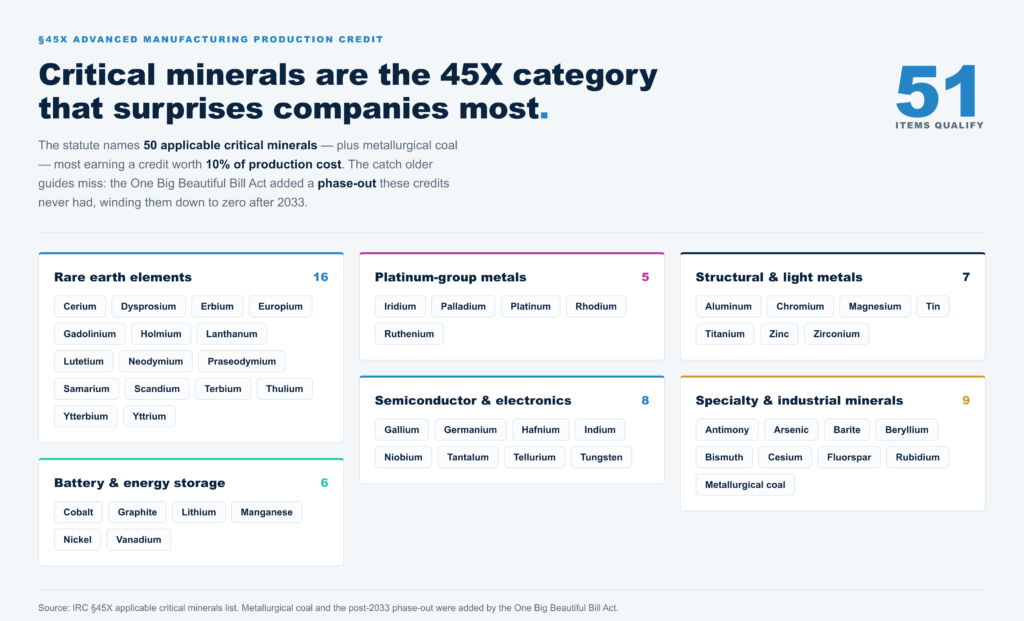
products can include a broad range of components used in solar, wind, battery, and inverter technologies, as well as 50+
critical minerals.
Unlike the investment tax credits that reward a taxpayer for the one-time investment of renewable energy property, Section
45X annually rewards the manufacturer for the production and sale of renewable energy components. Put simply, 45X is
designed to reward domestic manufacturing output, not capital investment. The focus is on producing eligible components
or critical minerals in the United States and maintaining the records necessary to demonstrate compliance with the credit’s requirements.
What products are eligible for 45X?
The credit generally applies to a defined set of eligible components, including solar, wind energy, batteries, and inverters, as well
as specified critical minerals. Within each category, the statutes establish detailed definitions and eligibility requirements, and
those distinctions matter. Participating in the supply chain for an eligible product does not automatically qualify a manufacturer
for the credit. The analysis must focus on whether the specific item produced meets the applicable statutory and regulatory
requirements.
For manufacturers, processors, and recyclers, the right starting point is not determining the value of a potential credit. It is
determining whether the product being produced is an eligible component or a critical mineral, and whether the activities
performed constitute qualifying production. A careful is often the first step in assessing whether a 45X opportunity exists.
For critical minerals, identifying an eligible material is only part of the analysis. The nature of the activity performed is equally
important. Qualification generally depends on whether the taxpayer’s process transforms the material into the required form,
purity, or specification through activities such as refining and purification. By contrast, extraction alone generally does not
qualify, and not every intermediate processing step creates an eligible product. As a result, a recycler recovering nickel, cobalt,
or other critical minerals to the required specification may have a position worth evaluating, while a recycler performing only
preliminary or intermediate processing may not. The distinction often hinges on the technical details of the process and the
characteristics of the resulting material, making a careful eligibility analysis essential before assuming a 45X credit is available.
Where 45X claims get tested
In our experience, 45X claims are most often tested on whether the taxpayer can demonstrate that qualifying production
activity occurred at its facility and that the activity resulted in an eligible component or critical mineral. For manufacturers,
this often means substantiating the production process and showing that a substantial transformation occurred rather than
a minor assembly, finishing, or handling activity. For critical minerals producersand recyclers, the focus frequently turns to the
technical processes used to refine, purify, or recover material to the required form, purity, or specification, as well as the
methodology used to measure and support those results.
Claims are also commonly evaluated through the taxpayer’s records. Production volumes should be traceable to operational
data, inventory records, and sales records, with a clear connection between the quantities produced, the quantities sold, and
the amount of credit claimed for the applicable tax year. These are not unusual or burdensome questions. They are the
fundamental issues an examiner or reviewer would be expected to ask, and companies that address them proactively are
generally best positioned to .
Planning for long-term 45X success
For many manufacturers, the greatest value comes not from a single year’s credit claim but from creating a repeatable process
that supports qualification over time. This begins with understanding eligibility requirements, evaluating manufacturing activities,
and implementing documentation procedures that align with the company’s operations. By addressing these issues early,
companies can focus on maintaining a consistent methodology as production scales and business conditions evolve.
This forward-looking approach can help reduce compliance challenges and create a stronger foundation for supporting
future 45X claims.
A practical next step
If your company manufactures components used in solar, wind, battery, or inverter technologies, or produces critical minerals
through refining, purification, or qualifying recycling activities, Section 45X may represent a meaningful opportunity. The key
is to understand whether your specific products and production activitiesmeet the applicable requirements before credits
are claimed.
Because eligibility depends heavily on the facts and circumstances of each operation, an early evaluation can help identify
potential opportunities, clarify qualification requirements, and establish the processes needed to support future claims.
Taking a proactive approach often provides greater value than assessing eligibility after production has already occurred.