Mergers, Mindsets, Modern Leadership
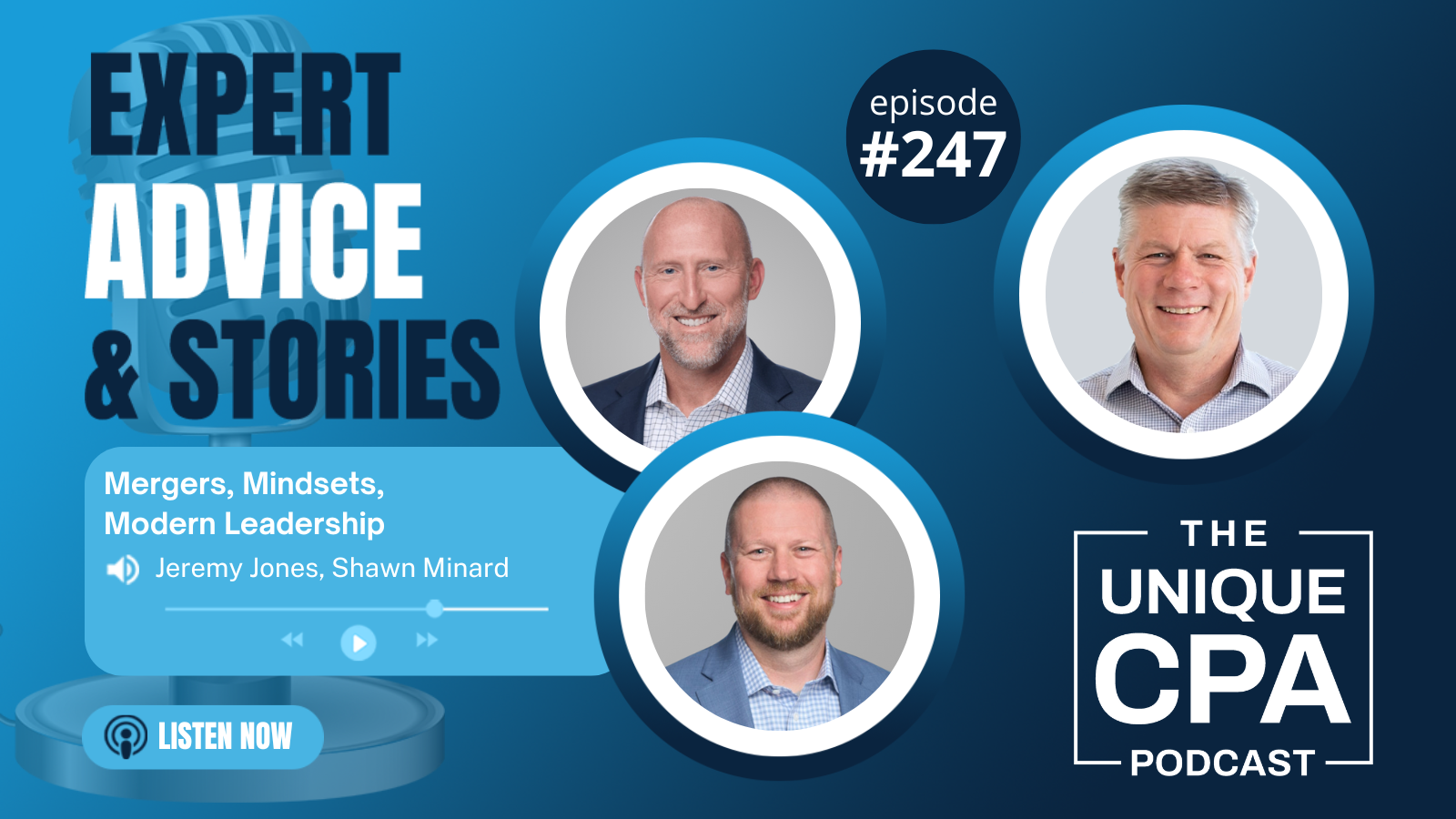
With Jeremy Jones & Shawn Minard
Shawn Minard and Jeremy Jones join Randy Crabtree to pull back the curtain on Frazier & Deeter’s approach to growth, culture, and leadership on Episode 247 of The Unique CPA. As the firm expands through private equity and acquisitions, the conversation moves beyond numbers to the real work of integrating people and ideas. Shawn describes how “stay interviews” and a flexible, opt-in leadership program have become cornerstones of their people-first philosophy, while Jeremy discusses the challenges of maintaining high standards, embracing flexible work, and prioritizing entrepreneurial thinking. Together, they weigh the value of emotional intelligence against technical skills, and consider how a flat leadership model can thrive in a 700-person firm. The result is a candid look at how culture and adaptability shape the future of accounting.
Today on The Unique CPA, I’m joined by Jeremy Jones, who is Frazier & Deeter’s Chief Operating Officer, and soon to be next managing partner. And Shawn Minard, who’s the firm’s Chief People Officer, which I love that title. Today we’re going to be discussing a few key topics, and as always happens on the show, I’m sure we’ll veer into some other topics as well, but just to give you a little preview of what we expect to talk about today: emotional intelligence and the importance of that, even comparing that to technical expertise. We’re going to talk about scaling a firm and how to do that while you’re doing M&A transactions. And we’re going to talk about leadership and what flat leadership could look like in a 700 plus person firm. Before I keep going further, Jeremy, Shawn, welcome to The Unique CPA.
Thanks for having us, Randy.
Awesome, thank you.
Yeah. Looking forward to the discussion. I’ve been a fan of your firm and involved with your firm from knowing people there for a long time now. I think it’s 10 to 15 years, somewhere in that range. If we talk about culture, which we’re going to talk about a little today, I’ve had a lot of fun in the past at the Frazier & Deeter Christmas parties. That’s some good culture creating experience there.
They are legendary here in the Atlanta market for sure.
They are, they are. It’s been fun. So before we get going onto those three topics I mentioned, I don’t know who wants to take this, but let’s get a little more background on Frazier & Deeter, maybe even some history and where you are today. Yeah, whoever wants it.
Yeah. Thanks again, Randy, for having us on today. Great being on, big fan of Randy Crabtree and The Unique CPA podcast. Thanks for inviting us on today. Frazier & Deeter’s been around since 1981. Jim Frazier and David Deeter came out of a large firm at the time and wanted to create a middle market firm that gave more of a white glove service to our clients and really focused on the middle market. Jim and David are still around today, still walk the halls. I actually had a conversation this morning with Jim, so it’s great to keep the founders around after 44 years.
The firm has grown over the years and we are a full service CPA firm based in Atlanta, but we have offices across the globe. We have two offices in the UK, as well as several here in the States. Most recently in May of this year, Randy, we took on a growth equity partner in General Atlantic. We closed that transaction in early May and that was really to set the firm up for the future. We’re excited with where we’re going, with GA as our partner, and we’re looking forward to what the future holds.
So a couple questions on that, because that’s a hot topic these days in the profession. Was this a long process, a short process? I’m assuming for the last five years you’ve been called nonstop about, hey, you’re looking to do a deal. So a little bit on the process and then in addition, what were the things that you were looking to solve with this transaction? Jeremy, I assume you want to jump in on that.
Yeah, for sure. I think any of these processes are long. Our process started really in 2022, as the board came to Seth and myself and said that they wanted to evaluate what it meant to be backed by a growth equity partner or what it would mean for a firm our size to roll up to a larger firm. For the majority of 2022, we spent a lot of time with consultants in the space, we spent a lot of time with other firms, some private equity players. At the end of 2022, we decided that it was not the right time for Frazier & Deeter to go to market. We did some internal restructuring, we invested heavily in our shared service team. We’d already brought Shawn Minard in, but we invested heavily in our IT group, our marketing group, and our internal finance group to build ourselves out to operate as though we were a private equity owned CPA firm.
We operated that way for about a year and a half, and then the market continued to be very hot, and we decided last year in early 2024 that we would explore private equity again. We went through a process starting in July of 2024. We hired an investment banker, and we went to market, and we talked to probably 35, 40 private equity firms. We had our rubric, we knew what we were looking for in a partner. We decided not to go with our highest bidder when we were looking at what would, it came down to making a decision, but we went with the firm that we thought was the best cultural fit for us.
Ah, nice.
That was the most important thing for Seth and myself and our partner group, and really for all of our employees, was to have the right partner to help us grow into the future. When we were evaluating whether we wanted to go down this path, we really looked to what was happening in the industry and where we wanted to take the firm. We knew to grow and to have the size and scale that we thought we needed to be Frazier & Deeter many years into the future, that we did need to bring a growth equity partner to the table that could help us with investments in people and technology, other offices, M&A activity. So that’s what really drove us to decide that bringing in General Atlantic was the right move for the firm and our partnership and our people.
Alright, perfect. I appreciate the background there, and because I want Shawn to have an opportunity to speak here. I mentioned in the intro, I love the “Chief People Officer” title, which I’ve heard before, but for people who haven’t, explain what that means and what your role is.
Sure. So Chief People Officer really encompasses a lot of things, but overall, the responsibility of my team is to recruit, go on campus, find experienced hires, build out the right employee experience, anything from small happy hours to really large company-wide events. We also have a pretty robust learning and development wing to my team that helps build out the technical learning experience as well as all of our leadership development and soft skills training. We’ve invested heavily over the last four years in the people and culture team. We’ve got about 15 members of the team that span across those three different departments with team members here in Atlanta, but we even also have someone in our India office, so spanning across the globe.
Nice, nice. And you’re going to have to make sure you let me know when that next happy hour is. I’ll meet you over there.
Can totally do that!
Alright, thank you. Before we get into those three topics, like I said, and we’ll get into other things, just because I think it’ll tie into that, since doing this deal or even prior to the deal you did with private equity, I assume that you’ve done M&A transactions merging in other firms. And that’s obviously been happening prior, but is that ramped up since that deal, or is that what you’re looking at doing?
Yeah. Prior to taking on private equity from General Atlantic, we had done probably half a dozen acquisitions in the past. They were smaller firms, specialty firms, but really since taking on our growth equity with General Atlantic, the mergers and acquisition talks have definitely increased. We’ve closed one transaction—we acquired a firm in Huntsville, Alabama, in July of this year, Anglin Reichmann Armstrong. That acquisition has gone fantastic on both sides, we couldn’t have asked for a better cultural fit than the team that joined us from Anglin. We currently have a couple other firms under LOI and, as you can imagine, there are a couple of dozen firms that we are in conversations with at different areas and pursuing them for sure.
I will not ask names of those firms. The Anglin Reichman, what’s the third name in there?
Armstrong.
Armstrong, I always forget, and I know it’s Steve Armstrong. Do I have that right or—
Yes, Steven Armstrong.
Yep. And I know all of them. I actually have known that firm longer than I’ve known your firm. I actually probably knew that that deal happened, but I completely forgot until you said it. So I’m excited about that deal. That’s a great firm. From a fit standpoint, when you’re looking at, let’s say them or other deals, and you mentioned it, it’s a specialty firm maybe, or you’re looking maybe geographically or is there a service that they have? All of the above? When you’re looking at transactions, what comes into play?
Yeah. When we’re looking at potential acquisition targets, obviously we want firms that are in good markets, that are well run, firms that are growing, and have a second level of talent. We appreciate that senior partners have grown a firm, but when we’re looking to invest in a firm, we want to know that we have some younger partners or younger talent that can really help us grow into the future. Yeah, it could be a specialized service offering they have, could be a specialized industry. Anglin, for example, was heavy in government contracting. We had some government contracting, but not as strong there as Anglin was. So they’ve definitely augmented our ability with government contracting. And then, you know, the geographical expansion.
But honestly, when we look at firms, the first thing we lead with is, is it going to be a good cultural fit for Frazier? Is it going to fit into who we are? Are their partners going to be good partners to our firm? And are their people going to fit in with our firm? If the answer is no, that’s not a bad thing. But if the answer is no, no amount of money, no deal structure is going to fix that. We’ll move on from that potential at that point.
Well, let’s expand on that because that was one of the key topics that we brought up at the beginning, and you already mentioned it twice. You mentioned it with the culture, with the PE firm, and you mentioned the culture when you’re looking to merge firms in. And so when you are scaling now, which you have been for a long time, on a growth mode, how do you make sure that the culture’s going to be a good fit? But then the next question on that, and you can answer the first one first, but I’ll forget about it if I don’t say it now. Are there opportunities, or do you find times when you look at another firm, it’s like, wow, that culture is something that we really should try to integrate more of what they’re doing in with us as well?
Yeah. I’ll jump in here, Jeremy. One of the main things, like you said, culture fit is so important to us, not only with our growth equity, but with potential acquisitions. When we’re meeting with specific firms upfront and early, there is a lot of relationship building that’s happening between their lead senior partners and our senior partners and executive team, we spend a lot of time getting to know them, understand their story, how they’ve built their organization, what their culture is like, what are they most proud of, what are they looking to do by merging in with a firm like us. We spend a lot of upfront time before we even go down the path of what the deal parameters or the numbers look like, because we want to make sure that there is a really good fit there.
When it comes down to once we start moving forward, we get under a letter of intent and we start meeting maybe more key members of their team as they’re getting brought into the conversations, we spend a lot of time understanding how their roles work, where their culture really thrives, and there are things that other companies do that we will adopt. I’ll give you an example with the Anglin acquisition.
Earlier this year, one of the things that I learned that they do is they do stay interviews with all of their people. Most people, best practice, you’re always going to do an exit interview when someone’s walking out the door. But we learned quickly, “Oh, so tell me a little bit more about the stay interview,” and they actually every year will go have conversations with all of their people and ask just a handful of questions about what keeps them coming back through the door every day. That’s something we’re going to incorporate here at Frazier & Deeter that we learned from Anglin that we weren’t doing in the past. So it doesn’t have to always be a perfect culture fit of exactly who we are. But it’s almost like a culture add. What can we do to help differentiate ourselves to stay people first in thinking about our people in the best way? That was a really good example that we’ve seen from the past acquisition that we’re going to adopt.
Yeah, that’s nice. I love stay interviews. It’s something, honestly, I don’t think we have integrated, we should. But I’ve heard about it so often that it makes sense because sometimes people aren’t going to feel comfortable coming up to say, these are things that I’m not happy with here. But if you bring that out rather than in an exit interview, but in a stay interview, that’s when you can address it. So that’s such an important aspect. So further on culture, because now, I mean, there are so many things in culture that I can’t even think of all of them, but let’s say just simple things like maybe the titles they use are different than the titles you use. Is that something that you have to work on integration? Because people’s mindset might be like, did I just get demoted or did I just get a raise or what’s going on? Have you run into that?
We have. We ran into that with Anglin and we are running into it with a couple of potential acquisitions now. The key to that is communication and being flexible. Working with their senior partners and talking through their employee roster and really getting a good understanding of what everybody does, what their responsibilities are, what their roles are. What we find is, yeah, we may all be CPA firms, but the way that they approach their work and the way they organize, it’s very different than maybe how we do. So we’re not going to jam everything into exactly how we do it, we will flex and we will make adjustments based off best practice that we’re finding, because we don’t want to break any of these potential firms that we’re bringing in and the way that they’ve been so wildly successful.
We’ll meet in the middle, we’ll have conversations about specific titles. If we use associate and senior and they only use the word staff, we’ll work through that and find the right common ground. Sometimes your operations people have different kinds of titles than at Frazier & Deeter, and we work through that. We try to be as flexible as possible just to make sure that they don’t necessarily feel as though they’re being jammed into something, but it’s more of a partnership right out of the gate.
Yep. And that’s good. So when you do a transaction like this from a culture standpoint, is there an integration playbook or do you have a step-by-step plan? What’s the process there?
There is a playbook. I use that term lightly because between the executive team and each of the client facing groups and the marketing team and the IT team, we all have different things we need to get accomplished to make an integration be successful. So each of us come at it from a little bit of a different angle, but we try to pull all that together, coalesce it together to make sure that we’re all on the same page when it comes to the type of data we need, the information we need, the communication we need to have.
I use that term loosely because I’ll give you an example: One of our potential acquisitions, they wanted to tell their employees about this potential acquisition happening a lot sooner than we probably would have done that. But it felt right for them and their culture, so we supported that, but then we pivoted and we were flexible to make sure that we changed our schedules to be there, to be a part of that conversation, to answer questions and everything like that. Sometimes there is a playbook, but you’ve got to be flexible because each firm is going to run a little bit different and they have different nuance and context with the way they want to communicate with their people.
I think it’s important, Shawn, to point out that with the integrations we do have a full scale cross-functional integration team, that their job is only to focus on integrating these firms that we acquire. That is a differentiator in the market, but it is critical, or we believe it’s critical to our success that any firms we acquire become fully integrated into Frazier & Deeter and are part of the Frazier & Deeter team. They don’t operate as a standalone office or a standalone team for very long. And that takes more time and more money, and that’s okay because we want it to feel like one firm. We’re willing to invest that time and money to make sure that we get it right and they feel a part of something bigger.
Yeah. I love that. I was just having a conversation yesterday with somebody, Alan Whitman, who used to be managing partner at Baker Tilly, and we were talking about that type of one firm and doing what’s right for the client, not specifically for my book of business or anything like that. So integrating everybody into that mindset is super important. I’m really intrigued about the one topic that you guys suggested we talk about, which is what the flat leadership model looks like, especially in a firm that’s 700 people. First thing I think is flat leadership is like, okay, so everybody in the company is a leader. What do you mean by flat leadership, first off?
Yeah, we’re almost 700 people. We have three major business lines of tax, audit, and advisory/consulting, and we have three heads of department for those different groups. But we have a lot of partners that roll up into each one of those groups, so there’s a lot of responsibility on those heads of department to run their business on a day-to-day basis. One of the ways that we’ve really found that has helped us thrive when it comes to flat leadership and not having a ton of hierarchical structure within our partner groups, so our partners can really focus on servicing clients, is really getting everyone on the same page with the language that we use around leadership. So we built a handful of really specific, nuanced leadership development programs that we have put all of our partners, all of our managers and senior managers, and all of our associates and seniors through, to where everyone’s learning what leadership looks like here at Frazier & Deeter, they’re learning best practice and they’re learning the language that we use to develop others and to give feedback.
So when you have a head of a department who might have 20 or 25 different partners that they’re responsible for, they can empower their partners to go off and develop people and have real feedback and developmental conversations with their people without them feeling like they’ve got to be in the weeds on it because everybody’s using the same language and the same theories around what we think leadership looks like.
Jeremy, any corrections?
No, he pretty much nailed it. I guess Shawn’s got us trained right, since we all speak from the same playbook.
Nice. I want to back up, Shawn: Did you say there’s a program in place where everybody’s learning these leadership skills? Can you expand on that? Because I love, that’s one thing that I don’t think we teach leadership, we just assume somebody’s good at doing a tax return, and so now they’re the next manager or the next leader of that group. So actually being intentional about what leadership is and means, if you can expand on how you do that, that’d be great.
Yeah, so we built a program, it’s called Accelerate, but it’s leadership for all. From associate all the way up to partner, and we take different topics throughout the year. We work our way around busy season. We’ll offer topics at different times throughout the year, so everybody has a chance to participate based off of their schedule. When we take those topics, we’ll put people in cohort groups to where they learn from each other. We’ll have associates in the same cohort group as a manager, a senior manager, or a partner, and they are listening to podcasts, watching videos, reading articles about specific topics, and then they come back together and they learn the FD way. You take those topics, you talk about how that applies here at FD, how does that apply on your job. We have many of those different options throughout the year.
Then, another part of that Accelerate program is promotion readiness or manager readiness training. A lot of our associates and seniors will start going through some manager-specific development before they’re even promoted into that role to get them ready for it, and they get to practice developing others, they get to practice feedback. And we give them tools, things that they can do on the job during busy season, and resources. That way they’re practicing on the job and it doesn’t feel like this thing that’s sitting over here where I’ve got to go to this training workshop, but it’s actually happening in your normal day.
So that’s the program that we’ve built over the last couple years. 87% of our firm has gone through the program in less than two years in some way, shape, or form. It’s not mandatory. You opt in if you want. We haven’t had to even make it mandatory, but that’s the learning and development culture that we’ve built over the years. Almost everybody is just opting in to be a part of it, which has been really helpful from the flat leadership perspective, to where we can be almost 700 people and not feel like we have all this hierarchy.
So not mandatory, you’re at about 700 people, about 600 of those 700 have already participated in the program. I think that’s a pretty good participation rate. I’m guessing that people are enjoying that aspect of it and learning, which I think is so important. We’re going to stick with Shawn. Jeremy, it’s been nice talking to you. We’ll talk to you later. But you picked the topics, not me, so I’m just saying, although they were all very, I wanted to talk about every one of these, so that’s pretty cool.
The next topic, which I’m guessing falls under the Chief People Officer role, is talking about emotional intelligence and the importance of that. When we talked about it, when you sent this over, even contrasting that with your technical expertise. When you said specifically with promotions, are we looking more at this emotional intelligence when we’re deciding who’s going to go to the next level promotion? Before we even get there, everybody knows emotional intelligence, they’ve heard it, but I don’t think everybody has the same definition. How do you look at emotional intelligence?
Yeah, emotional intelligence is having the understanding and the wherewithal to be able to meet someone with empathy and know where they’re coming from and understand context of their viewpoint. You can read a room, step into a meeting and understand the vibe of what’s going on and know how to fill in the gap. That’s the most practical way I can talk a little bit about emotional intelligence. When I think about emotional intelligence and the way we look at it and view it here at Frazier & Deeter, it starts with campus recruitment all the way down, when we’re looking for interns, when we’re interviewing and we’ve got people on campus, meeting people, yes, the technical learning that they’re doing in their GPA and all of those things, we look at all of that, don’t get me wrong, but that’s table stakes. The thing that really separates for us is how do they interact with other people, can they read other people? Are they humble, hungry, smart? There are things that we’re looking for on campus that will separate them when they start their career with us.
What we’ve found is once they get here, there’s a lot of technical learning and expertise that we have to train up anyway when they get here. That’s a lot easier to teach and train. The emotional intelligence piece takes a little bit more work, and so if you can find people that have already done a little bit of that work on their own or they’re naturally inclined that way, we find that they move through their career progression quicker. So we see associates get to senior and senior to manager and manager all the way up to partner much quicker when they have those extra skillsets, innate. We search for it, we look for it, we train to it. It does not discount the technical piece at all—it doesn’t. That is table stakes.
When you couple that with what’s going on in society and the world right now with AI and all of the things that we’re going to be having to manage when it comes to technical skills, some of the things that people are learning might be obsolete for them to have to do as a task in the next few years. The thing that’s going to help you thrive in your career is going to be how do you interact with others? Do you have that emotional intelligence to be able to read a room and to influence others?
Yeah, I agree completely. Do you think part of that gets enhanced or the people that maybe don’t have that high level already, part of that leadership program, is that built into there?
It is, yeah. Within the leadership programs that we’ve built, we’re really intentional about making emotional intelligence, psychological safety, development of others, feedback, how to influence others—those topics are all embedded inside of our leadership programs to give people practical tools and practice on how to bring the best out of themselves when it comes to those.
Alright, Jeremy, I’m going to give you an opportunity to answer this and then we’ll see if you want to hand it over to Shawn or not, and Shawn alluded to it, but the skills that people are going to need in this profession for the future, maybe some of the same, but there’s going to be new skills, there’s going to be emotional intelligence being part of it, but just being able to manage how to use AI in this setting. Do you see skills that you’re looking for for the future that are not as prevalent right now, or that you see are important when you’re looking at new people today?
Obviously one of the big areas that we are focused on is, do people have the ability to use new and innovative technology and artificial intelligence? That is going to be a big part of the future. I think a big part of what we do. A lot of the lower level tasks that people get trained on how to do today when they come out of school, of preparing a tax return or doing an audit, a lot of that can be automated over time, and it will be. We already see that with some of the new software technology that’s recently come out. We do think that’s a big area that we need to focus on, making sure people have that skillset to be able to look at technology and use the technology and not just think about how to do a tax return anymore.
The other side for us, and I know we’re a little different as a CPA firm, but one of our core values is entrepreneurialism. So when we look at hiring people off campus or experienced hires, we want to know that they have that gear, that they can be entrepreneurial and they can think outside the box. It doesn’t mean they have to go start a whole business unit, but maybe they bring a new idea or a new process. New technology, they bring something to the table that differentiates how we do what we do. That’s key to us, that is very important for all of the new talent we’re bringing in.
Yeah. I’m a big fan of being open to ideas, because ideas can be looked at as mistakes at times because, oh no, this didn’t work. But if you don’t bring it up, you’re not going to advance, you can’t be innovative, you can’t be creative. So letting people know that yes, it’s okay to try this new thing because we’re going to need that. So this may come off of that or not. I can let you comment on that. You can say, Randy, yes. That’s great. I love what you said.
“That is great, Randy!”
Alright, we’re getting the laughs out of the way. What I wanted to talk about a little bit is defining career paths because I sometimes think we’re not. Different firms do it different ways. I think we often, I don’t know what you guys do, you can answer this. We often concentrate on here’s the partner career path, but not everybody wants to be a partner. So when you’re defining career paths, are you looking at multiple career paths for people to follow?
Yeah, we are actually, and we have your traditional career path, we have that baked into our onboarding process. The moment people come in, they get exposed to our roles and responsibilities, we have role guides, we have learning paths attached to those role guides, to where as an associate, I know the expectation of my role are these things, and I can see what the expectations are for a senior and so on and so forth. So you can see what it’s going to take from a skills perspective to move up through your normal, traditional career path in a CPA firm. We have all that at people’s fingertips. The other thing that we actually do a really good job of is we are flexible. We have a lot of folks that will be in our client facing roles for years, and they’re great contributors, but they may not want to always do client facing, or they may not want to get on that partner track. So we end up with a lot of really cool, innovative operational type roles that people end up stepping into and making something of it that has enhanced our firm’s culture.
We have had folks come out of the tax business into our finance department and our current head of finance, she was a tax associate and moved her way all the way up, and so she’s running our finance department. We’ve got people who will step into scheduling roles or operational roles or what we would call a chief operating officer role of a specific department because it’s a non-traditional career path, but we’ve opened that up for people and people see that there are other options besides just moving all the way to partner.
Okay. And then again, the freedom for somebody to think it’s okay for me to say I want to be over here rather than over there. I think that alone is just a, sometimes a skill in leadership that we don’t use enough. And Jeremy, I want to ask you another question. Since you are currently the COO and soon to be CEO, but from an operations standpoint, do you see a way that, when operations, you’re looking at productivity, I assume, and getting work done, and this kind of intersection between culture and output and how those interact with each other?
Yeah, they’re not mutually exclusive. You can have a high performing team that has a great culture, and that’s what we are building here, that’s what we have built, that’s what we’ll continue to build here. We reward our employees very well. We do have high expectations, especially depending on the time of the year. But, Shawn mentioned it and talked about it a little bit: We also have a lot of flexibility with our people. So it is very common for us to have part-time people in our client facing roles. We have a lot of remote employees. We actually just became the first CPA firm to be hybrid certified. We’re proud of that. There’s a lot of opportunities for our people to continue growing and being flexible. Again, we do have accountability. We are running a business, but at the same time, we can still have a great culture in everything we do.
Yeah, and I think it’s important from that standpoint to be, you are running a business, you have goals, you have places you’re looking to go, and we’ll talk about that in a minute, where those places are. But being transparent on all of that is so important to me. If you’re not transparent, people will make up their own ideas in their own mind of this is what’s happening. When you are transparent and saying, this is why we’re doing this, maybe not everybody’s going to be agreeing with you, but if you at least show them this is the plan, this is why we’re doing it, I think you have much better buy-in because I’ve seen it where people will make up their own ideas and when you let that happen, that’ll kill a culture immediately. Obviously things have changed. Things are changing all for the good it sounds like. But the next change, or at least major change that comes into play will be January 1st when Jeremy Jones becomes the CEO of Frazier & Deeter. I assume you’re going to continue things as is, but where do you see? Are there some changes you want to make or do you see in general? What’s the future of Frazier & Deeter? Where do you see going? Are we going to be, you already mentioned global, but are we going to be an office in every state? Are we going to be, just give me the high level picture of what’s going on with Frazier & Deeter.
Well, Randy, I’d love to tell you we have the perfect roadmap, but the way the industry’s changing every day, I don’t know, we have to change and be nimble as well. I will be only the fourth managing partner here at Frazier & Deeter in 44 years. My predecessor, Seth McDaniel, has done a fantastic job taking us from a $30 million to $160 million firm, and maybe a little bit bigger if we can close a couple acquisitions by the end of the year, would be great. Seth’s done a great job. We all have different leadership styles for sure, but what Seth and I share, as well as with Jim and David, the founders of the firm who were also managing partners at one point, is we do believe in the people. We believe in the entrepreneurial spirit. We believe in being accessible to our people and having high quality work, and that is not going to change. That is core beliefs of the firm. That’s what we were founded on. That’s what we continue to operate under today, and we’ll continue that into the future.
I do think we have an opportunity right now as an industry. I don’t know how long this opportunity will last, but there are a lot of great firms in the market today that are trying to figure out their future. So firms like Frazier & Deeter have the opportunity to fill that void for some of those firms and to help them grow what they currently have by acquiring those firms, and they come onto our platform and they can still be strong leaders in their market, it could be leaders within the firm, and I think we have a great opportunity for that. Over the course of the next three to five years, I think we’ll do a lot more geographical expansion through acquisitions. At the same time, we are laser focused on what technology does to our business. We have an innovation committee within the firm. Their whole job is to really focus on what is the new technology available and what is the new technology we need to either go buy, build, or partner with somebody to make our jobs easier and make client work more efficient and effective in everything we do. So those are a few things we’re leading with right now. You’ve gotten to know Shawn a little bit. He’s obviously a key part of that. On the people side, we have to have the best and the brightest people. We’ve also invested heavily in our IT group and our marketing group because those are our key areas of focus on growth here in the next three to five years.
That’s just an engine there working out with the marketing and sales, while everybody’s doing their tax returns and their audits and their advisory businesses coming in. That’s part of, from the reputation you’ve built as well. It’s easier to promote it and market it when you have that in place. Alright, before we wrap up, there’s a final question everybody gets, and I think you were warned ahead of time. I love talking about this profession. It’s an amazing profession for me, but who we are and what really makes us who we are is what we love doing outside of work. Jeremy, I’ll start with you. Actually, no, I’m going to change it. I’m going to start with Shawn. Shawn, what are your outside of work passions? What do you enjoy doing when you’re not being the people officer?
Yeah. I’m a big family guy. I’ve been married for 20 years. I’ve got an 18-year-old son and a 16-year-old daughter. I’m in the throes of trying to find where college he’s going to go to right now. He grew up playing sports. He’s a three sport athlete. I coached his travel baseball team for years. When I wasn’t working, I was on a baseball field. That leads me into another passion of mine, which is sports. I’m a huge Chicago Bears fan.
Yes!
I’m a huge St. Louis Cardinal fan.
No!
Yeah. Big Bears fan, big Cardinals fan, and a big Virginia Tech Hokie, because that’s where I met my wife and where I went to school. So I spend a lot of time attending sporting events, going to sporting events, watching sports. The last thing, just in general, this kind of relates more back to work, but a huge passion of mine in some way, shape, or form, is developing people. I want to bring out the best and the brightest in every single person. I want everyone to feel as though they’re appreciated, that they’re adding value and that they’re making an impact. If everybody shows up to work and feels those three things, retention’s high, loyalty’s high. I try my best to put the infrastructure in place for all of our leaders to thrive in that area and for them to develop the next generation of people. That’s why we build the programs we do, but we put it in their hands to go build those relationships with the people around them.
Nice, nice. Jeremy, your turn.
Well, I hate to copy Shawn, but I will a little bit. Big family guy. Married, got three daughters. My wife for the past 27 years has been around on raising girls. My wife and I actually just became empty nesters in August of this year, our youngest went to college. It’s always interesting when you have to learn how to re-date your wife after you’ve had three kids around the house for all these years. But it’s been fantastic. Having three daughters and a wife that are very active, outdoors are a big part of our life. Whether it’s wake surfing on the weekends, or out hiking and backpacking and sleeping in the woods overnight, which my whole leadership team thinks is hilarious that I go get lost in the woods on the weekend and actually rough it a little bit. That’s a big part of our life and we love it. My wife and I are actually doing a trip next weekend, so it should be fun.
Those are our big passions on the personal front, and yeah, I’ve been in this industry a long time. I love work. I know that’s weird. It sounds nerdy, but I love public accounting. It’s given me and my family so many opportunities. It’s helped me grow as a person, as a leader, as a business person. You just see so much with the number of clients we interact with, and I think this is a fantastic industry and I love coming to work every day. Feet hit the floor at five o’clock and I’m ready to go because there are so many things we can do with public accounting and with accounting in general, and I’m just excited for the next generation to see where it goes, because it’s going to be totally different, Randy, than what you and I grew up with. We’re going to be dinosaurs before we’re ready to retire.
I already am, but that’s alright. Alright guys, this has been a fun conversation. I love hearing what you’re doing. Exciting times at Frazier & Deeter, and I’m really looking forward to watching what happens over the next handful of years. Thanks again for being on The Unique CPA.
Awesome. Thanks for having us.
Thanks, Randy.
Important Links
About the Guest
Jeremy Jones joined Frazier & Deeter in 2001 and was named Managing Partner on January 1, 2026. He transitioned into this role with more than 25 years of public accounting experience. A vital contributor to Frazier & Deeter’s Audit Practice and a driving force behind its operational growth and professionalization of strategic Shared Services initiatives, Jeremy is nown for his expertise in internal controls, financial reporting and trend analysis. As Managing Partner, he will continue the firm’s dedication to sustainable growth, high-quality service and client success.
Shawn Minard is the Chief People Officer at Frazier & Deeter, a position he’s held since 2021. With a demonstrated history of working in multiple corporate industries, Shawn is skilled in Leadership Development, Talent Management, Performance Management, Recruitment and Learning & Development.
Meet the Host
 Randy Crabtree, co-founder and partner of Tri-Merit Specialty Tax Professionals, is a widely followed author, lecturer and podcast host for the accounting profession.
Since 2019, he has hosted the “The Unique CPA,” podcast, which ranks among the world’s 5% most popular programs (Source: Listen Score). You can find articles from Randy in Accounting Today’s Voices column, the AICPA Tax Adviser (Tax-saving opportunities for the housing and construction industries) and he is a regular presenter at conferences and virtual training events hosted by CPAmerica, Prime Global, Leading Edge Alliance (LEA), Allinial Global and several state CPA societies. Crabtree also provides continuing professional education to top 100 CPA firms across the country.
Schaumburg, Illinois-based Tri-Merit is a niche professional services firm that specializes in helping CPAs and their clients benefit from R&D tax credits, cost segregation, the energy efficient commercial buildings deduction (179D), the energy efficient home credit (45L) and the employee retention credit (ERC).
Prior to joining Tri-Merit, Crabtree was managing partner of a CPA firm in the greater Chicago area. He has more than 30 years of public accounting and tax consulting experience in a wide variety of industries, and has worked closely with top executives to help them optimize their tax planning strategies.