Telling a Better Story about the Greatest Profession
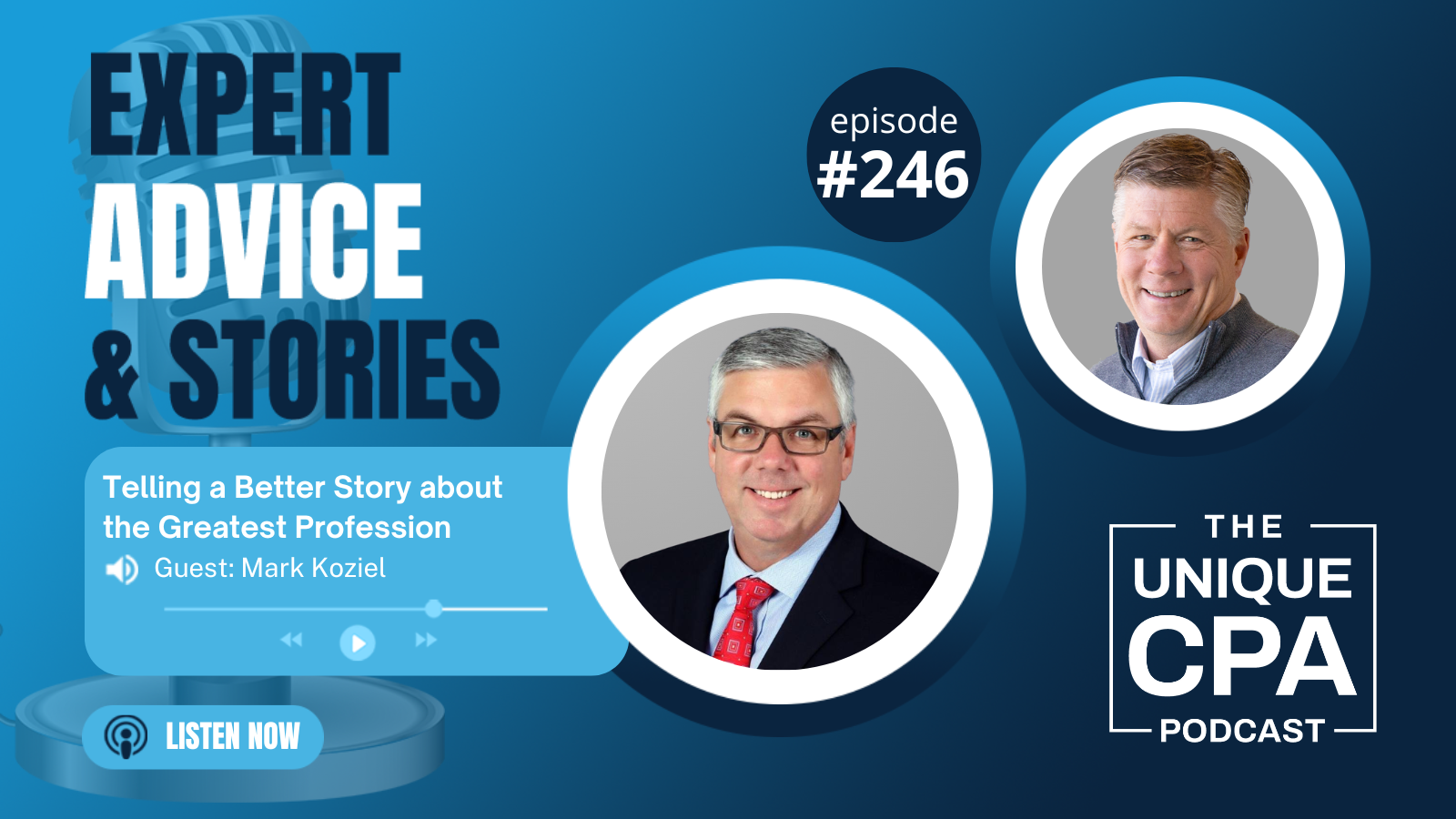
With Mark Koziel
Mark Koziel’s first year as AICPA President and CEO has been anything but quiet. He tells Randy Crabtree on Episode 246 of The Unique CPA that nine days into his tenure, Ohio became the first state to roll back the 150-hour requirement, setting off a chain reaction across the profession. Then came the “Big Beautiful Bill” with provisions that could have devastated pass-through entities, followed by Florida’s deregulation attempt, IRS commissioner turnover, and a 43-day government shutdown. Through it all, Koziel maintains an infectious optimism about accounting’s future. He pushes back against the narrative that AI will replace accountants, pointing to decades of similar fears about calculators, spreadsheets, and blockchain. The real challenge? Telling a better story about a profession that touches every corner of the economy. From his perspective on value-based pricing to his vision for the Rise 2040 initiative, Koziel makes the case that accountants remain the trusted guardians of financial information, and that this legacy is worth protecting.
Today’s guest doesn’t need an introduction. If you are in accounting, if you’re adjacent to accounting, if you know an accountant, you probably know this person. But today’s guest is a repeat guest, and it is Mark Koziel. Mark was on, oh, I don’t even know what episode number, but it was back in 2021, I think, early 2021, Mark was on the podcast, In his current role, he is president and CEO of AICPA and CIMA, he took over that role about a year ago, January of ’25, after decades of serving the profession, most recently CEO of Allinial Global. Mark has spent his career working closely with firms and professionals, giving him a very unique perspective and actually more than perspective on where the accounting profession has been and where the profession is going; he can actually have an influence on that. And as long as I said influence, he was recently named an Accounting Today “Top 100 Most Influential Person in Accounting.” I think that was a, for me, a “duh” moment. Obviously, it’s Mark Koziel. So Mark, welcome back to The Unique CPA.
Thanks, Randy, for having me. It’s always a pleasure.
Yeah, it’s always fun to talk to you. We actually got to talk in Napa earlier this year. That was a good time too, out at a conference out there that obviously you were the headliner of. So let’s go into this. I just mentioned you’ve been in this role for a year, just about a year now. You’re not new to AICPA, you were there for what, about 14 years? Is that what it was before, your first stint?
It was.
A year is a while, but I guess compared to Barry, that is a small fraction of your predecessor. But you know, what has this first year been like for you? Open-ended question: How’s it gone for you?
You know, what’s interesting is, I’ve been in the profession now 30-plus years and started in public accounting, 12 years of that. It’s nice to have all these different phases of my life that have all prepared me to sit in this seat as I do today. We announced October 15th of ’24 that I was coming back and taking the role, and so from that point, I was pretty well entrenched into it already. So by December this time last year, Ohio had already passed legislation to bring bachelor’s plus two years of experience plus exam back to their accountancy law. And it was signed into law January 9th. So now nine days into my tenure, I had our first state that brought the old rule back as an additional pathway, and there were already a number of states that I was speaking to. I was with all the state society execs the day that the Ohio governor signed it into law, and so we knew already how many states there were going to be. So people would ask me the question, are you for or against bachelor’s versus 150? And I said, my opinion means nothing, train’s left the station. Now it is up to us to make sure that the impact on the profession is as limited as possible, meaning mobility, that being the number one thing.
Yes.
Because the minute that Ohio signs that into law, mobility is now broken for Ohio CPAs and other states. We’re now up to over half of the states that have already passed legislation on that. So you talk about one of the big issues in my early part of my tenure, boom, because 150, 120 has been an argument since the day it was adopted. So you had that, you had the Big Beautiful Bill in May—lands third week of May, and we were in the middle of our council meeting, and there were provisions in there that would’ve had an incredibly negative effect on the CPA profession and other SSTBs, personal service companies that are pass-through entities. So we had to get to work on that, five weeks, we had to get it done with the Senate, making sure that provision wasn’t in there. And it’s not a provision like, okay, people are going to physically see this and say, you know, thank you AICPA and state societies for doing this, we just kept them whole on what they were allowed to do a month prior. And so again, it’s just amazing how these things happen. Big Beautiful Bill passes, becomes HR 1, implementation, with that, so much going on in DC around that.
At the same time, deregulation becomes a major risk. We’ve talked about it as a profession for a long time. Florida in January introduced a bill to deregulate the CPA profession along with others, passed the house in Florida. The Florida Institute of CPAs, in collaboration with AICPA and others, absolutely did a phenomenal job to get that pulled back so it didn’t pass in 2025. But at the same time, we knew we would see it again, which we could talk about for the future, ’cause it’s already landed as a pre-bill and it’s going to be there for January.
I heard this. Yep.
So we’ve already started work on that. So deregulation, Florida, which by the way, Florida was the first state ever in 1988 to pass the 150-hour rule. So they’re the ones who created the 150-hour rule for us back in 1988, only to try and deregulate us now. So it’s amazing how cultures change in various states. So on top of that, you know, international standard setting, there were a number of things that happened with that, pipeline-related issues, new SEC, government shut down for 43 days. Working with the IRS, who’s been through seven IRS commissioners, a number of them that I had met with and a number of them weren’t there long enough for me to even schedule a meeting. So, you know, when I first started, even before I started, our DC team tried to schedule a meeting with whoever was the acting commissioner at the time, and the name literally changed three times before the IRS finally just gave up and said, you know what, we’re not going to be able to hold that date. So we’ll have to plan it for the future. So it has been, to say the least, it has been one heck of a year.
Yep. I was going to say pretty easy first year, nothing going on. Just sitting back and relaxed. AICPA and CIMA are on autopilot, obviously not the case. So yeah, you got thrown into a bunch of stuff. And on top of that, you know, I mean, I’m assuming every generation, you could say there’s a lot going on in this profession, right? But this is, there is a lot. And there’s a lot of things happening. You’ve got a lot that you’re going to be dealing with for years to come. And so I want to jump into a few of those. But before I do, I want to ask about the deregulation, because I was hearing that. The last I heard it was maybe coming up for a vote in March. You said January. Is it like started to be argued in January or is there a vote?
Yeah, it’ll be introduced. It’ll be introduced into the House bill in January and we’ll just go through the same process over again in 2026 as we did in ’25, and know that the house could be likely to pass it. The Speaker of the House, it is one of his agenda items, so we know it’s going to be introduced. But this will also, 2026 will be his last year, so you never know where it’s going to go. Our fear is no matter what state it is, you know, and DOGE was a great excuse for a lot of states to say, well, we should be DOGEing ourselves, and cutting government and everything else, and they want to take state boards of accountancy with it. And again, it’s just the rhetoric around it.
And deregulation will always have two sides to it that both will say that we should deregulate, but for different reasons: The Republicans, less government; the Democrats, access to professions, access to trades, making it harder for the underprivileged to be able to employ within some of these. And I think, you know, we’ve done a tremendous job of trying to create diversity and to help the underprivileged get into a profession as great as ours. I’m a living example of it, not from a diversity standpoint, but from a lower economic input. My first graduate of my family, very low-middle income, blue-collar family. Like I think so many of my predecessors in this profession, we are built on that. We need to become more diverse and still continue to attract that type of skillset to the profession, those who appreciate hard work and appreciate what accounting could do for them.
I agree with that. We do a few different things, comments on that: One, I have the privilege of being an AICPA scholarship judge, and man, those applications that come through are amazing to see. The people, the passion that they’re showing and the knowledge that they have? Man, they are so far advanced from where I was. But a lot of it, I do see a lot of diversity in these applications too, and that’s always a bright spot to me. We do a survey in the profession on satisfaction levels, and one of the most positive impacts of creating satisfaction is when we do have a diverse workforce. And so seeing that be something that you’re excited about excites me too. So thanks for being part of that.
So since we’re in that topic a little bit about—I guess I just brought up—but the next generation, we have obviously one of the things you’re dealing with is we have a pipeline issue, we have a talent issue. You know, there’s plenty of stats out there. I know your organization has said, I think we’re probably at the 12-year mark now, that 75% of us are going to retire in the next, 13 is the number I saw, but I think I saw that a year ago, so let’s say the next 12 years. Me being one of those, I assume I expect to be retired in the next 12 years.
You and me, both. I’ll be right there with you.
Alright, so we’ll plan a party. In fact, I want to come to your retirement party. The numbers there, we saw a little uptick in enrollment at the end of ’24, beginning of ’25, but I think that also was tied to, I think Jen Kreider just mentioned this yesterday, there was actually a little population uptick at that level too, so she saw it was coming back down. I don’t know if you have thoughts on that, but let me finish the stage, and we have too many people leaving the profession too. So that’s obviously, I’m sure, a big thing that you are working on. And first, in your opinion on what’s going on, and then how are you and AICPA addressing the pipeline issue?
Yeah, so you’re right. We had a 12% increase in enrollment in the fall of ’24 and a 12% increase in the spring of ’25, all correlated around the fact that I was announced as new CEO of AICPA. So you’re welcome. We’re immediately seeing impact. You know, of course I had, yeah, right, like I had anything to do with it. But you know, I think the bigger thing is number one, you have to look at what’s happening in the environment around us. I think the economy has softened a little bit, even if it was just rhetoric around it. So in the fall and, you know, we’ve come out of four years of an inflationary environment and things. What accounting degrees, what accounting majors feel is stability, and so we need to continue on that realm, that it is a stable environment, generally stable. When we’ve gone into recessions, hiring has softened ever so slightly, never enough, since I graduated anyway, I graduated in ’91, probably the worst in 30 years at that point in time, and, you know, the banking system was completely crushed by the S&L and a bunch of things. Anyway, we haven’t really recovered from that ever, and so it’s amazing how fast people on campus will hear things that are happening inside the profession. We see that on a very regular basis. That’s what worries me about everybody saying AI is going to come in to replace every accountant, you know, the same thing.
You know, and so we need to continue because I, you know, Randy, I don’t know what the predecessors of CPAs did, the society before us, but it’s amazing to me how when there’s layoffs, they want to talk about, oh my god, the sky is falling on accountants. AI is going to, any type of technology innovation is going to replace the accountant. I’m like, why is it everybody wants to replace us at some point in time or write that we’re not an attractive profession? And so I’m constantly fighting with that because you know what? It’s the greatest profession in the world, and it is going to continue to be as long as we do the right things to make sure that the legacy by which we are living today we could leave for the next generation so that they too can live the same legacy
The predecessors before us, I mean, we have catapulted as a profession in the last 20 years in opportunity, in financial gain, in being able to still make the public feel secure about the capital markets and the financial information that they receive, and a whole variety of things. And we’ve expanded beyond just the trust factor in one aspect of business into all kinds of other aspects of business. And that is what’s really helped us grow. But again, I mean, the pipeline has to continue to be full. We are going to face just pure demographic shifts that there’s less people, period. So what does that look like as we go forward?
So we are focused on the pipeline, and I say first and foremost, telling a better story: I came out of, you know, 13 busy seasons—12 or 13, I can’t remember, some of those I was in advisory by then—but then I went into political and public affairs media for three years, and I will tell you those three years I could have measured in dog years in comparison to how bad tax season was for me as an auditor, you know, in a local firm. We don’t own hard work as a profession, yet that’s all we ever hear people talk about is how grueling it can be and all these things. And I think that’s what we need to start with is telling a better story, getting firms to think about it culturally. How do we fix that first in ways that make it happen?
Yep. I like “culturally” what you said, and I want to expand on that in a second. But I agree with you. I think one thing—I’m going to pontificate now for a second. I think one thing is that we just get in this, change is so scary and we can change so many things to make ourselves much more efficient, but we are told this is the way it has to be. This is the way tax season is. And when I started my firm, I was working crazy hours, back in ’88 I started, sold in ’06, but I was working crazy hours just because that’s what I had thought accounting had to be and accountants had to be. And it doesn’t. There’s so many ways you could do things better. And I’ve learned that over the last 10 years now, so late in my career, but I try to get that message out to everybody.
And when you said, this is the greatest profession, I say the same thing. There is nothing that happens in our economy that we don’t touch at one level. Every single business owner needs an accountant. Every single person needs a tax return done, not all of them, some do it themselves, but they need an accountant. Everything from that standpoint. And as a friend of mine and yours, she quoted this once and I love her quote. And I’ve said this multiple times now, and I give her credit every time because it just gives me goosebumps every time: “Accountants are the guardians of the galaxy’s economy.” Jennifer Wilson said that.
Nice.
And it just like, yeah, I love that. I love that quote. And how could you not want to be part of that? Sure. So you’re right. We need to tell a better story. And I think we all get dressed up in superhero costumes and go out and show them we’re the guardians.
You know what, it’s absolutely, you know, we continue to hear it. Whether you’re in a large firm that does public company, you’re in a small firm that does private company, you know, audits for the banks, audits for public filing, tax. I’ve said time and again, maybe this is the auditor in me: audit is the one thing we are licensed to do in every state. All the state rules can be different, but the one commonality we have is audit. And audit equals trust. And we are the trusted profession. All the other things we do are by permission, because of the trust we’ve created inside of audit. You know, the government, the GAO I’ve met with in my first year, and the not-for-profit audits that we do, they highly value those. The local government audits that we do, digital assets now passed in the law, and they’re saying a CPA has to actually verify the reserves that are behind the digital assets. So again, I don’t want to call it a win, and I’m not saying these are windfalls, but it’s the fact that we are the trusted profession—why it’s so important that we have self-regulation and peer review and all these pieces to ensure that we maintain that quality and that quality is perceived by the public to be the protector of that financial information, the guardians.
Yeah. And there’s so many, as you just pointed out, there’s so many things we can do, you know, we’re doing by permission, I think is the way you said it, which is true. And I think sometimes we don’t see that because we are so trusted. There are things that we can, there are other services we can offer as well that sometimes we just feel like we’re so busy that we don’t do it. And I think we need to look at those. Because, well, I won’t go on my tangent there. But I was just talking to somebody a couple days ago. And he has a certificate program that he does, and it’s something with, you know, basically verifying data security or tech security. I’m getting this wrong. But he was talking to me ’cause he says, hey, I want to get in front of the CPAs. I think this is a certificate. This is a service that they could offer. And those types of things, that was somebody, not a CPA, not an accountant, but he realizes that we’re the ones that people are going to come to and thought, hey, this is another thing that they can add if they want to, to what they’re doing. So I guess advice to everybody out there is, you know, don’t have blinders on. There are lots of opportunities out there for you.
In my old firm, you know, it was funny when I started with my second firm, I was with two firms in Buffalo, three years at one firm, nine at the other. And in my second firm, there were three departments when I started, there were nine when I left nine years later. And you know, part of the conversation we were having, so I practiced in Buffalo my entire time and one of the things we figured out is if we wanted to grow, we had to grow in the types of services we were providing. The net number of businesses in Buffalo continued to shrink. There were more companies that were selling cross-border to Canada, selling overseas, we lost a number of clients to that, and we said, if we’re going to take our client cradle to grave, what are the services that we needed to be in? So wealth management, we had added. We had technology, but we expanded technology and other pieces of that. We started an HR and recruitment division, started a management advisory division to help businesses with their growth and startups. We created an M&A division. All these things because that’s how we were going to help serve the marketplace.
Yep. That’s awesome. That’s a great example for firms. Alright, I want to keep moving on ’cause I don’t want to lose you here. We’re going to run out of time, but there’s a lot of topics we can touch on. And a couple things you mentioned over the last few minutes I want to expand on. You were just talking about technology, so let’s start there. And you mentioned AI and the fear apparently that some people have of AI out there taking their jobs, which I do not see happening, and obviously you don’t either. But how are you, AICPA, CIMA, addressing AI? What kind of advice are you giving people? Where do you see the impact? And I guess we’re at the tip of the iceberg, so what’s your advice and forecast of what’s going to be going on with AI?
So, you know, again, people are going to put us out of business ’cause AI is going to take over our jobs. And I have a slide I use all the time. It’s “innovation in the profession,” and it goes all the way back to 1933 and the advent of the electronic calculator, ’cause that was going to put a bunch of math whizzes out of business back then, right? You mentioned it, you know, the advent of Excel. Well, in our days when we started, VisiCalc was the spreadsheet of choice coming out, and then Lotus 1-2-3 took over. And, you know, you ask any kid, you can ask them how to dial on a rotary phone and what is Lotus 1-2-3? Neither one they’ll get right at this point. So we’ve been through this. We’ve been through it so many times. Blockchain was going to put us out of business, here we are. And we’re actually benefiting from blockchain and crypto, and all those digital asset pieces.
You know, AI, we’re talking a lot because we represent the entire ecosystem of accounting and finance with, you know, finance departments inside of business and also the audit and the public accounting space. AI is getting integrated inside of companies all day. Companies are struggling with putting controls over AI. And when we talk about developing controls, what one department inside of organizations has experience in controls and controls implementation and oversight? It’s been the finance team. So, you know, we’re not talking about technology controls, it’s data controls, controls over data, controls over usage, controls over reliability. And then on top of that, once the company has it in there, is there some level of external assurance that should take place over it? So our ecosystem, once again, has the opportunity to grow with AI getting more and more integrated inside of companies as we move forward. How do we know that the data that we’re providing or we’re relying upon to make decisions was reliable to be able to do that? And so all of this in the ecosystem for AI, it’s going to change what we do. No doubt. I mean, this is what we’ve continued to see.
But you know, I had a consultant to the profession who’s been around for well over 40 years, and he tells me about the rooms full of footers that sat in audit rooms at clients. That’s all they did were foot schedules all day, every day. And that’s what a staff accountant was back then. I said my element of success in 1991 was how fast I could make copies of stuff, envelopes for accounts receivable confirmations. Today we’re asking the young professional to actually provide an opinion on whether or not the AR is reasonably stated. All the rest of it got automated to a degree that they don’t even have to worry about stuffing envelopes or following up on confirmations or any of those things. It’s getting automated more and more every day. So again, changing what we do, but it can’t be a drive to create efficiencies to drive down price. We as an ecosystem need to focus on the fact that there’s still a value to what we are providing and we’re not providing hours and input, we are providing a value of an audited financial statement.
One quick story on this, ’cause this happened to me years ago: I had a client back in the day. They were a really good client. They were an audit client. CFO, incredibly reliable, great relationship with their bank. And the CFO says, you know, it’s frustrating that the bank requires us to do an audit every year. They know how clean it is. They know, you know, what we’re up to. I think we should go to the bank and ask if they would accept a review of a financial statement instead of an audit. I said, alright, you know what? We’ll go in there with you and we’ll have the conversation. And we were successful. The bank says, you know what? You’re right. You know, nothing really changes year over year or so. A reviewed financial statement we could accept that risk.
And so we’re driving back to their office after the meeting and the CFO’s like, he’s like, great. He said, so how much are my fees going down next year? I said, how about none? He says, well, wait a minute. He said, you’re not doing an audit anymore. You’re only doing a review. It’s far less time. I said, wait a minute. What service do we provide to your organization? He says, well, you do an audit. I said, yeah, what do you need the audit for? He said, to get a loan from the bank. I said, are you still getting money from the bank? He said, yeah. I said, so what changed? The value to you is getting money from the bank, not the vehicle that we need to do. Now, I did bring the price down. But I at least set an expectation. I did not bring it down based on hours and rate. I brought it down based on what the value could be, and that became a more profitable client for us. Not that an audit is unprofitable, but having the ability to do that and getting the client to think of what our value truly is, is what becomes important.
Oh, I love that story. And now you’re going to bring me down a tangent because I’m going to ask you about hours and billing by the hour and selling our time rather than selling the value that we deliver. I assume you are on the value side, and is there a way that we can get there. Are you all for tracking all our hours and billing by the hours, or would you like to see something else?
It has to be something else, because the hours aren’t going to show up anymore. You know, you can’t tell me that in the Big Four doing a public company audit, that the level of risk to the Big Four firm has gone down just based on the fact that we now have AI. Maybe it actually went up because we have more reliability in AI, you know, what are the risks that we have that something goes wrong inside of AI versus something else, or the data that the client’s providing that was AI-generated that is actually reliable? So there’s just a lot of pieces to it. And in my Allinial days, you know, now as head of AICPA, I can’t tell our firms how to price. But when I was at Allinial, we actually had a system set up, we had, talking about three-tier pricing, getting our firms to think differently globally, around how they provide value to the client. I think that’s the ultimate, you know, how you get there. Ultimately, what is the value at the end of the day to the client for all the different services that we provide, I think is absolutely necessary.
Yep. I agree completely. My fear is what you mentioned earlier is as we get more efficient and if AI is making us more efficient or whatever, we’re going to say, well, we’ll charge less. And I just, I think we’re too nice of people sometimes. It’s like, oh, I didn’t spend as much time. We’ve got to get rid of that mindset. It’s not time anymore. It’s what the value, your story from years ago, that’s a great story.
Alrright, let’s go. I want to get to one, at least one more topic before we close up. You mentioned a culture within organizations or changing the culture, changing the story out there, I assume a community, people in general. What are your thoughts on that and what we need to do?
Yeah, so as soon as I started, I created an email address—AskMark@AICPA-CIMA.com. It’s still open today. I’ve had over 2,000 emails to that email account, and I’ve answered each and every one of them. And so for me it was really important to hear from our members. And I had these general themes, you know, and again, you mentioned CIMA—CIMA is a global designation, we have the CGMA, so that 2,000 includes our CIMA members as well. For AICPA though, I was able to take this information and then again, using AI helped a lot. But the general themes were, don’t forget about the small firm, small firm support, need to be focused on the small firm, so absolutely. Audits of state and local governments actually came up as a challenge because a lot of firms are trying to get out of it because they’re messy. You gave me a bunch of ideas around that.
But community, you mentioned community, it’s one of the five, and creating a sense of community. We did that my last five years in my prior role just with firms. We created a community platform so that members could interact with each other 24/7 on a mobile platform or on the web so that they could talk about transfer pricing or audits, international audits, or US auditing standards or whatever it was, creating these communities, ’cause we are a diverse profession in the type of work that we do. And I always said for AICPA, you know, we try and send out one message to hit in the middle of all our members and we miss everyone. And so communities will be a way for us to have our members talking to each other in that community, whether it’s tax, maybe it’s employee benefit plans, PCPS on firm management, creating these communities, we’ve already started, we’ve got about eight of them that we’ve launched thus far.
But what’s amazing is we saw this, in my last five years at the Firm Association, was the fact that because we were creating greater engagement on a daily basis, we actually saw more people at our live events because now they could collaborate differently. But this isn’t a LinkedIn, this is about having a platform where you can ask questions in a confined environment of only those who are interested in that particular topic, a place to actually put resources, we could put newsletters and past webinars and resource tools and resource guides that people are interested in that particular topic, right inside of that community platform because it has the ability to do that. You know, I get complaints and I will tell everyone, I will fully admit that our website is awful and you can’t find anything. But if I can focus you in on a tax-only community and you know that’s where you go to find the information, it’s going to make our connectivity and interaction easier for AICPA to our members to be able to deal with.
Yep. Community, connection, collaboration, those are key topics I love to talk about as well, so I think trying to enhance that in any way possible is awesome. So great job on that. I was about to wrap up, but I figured, you know, there’s one more topic we need to talk on if we’re going to be talking on the key topics that are hitting the profession right now. We’d be remiss not to discuss that PE is very active in the accounting profession now, so just get your thoughts on what’s going on there.
Yeah, again, you know, I said this about the bachelor’s plus two coming back. When I started January 1st, we already had, I don’t know, at least 10 or so private equity-backed firms. So people that asked me my opinion on and my for or against, I say, that’s not up to me to decide. That’s up to the firm to decide what it is that they’re trying to accomplish. I used to tell our member firms in the firm association, if you want to remain independent, you can absolutely remain independent, but there are two things you’ve got to get absolutely right. You need to fix your governance and you need to invest in technology. And if you can get those two things done, if independent is one of your key strategic focal points, then it can be done. But then there are other firms who said, you know what? I want to move upmarket, I’m going to need a greater capital infusion that I can get knowing staying the way I am, and they’ve chosen that route. Again, they have a different strategy than those that want to stay as independent firms. So first, having your strategy down.
As a profession, I have to worry about it every day. We have to worry about quality in the profession, and we are only as good as our last accusation that comes into the profession. I always talk about corporate failures, it’s funny how they want to blame the auditor each and every time. But you know, it starts with the preparer, it starts with the audit committee, you know, all of those pieces are, again, part of the ecosystem. We’re very actively engaged in that. But my worry is that if there is an audit accusation and it happens on a firm that’s backed by PE, that’s going to be the focal point. I know the SEC is focused, it is one of their agenda items, they talk about PE. Our professional ethics committee and our peer review committee, they are all looking at are rules today appropriate for all these new firm structures.
It’s not just about PE, it’s family office. It is ESOP. It is a variety of things that have happened. We’ve had public company in the profession for 20 years. And so all of this, and PE does get more complicated in who owns what and it’s harder to follow the trail than it is in public company. But again, as a profession, I’m excited about the fact that private equity believes us to be as attractive as we are. A lot of folks want comparison to the medical profession to say, look at what they did there. Our rules, our alternative practice structure necessary for the audit and the way that it is, there are some protections already in place, I think, for the profession. I’ve had private equity firms tell me directly, the last thing we want is to have an audit accusation happen. Because in theory, if we’re not in this for the long haul, if this is a five-to-seven-year investment for us, we can’t have an audit accusation in years three or four and retain the value that we want to retain inside the organization. But that said, you know, again, audit accusations can come from a variety of different sources. I have to worry about that every day, what’s the reputational risk to the profession on any of this, and how do we stay on top of that to make sure that we are not in some way accused of something that isn’t necessarily at the root cause of what happened.
Yep, makes sense. Great answer. So I’m going to start wrapping up. But so I guess the one thing is, you know, looking at everything we talked about and things we didn’t talk about, I can tell that you are excited about this profession and where it’s going. But what is the one thing, or you can name a couple, that really gets you excited that where you see, we are a great profession and this is where it’s going to take us and this is why it’s going to continue to be the greatest profession in the history of the world, without those things.
You know, I think one of the things that we’ve done a great job at, and this is all predecessors, predates me being part of it, is trying to be visionary as a profession. So the Vision Project in the late ’90s turned into the CPA Horizons 2025 project that was finalized in 2011. Now we fast forward, now we’re in 2025. We need to be looking out 15 years and again, making sure that, you know, we are living the legacy, that we leave a legacy in 15 years from now we’re as viable a profession.
There have been three hard trends that have been identified over all of these years: Demographics, we’ve talked about that. Technology, we’ve talked about that. Regulatory, I’ve touched on it and all the things that have happened around us. And so those three are still standard. We’re seeing this on a regular basis, but it’s the soft trends around it. Technology, today we’re talking about AI. In 2011, we were talking about cloud, and now we don’t talk about cloud anymore, it’s an automatic, right? And so at some point AI will be the automatic and then what’s the next thing?
And I think the profession has done a good job of staying on top of these changes and these trends that are facing what we do. So we have Rise 2040. It is to take 2025 CPA Horizons and move it forward. We have the ability now to expand it beyond just CPAs in the US with the CIMA relationship and CGMA. We’ve had over, I don’t know, 3,000 inputs from 3,000 different members from around the globe. The idea is when this gets done, we will publish a report on what the Rise 2040 key themes are going forward, and we will publish that in the May timeframe around our council meeting—May is the AICPA council, June is CIMA council. From that, we’re also creating an AI-supported platform for our members to be able to go in there and say, okay, I am a CFO in construction in Wisconsin. What do I need to know as far as, you know, what are the trends, and being able to maybe even line it up with some industry data to be able to help our members give value of strategy to their organizations or clients in a different way. Because this is where we’re truly getting to that trusted advisor, and I am incredibly excited about this and you know, I think it’s just a great opportunity for us to continue to stay ahead of the game.
Yep. Awesome. Well, your excitement shows through, which is awesome. Anybody that goes out and is excited talking about the accounting profession I’m all for, and luckily I’ve seen more and more people do that, so that’s great. That’s great. But let’s do a little switch. When you’re not being all excited about accounting, although you are 24/7, but what are—and I asked you this question the first time you’re on the show—what are your outside of work passions? What do you love doing when you’re not thinking about the accounting profession?
I’ll have to go back and listen to my 2021 answer, but you know, I was asked on another podcast, you know, your why, you know, what is that one thing? And I have a new summary answer to that. I say generally that I’m a smoker. And people are like, well, that isn’t something to brag about per se. And I said, well, it’s actually twofold. It’s yes, I enjoy a good cigar and I have a cigar club in the town in which we live, or just outside of where we live. And then I also am a big barbecuer, so smoking anything. I have a Komodo Joe. I have a Big Green Egg. I have a Blackstone and I have a gas grill. Gas grill is only to cook hot dogs, everything else is done any one of the other three ways. That is my pleasure: feeding others. And again, when you talk about community, it’s amazing how food or cigars bring together people from all walks of life in a different way. So that’s what I enjoy to do.
Nice. I’m almost certain that was not your answer the first time I asked you. So that was a great—I want to experience some of the smoked meat sometimes. So I’ve got a feeling I’ll be in North Carolina next year, so I’ll let you know and I’ll weasel my way into one of your parties.
That sounds good.
Alright. And then last, obviously, just so people can hear more of what you’re doing, you named some stuff, they can go to the website, but where’s the best place to look you up?
Yeah, I mean I mentioned the Ask Mark email address. My email is Mark.Koziel@AICPA-CIMA.com is my standard email address, but the AskMark@AICPA-CIMA.com is easy for people to remember too, so you don’t have to worry about misspelling my last name. So it’s only known, you know, it’s a name Randy common in your town and in Buffalo. So it’s definitely a Chicago Buffalo thing.
Well, I appreciate you being back on the show. This was a lot of fun. Look forward to seeing you somewhere out in the accounting world this next year. I’m sure we’ll cross paths and thanks again for being here.
Thanks, Randy.
Important Links
About the Guest
The former president and CEO of Allinial Global, Mark Koziel now serves as CEO for AICPA and CIMA, a role he has held since taking over for Barry Melancon in January 2025. Allinial carries on as association of independent accounting and advisory firms with $6 billion in collective revenue and 268 member firms worldwide, underscoring Mark’s extensive leadership experience. He held that role in 2020 after 14 years with the AICPA and the Association, where he served in a number of roles, including executive vice president, Firm Services. He began working in the profession at a large accounting firm, Lumsden McCormick, based in Buffalo, New York. Throughout his career he has been a consistent advocate for accountants and has developed a strong global understanding of the accounting and finance profession.
Meet the Host
 Randy Crabtree, co-founder and partner of Tri-Merit Specialty Tax Professionals, is a widely followed author, lecturer and podcast host for the accounting profession.
Since 2019, he has hosted the “The Unique CPA,” podcast, which ranks among the world’s 5% most popular programs (Source: Listen Score). You can find articles from Randy in Accounting Today’s Voices column, the AICPA Tax Adviser (Tax-saving opportunities for the housing and construction industries) and he is a regular presenter at conferences and virtual training events hosted by CPAmerica, Prime Global, Leading Edge Alliance (LEA), Allinial Global and several state CPA societies. Crabtree also provides continuing professional education to top 100 CPA firms across the country.
Schaumburg, Illinois-based Tri-Merit is a niche professional services firm that specializes in helping CPAs and their clients benefit from R&D tax credits, cost segregation, the energy efficient commercial buildings deduction (179D), the energy efficient home credit (45L) and the employee retention credit (ERC).
Prior to joining Tri-Merit, Crabtree was managing partner of a CPA firm in the greater Chicago area. He has more than 30 years of public accounting and tax consulting experience in a wide variety of industries, and has worked closely with top executives to help them optimize their tax planning strategies.