Building a Thriving Accounting Alliance
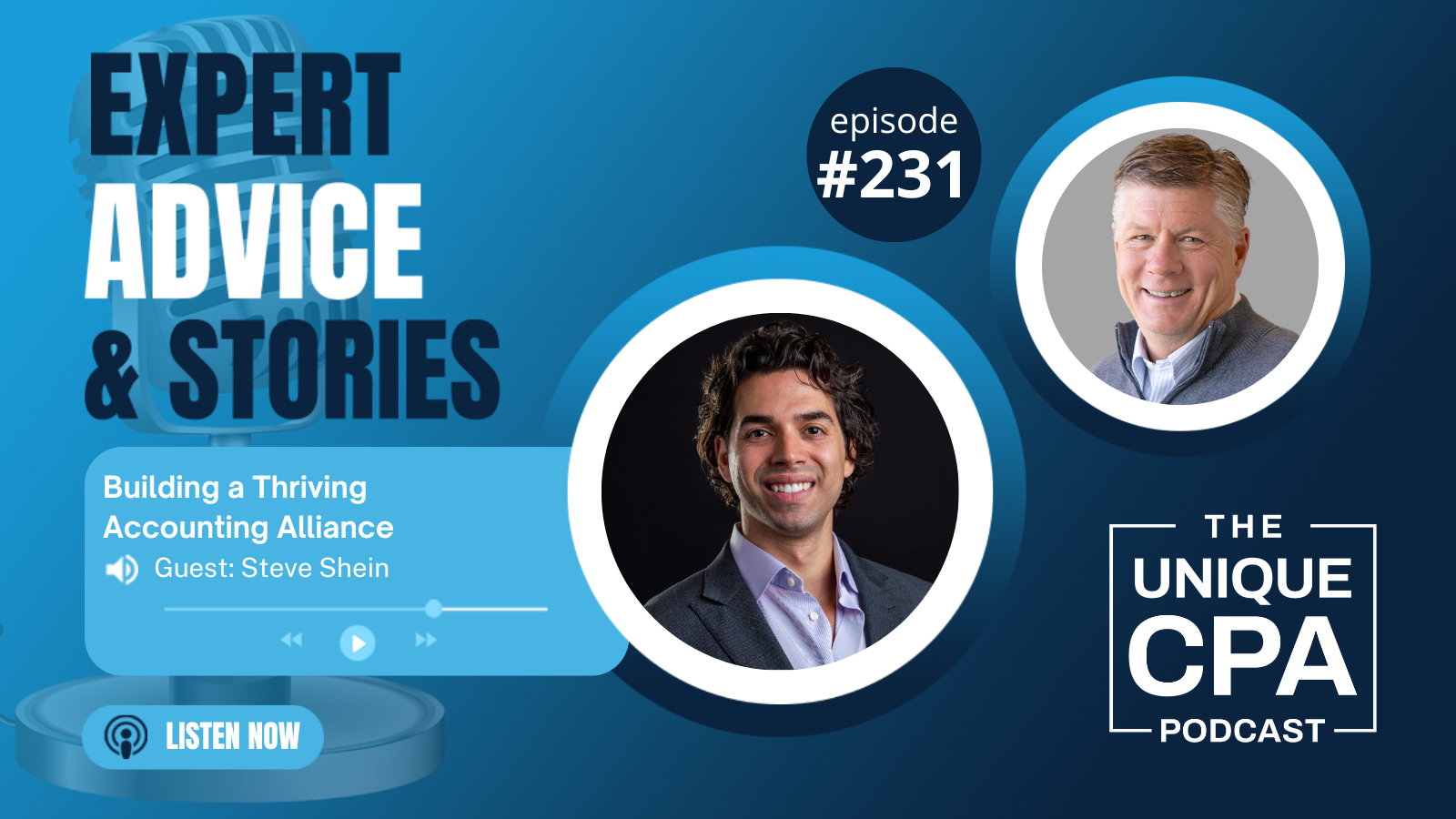
With Steve Shein
Small firms are facing a new era, and on Episode 231 of The Unique CPA, Randy sits down with Steve Shein, the co-founder of Franklin Alliance, to talk about a new partnership model in the profession. Steve shares his journey from capital markets to building a collaborative network that grants firms access to capital, while they maintain their independence. Franklin Alliance brings with it a vibrant community of strategic advisors and forward-thinking leaders, Randy included. Find out how you can grow your firm on your terms while keeping its identity and autonomy.
Today’s guest is Steve Shein. Steve is co-founder of Franklin Alliance, which we will be spending a lot of time discussing today. Steve and I met for the first time at this year’s Bridging the Gap Conference, and I was very interested to hear what he was doing with Franklin Alliance, which is supporting CPA firms around the country. And I’ll let Steve expand on that. But before you do so, Steve, welcome to The Unique CPA.
Thank you, Randy. It’s a pleasure to be here, man. Good to see you again.
Good to see you too. So I mentioned Franklin Alliance. I should probably mention before we even go too far, that I am now associated with Franklin Alliance. Do I have an actual—what do we call me?
You are a strategic advisor, my friend. You have the Randy “halo effect” that you bring to the organization, which we appreciate.
Yeah. Well, I’m excited. So let’s go into that. Actually, before we even do, because this is something that I think you started within the last few years, but before Franklin Alliance, give us a little background on yourself.
Yeah, happy to. I started my career in capital markets. I was a trader for years, kind of buy-side trading, proprietary trading shops, hedge fund, etc. Did that for years, really liked the meritocracy of it, but it comes with its challenges and the market gets more efficient over time. So I pivoted out of that into entrepreneurship kind of serendipitously—we were building software for capital markets participants, and as that grew and we increased our subscription base, I realized that the recurring software model was pretty nice and it was less risk and less stressful. So I pivoted that way a little bit, ultimately exited that business to a strategic, and transitioned into venture capital.
So I’ve been investing in early stage venture capital with OCA Ventures in Chicago for five years, and two years ago, we were really interested in the accounting space from a technology perspective. As I really dug in and learned more, I got very excited about the dynamic nature of the accounting space for a lot of reasons I’m sure we’re going to touch on today. But because of that kind of workflow, we launched the Franklin Alliance just under two years ago, because we realized that there’s a massive number of firms in the US and 97% of them are below $10 million of revenue. They all face similar headwinds, and it’s a really dynamic time in the industry. We thought that an alliance that supported this SMB segment of the accounting industry would really drive a lot of value. So we launched it and we’re really excited to have people like you involved.
Yeah, it is really interesting. It’s different. Well, I guess you can explain it, but right now obviously there’s this huge PE influx coming into the accounting profession. You mentioned this as VC-backed. What’s the difference? And honestly, educate me on this: What’s the difference between someone investing in a firm through PE and somebody coming in with venture capitalist money?
I think the tactical differences in how we structure this is we’re not a fund. So the Franklin Alliance is not a fund—it’s a company, just an operating company, it’s an accounting company with capital on its balance sheet to invest in accounting firms and build a platform to support its alliance members. The reason that’s differentiated is for a couple reasons: One, I think the timeline and the way that we will drive value for our investors is different than, I think, the traditional private equity play. To expound on that, our timeline is more flexible because of the way we structured the Franklin Alliance. It’s an operating company with a longer-term time horizon. Traditionally, private equity has certain horizons where the investors in that private equity fund, the LPs, would want to be paid back, right? Let’s say it’s three to five years, et cetera. Sometimes, not always, but sometimes decisions need to be made that can facilitate a shorter-term exit liquidity path, right? And oftentimes, I think the smaller segment of the—like any industry, but particularly accounting—there isn’t the infrastructure to drive a lot of the playbooks that the private equity return is predicated upon. So it’s incongruent. What I’m trying to say is I think it’s incongruent with the smallest segment of, let’s say, less than $10 million firms.
So for us, when we look at a $5 million revenue firm, we don’t look at that as an add-on to a regional firm. Like the private equity play, the traditional private equity play, would be a $20 million revenue regional firm. I’m painting with a broad brush here, but just in a hypothetical example—a regional firm, $20 million of revenue, backed by private equity, they’ll go and acquire $5 million revenue firms and there are add-ons to that regional firm and they get subsumed into the regional firm. So the culture, the leadership team, the software stack, the policies, everything—pricing, the name of the firm—it gets subsumed.
Our model—and I can expound on why this has played out with our first two partners were actually second-generation CPA firms where the current owner of the firm, it was started by both of their respective fathers, so their names are on the door, so for them, being subsumed by a regional firm wasn’t the ideal play. They wanted to maintain the legacy and the culture. There aren’t that many options for a $5 million revenue firm for example, that wants resources, wants to grow, wants capital to do acquisitions, wants all of the resources of a larger firm or more of them, but doesn’t want to be subsumed by regional. So that’s kind of where we have come in and that’s why our model of growth is different and more, I would say, patient capital than what people typically presume when they think about traditional private equity. Does that make sense?
Yeah, that does make sense. Well, some. I learn every time I talk to you or anybody, but it does make sense. And what excited me about what you’re doing is that you just mentioned it, these smaller firms don’t have all the options that a larger firm has. They do want to stay independent at times like this, especially with that second-generation firm, but they don’t have the capital either that they need to maybe compete. As a $5 million firm, you’re competing with a $1 million firm, but you’re also competing with a $20 million firm, and you’re kind of stuck in the middle. What I’ve seen is that those firms are the ones that are struggling the most because they just don’t have the capital to get the technology in place that they need. The pricing models are different if you’re competing with a $1 million firm than a $20 million firm often, so getting those things all tied in is super important. So you coming in and giving them an opportunity to—whatever their goals are, and I assume each individual firm coming in has their own goals and you can structure what makes sense for them. Is there a common theme of why people are becoming part of the Franklin Alliance Alliance? Do you call it the Franklin Alliance Alliance?
Exactly. The Alliance, the Franklin Alliance, exactly. Yeah, that’s well said. There has been a common theme among the first partners that we’ve brought onto the platform. It’s been a couple of things: It’s diversification of resources. It’s a growth-oriented partner. The economics help, because an individual firm is valued as an individual firm, whereas an individual firm that’s part of the Franklin Alliance inherits the valuation of the Franklin Alliance. That helps. But out of the first several firms that we partner with, it actually is less to do with succession than it is with growth. Now, that’s not—I don’t think that’s going to be ubiquitous across our platform. We actually have a partner right now that we’re talking to, we’re under contract with, we haven’t finalized the onboarding yet, but we’re under contract, we’re really excited to partner with him. And I think for him it’s more succession-based with the excitement factor of what we’re doing and wanting to add value and contribute to it, which I think is reciprocated on both sides.
But I think what’s interesting for our platform, and you highlighted it nicely, is we don’t meet someone and try to articulate their goals for them. We want to understand what their goals are, and if we can help them with them, then maybe we can be a great partner and we can explore it. If we can’t, then that wouldn’t be a good fit for either of us. So I think the through line so far, we have partnerships with two firms, we’re under contract with several others—if we were to be able to get through all of the deals that we have, all of our partners, if we were able to formalize all of those partnerships within the remainder of the year, I think we’d be at maybe five to six partners at the Franklin Alliance with multiple offices throughout the US. I think if that happens, 40% I would say are acutely interested in succession, the other 60% are more interested in growth, I would say, roughly. But everyone likes having an embedded succession plan. Our goal is that if you want to grow your firm for the next five years and you want to have an embedded succession plan, we can provide that. We want our platform to be able to provide liquidity for you. Let’s say you’re running your firm, in three years, five years, you want to start selling your equity to the platform and taking cash off the table, we want to be able to facilitate that.
Right. So let’s talk about the mechanics of that then, of how you’re coming in now with firms currently, because obviously there’s some cash infusion that you’re doing with them now. Are they retaining equity? What’s the mechanics of how it looks with being part of Franklin Alliance?
Yeah, so our model—I guess it is why we use the word partnership—because our main model is to find a partner that values the resources and we have alignment—like, goal-specific alignment. They want to be, in most cases—again, I don’t want to paint with a broad brush, but this is what’s been representative so far—is that the owners of the firms want to maintain the legacy, the culture that is currently existing in the firm. They want to own a significant piece of the capital of the firm. So our partnerships have been ranging from someone wanting to own, let’s say, 20% of the firm to 40. We’re flexible. If someone wanted to propose something to us, we would listen. At the end of the day, what we care about most is just partnering with the best people that share the vision with us. So our CEOs, our leadership teams, own a significant piece of the business. Then we are their teammates. We invest alongside them. People can take cash off the table, they can diversify their net worth a bit, they have capital for growth and for acquisitions if they want. They can leverage some of the operational pillars that we have, which I can touch on.
But I think that’s been why people have been interested in the Franklin Alliance as opposed to some of the other models, because some of our firms have looked at all the models. They talked to some of the regional PE-backed roll-ups, they’ve talked to some regional firms, they were considering, like, how do they—what’s the next chapter of their firm and their future look like, and if they didn’t want to go at it alone, who are the partners that potentially exist? We like when people do that because if they’ve done that and they’re aware of all the different options and they like our model, then we have some type of behavioral alignment in terms of goals.
By the way, for firms, we have a one-pager on this if people are interested, there’s a one-pager that we put together. It’s on our website in a DocSend link where it outlines all the different potential partners for CPA firms. That could be an individual firm looking to acquire a firm with an SBA loan, that could be a regional firm looking to acquire a smaller firm to add either a new location or just expand service offerings, it could be a PE-backed regional firm acquiring a firm. There are all of these different options and we try to break down, in a matrix style, what each of those options mean and how they impact a small firm.
Okay. That’s pretty cool. I should probably look at that.
We’d love your feedback, man. You’ve been around the industry. You’re an OG in the industry. We’d love your feedback.
Yep, I’m old. That’s the whole point, right?
No, no! Wisdom. That’s wisdom. Wisdom is earned.
You know what? I like how you said that because this is a new passion of mine—not to get off topic—but I think I’m writing a new keynote just on this whole stages of your career and what the best use of your time is. At this point in my career, the best use of my time is, as you put it, wisdom. It’s things I’ve learned over the years, it’s relationships I’ve built over the years. I’m not going to be the technician that I was 20 years ago, and I don’t want to be that technician, but I have a lot to offer and I think people don’t see that.
So this is—we’re going on a tangent for a second, we’ll pull it back to Franklin Alliance. But I think this is something important even with the firms you’re working with, where they can actually step back from something that they don’t have to do that they’ve been just the production person the entire time and they realize, I can’t do the growth if I’m doing the production. I’m more valuable with the relationships I build. So I assume those are some of the things you’re seeing in this.
Well, that’s so well said, and it dovetails perfectly into one of the things that we try to do, as we talked about earlier, like you being a strategic advisor. What we try to do is bring together people like you. We have a strategic advisory board that’s composed of people like you, like Rick Dryer; people like John Siegel, who grew his firm in Chicago an d sold to Aprio. Kenny Allen. People that have made an impact in the accounting industry and have seen a firm go from either zero to 5 million or five to 15, or 15 to 50, or 50 to a hundred, or even in the case of Rick, a very large firm. It’s what you just highlighted: It’s helping people not reinvent the wheel, so they can lean on the wisdom of people that have done it, so they can not stub their toes around every corner. They might be able to lean on someone else to share some feedback and life experience with them. And that strategic advisory board, those people meet with our firms as much as our firms want to meet with them. The people that are proactive and growth-focused, they want to be a sponge and learn from the wisdom that people like you can impart.
So I like what you just said with that, also the freeing the people up. When they are in this, “Hey, we want to be part of Franklin Alliance because we want—I’m not looking to retire next year. I want to, I just don’t have the opportunity to grow the way I want with the staff I have because I have to do so much right now, or I don’t have the funds available.” And this investment that you give to them, that they keep, forty percent, let’s say in that scenario. I assume someone that wants to grow is going to want to keep a bigger percentage. That money, that 60% buyout, let’s call it, that they get from you, is that something that they use to invest? Is that something they personally just go invest for themselves for the future? Is there a requirement that’s used in any way?
No, there’s not a requirement. I think it’s case by case. I think it’s really dependent on which stage in life someone’s in. Brent was our first partner—Brent’s young. Brent has his whole professional career ahead of him. Arguably, he could work for 20 years if he wanted. I don’t want to speak for him, but he’s a young guy, he’s a spring chicken. So for him, and all of our partners are actually pretty young so far. We do have one partner who, like I said, is more interested in succession, so for him, it might be taking those chips off the table, financial stability for him and his family because he might not want to work for as many years prospectively. For him, it might be take the chips off the table, reinvest elsewhere, financial obligations for him and his family. But for others, it’s like, double down. How do you double down? How do you diversify your wealth a little bit and excel in what you’re doing? So there’s no recipe that people need to follow. I think it’s really just predicated on where in life they’re at.
Yeah. And you’re being a good partner and just helping them wherever they need. So let’s talk about just what you said. There’s somebody, hey, maybe it’s a year or two, he’s going to be—someone else may be around for 20 years. What happens in that one or two years that they want to get out, the 20 years someone else gets out? Does Franklin Alliance buy the rest of them out? Or how does that mechanic work?
That’s our north star. The north star is, we want to be a vehicle that can provide two-way liquidity. So for example, we’re already doing this now—we want to empower the mid-level aspiring leaders of firms with equity, even in some cases it’s option pool type equity, where they haven’t purchased the equity in the firm, but they’re adding tremendous value and they’re up-and-coming leaders of the firm. We want them to be owners in parallel to us and the ownership teams of the firms. So we want to facilitate that, finance that. That’s one way we’re providing capital and we’re facilitating financing the equity ownership for people that maybe don’t want to put up or can’t afford to put up the capital because of the stage that they’re at in life. That’s one aspect.
The other is if they’re closer to the tail end and they want to start winding down or transitioning, we want to be able to facilitate their ownership transitioning directly to us, so they can sell out a piece of their ownership every year. They know they have an embedded succession plan. Their firm is worth more because they’re growing, they have the resources around them, and then they can sell out whatever piece they’re interested in over whatever period of time they’re interested in, to the platform. So basically it becomes this virtuous cycle of liquidity where we can provide liquidity, then we could also provide equity. We’re only two years into the journey. I don’t want to sell it as if we’re there—we’re not. We’re learning, we’re growing, we’re two years in. I think we’ve had a lot of momentum and it’s exciting. I think the north star is a little bit of a ways away. What’s the saying? Small steps can combine to become a long journey? I think that’s where we’re at. The north star is, we started to structure that with people, to enable them to sell equity back to us and also with aspiring leaders to enable them to get equity earlier, and we facilitate that. As we onboard more firms and more people and we have more aspiring leaders, it’ll just grow. That’s our plan and our hope.
Okay, and that’s great. We talked a lot about the financial end of things, but really you mentioned earlier the operational things that you can bring to these firms that become part of the alliance. Let’s expand on that some more then.
Yeah. So with several different verticals, I’ll go through each of them. One of them is recruiting. Recruiting’s a big one because we’re all aware of the talent dynamics in the accounting industry. I’ll spare everyone the statistics. I’m sure they’ve heard them. Recruiting is a big one, and not only do we have dedicated resources at the parent platform level for our firm’s recruiting, we also have seen that the narrative helps because we’ve had our—one of our firms, for example, has recruited an aspiring leader who’s doing great, and they joined the firm because they were excited about the narrative that the leadership team at that firm was sharing with them. They knew that they were partnered with us. They knew that they had capital for growth. They didn’t want to sustain as a few million dollar revenue firm into the future and then just pull all the capital out every year. They wanted to reinvest, they wanted to grow, they wanted to do acquisitions. That narrative and talking to all the Franklin Alliance co-founders, I think that’s what pushed this gentleman over the line to join that firm. I think if you spoke to the principal of that firm, I think he would tell you that the reason that gentleman joined is because he was a part of the alliance and we take great pride in that. So that’s one, I think recruiting.
Offshoring—we help our firms with offshoring some of the data entry, et cetera. We have our strategic advisors that have a lot of experience in doing that for large firms, etc, so we try to leverage some of those relationships to help these smaller firms that maybe are aware of it but haven’t tried it and want to avoid any pitfalls that might come with it. So that’s another. Technology is another big one. We want to be the technology compass for our firms because there’s a lot of moving pieces right now. There are so many different players, so many, you know, AI for this, AI for that. How do you decipher between what’s valuable and what’s just a shiny object? That’s hard. We know there’s a lot of—so we try to leverage our relationships with preferred partners, not only to get them better pricing, but to get them first exposure to products, have them lean on us so that they can take that off their plate for certain workflows, especially related to tax. We’re less focused on audit, but we’re opportunistic. I think those are big ones.
Capital for growth is a big one. Certain firms want to acquire other firms. They’re in their region and they know that there are a couple books of business in the local, retiring CPAs in the local area. They want to grow, they want to acquire them. They want help structuring the deals. They want help sourcing those deals. They want help financing them. That’s something that we do. And then the last is kind of the strategic counsel. The network aspect of having a group of people and a network where everyone’s in it together. We do fireside chats with our strategic advisors and they just meet with our firm owners, chat about what’s top of mind. Those go in a lot of different directions, but it’s great when two firm owners are talking about challenges they face and they’re bouncing ideas off each other, then they’re talking to some of our strategic advisors that have seen that exact issue and worked through it—that kind of crucible creates a lot of value for everyone.
The other thing I want to say is we’re not prescriptive about it. It’s not like every firm that onboards onto the Franklin Alliance has to use X, Y, Z tax software. That’s not how we operate. We want to be partners. If you’re using Ultra Tax or you are using Lacerte or CCH and you like it and it works for your firm, we want to support you. We don’t purport to know your firm better than you. We do have the flexibility, which I think is a big differentiator as it relates to a regional accounting firm that acquires a small firm—that smaller firm is forced to subscribe to whatever the larger firm is doing. So that’s some flexibility that we offer. At the same time, if you were to lean on us and say, “Hey Steve, what practice management system should I be using? What should I be using to bind to? Is there any software that can support me in the binder building process for tax? I don’t want to chase down all the clients for K-1. I want to just have the AI do it.” We have some recommendations for things like that. We can introduce and facilitate, but it’s more of a partnership teammate perspective rather than a prescriptive perspective.
Yeah, I love that aspect of what you were talking about with just the knowledge that you have that you’re able to share from the other strategic—what am I, advisors?
Strategic advisor, yeah.
There you go. Because they have a lot of knowledge and so I’m a big fan of collaboration and community, and so you’re kind of building this community aspect of it, and that community aspect is just so important, I think, for every profession. What I like about our profession is that it seems to be a major part of—we’re not a hoarder of knowledge. As a profession, we tend to share and you’re facilitating that sharing, which I like to see with the people that are part of the alliance and the simple things we mentioned early on, pricing. Pricing is such a wide range of options and people way underprice and people base on hours when they should base on value or they should base on subscription. I’m a big anti-fan of hourly billing. But that’s me, personally. So things like that, and then the tech stack, like you said, and letting them decide what they want, but you’ve given the advice on things that can work together with that. That’s again, one of the things that got me excited about what you’re doing.
No, and I appreciate that, Randy. You seeing the value in it speaks volumes. To your comment about pricing, for example, we were on this fireside chat. One of our advisors shared this super sage comment that, effectively, “you never price alone” is what he said. It just—you bounce ideas off of each other. When people—you’re running a firm in, let’s say, Pennsylvania and you have a counterpart in the Alliance who’s in Utah. It’s not like it’s a competitive environment. It’s just you purely bouncing ideas off each other, like, “Oh, how do you price this? What’s your pricing calculator? How do you navigate that?” There’s value in that.
Alright, so—great. We talked about the financial end, we talked about helping with the operational, but what’s this look like from a—are you meeting with them on an ongoing basis? Is it just when they have a question they call you? How does that relationship work that way?
Yeah, I’m glad you asked. It takes a couple different forms. I think the overarching modality for us is that we have weekly management meetings with our firms and leadership. We talk about what’s on their mind. We’re a big believer in what gets measured gets done. So we’re very forward in trying to just manage workflows, to-do lists, et cetera. Things like Asana. We want to help surface things like your goals. If you’re running a firm, what are your goals and help you elevate, to be more working on the business rather than in it. We do that by having weekly meetings. We have a workflow list. We’re using some type of tool, like an Asana, and we go through and we check those things off and we try to bring our resources to bear. Things can change as much or as little as you want them to as a firm owner. That’s how it’s transpired so far. So I would say we’re kind of like an accountability partner to helping our firm owners.
Yeah, no, that’s great. Because I think it’s—when you’re running the firm, you get too focused on, I think, clients, like you just mentioned, working on the firm rather than in the firm. It’s too easy to just work in the firm on the clients and forget about everything else that’s going. So that weekly accountability is probably as valuable as anything. I love that, the fact that you’re doing that.
Exactly.
Alright. Well, I’m excited to see where this goes. I’m really, really impressed with what you guys are doing. I think it is a nice alternative option for people out there, especially with the smaller firms. We didn’t really define size—you mentioned $10 million and below, so before I even wrap up, what is the target market that you’re looking at for this?
So we try to be opportunistic in that we ultimately care about the best partners who are shared in our vision, I think, but in terms of guardrails, I would say roughly $2-8, $2-9 million. $10 million? Again, that’s a guardrail, but if you start going larger than that, maybe our value add would be—I don’t want to say less relevant, but I think we can help firms that are smaller make an impact faster. And so that’s why we focus, and there’s so many firms in this segment, that’s why we focused here. I think the real strike zone is like, yeah, I would say like 2-8.
Yep. And I think that’s probably a good range there that needs this and that is harder for them to maybe team up in other areas. So, okay. So if anybody wants to hear more, they want to at least see that checklist that you mentioned, or they want to get more—connect with you, where should people look?
Yeah, so my email is Steve@FranklinAlliance.co. And our website, FranklinAlliance.co, has a bunch of resources on there. We’re a big proponent of just sharing the knowledge that we, and the data that we’ve acquired, because we want to pay it forward and we think that’ll ultimately just be a—it’ll pay us back in spades. If we pay it forward to the industry, for example, we collect data for P&L benchmarking data that some firms will charge a small firm quite a bit to do a management consulting project and share that data. We’ll share that for free. People are curious and they want to learn more, want to see some of the resources that we’ll offer for free, even to non-partner firms. Hit us up. That’s our website. That’s my email. We’re trying to get more active on social, but there’s only so much time in the day.
Well, you just said another thing that made me realize that there’s—I knew there was more reasons that I liked you. One of my mantras is share your knowledge. That’s something I’ve said for a while: It’ll come back to you. If you don’t hoard it and you share it with others.
Exactly. Amen. Well said.
So before we finally wrap up, we’ve been talking about Franklin Alliance and what you’re doing and the exciting things, but you are not just your job title, you are a human. I don’t know if you realize that. You have passions outside of work and you have things you do outside of work. So I want to know what you love doing when you’re not supporting your firms in the Franklin Alliance.
Yeah, I’m happy you asked. As I was reflecting on this new chapter for me, my—so my wife and I, we lived in the suburbs of Chicago. We recently moved because we have two little ones. We have a 1-year-old and a 3-year-old. So life for me has been a little bit of a cyclone, but it’s exciting and it’s full of love. Right now my passion is just trying to, as hard as it is, stay kind of present with everything that’s going on, because I don’t want to blink and my youngest will be three years old before I know it. So I’m just trying to be present and be a part of everything that’s going on in my community, my friends, family, and as well as the Franklin family. So that’s what I’m focused on right now. I’m struggling with it, but I think I’m in the eye of the storm, so I know it’ll pass.
Yeah, for sure. Well, family is important. Friends are important. In fact, your happiness level is way more tied to family and friends than it is to the money that you made or anything like that. It’s amazing what we concentrate on sometimes, so that’s cool that you’re trying to stay present in what’s happening today because that’s hard to do sometimes.
Trying my best, yeah. You’re spot on. That is the wisdom, right? That’s the strategic advisor wisdom that we need.
Right! Well, for some reason, over the last few years I’ve started reading books like that. Forever I just relied on my own knowledge and learning from others, and it’s pretty cool to hear the things that are out there and the knowledge that you’re able to learn and then share with others.
I love that!
Well, I appreciate you being on here. I appreciate the time. I appreciate you asking me to be part of Franklin Alliance. I’m looking forward to the future and seeing where this takes us. Thanks again for being on The Unique CPA.
Awesome. Thank you so much, Randy.
Important Links
About the Guest
As someone who grew up on Main Street rather than Wall Street, Steve is deeply passionate about democratizing opportunity by helping small businesses thrive and reach their highest potential. His journey from trader to entrepreneur to venture capitalist has been driven by a desire to see others succeed and pursue their dreams, and he co-founded Franklin Alliance with the mission of helping accounting businesses to reimagine what’s possible. His entrepreneurial and investment experience, which spans over a decade, is crucial to this mission. This experience is represented most recently by his work with OCA Ventures, one of Chicago’s original pioneering Venture Capital firms. Before this, Steve founded ReVal, a fintech SaaS company, and led it to a successful acquisition as CEO. Before his entrepreneurial adventures, Steve focused on macro relative value strategies as a buy-side discretionary trader. His love for numbers and strategy started early, inspired by his upbringing surrounded by small businesses. This background has instilled in him a fundamental commitment to helping small enterprises flourish.
Steve holds a degree in Finance, Investment & Banking, and Real Estate Economics from the Wisconsin School of Business. Steve also earned his MBA from the University of Chicago Booth and is a proud CFA Charterholder.
Meet the Host
 Randy Crabtree, co-founder and partner of Tri-Merit Specialty Tax Professionals, is a widely followed author, lecturer and podcast host for the accounting profession.
Since 2019, he has hosted the “The Unique CPA,” podcast, which ranks among the world’s 5% most popular programs (Source: Listen Score). You can find articles from Randy in Accounting Today’s Voices column, the AICPA Tax Adviser (Tax-saving opportunities for the housing and construction industries) and he is a regular presenter at conferences and virtual training events hosted by CPAmerica, Prime Global, Leading Edge Alliance (LEA), Allinial Global and several state CPA societies. Crabtree also provides continuing professional education to top 100 CPA firms across the country.
Schaumburg, Illinois-based Tri-Merit is a niche professional services firm that specializes in helping CPAs and their clients benefit from R&D tax credits, cost segregation, the energy efficient commercial buildings deduction (179D), the energy efficient home credit (45L) and the employee retention credit (ERC).
Prior to joining Tri-Merit, Crabtree was managing partner of a CPA firm in the greater Chicago area. He has more than 30 years of public accounting and tax consulting experience in a wide variety of industries, and has worked closely with top executives to help them optimize their tax planning strategies.