Beyond Perfection: Practical Content Strategies
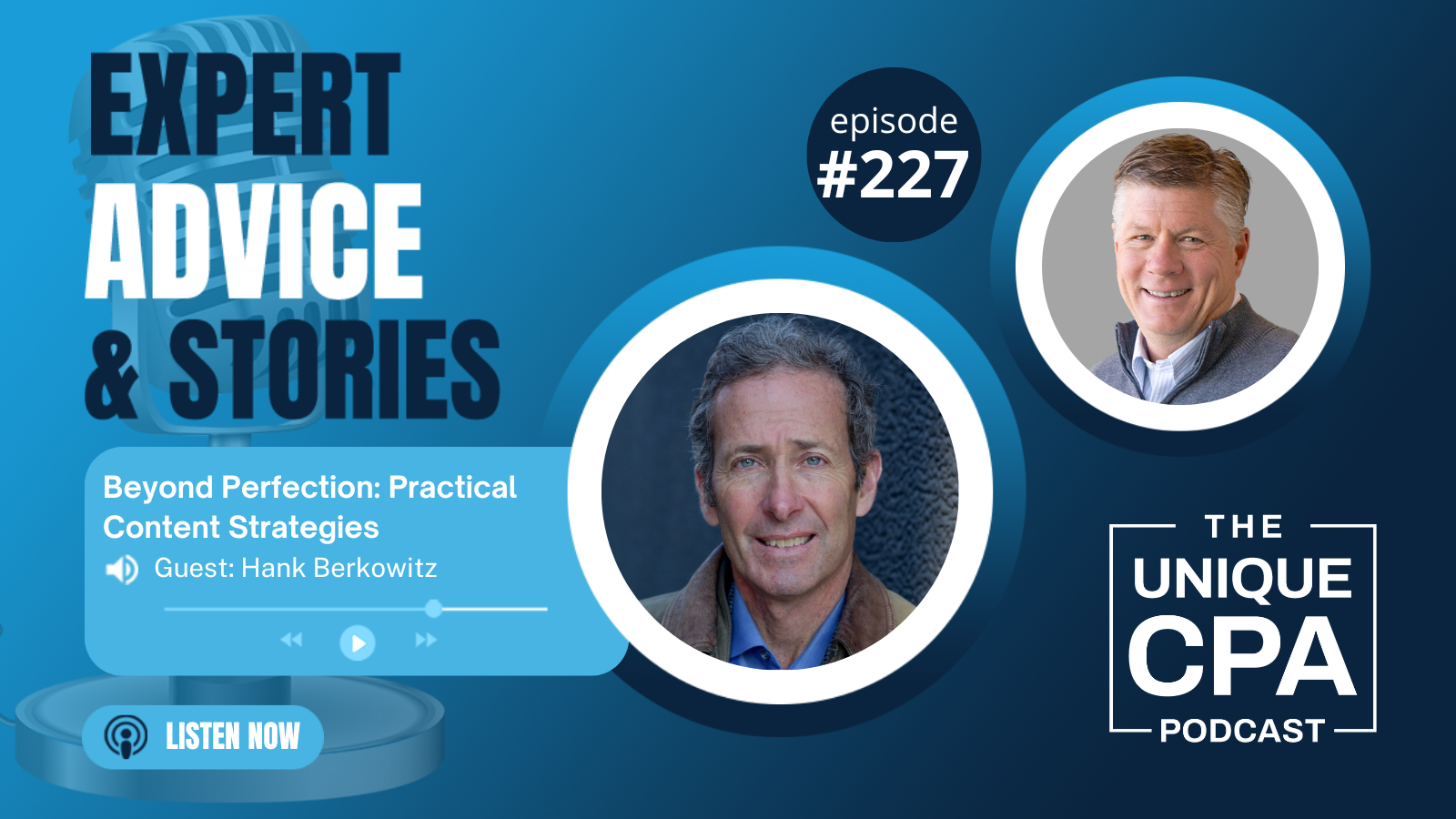
With Hank Berkowitz
Randy welcomes Hank Berkowitz, founder of HB Publishing and Marketing, for an insightful conversation on content, communication, and credibility in the accounting profession on Episode 227 of The Unique CPA. With over 25 years of experience helping CPAs and financial advisors amplify their voices, Hank shares practical strategies for building thought leadership, pitching stories to editors, and turning content into a valuable asset. Discover the difference between influencers and true thought leaders, the power of repurposing content, and why authenticity matters more than perfection. If your goal is to publish your first article, write a book, or simply get your ideas heard, this episode is packed with actionable advice and real-world examples to help accounting professionals stand out and make an impact.
Today on The Unique CPA, we’re talking all things content, communication, and credibility in the accounting profession, and there’s no better guide than Hank Berkowitz. Hank is the founder of HB Publishing and Marketing and has spent over 25 years helping CPAs, financial advisors, and thought leaders get their voice heard. With a background at powerhouse organizations like AICPA, among others, Hank understands both the technical and the human side of the profession. In this episode, we’ll dive into what true thought leadership looks like, how to pitch your story without sounding salesy, and how to actually enjoy the writing process. Hank, welcome to the show.
Hey, thanks, Randy. It’s great to see you and great to hear about the injury recovery and setting all kinds of records, and now, yet another definition of the word unicorn. I always thought it was an animal with one horn. Apparently that was out of favor, and now it’s privately held companies worth over a billion dollars, and now it’s pretty much anybody who’s an extreme outlier. I don’t know whether it’s you or your knee, or combined, but extremely exponential progress on the knee recovery—I’ll take it.
I think this is the second straight podcast we’ve talked about my knee recovery. We just did a recording the other day, too. Yeah, I’m very fortunate, it’s going really well. So, you and I, what, five years now we’ve been working together? Probably, 2019?
Yeah, at least.
That’s what I thought, yeah. So, Hank’s horn, Hank’s amazing. I’ve had quite a few articles published different places. I pretty much just speak them, and then Hank writes them, or he takes my thoughts and makes them sound, puts it on the paper, and makes them legible. So, it’s always been a joy and a pleasure working with Hank, and I’m not the only one that Hank works with. As I said at the beginning, Hank has been out there working in this profession for quite a while. I call him personally, behind the scenes, the influencer maker, and he’s definitely helped me out with that, so I appreciate you, Hank.
So, yeah, Randy, thank you for letting me appear on your show and getting to know your organization so well, and your extreme network of contacts and COIs. I’ve spent about 25 years—I hate to use the word space—but I’ve spent this time in this space because, A, I’m still trying to find the connection between words and numbers—I might not be smart enough—but I’ve always felt there’s some mathematical form. It’s impossible to write a perfect sentence or a perfect paragraph, but there’s got to be some relationship between words and numbers. I’m not smart enough to figure that out. But the only other reason why I chose to pursue that path is because I’m basically really bad at everything else. Starting in the earliest years of school, I always did surprisingly well in English and verbal and even better in math, and just absolutely terrible in everything else, except I think college philosophy where we never had any tests or exams, I did pretty well in that. But other than that, I was terrible at everything else and still am. So how are you going to make a living?
Well, I could say, I know you’re not terrible at everything because I know you’re a—and this is something we’ll probably get into later, but—triathlete, runner, swimmer, biker, so I know that’s an area that you’re good at, but let’s not get into that yet. We can talk about that later. Let’s get into this whole—I just called you like the influencer maker or a thought leadership, and because you do help a lot of people at least get their voice out there, and so let’s just start with the basics in defining thought leadership: What does this mean to you and what makes someone a thought leader versus just a frequent poster?
Right, there’s frequent posters, there’s imposters, there’s posers, and there’s thought influencers. And then in this day and age with TikTok and all the other social media news, the word “influencer” often gets mixed in with “thought leader.” An influencer is trying to get you to do something: buy this product, listen to this music, vote for this candidate, and so forth. The thought leader, which is where I try to help people the most—and I don’t know if I’m a thought leader myself—but it really just means you’re the go-to source of expertise on a particular topic or entity. You don’t have to be the go-to expert source, but you’re certainly in the conversation as one of the go-to sources. And you know, you’re not necessarily the best known or the most widely promoted or having the most followers and likes, but it’s just sort of being authentic—which is so much of Randy’s brand, being authentic—and influencing other people to maybe think differently about something specific, preferably an area where you or your organization have special expertise. And if you don’t like that definition, just everything we try to do goes down to the two most powerful words in business marketing: credibility marketing. That’s according to Randy Crabtree!
If most companies, accounting firms, did a better job with mental health resources and getting rid of billable hours, they’d be a lot more productive, happy, better retention, better recruitment, and so forth. And how do we know that? Because on top of all of Randy’s podcasts and articles, they also have the CPA Career Satisfaction Survey, which is original primary research. And that is “according to”—based on several hundred outtakes from several hundred CPAs at all levels of the profession. So that’s what thought leadership is: equals according to.
According to whoever you’re working with, not just me. I know there’s plenty out there, they probably all don’t want to be named, they want to be—well, I shouldn’t say it like that, but you’re behind the scenes helping people get their voice out there, and let’s talk about that then, so—
Well, that’s also, just to interrupt real quick. Almost everybody is an “award-winning something” these days, and almost every single book that’s ever been published apparently is a bestseller, so I think it’s harder to get on the non-bestsellers list.
Alright, well let’s talk about books real quick, because that’s one thing you and I have been working on for a while, and I should say you mainly, because I’ve been the bottleneck in this whole situation. I mean, I have lots of ideas, I say lots of things, but I just am all over the board sometimes with busy. I mean, you try to rein me in and it’s not always the easiest. Is that a common occurrence where the people you’re working with are the bottlenecks?
Well, yeah, I mean, the stuff that I do, that we do for our clients, it’s both the easiest and the hardest thing you ever have to do. It is putting words on a page or words on a screen—what we do is a lot less complicated than tax returns or investment analysis or estate planning. I mean, you have to really know what you’re doing in those realms, and there’s compliance rules and things. What we do is not as tightly regulated. The hard part is just about being consistent. And I guess we’re talking about long form, like white papers or books or eBooks. One of the first things that happens is when people call and say, “I need help writing a book.” I’m like, “Why do you want to write a book? Why did you decide that a book is the right thing to do?” Again, going back to, is that going to make you a thought leader? You might be better off starting with a couple short blog posts or maybe some articles or maybe a couple podcasts or presentations or snappy videos, whether it’s on TikTok or your own site. And sometimes that’s a good way to test working with people, date a little bit before you get married. What are you trying to do with the book?
And we have, I thought, a pretty simple, kind of fun exercise at the start that really stumps people—including Randy’s a year in, still hasn’t completed it. Just go to your laser printer, take some blank white sheets of paper out and tape it on one of your favorite coffee table books and with a pencil, preferably not a pen, just start writing some cover lines and what would you call the book by Randy Crabtree? What would you call it? What are the cover blurbs? What is on the back cover? Who would write nice blurbs about you in praise of whatever? And how does that look? Does that still seem authentic to you? Does that still seem like “according to” will resonate with the marketplace? Who are you trying to reach?
You know, if you can imagine people in their pajamas or their underwear, you know, reading your book, or on a plane, who is doing that? You must have some visual representation in your mind about who that person is. And you better get real with that before you just start spitting out words on a page. There’s an amazing number of ways to capture content with transcription services, AI, voice recorders, and so forth. But you know, garbage in, garbage out, if you don’t take the time to do it. So what would you call this book? And it could take some people three or four or five tries just to get the blank white sheet of paper, and the spine, and put it up on your bookshelf.
And then the second part is skip all the difficult part with the outlines and the grammar and the transcription and the manuscript, blah blah blah—it’s done. Now the second exercise we do, we skip all that, like from the Seinfeld show, you’re being interviewed on a podcast: “So, Randy, what made you decide to write Culture is Ground Zero?” You know, why did you write, and your future self, pretend you’re being interviewed by a podcast or radio host: “Why now? Why did you write this book?” So if you can’t do these two simple exercises, then maybe it’s not quite the right time to do the book.
Yeah, the second one, I have no problem doing it with. The first one, I, for some reason, I have had this mental block of putting the paper on the book. But you and I are very far along. We’re really close. I think within a month or so, we will get this ready to go. Alright, that’s longform. I skipped short form, because I want to get to that, because we just talked about being a thought leader, and there’s so many ways people could just post things out there, and are you an influencer, are you a thought leader, are you just wanting people to hit like, or what’s going on. But let’s assume, because it’s easy to put content out now, right, anywhere, I mean, content is easy, but if you want to get into, let’s say, you know, a magazine that’s been out there for a while, is there, like, do’s and don’ts when you’re, you know, looking to pitch an article to these editors, or a radio show, podcast, whatever, what are some of the best practices, I guess, and non-practices, best non-practices that you should do when you’re looking to do something like that?
Yeah. So I’ll preface my answer to that with how I conclude any presentation or speech that I’m able to give: “Then again, I could be completely wrong.” I know an awful lot about how to do it wrong. Hopefully those lessons, after 25 years, have helped a few little things to making it how to do it right. So you mixed a couple things in there, Randy, at the same time, but I think what you were saying in PR content speak is owned media versus earned media.
There you go.
And that’s different from paid media where you pay for play or buy your way in, which a lot more organizations will publish your article, will have you as a speaker, if you wouldn’t mind sponsoring, and so forth. I’m proud to say that Randy’s Bridging the Gap Conference does not do pay for play. Most of the reputable publications, podcasts, other media outlets we work with, they don’t do pay for play, and we don’t want our clients to do that if they don’t have to. And when you’re publishing your own stuff, for your own blog, your own newsletter, your own website, your own video page, that’s called “own media,” because you own it, you’re publishing it, you may or may not have certain safeguards and best practices, but it’s out there, it’s yours, you own it, you can do whatever you want with it.
The next step for getting “and according to” is reaching out to well-known or reputable publications online, in print, podcasts, radio shows, conferences. Those are the gatekeepers and you have to try to, without being manipulative, try to convince them why should they take time out of their busy day to give you space, and especially they’re giving you wide distribution and vetting you and giving you the good housekeeping seal of approval. Why should they do it? They’re not going to pay you in many cases, but you’re not paying them. So why should you do it?
One of the biggest mistakes that a lot of people make is they don’t do their homework. They go to the trouble to write an article or a blog post or a white paper—they go to the trouble to write something or create the content before they’ve run it by the editors and pitch them and say, we’re working on our—if we were an article about this, you know, cultural aspects of accounting firms, or early burnout in accounting. Would you be interested in it? And they may say yes, but not now, we’ve covered it too much, or no, it doesn’t seem right for our audience, however, if you tweaked it this way and that way, what would you do? It saves you a lot of hassle, you don’t—same thing with a book, you don’t want to go to the trouble of writing an entire manuscript and then shop it around, that’s just the spray and pray approach.
So you want to try to build a relationship with these busy media gatekeepers, that’s where we can help an awful lot as a “talent wrangler.” Newsrooms are depleted right now. They’re all shorthanded, make their life easier. These media channels, including the accounting trade, they don’t exist to make you famous. They don’t exist to build your brand recognition. They have to inform the audience on what’s current, what’s helpful, what’s important, what’s nuanced. How can you make their life easier? So, you give them targeted content that they can slot in directly with minimal editing and proofreading and fact checking, and they can get it out to the audience and it engages and resonates with their audience. You’re making their life easier and before you know it, instead of you pitching them, they’re going to reach out to you and say, “Hey, Randy, we’re on tight deadline. Can you help us with a little bit about R&D tax credits? We have to get this out by next Tuesday.” And you become a go-to—again, the word go-to from the beginning of this talk—a go-to source.
That also relates to another thing that goes on behind the scenes, but it’s pretty interesting and ethical. It’s called crowdsourced journalism. And even New York Times, Wall Street Journal, Washington Post, they post things on tight deadlines, stories they’re looking for on various listservs and talent wranglers—not just me, but like myself or our firm—have access to and we’re sort of a trusted source. They know if we provide them with a source on tight deadline to talk about R&D tax credits or the employee retention credit that the Randy Crabtrees of the world know what they’re talking about, it’s legit, it’s been approved, their compliance is okay with it. And so they’re working on stories on tight deadlines. So instead of you pitching them, they’re reaching out to you.
Now, again, they’re not reaching out to you exclusively. You know, it’s generally free or very low cost to join these various lists, but you’re going to be competing with other talent wranglers. So there you go. So instead of competing with 10 million people out there, you’re only competing with two dozen. But those other two dozen are very tough competitors. But it’s a very interesting way. And you know, what happens is very often you don’t make the cut on the initial attempt to reach out, but if it’s good, they’ll reach out to you down the road and surprise you, and they’ll keep your comments on file. But meanwhile, even if you didn’t make the cut for the Wall Street Journal, Washington Post, even Accounting Today, you can take those comments that you worked so hard to craft and fit into a tight space, and you can use it for your own blog, your own podcast, your own articles, your own white paper, so it’s not a wasted exercise. And so that gets us to the very fundamental formula for everything we do: We follow what’s called the Frank Perdue Chicken model of content. What the heck is that?
Yeah!
And if you’re familiar with the—I do not get a paid endorsement from Frank Perdue, although I do eat a lot of chicken. So the Frank Perdue family of products, they have pretty good chicken from what I’m told and what I’ve experienced and they use every part of it. So take the time to grow it in a healthy, good environment so that—the same with your content, take the time to do a little bit of mental heavy lifting and careful thought, make it good from the start, and then repurpose it, repurpose it, repurpose it, repurpose it. There’s a million different ways to slice and dice your content, and that’s why we like to think of it as an asset for your organization rather than a marketing expense or a content expense. So when marketing becomes a profit center rather than a cost center, it starts to—you know, it messes up the accounting team, of course. They don’t like that with their balance sheet. But when marketing goes onto the profit side of the ledger and the asset side of the ledger rather than the cost side of the ledger, it starts to get really interesting.
That’s funny you said that because there was a podcast I was on that was just released today and I sent it to our marketing team and one of the first questions they asked is, hey, can we get the transcripts of this so we can turn it into a blog post that we can use for marketing? And yeah, the exact same. I mean, right? I mean, that’s like the same thing. Anyway, that was on basically interplay between a bunch of different credits and incentives, stacking credits and that. And so, yeah, I don’t know if we can, I have to ask them because it’s their content, I believe at this point, but we’ll see if that’s possible.
Alright. So there are, like we said earlier, and you just mentioned crowdsourced journalism—there are different ways to get content out there, but you say, is there new shiny objects out there? There are new ways that people are looking to, or that you’re seeing that may be possible that get their thoughts out there.
Yeah. There’s no shortage of these, Randy, and no matter what I share with you now, people are gonna write in and say, “Hey, dummy, how come you didn’t talk about this?” So, I’ll just preface that. So, I’ll just work with things that I feel, not necessarily endorsing any of them, but that I feel pretty confident can help you, whether you’re a tiny organization, mid-sized, or large organization, to help you on the path to the right kind of thought leadership where you’ll be connecting with the right types of clients, prospects, potential employees.
Print on demand is a pretty interesting thing. It’s not necessarily if you’re doing books or more commonly we do eBooks. We don’t even bother to print the hard copy. There’s a number of vendors out there. Again, we don’t get any commercial consideration, Bookbaby, for instance, bookbaby.com is an example, print on demand, where they can help you on every step of the way, or they can just take it the last mile, which they typically work with us, and once you have a finished manuscript ready to go, they can handle the printing, the distribution, and with a couple presses of the button, get you into Amazon, Barnes & Noble, Ingrams, and thousands of other retail distribution outlets, and most importantly, get you fulfilled. So once people start ordering your book or your long form content, they can handle the payment, they can handle the tax withholding, the sales tax, shipping, and most importantly returns. You don’t want to be, you’re too busy as a financial professional, you don’t want to be handling all that.
No, not at all.
And so when it’s called print on demand, in the old days, it was called short run. You used to be, it used to be very cost prohibitive to go back on press, if you will, once you had your book to do version two a year later, or to fix a chapter. Now it’s all done digitally and you never really have to take delivery of more copies of your book or other long form content, white paper, whatever, than you need. And so, if you’re speaking at the Bridging the Gap conference, you might want to have 50 copies to hand out or 50 copies to sign at a book signing or 100, whatever. It doesn’t matter. They can ship precise quantities and you don’t get 10,000 sitting in a warehouse that are out of date a year later.
Secondly, with the print on demand, it’s very, very easy to update an individual page, a chapter, you might have made a small mistake or used an outdated headshot or chart or, you know, in the accounting financial world, rules and regulations change all the time. So instead of having to go and trash all the books, just fix two paragraphs on Chapter 3 and one paragraph on Chapter 7 and you’re good to go.
Nice. That’s my problem. Why I’m a bottleneck with the book, and then we’ve talked about this already, but I’m like, okay, but it has to be perfect, because what if we make one mistake, and that’s out there, and I know, and I already know in my head, well, we can fix it, we can change it, but for some reason I’m having this mental block of getting past there, and I’m just going to power through it, because it’s time, we need to get this out there. Alright, sorry, go ahead.
Yeah, so there’s really no such thing as perfection, maybe in ice skating and gymnastics there is, but not in the world of content. You’re never going to have the perfect manuscript, book, presentation, podcast. So don’t let the pursuit of perfection be the enemy of progress. I’ve butchered that quote and paraphrased from a number of very smart people, so. It’s just, you can always do version two. Now you can’t be crazy and put out stuff that’s completely wrong or misleading or harmful, but do your best, and whatever your article, your book, your blog post, it’s just a snapshot of your best thinking at this point in time. And then always just update it, just like an oil painting’s never finished. So that’s why we like print on demand.
And also what’s great about print on demand is you can sell individual chapters. If you’ve got a fairly high price point, which many accounting financial books are, to get people to whet their appetite that if you’re in a higher price point, maybe just let them buy a chapter for a few dollars, or ten dollars, let them buy the chapter and use a credit for chapter one and chapter two against the purchase of the full book, and if they decide not to purchase, at least you have incremental revenue, because selling a couple chapters is better than zero, better than a poke in the eye, right? And it builds your list up.
The other reason we like print on demand is many of you would be in professional world would be speaking at various conferences, or state societies, or organizations, or even universities. Well, here in April, you might be speaking for the Florida CPA Society, and then in June, you’d be, I’ll be speaking for the New York State CPAs. You can have a custom foreword inserted into each book for each organization. Just print a short run. Again, print on demand. Just what you need. Fifty copies here, fifty copies there, shipped to the venue, and so forth. It’s easy. And it’s really, really powerful to let the head of whatever organization you’re working with have the custom forward to resonate with their members.
Oh, I’ve seen this multiple times, I mean, my friend John Garrett, in his book, What’s Your “And”?, he has done that, he actually had special copies printed for us at Tri-Merit, when he came out and spoke to our organization that showed Tri-Merit at the back, and so yeah, I love that, I love that part of the print on demand, where you can easily add, edit, personalize a book for wherever you’re going to be at a point in time. That’s awesome.
Yeah, and it goes back to Randy’s earlier point: It takes the pressure off of being perfect.
Yes, I know.
You fix it and adjust it and new stuff comes along. So Randy’s book, like many others that we work on, are derived or derivative of the great podcast interviews. And of course the podcast, the new episodes are coming out every week, so it really goes back to the model of changing the wheels on the bus while it’s rolling down the highway. It’s never really going to be in the garage in the yard to be permanently fixed and approved. So you, again, it’s your best thinking at this point in time and you keep it rolling as time goes on. So, that’s another thing we’ve found very helpful.
Substack, newsletters are another thing some of you may have heard of. That’s a way to take the newsletters or the blogs you’re producing for your own purposes and basically monetize it on a widely distributed platform called Substack. They have a variety of plans, many of them are free. You can put it out there just for distribution or you can get into the paid model where you basically just give a portion of the “subscription” to the Substack people in exchange for giving it a platform. And I don’t think at the income level that most of your listeners are, I don’t think it’s going to be life-changing money. But again, if your marketing, your content can go from the cost side of the ledger to the profit side of the ledger, why not? And again, it becomes an asset. And it gets great distribution and they do a really nice job at Substack. Again, I get no endorsement or commercial consideration from them.
And then there’s two other things I’d like to mention that are really, really basic. One, LinkedIn. I personally feel like instead of posting all the time, publish an article. Many of you may have seen that. It’s a really great way to get your material out published to outside your own network. I don’t understand the entire algorithm, but the LinkedIn publishing tool, they do a really nice job, it’s literally just cut and paste your content into the tool with one nice image, a couple keywords and tagline. They do a really nice job and it will get your material out to lots of other people who aren’t officially in your network yet. So that’s a great—
Oh, I’m sure I’ve seen it, but I didn’t really realize that that was a thing.
Yeah, and I’m not a LinkedIn expert, but when you go on to your profile page or when you go on to what’s happening instead of just automatically posting or cutting and pasting it to the post or what’s that? Just go slide a little bit to the right: Publish, publish an article. And it’s super easy to use. Sometimes our clients get frustrated. They don’t get as many likes or engages or claps, but it gets you out to people who aren’t already in your network, so you never know who’s going to be that great new contact you make as a potential hire, as a potential client, as a potential center of influence, strategic partner.
And then Outlook email, we’ve done a lot of studies on this. Very few people publish their blogs and newsletters and share them. Just an Outlook email. I’m not just necessarily talking about it as an attachment, just an excerpt of it in your Outlook email. Send it to your clients and the reason to do that is because very often that’s the best way to get direct engagement. People don’t want to post comments publicly about what you’ve written, but they just want to send you a note. You send it to people who already know you, and would you rather rack up lots of stats on engagements and opens and clicks, or do you want really quality people giving you helpful information, context, leads who just don’t want their comments shared in a public forum? So don’t—we very often, we just publish an excerpt of the full blog post or article and say, “click here to see the full post.” So you won’t get a lot of cool metrics, like the younger people, the frustrated, but would you rather have metrics or would you rather have cash in the bank? Personally, I’d rather have the cash in the bank.
I agree. I have a question on the crowdsourced journalism again.
Yeah, sure.
So, like, I’ve been a, I guess named author on three, I think at least three books because I’ve had a chapter or made comments or something like that. Is that crowdsourced where you ask other people to submit their ideas on your theme of the book or what, what do you mean by crowdsourced?
Okay, so that’s a little different. So that’s multi-source. I was going to get to that.
Oh, okay, good.
About making the content process less daunting. So, if you’ve been a source on many other people’s books, I know you’re in Dawn Brolin’s book, you’re in Rory Henry’s book, there’s probably others. That’s what a lot of busy professionals are doing with us and on their own. Instead of sitting there staring at a blank screen and how you’re going to fill up 40 or 50,000 words for a manuscript. Reach out to other esteemed professionals in your niche and ask them to contribute a chapter or to be interviewed for the book. We can always help with that. And that takes the heavy lifting burden off you, but it also gives your reader a nice variety of opinions. We found it’s actually helpful if you sometimes have expert sources who don’t completely agree with each other, but providing a variety of opinions can sometimes be more helpful than just saying, “You must do it this way now, today.” You know, you just want to—it’s just like with hosting a podcast, though, you have to be careful when you’re reaching out to a lot of—you don’t want to crowd yourself out of your own book, just like you don’t want to crowd yourself out of your own podcast. You’ve got to leave a little space for you to say some things, which is always helpful. Otherwise, you’re just hosting a party.
Exactly. Well, I don’t mind a party, actually.
But then you have to clean up the mess afterward.
Yeah, I don’t want to do that, that’s true. You mentioned Rory Henry. He’s got a new book out and it was a cool thing Rory was doing because we’re talking about content and leadership and getting content out there. He just had me on a podcast yesterday with another author in the book, where we just did a book discussion about the chapters that we were part of, which I thought was pretty cool, and I really enjoyed that conversation, so that’s just expanding on this book you already have, and it’s almost to the standpoint of what you said, hey, the content’s always going to be changing anyway, so just get it out there, and it just changed probably in the conversation we had yesterday as well, which was, it was a lot of fun.
Yeah. Rory’s book is an example. There must be over two dozen expert sources, and he has basically hosted a really impactful conference on the intersection between wealth management and accounting. I’m oversimplifying—he’s hosted a conference within the pages of the book. You don’t have to travel to it, and you can jump around. So accountants, I want to just a quick aside on consumption of content. I love accountants. Accountants will read the books, most likely, chapter 1, 2, 3, 4, 5, looking for guidance, and they’re not going to skip ahead or jump around. The wealth advisors, the estate planning professionals, hate to, they’re not—you couldn’t pay them to read the book, 1, 2, 3, 4, 5, 6. They’re going to jump around to the end, the beginning, who wrote it, I don’t like this person, I like that person. So, you got to, again, go back to think about, in their underwear, in their swim trunks at the pool, who is really going to be the ultimate consumer of your book. And that’s why in all the longish form content, white paper, longer articles, and certainly books, we constantly try to recap what’s already been mentioned, as mentioned earlier.
And that’s when you want to also enlist the services of a continuity editor. That’s different from a proofreader and a copy editor. These are people who are really, really good about reading a lengthy body of work and can remember, we already mentioned this in chapter three or in chapter three, you said we’d cover it in chapter nine and you’ve put it in chapter 10. That’s a special gift. I don’t have it. We pay people to do that. Do not underestimate the importance of that. But in television and film, they call it a continuity editor. I don’t know what they call it in print anymore, but that’s basically what it is.
Yeah, my wife’s an editor. She edits actually a medical journal and I think that’s one of the things she does, because she—
That’s a real skill.
Yeah, she talks about the fact that, you know, hey, they mentioned this, whatever, figure. And then, the figure doesn’t exist, or the figure is a different number that they mentioned earlier, I mean, like, just this stuff, I’m like, I don’t even know how you track all that. She’s very helpful to me, because even if I’m going to write a text sometimes, I’ll ask her, okay, does this look okay? So, yes. The editor is—even the continuity editor is super important.
And the other reason you want someone who hasn’t read the material. You need to have a fresh set of eyes on it. So it’s very hard when you’re staring at it all the time or if you’re using a ghostwriter or a ghost editor. It’s very hard, you lose some of your objectivity. And you want someone who hasn’t read it, seen it before, a fresh set of eyes. And it’s very important to send out the right message. As your manuscript or your long form content is getting close to being finished, I strongly recommend running it by a few people you can trust to review it before you go live.
Well, that’s a good point, too, because, you know, sources, especially when we’re looking at, you know, if you’ve got content and you’re quoting a source or you’re getting information from somewhere, especially now with AI out there, you know, we’ve heard of hallucinations and all that with AI, I mean, is there any—obviously it’s important to verify what you’re using in your articles, or books, or newsletters, or blogs, or whatever, how do you talk about or help people make sure that the sources that they’re quoting are verifiable?
Right. So there’s no easy answer to that, but it’s really important. One of the things that really grates on me is when you’re reading something really interesting or listening to something, they say, “Research says,” or “Studies say, that 72 percent of accountants don’t like to do tech bookkeeping.” Oh yeah, well who said? And then if you run it through various digital helpers, chatbots, they may or may not have the right source or more, likely what happens is they’ll point to the New York Times or Wall Street Journal or a major, who mentioned that stat, but they didn’t provide the primary original. It could have been an obscure professor at Texas Tech or Yeshiva Institute who came up with the original research, but they didn’t give that person credit, or they maybe just credited them in an offhand way, and you can’t say that the source was where you read it. You have to go back to the primary source. Many people don’t want to do that, but you really have to spend a little bit of time to do it. And you owe it to the people who did the hard work, the hard research, to show them a little bit of love.
There’s a lot of debate—we prefer not to do footnotes and end notes in our material. There is no right or wrong way. We found that people would just rather click on a link and go to the source, the original source, preferably. That’s, I think, the most efficient way to do it, but then when you transfer your digital material into print then you have to decide what you—in a PDF it’s fine, but into a physical tangible book you can’t click on anything. I mean, as far as I know, the technology is changing, maybe you can. So most good publication sources can take the links and create footnotes and endnotes for you, but try to weave a reference to the source into the narrative as much as possible. “According to the American Institute of CPAs, 71 percent of…” Try to at least give them a source so you don’t have to kill yourself with the digital links and you’re going to drive yourself crazy checking it, people just are too busy. They don’t want to flip to the end of the chapter, the end of the book to say, oh yeah, but again, it goes back to “according to,” they still want to know who the “according to” was. Don’t make them work for it. They’re already giving you a tremendous amount of their valuable time by reading what you have to say. Make it easy. We’re in an Amazon Uber economy.
Got it. So let’s, let’s, I guess we probably should start wrapping up, but if somebody wants—I mean, if really, if somebody wants to start being a thought leader or has something they’re passionate about that they want to start getting out there, you know, build a following, whatever they want to do, you know, it could be daunting to think about it. I mean, is there an easy way? Small steps they can take to really start to at least get the process going?
Yeah, back to like what your 9th grade English teacher probably told you. You might not like them, but I didn’t like mine. Outline. Just put an outline out there. And you know, don’t get hung up with like introduction and main point and key thrust and all that. Forget all that nonsense. Just tell them what you’re going to tell them—that’s the intro, then the main body is, then you tell them, and then this conclusion, tell them what you just told them. Try not to rely too heavily on the AI tools and other tools, try to do it yourself first, then you can enlist them for help, or enlist a professional human. But what are the two or three things you want the reader or the consumer of your content to know? Wake up and smell the coffee. If they get nothing else out of it, what you want to do. And we also recommend there’s three or four summary bullet points at the top of every piece of content. What are the three or four main things you want people to take away? Because that’s how the eye tracking tends to work. You grab them with the headline, then they want to see who wrote it, they’ll skip down to the end of the piece, to the bio, and then they’ll go back up to the key takeaways, or the summary bullet points, or the “key learn,” whatever you call them. Then they’ll decide whether or not one of three things. “No, I don’t think so. Delete.” Say, “I think so, but I’m too busy now. It goes in the weekend reading list.” Or, “This is awesome. I’m going to drop everything and read it right now.” One of those three outcomes, but if you can do a nice tidy summary. And we’ve even found that when it comes to podcasts and videos, we found that when you have a nice tightly written text-based summary below your player, whether it’s podcast, video, audio, that will significantly—we found like almost a 2 to 3x increase in engagement because they don’t want their browser or their device co-opted. They want to decide what it’s all about before they hit the play button. And tell them, if nothing else, tell them how long it is. Is it a two minute read? Is it a 65 minute podcast? Is it a 25 hour speech? Tell them how long it is before—
No, I find that, I, you know, I don’t even think about that, but I find that great advice because when I see like just a LinkedIn post and I see that I’ve got to click more for it to open up further and then it covers my entire screen. I’m like, nah, I can’t read all this. But if I had those three bullet points at the beginning, that may catch my attention, like, “Oh, I’ve got to find out more.” Where’s this going? So I love that. It makes sense. I think I’ve seen it, but I haven’t really heard how important that is. So I love that.
Yeah, some of the self-publishing, but we like Medium.com. Again, no endorsement. Reaches a wide audience, mass distributions, it’s generally free. You could post and the first thing they do is the minute you hit publish at the top of the article it says “It’s a three minute read. It’s a six minute read. It’s a five minute read.” And that’s really helpful. They basically just count the number of words divided by, I think it’s 200, which is the typical okay amount the average human can read per minute. We speak at about 175 per minute, except Randy at 300 per minute, but the reading, most people read approximately 200 words a minute, and that’s very helpful to know, as Randy said. Make the reader’s life easier.
Well, I think Dan Hood’s got me on the speaking speed. I love Dan Hood, but man, I could listen to him speak all day long. That guy’s amazing. Alright. I think that was great information. I think we did a good job of wrapping up that situation. So before we get to your contact information, because I want people to see what you’re doing and everything, I alluded to this a little bit at the beginning, I don’t know if this will be your answer or not, but I love asking everybody, you know, when you’re not doing this, when you’re not helping people write and you’re working and you’re publishing and all that, what do you do for fun? What’s your outside of work passions?
Well, that’s a good question because it’s really the reverse. It’s how do I—how do I find time to work with all the other diversions?
There you go! I love it.
So yeah, I’ve been a, for better or worse, a national class distance runner and triathlete for most of my adult life. I’m in an older age group now, so the competition’s not as hard, but it’s a lot harder with yourself. And I was a wrestler growing up in Pennsylvania, so I’ve got pretty high tolerance for pain, I guess. And when I’m not doing that, I’ve been a home brewer, not quite as prolific as Randy, but since I had Crohn’s disease, I’ve had to learn how to do gluten free, gluten reduced home brewing, so still able to do that a few times a year. And love to play tennis, ski downhill and cross country, chase the dog around, and pretty happy family life, wife and two almost grown boys. And do some masonry work too. That’s also very helpful. I live in Connecticut where you can’t dig more than three inches down without hitting rocks, so stack them up, make walls, make gardens. It’s very therapeutic to go. I found it more therapeutic than going to yoga after a challenging day hammering out content, go hammer on some rocks and you’ll feel a lot better. Bring your favorite beverage while you’re out doing it, just don’t operate power.
This is a new thing, this part of you I didn’t know before, so I’m glad I asked this question then. The masonry, alright, nice. And then if people want to find out more, you know, just to see what you’re doing, or maybe they are looking for help to get started in thought leadership, where can they find you?
I think probably the best place to start is just HBPubDev.com. Hank Berkowitz is H-B as in “happy birthday,” P-U-B as in publishing, D-E-V as in development. HBPubDev.com. We have a lot of free resources on the website. You don’t have to give us your contact information, you can just consume it. We have a blog you can subscribe to. It’s basically just the regular guy’s guide to content marketing.
And then I just—the final thing was just, with the athletic background and having had the privilege of being an athlete for not one, but two hall of fame coaches, one in wrestling, one in track and field—we believe very strongly in the interval approach to any type of work. I know this is important for Randy because of just mental health and burnout prevention. Even back 25 years ago, when we started all this, I never was a big believer in time tracking and grinding out the hours. I really don’t feel like you can be productive for more than three hours at a time. So try to get up out of your chair at least once every hour, take a break, go outside, just walk around the office, stretch a little, chair yoga.
And then your clients. If you’re six, seven, eight hours into a workday without a break, you shouldn’t be charging them the same amount of money, whether it’s billable or fixed fee. You’re just not as productive. So I try to break my day up into three—they say, “How much do you work?” And they’re expecting a certain number of hours. I just say, “I work about 16, 17 times a week.” Three times a day, Monday through Friday, once or twice briefly on Saturday, once or twice on Sunday. And, you know, as one client told me, work is something you do. It’s not a place you go. So three hours, take a long break. Another three hours, take a long break, another two hours, you could break it up after your meals or your exercise or you’re pursuing your shopping or passion, your hobbies. People, I work in a busy office. They’re always looking at me like, where do I disappear to every time at work for having lunch for an hour and a half? I eat lunch at my desk, but I take a 90 minute break to generally do my triathlon training. And you know, sometimes like, “I don’t have time for this.” But everything I was stuck on, or everything I was thinking of turning in before I took that long break, I come back and review it later, and it’s complete crap. I say, thank God I didn’t turn it in.
No, great advice. I love that, yeah.
Never turn in a final draft in the morning. Randy and I are beer drinkers, so that’s even more applicable to us, because it sucks. It’s just not ready. And then you come back from a 90 minute break or whatever, and within 40 minutes you’ve made up the lost time, because you’re—I think that’s the math, because you’re three times more productive.
Yeah, that’s awesome advice.
And the other final thing I do is, you know, I work a little bit every day, but I try to take a 24 hour technology fast, no technology of any kind whatsoever, sort of from midday Saturday to midday Sunday, just leave it, don’t touch it.
That’s great advice, because I just—today I was on a text chat with a group of CPAs that are going through tax season right now, and they had a question about LinkedIn, how often you look at it. And my answer was too much. And I’ve just got to stop. I’m not sure why, I guess I probably know, you know, marketing put—our team puts a lot out and I’m often tagged on it and I don’t know if it’s an ego thing, but I’m like, oh, there’s another thing I’m tagged in. Who cares? Whatever. It’s out there whether I see it or not.
Some of the other activities I mentioned, I think they’re frankly better ways to get a dopamine rush or a dopamine fix than on social media. But that’s just me.
Yep, no, I agree. No, my exercise does it for me. I mean, man, do I feel energized after I work out. And with this knee injury or replacement surgery, my workouts have been suffering, but I’ve still been getting them in. Not to the intensity I normally do, but that’s important. Alright, Hank. Well, all awesome advice. I was very excited when we set this up and it didn’t disappoint. So thank you for being on the show.
Yep, thank you, Randy. It’s been a pleasure. And my final disclaimer, as always: “Then again, I could be completely wrong.”
Good way to end the show! Thanks.
Important Links
About the Guest
 Hank Berkowitz, MBA, MA, is the founder of HB Publishing & Marketing Company, LLC. Hank has served the accounting and wealth management industries for more than a quarter of a century as a ghostwriter, publicist, analyst and consultant. Prior to forming his own company, he held editorial and management positions at the American Institute of Certified Public Accountants (AICPA); EDGAR Online, CFO/Economist Group and Pensions & Investments Magazine. He has spent his entire career at the intersection of words and numbers and is passionate about helping clients navigate the two demanding disciplines. Away from the office Hank is a national-class distance runner and triathlete in his age group and enjoys (gluten-free) home brewing, masonry projects, tennis, downhill skiing and freestyle cross-country skiing.
Meet the Host
 Randy Crabtree, co-founder and partner of Tri-Merit Specialty Tax Professionals, is a widely followed author, lecturer and podcast host for the accounting profession.
Since 2019, he has hosted the “The Unique CPA,” podcast, which ranks among the world’s 5% most popular programs (Source: Listen Score). You can find articles from Randy in Accounting Today’s Voices column, the AICPA Tax Adviser (Tax-saving opportunities for the housing and construction industries) and he is a regular presenter at conferences and virtual training events hosted by CPAmerica, Prime Global, Leading Edge Alliance (LEA), Allinial Global and several state CPA societies. Crabtree also provides continuing professional education to top 100 CPA firms across the country.
Schaumburg, Illinois-based Tri-Merit is a niche professional services firm that specializes in helping CPAs and their clients benefit from R&D tax credits, cost segregation, the energy efficient commercial buildings deduction (179D), the energy efficient home credit (45L) and the employee retention credit (ERC).
Prior to joining Tri-Merit, Crabtree was managing partner of a CPA firm in the greater Chicago area. He has more than 30 years of public accounting and tax consulting experience in a wide variety of industries, and has worked closely with top executives to help them optimize their tax planning strategies.