Breaking the Silence
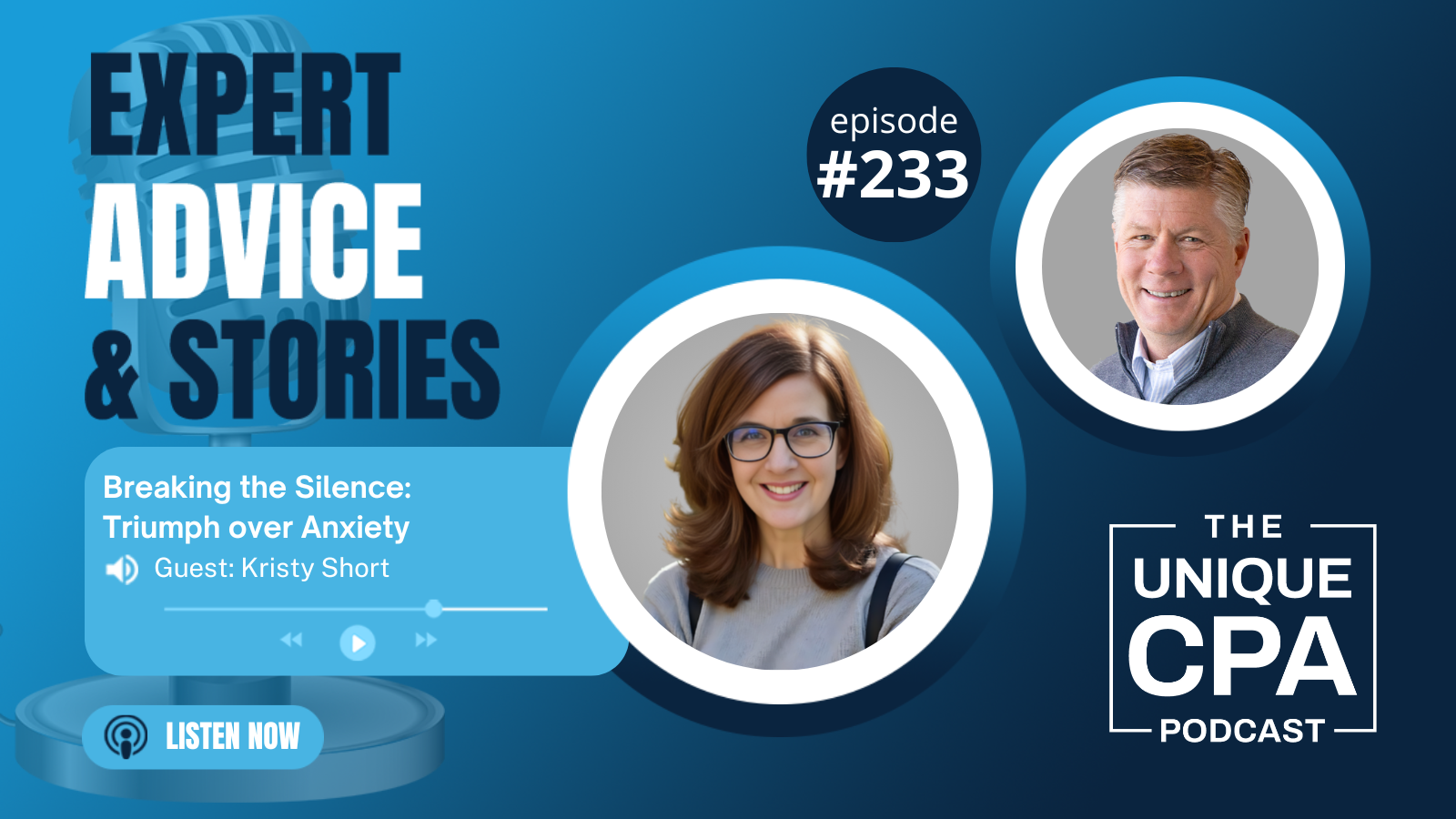
Triumph over Anxiety with Kristy Short
Episode 233 of The Unique CPA centers on Dr. Kristy Short’s raw account of living with anxiety, depression, and burnout throughout her 25-year accounting-adjacent career. Kristy tells Randy about the origins of her struggles, from her first “spiral” in her 20s—marked by relentless work, academic pressure, and suicidal ideation—to her more recent breakdown in her 50s, which ultimately led to her writing her memoir and “self help-ish” book, Civil Warrior. Kristy recounts a particular turning point, signing a suicide contract with her therapist and the dream that inspired her to write her book. Key to her success was personalizing a program for her own mental health, which she encourages anyone struggling to do for themselves as well. Kristy, like Randy, doesn’t shy away from the stigma and isolation professionals face, and she offers a candid, hopeful look at building resilience and community in accounting.
Welcome to The Unique CPA, where we shine a light on stories shaping the future of accounting and the people behind them. Today’s guest is someone whose voice is as bold as needed in our profession: Dr. Kristy Short has spent more than 25 years in the accounting space helping firms grow their brand and impact, but behind the professional success she faced a deeply personal battle with anxiety, depression, and burnout. She has an upcoming book, Civil Warrior: The Raw Gritty Truth about Anxiety, Depression, and Workplace Burnout. It’s “part memoir and part self-help-ish.” Kristy offers real world experiences in hopes that her stories will connect with others who battle the same issues. Today we’ll be talking about her journey, what recovery and resilience look like, and why it’s time for the accounting profession to finally have this conversation. Kristy, welcome to The Unique CPA.
Thank you! Thanks for having me, Randy. I’m super excited about this topic and about talking to you.
Well, I’m super excited about this topic and about talking to you, so there we go.
It’s mutual!
Awesome. There you go. Well, it’s a topic I’m very passionate about. Anybody that’s listening to the podcast knows that, so I think we just jump right into it. I’m really excited about this book that you have. What is it, July? The book’s coming out.
July, correct.
July. Well, let’s just jump into it. Let’s just get going with your experience, because the book is about your experience. So tell us what really led to you dealing with anxiety, depression, and burnout, and get into the story.
Yeah. So I’ve struggled with anxiety my entire life. It’s partly inherited, it’s partly in my DNA and some of it’s self-taught, right? Just being a workaholic, being the middle child—I’ve got the personality that leans into anxiety for sure. But I’ve had specific eras in my life where I’ve gone through a spiral and I recently went through one in my fifties and it had been a good 20 years of even keel, a beautiful emotional plateau, and I just hit a wall in November of 2024.
Oh, wow.
And that’s when I got the idea for writing the book. It actually came to me in a dream, Randy, which is, I just think, an interesting part of the story. So over the last two years, a lot of things had piled on. I had divorce, death, I lost the love of my life, my dog child, which is as a family member. My neighbors and I had to get a PPO against one of our neighbors who threatened to shoot us several times. It was a lot of stuff and I really thought I was handling each event well, and I clearly wasn’t. I wasn’t working what I call my program, I wasn’t talking to anybody. For a lifelong anxiety struggler, I knew what I needed to do, and I wasn’t doing it.
So when I started to spiral in November, the first thing that I did, I went on medical leave, which was wonderful. Medical leave gave me the space to really stop, get clarity, redefine and redo my program so that I was doing what I should have been doing. The first thing that I did was I had been taking basically Xanax every night just to sleep. My insomnia was so epic, I had to take a benzo to sleep every night, and I thought, while I’ve got this space, I’m going to kick that habit because it was making me foggy, it was actually amplifying my anxiety even though I was getting decent sleep. So the first thing I did was, I just went cold turkey. About the second week into it, once that low hum of anxiety withdrawal or Xanax withdrawal went away, I had a dream. I was starting to get natural sleep. And during one particular night of natural sleep, I dreamt about writing this book. Literally the title came to me because I was questioning, so when I got back on track, I started feeling better. I started questioning, this time is a gift. There’s something bigger I should be doing. And sure enough, it came to me in a dream and I had been journaling up until then, so I already had a head start. The next day I went to a coffee shop. I pounded out the prologue and I pounded out the outline for the first eight chapters. And from there, eight weeks later, I had a book.
Wow! That’s amazing. I need to take a lesson from you. I’ve been working on mine for three years.
Oh! Maybe I can help you, Randy.
Alright—so it came to you in a dream, and then you spent the next eight weeks pumping out an entire book. Was that by itself kind of a cathartic thing? Was just writing it down and going through your journals and everything, did that get you to a good spot?
Yeah, so I was already on my way. I had completely amplified my program. I added three days of CrossFit, because exercise, nutrition, massage, all that’s part of what I call my program. And my program really is just my blueprint for healthy mental living. It’s the routine, it’s the structure that I need to stay consistent. I think that probably resonates with a lot of people. But writing my book, yeah, it was just, the journaling part was part of my program. When you see your emotions on paper, they become very real and it allows you to sort of pick through the garbage, rearrange, reassess, because you can literally see it on paper. So I had a feeling of excitement every time I would leave for a writing session, kind of like the excitement I feel when I find a really good therapist, and I look forward to the next session because I know I’m going to feel great when I leave and I have all these things I want to talk about, there was an excitement that fueled me. I felt my strength coming back and that fueled my creativity.
So as I was writing, it was fun, but it was also cathartic, because I was getting it all down. I knew I wanted to share my story and in the back of my mind I kept thinking, I had pounded and pounded that question about what bigger thing do I need to do while I have this time off? And in the back of my head I’m like, yes, I want to write a book, but I want it to speak to people, because I know there are so many other people out there who struggle with anxiety and depression and workplace burnout, and they just don’t talk about it, and they think they’re alone like we all do—I felt isolated, I felt like I was on an island. And this is my third spiral in my life. I knew better than that. But anxiety has a smashing way of lying to you. In a way, you detest your own mental state and it just pulls you down further. So, I mean, the book is my story, but I think everybody should be talking about this.
Yeah. And so you actually say it’s a memoir or part memoir and part self-help-ish. And so from a self-help-ish standpoint, then what are we, what’s your goal? What are you looking to do, and what are you doing through the book to have it be a self-help book?
I’m just looking to share my experiences and what works for me. And I state very clearly in the book that my program is unique. It works for me, but I’m sharing all the elements of that in hopes that people will say, oh, let me put my own program together. I see what she means. Like, why this should be an element. For example, exercise. Nobody wants to hear they should exercise. I don’t necessarily love exercise, but I love the dopamine hit I get afterward. And you do start to get addicted to that. So I talk about five or six different elements that are core to my program, and I want people to take from that what they will. I want them to see the benefits that I’m feeling, and I weave in—that’s where the memoir part comes in—I weave in my real life stories and how I move forward and how I started to progress once I started to put my program in place. So that’s the self-help-ish part, is me sharing in detail my program, but also weaving in some of the raw, gritty stuff from my spirals, from my battle with anxiety.
So anxiety, because you say anxiety, depression, and burnout, so do they all interconnect in some way? Anxiety is what it seems like we’re concentrating on now, but does that lead to depression or did that cause overwork, which created burnout? How do all three of these play into the memoir?
Yeah. So they are all interconnected with me, but they don’t all happen at the same time, always. My experience has been that extreme anxiety, the natural outcome is depression. Anxiety comes in, hits you with panic attacks and worry and stress, and it just wears you out. And so naturally when you’re depleted, depression just comes next—that’s what hits you next. Workplace burnout, it depends on where you’re working, right? It just so happens that I was experiencing workplace burnout on top of everything else at my last employer. All my choice, by the way: working long hours, not taking breaks, preaching to my staff about self-care, but I wasn’t taking my own advice. So the workplace burnout kind of snuck up on me, but because I was in a depleted state, I just felt overrun by the work I was doing because I did have anxiety and it was pushing me into a depression.
Alright, so you just made me think. We talked a little about my story off air last time we talked, but 11 years ago, a stroke and then, so I always go, and this is what a therapist told me, I was dealing with PTSD, but I guess in reality that’s probably a form of anxiety, I suppose, so really I could say it was anxiety and then that I always felt that is what caused the depression that I was dealing with. Well, you see, your self-help is already helping me. At least I’m understanding.
I’ll send you the bill for the session.
Thank you! I appreciate that.
No problem.
I’ll schedule the next one as soon as we finish this recording. Actually, we’ll just have to record another one, and that will be the next session.
Let’s do it.
Alright, so now let’s just dive into the contents of the book and I’m just going to open up to you and let’s just explain what’s in there and what we should be looking forward to once we read it.
There’s a lot in there. And on a broad level, essentially what I’m doing is I’m posting my very personal journal for public consumption. I’m making myself very vulnerable, but I feel really good about it. I think it takes courage to put your story out there. And again, my drive is that this will speak to somebody. They’ll read it and they’ll say, “Oh, I thought I was the only one that felt isolated. I thought I was the only one going through this,” which we’ve all felt. So I get into things like my program and what I did to really come back from my 50s spiral. But I get into my 20s spiral. I get very detailed about specific instances in my life and what happened with my therapist, I take you right inside my therapist’s office, my turning points, my lowest moments, but also my turning points, which I think should also resonate with people. But overall, the goal is to really just pull back the curtain and let people see everything, and then pick the pieces that speak to them. But if I leave anything out, then I risk not speaking to people on some level.
So chapter one is called “That Little B***h I Call Anxiety.” I like it and I call her that because she can be sometimes. And just to give you a feel for just how raw and gritty the book can be, here’s the first sentence of the first chapter: “If I have to go one more round with anxiety, suffer through another night of depression’s suffocating weight, it might just be time to tap out, a thought I’ve had more than once in my life.” So I’m coming out swinging because this is exactly how I felt. Anxiety had me so wrapped up in my own mental depletion, and depression just adds that weighted wool blanket of shame and guilt. It’s something that we all feel and something we have to talk about.
So I throw it out there right away, and then as I progress in chapter one, I do provide a big detail about my 20s spiral, which was my first spiral, my early 20s. I was working 24/7 basically, so I was attending school for my MBA, hated every minute of it. I was working at a job that was absolutely horrific, hated every minute of it. Then I’d go home and study every night to go back to school and take a test or hand in a paper for a program that I hated. So basically every single minute of every day, I was miserable. Literally, I was miserable. But I didn’t say anything because I thought, oh, I’m so old. I was 22. I can’t start over. I can’t start over with a new master’s degree. I can’t get another job. I can’t switch fields. And all of that led to my implosion in my 20s. I kept it inside for a long time, I didn’t tell anybody, as a matter of fact, when I finally started therapy and I found a phenomenal therapist, I loved him so much, when I finally found a therapist, it was six months before I told my parents. And that was just a beautiful moment too, because once I told them, then there was just this avalanche of information from them about their own struggles in their life, which helped further inform me about why I was the way I was and about what I was going through. So it gets very personal.
And so I was going to ask, when you said your 20s spiral and your 50s spiral, I’m like, wait, are these terms I should know? I get it now: Your age. So you said there were three spirals in your life.
Yeah, I went through, so my 20s was my big one. That’s when I had a lot of work to do, a lot of homework to build my wellness toolkit, the things that I used to cope later in life. I did have a milder version in my 30s. That’s when I left my full-time job. I was working at Thomson. I left to start my own business. That first time going out on your own with no safety net. It was about a month I was having panic attacks, but I worked through that one fairly quickly because I had the tools from my 20s, and it really wasn’t based on my whole life sucking, it was just based on the fear of starting my own business, so I was able to work through that quickly. I went back to the tool belt that I had, all the elements that I had from my therapy in my 20s, and I just put it to work.
Alright. And then the fifties is the most recent. November 2024,
It was a big one.
And this is what created the book, I guess.
This is what created the book. And what I wanted to do in the book was create a timeline, because I do want people to see that dealing with anxiety and depression is not a one and done. It takes a lifelong commitment. So even though I had between my 30s spiral and my 50s, I had 20 years of being relatively comfortable on an emotional plateau, which is what I strive for, that even keel. You know, happiness is great, but there are rare moments of happiness. When people say, “I just want to be happy,” it’s not really realistic. What you want to shoot for is general satisfaction, that feeling of calm and cool and you’re doing things right and you keep moving forward. But my 20s spiral was where I learned everything, where I started my program. I set the stage for this tool belt that has gotten me through subsequent spirals in my life and it really did start with a therapist.
So I was about six months into therapy and mind you, I was having suicidal ideations. One part in the book I share about the weekend where I was thinking about killing myself and I thought, where can I get a gun? How many pills would it take? Do I have a hose long enough to go from the tailpipe to the driver’s side window? I mean, I was going through all of it. I was that low. And about six months into therapy, this one particular session is when I had my first breakthrough. It’s like when the clouds parted a little bit and I’m like, oh, there’s a glimmer of light. Literally it was a sliver, but it was enough to move me forward and out of feeling like I was ready to call it quits. And two things happened on that day in that office with my therapist. The first was he had me sign a suicide contract—I talk about this in the book—which was no more than a half page document that said if I thought about killing myself, I had to call him first. And it sounds so simple, but the anxiety was immediately quelled because I thought, okay, the onus of my stress is now on his shoulders. The onus of my life is on his shoulders. All I have to do is call him and he’ll talk me off the ledge. It was like having my own personal suicide hotline. And it just made me feel great.
The second thing he did that day was he gave me a choice. He said, I’ve listened to you talk about how horrible your job is, how much you hate school, how you think you’re a loser, how you think you’re fat, and useless and ugly, I mean, when anxiety takes control, it’s completely irrational. So he’s like, I’m going to give you a choice. You can leave all that heavy baggage in my office today, or you can continue to carry it around with you for the rest of your life. And I thought, oh my gosh, this is so completely foreign to me. I have a choice. It was so simple, but it was just so profound. And I said, you know what? I’m going to leave my luggage here. So I left my imaginary luggage in his office, and I walked out feeling lighter than I ever had. And I remember driving home with the windows down, enjoying the sunshine, which I hadn’t done in a couple years, and I was singing to, I can’t remember if it was Prince or Michael Jackson, but I’m sure it was one of the two. And I just thought, man, I hope this feeling lasts. This is it. This is the start of my climb out of this very deep, depressing valley to one of those emotional plateaus. And that’s what I did over time. It wasn’t a linear path, as we all know—therapy is a series of hills and valleys where over time you elevate to higher hills and your valleys start to dissipate, and then eventually you reach that plateau or that continuum, and that just feels magnificent.
And that’s where you are now?
That’s where I am now.
That’s nice. So just in all those stories you just told, and that story you told about the suicide pact, I mean that was just powerful, but vulnerable. And vulnerability to me is one of the greatest tools that we have as people to help other people. I don’t know if you go into vulnerability in the book, obviously you’re very vulnerable, but do you talk specifically about vulnerability or do you have your own ideas of how vulnerability, because you mentioned it: Your goal is to help others with this book and for me, vulnerability is one of the biggest tools you have to help others, because they can see, yeah, okay, you’ve been there and now this is the result. So I guess I just want your take on how vulnerability plays in this.
Yeah. It’s a big player in all of this and I feel like I’ve really embraced vulnerability since my 30s, that’s when I really got super comfortable with talking about my mental health and my emotional health because I saw how it helped people. And it’s helped me later in life—I’m a foster parent. I foster teenagers, and as you can probably imagine, teenagers are not in the foster system because they’ve got a great life, so being vulnerable with them has helped build trust. I think vulnerability is the foundation for trust. I use it in a leadership position. When I have a team, I’m very open about my emotions. I’m very open about, you can tell me anything, because it’s not just about work. You can’t show up for yourself if you’re feeling like crap and you feel isolated on an island. So vulnerability has helped me be a good leader, but generally in life, I found that vulnerability has been one of my success factors, it really has in my own path of moving forward, but also in helping others. So my big thing in the book that I mention a couple times is that we just all need to talk about this: anxiety, depression, workplace burnout. It pervades our industry, but it pervades almost every industry, and the more we talk about it, the easier it gets. And I think specifically for tax and accounting, because the main demographic are males, Boomer era, maybe Gen X. And those eras didn’t talk about their feelings. So it’s time. It’s time we did, and that’s why I think it’s so great what you are doing because you are the epitome of the overall demographic and you’re up there just spilling it, and it’s having an effect. I think a lot of women talk about this just naturally, women, I think, are more comfortable talking about it, but we do need more men talking about it too.
Yeah, and I hear that a lot, and to me, it just seems obvious that we should do this. And I hear that, oh, well Randy, you’re a 60-plus-year-old guy talking about this. How do you do that? I’m like, well, it just feels like it’s something that should happen. I don’t know. But when I do, and when you do and when your book, what your book’s going to do, is this what you said. Every time I’m out speaking mental health awareness or whatever the topic, but often mental health awareness, almost always somebody comes out to me afterwards and, the demographic you just said, somebody that looks like me will come up to me and say, “I just thought this is the way I had to be. I just figured I just needed to power through the next five years of work and then everything’s going to be great again. And you just made me realize I can do something about it.” And I shouldn’t say like I did, but they just decided. Well, that’s one of the biggest impactful things to me, is a guy came up to me in tears and said, I’ve been dealing with this depression for a long time and really didn’t think I could do anything, and when I get home from this conference, I’m going to go seek out a counselor and I’m going to do what I can to get rid of this. Like that—how can you not do this when that’s the result, when somebody realizes that they don’t have to be the way that they feel right now?
Yeah. And I think every pothole, every bump on our path is there for a reason. And so when I was going through my spiral in my 50s, and I was working to get back on track. When I finally realized that my medical leave was a gift, and I needed to make use of that time, I wanted to write this book and I wanted to talk about this, but I also wanted to have a purpose, because I felt like I hadn’t had a purpose in a long time. I worked for a big tech company and was very insulated. I’d helped build a company prior to that—I was a partner in and I talked one-on-one with clients, and I was just really missing being face to face with the profession and feeling like I was helping move them forward. So I was sort of in a self-isolation box over the last five years, and I thought, okay, I finally pinpointed what the issue was: I don’t have a purpose. I don’t have a purpose that drives my passion, and this drives my passion.
So while content strategy and content development is my business, that’s what I do. I do want to become one of the thought leaders on mental health, and I want to tell my story, and I just don’t want to tell my story to tell my story, I want to tell my story to make people see that you can be vulnerable and still be highly respected, still be a professional and help other people. I mean, that’s my whole goal. That’s my purpose, is to get this message out and make sure other people hear it, and hopefully they come up to me and say, “You’ve changed my thinking on this. I’m going to go seek out a counselor,” or “I’m going to start exercising,” or “I’m going to become a vegetarian or a vegan, I’m going to get more massages, because you say personal touch is so very important.” Physical touch is so very important in mental health, and it is. I talk about it in the book. I just want something to speak to people and whether that’s my story and being vulnerable, or whether that’s sharing the elements of my program, take something from the book that’ll hopefully make your life better and put you on a better path to mental health.
Yeah, so I mean, everybody’s going to get a different thing that resonates with them out of the book. But is there, if you pinpointed one or two that you’re like, I hope this sinks in with people, or, I hope this is the impact that I have, what would it be with the book?
That they’re not alone. That’s part of my dedication. My author’s note up front, I make it very clear I’m not a mental health professional, I hold no certifications, I’m just your average Jo, telling her across my heart, hope to die, story of anxiety, depression, and workplace burnout. And I want people to know that this is my story and if something resonates with you, then that’s great. That’s really what I’m looking to do.
Yep. That this is your story, but then probably even beyond that, this is my story, and then I’m in a great place right now, you can be there too.
Yeah, absolutely, absolutely. But again, the big thing is you are not alone. I say that on my dedication page: I dedicate this book to all my fellow average Jos, J-O and Joes, J-O-E-S, and to let them know they are not alone.
Yeah. And that is the common theme that I hear too, is “I didn’t realize other people were dealing with this. I didn’t realize, I thought, this is just me. I thought this was me, the only one.” Alright. I really enjoyed this conversation. I’m going to be waiting for the book for sure, but I want to make sure we didn’t miss anything. I’m sure there’s plenty of things that we could talk further on, but is there a key thing that you feel like we really need to emphasize that we haven’t touched on yet?
Yes. I just want to make it really clear that anxiety and depression, they don’t discriminate. There’s no age limit to it. You can get it in your 20s, your 30s, your 50s, and it can send you into a nosedive like it did me. And it’s all testament to the fact that you need to stay on top of it. You need to take care of yourself. You need to put your own unique program in place, and you need to understand that anxiety requires management. That’s why you have a program in place. I compare anxiety to grief a lot. You know when you lose someone you love so much, you go through the grieving process and sometimes you hear, have you moved on? Well, no, you never move on. Just like you never move on from anxiety, you just learn to manage the pain.
And that’s what I want people to understand too. You can feel better by managing the pain, but you never move on from it. You never move on from anxiety, because she lives in your brain. She’s there, she’s a resident, she’s not going away, and if you manage her, she can actually help you. That’s one of the things I reconciled with anxiety. I got to know her. I was curious about her. And I finally realized that she’s not all bad or all good. She’s a little bit of both. At her worst, she’s a little devil, and she drives me on the floor of my closet with a panic attack. But at her best, she’s pushing me. She’s pushing me to get my advanced degree while I’m working full time. She’s pushing me to get out of bed and get stuff done. She has her purpose too, and it’s not just all bad. Anxiety can be managed and you can learn to love her. She’s a little b***h sometimes, but I still love her.
I don’t know if I could equate to this, but I say the same thing about my stroke, that I’m grateful I had a stroke, which sounds really weird and it feels selfish for me to say that because I physically recovered and there’s many people that didn’t physically recover the way I did, but it got me to the spot I am now, in the place I am now, it’s a beautiful place. And if I had to go through that again to get here, I mean, it’s easy to say right now. I would, I’m not sure if it was in the moment I would say that. But after the journey, I mean, I may have said this to you before, but I feel like I live at the intersection of my passion and my skills and every day I just love what I’m doing, and my stroke got me there.
I love that. I mean, basically I think our stories sort of overlap there. I think this is a nice way to wrap: People ask me all the time when I tell them, when I’m very open about my 20s spiral, which was my worst, suicidal ideations. I really, several times thought I was going to tap out and just be done. They ask me, they say, do you wish you hadn’t gone through that? And I don’t even pause and I say no. I wouldn’t change a thing because now I have a true metric to compare what true depression is, to just feeling sad, and what true happiness is to just sort of dealing with life. It gave me a metric and it opened my eyes and I would not change that time in my life for the world. It made me who I am.
Yep. And I mean, it wasn’t fun, but it got you here. I think one thing that we should, and probably put in the show notes, but we should point out that if anybody is, and I’m no medical professional and you aren’t either, but if anybody is going through something like this and having suicidal thoughts, there is a hotline available, 988. So it’s a resource for people and we’ll put that in the show notes too, but I’m glad that you had a therapist that took that burden for you.
Yeah, I did. I’ve led a wonderful life and anxiety and depression have been part of that. They’ve been players in my life and I wouldn’t change it for the world, because now I also have the knowledge and the tools that I could pass on to other people.
Right. Well, this was a very deep conversation and I really appreciate you sharing, but we’re going to lighten it up a little bit because I already heard a couple of your outside of work passions while we were talking today. But that’s a question I would like to ask everybody because hey, you’re doing amazing things, you’re writing an amazing book, you’re helping people, but when you’re not out doing all that, what do you do for fun?
Well, some people might not think this is fun, but I foster teenagers. I’ve built some great relationships. If you feel like you’re changing a kid’s life for the better, even if it’s just to give them a safe place to stay for the weekend, it’s great. I foster dogs, which is fun, getting to know new dogs, helping them get a new home. For fun, I would say this is probably a stretch, but I would say exercise is getting to be kind of fun because I feel so good when I’m done. And joining CrossFit was awesome because there’s a community as well as working out, and I’m starting to make some added friends in my life, which is pretty cool.
Well, that’s another thing you mentioned before, isolation. People think they’re alone. You are alone if you stay alone. So having a community I think is huge. I think community is a big aspect of things, but I agree with you on exercise. That’s something I have to do every day and just enjoy it, but I think it is, like you said, a mental health boost as well.
And my pants fit better!
Yeah, that helps a lot too. Although the last eight weeks I’ve been recovering from knee replacement, so my exercise hasn’t been to the level I want. So my pants got a little tighter, but I’m on the down right now.
That can be depressing, honestly.
Exactly. And then one other thing you said is the fostering dogs. I don’t think I’ve said this on a recording, maybe I did, but three weeks ago, we suddenly lost our dog of 11 years who was in great shape, and we fostered a dog a week later and we are now what people call foster fails, meaning we adopted the dog, which is this new dog, Zeke is an amazing, amazing guy. It’s our first male dog after three female dogs, but we’re really enjoying Zeke. Zeke doesn’t replace Roxy, but just adds to the joy of our life to have Zeke now too.
Right. I completely agree. That’s wonderful. That’s wonderful to hear. Dogs bring such joy in our lives and honestly that’s part of my program too, is to take my dog to the dog park and get a few good dog scruffles in. It’s like taking recreational drugs. I get that same buzz from being around dogs.
Nice, yep. They’re great. So, alright. Well, Kristy, thank you so much. I’m sure we will talk again, probably we should schedule something after I have time to read the book so we can even dig deeper into what you share in that book.
Thanks, Randy! Thanks for having me, I appreciate it.
Important Links
About the Guest
Dr. Kristy Short has been serving the accounting profession for more than 25 years—offering a deep knowledge of content strategy and development, marketing, and branding. She’s worked with hundreds of firm partners and staff to educate and help elevate brand presence for the modern era. She’s earned three CPA Practice Advisor Most Powerful Women in Accounting awards and is a contributor to CPA Practice Advisor and Accounting Today. Kristy is also passionate about raising awareness around anxiety, depression and workplace burnout that pervade the accounting profession. She is a dedicated advocate of promoting mental wellness and self care.
Meet the Host
 Randy Crabtree, co-founder and partner of Tri-Merit Specialty Tax Professionals, is a widely followed author, lecturer and podcast host for the accounting profession.
Since 2019, he has hosted the “The Unique CPA,” podcast, which ranks among the world’s 5% most popular programs (Source: Listen Score). You can find articles from Randy in Accounting Today’s Voices column, the AICPA Tax Adviser (Tax-saving opportunities for the housing and construction industries) and he is a regular presenter at conferences and virtual training events hosted by CPAmerica, Prime Global, Leading Edge Alliance (LEA), Allinial Global and several state CPA societies. Crabtree also provides continuing professional education to top 100 CPA firms across the country.
Schaumburg, Illinois-based Tri-Merit is a niche professional services firm that specializes in helping CPAs and their clients benefit from R&D tax credits, cost segregation, the energy efficient commercial buildings deduction (179D), the energy efficient home credit (45L) and the employee retention credit (ERC).
Prior to joining Tri-Merit, Crabtree was managing partner of a CPA firm in the greater Chicago area. He has more than 30 years of public accounting and tax consulting experience in a wide variety of industries, and has worked closely with top executives to help them optimize their tax planning strategies.