Unleashing True Value
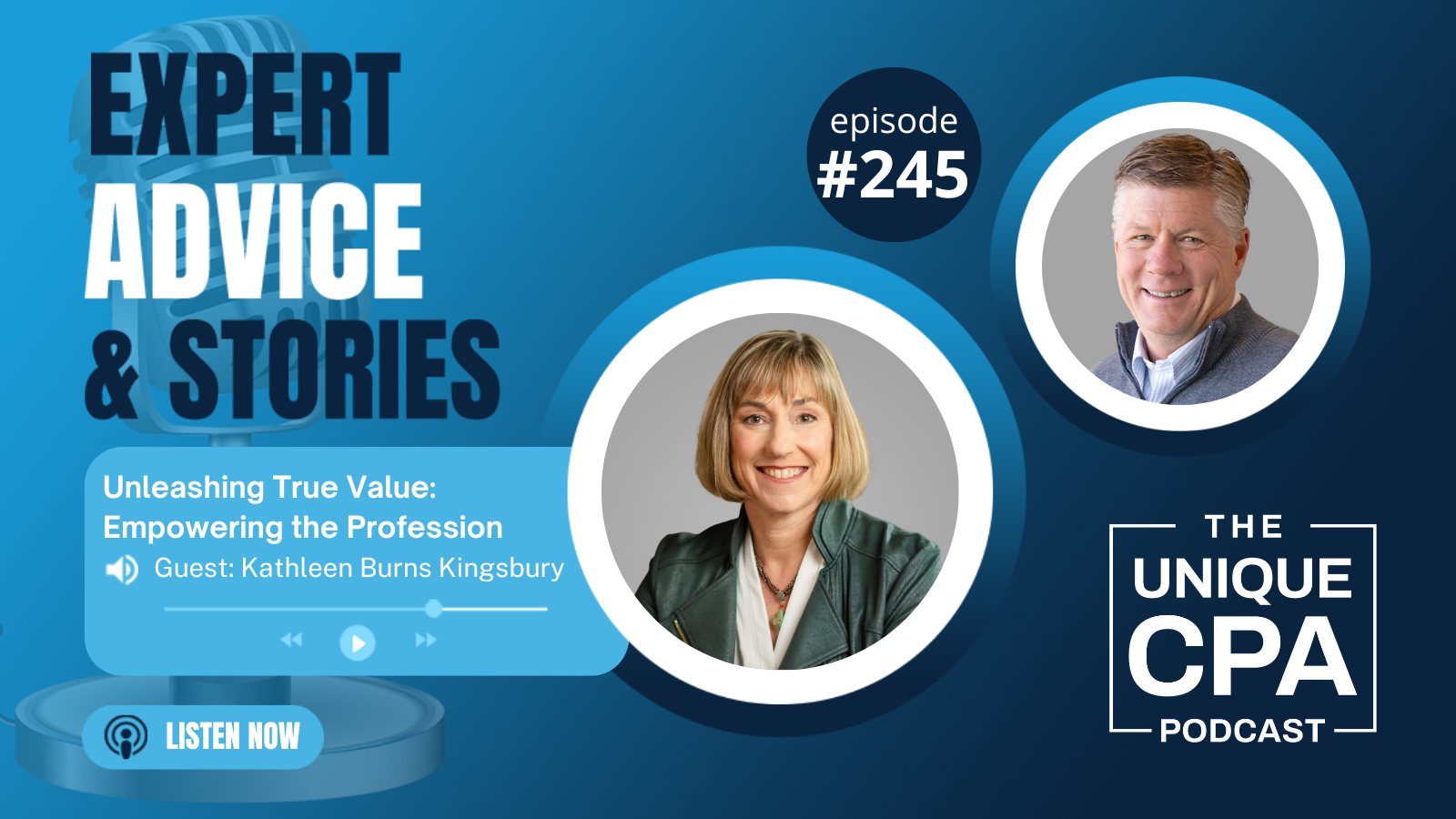
Empowering the Profession
Kathleen Burns Kingsbury joins Randy Crabtree on Episode 245 of The Unique CPA for a candid conversation about the hidden forces shaping how professionals, particularly women, perceive and communicate their worth. Drawing on her journey from FDIC bank examiner to wealth psychology expert, Kathleen unpacks the cultural and personal barriers that keep so many from asking for what they deserve. The author of Breaking Money Silence, now in its second edition, Kathleen shows you how building confidence, embracing value-based pricing, discovering the power of niche expertise, and shifting one’s mindset can transform both career and personal fulfillment. Weaving in stories of her own missteps and breakthroughs, Kathleen’s passion for empowering others shines through a conversation that’s as energizing as it is insightful.
Today’s guest is Kathleen Burns Kingsbury, a pioneering force in the realm of women and money. She has dedicated herself to empowering women across finance, business, and entrepreneurship. In addition, she’s the author of several books, including the second edition of the recently released Breaking Money Silence. Kathleen, welcome to The Unique CPA.
Thanks, Randy. It’s fun to be here and “break money silence” with you.
Awesome. Oh, look at you doing that. I appreciate you—behind the scenes a little here, we were going to record a couple weeks ago and I had to reschedule, so I appreciate you being flexible to get this on at a different date. So thanks again for that.
You’re welcome.
Okay, so let’s go. I did a quick intro, obviously real quick. I’d like to know more about you, because I teased what you do here at the beginning, but give us more about who you are and what you do.
Sure. So my area of specialty is wealth psychology and women and wealth, and I primarily work with two different groups of people, financial advisors and related professionals like yourself and also women in business. And so my whole mission with my company, KBK Wealth Connection, is really to help empower women and the advisors that serve them, whether that’s coaching, consulting, keynote speaking, doing workshops, virtual trainings, it’s all about that end goal. The company started in 2007, and I worked my little, you know what off, and it’s been successful, so I’m happy to say we’re at a really good place.
So I’m curious, so what was the—obviously there was a need out there. How did you identify that? What made you think, okay, this is the business I need to start, this is where the need is, this is where my passion is, and so what prompted that?
Such a great question. It was not a straight line by any stretch. I spent a couple years really thinking I wanted to do something different. So when I started in my career, I was actually an FDIC bank examiner. And so I was an auditor, and I was looking at banks, and while I was good at it, it didn’t really feed my soul. I wanted to coach management on how to do better, and that wasn’t really part of the job description. So I ended up switching careers and because I tend to be all or nothing, I went completely out of banking and finance into the clinical world and I got a master’s in counseling psychology where I empowered women for about ten, fifteen years as their therapist.
And then I started to burn out from that field, so I said, what can I do that combines my love of finance and my love of empowering women? And it wasn’t like, oh, just one day. It was a lot of research and really thinking it through. I decided to position myself to be somebody that would advocate for women, but do a lot of training, speaking, and writing for men. And that positioning has really helped me to be successful. So sometimes people think, oh, she just works with women, you go to my website, you look that way. Not necessarily true. I’m an equal opportunity coach, consultant, and speaker. But it was a lot of figuring out what was going to feed my soul, because I think that’s really important in being successful, but then also where the gap was in the market. And to be honest with you, Randy, I really got going probably 2008, right when the market crashed and right when the Boston Consulting Group came out with a big report about how women were the most underserved market in financial services. All of that, not that the crash was lucky, but all of that, the timing was lucky—that I couldn’t have predicted. And so just really capitalizing on the moment.
Yeah. Well, I love that that story. Feeding your soul, I love the way you say that. For me, finding your passion is what I say, but man, I—deal your line, go for it. Finding your passion of what you want to do, what you love, doing what you’re good at doing, and if you do that, I mean, to me, nothing feels like work. It just feels like I’m doing what I’m supposed to do. And that sounds like that’s where you live right now.
Oh, absolutely. And you know, you still have to work hard, but you’re right, it has a very different feel than going to a job where you just don’t feel it kind of aligns with you. And again, I know for people out there listening in, you can be really good at what you do, but if it doesn’t satisfy a part of you and you know, you could call it life purpose, whatever you want to call it, keep looking, because I really think that that’s when we do our best work.
Alright. Well, let’s get into something that you had said before we went live here, that you’re passionate about, and that is helping women in finance and men, as you just said, unleash their true value and get paid what they’re worth. What does that mean? What is their true value? How do they find that and how do they get that payment that they really deserve?
Sure. I think one of the things that is really hard for people, especially people who are self-employed or entrepreneurs or salespeople and they have their own book of business, is to differentiate themselves and to talk about themselves in a way that’s going to be compelling to their prospects or clients. And so when I think of women, let’s just start with women. I think of women, there’s the gender wage gap often. Not all women, but a lot of women have trouble. They feel like they’re bragging or they don’t want to be too assertive, and so there’s all this mind junk that they have about asking for their worth.
And then you take anybody in our society, we happen to live in a society where talking about money and certainly salaries is very taboo. It’s becoming less so, but with a lot of the people I work with, it’s still there. And so how do you bust through and have an effective conversation where you are communicating what you’re bringing to the table? And true value isn’t just your market value, it isn’t just your skills and expertise—it’s what makes you different, what makes you have this impact on people around you. And it’s so fun to try to help people discover that and then figure out how to communicate that in a way that’s going to resonate with whoever their ideal client is. So I have a lot of fun doing the work, and it’s really satisfying to be able to see someone go from even being a seasoned business owner to somebody who’s seasoned and maybe now they’re more confident when they’re writing a proposal or asking for their fee. So I have a lot of fun doing it.
Yeah, I think in—obviously this is The Unique CPA, so we talk about the accounting profession a lot—and I think that’s one of the, I think, universal downfalls of a lot of firms is the, I guess if it’s “universal in a lot,” that’s not universal. Many firms, they just don’t charge what they’re worth, they just don’t value themselves, they don’t understand that what they have is such an important skill that others need and they have more of a mindset, us accountants, of we just need to help everybody rather than, you know, we need to also make sure that we’re getting the value out of this that we deserve because we’re delivering value to them. So what do you think keeps people’s mindset from understanding their worth, their value?
And with accountants, chances are you didn’t get any of these lessons about communicating your worth at college, or as part of your training. So I find that it can be new, but what are some of the things that get in the way in terms of mindset, I really think it’s how we were raised around money, what our society says around money, and then also what our profession says. And so if you look at accountants in general, and this is—I don’t want to stereotype, but I’m going to, how’s that? I don’t want to, but I’m going to. So a lot of accountants have a money personality—and when I work with people, I do this money personality assessment—have a money personality where they tend to be accumulators. So accumulators are people who are inner bankers. They’re really responsible with money. They like spreadsheets. They tend to struggle a little bit to invest in themselves, but are really responsible around money. So that type of money personality can struggle asking for what they’re worth, because often they’re bargain hunting when they’re the buyer.
And so the idea is we project our mindset onto our prospect and believe, well, they’re not going to pay for that because maybe we wouldn’t pay for that. And so it’s really helping people who have that mindset shift to be more abundant, sometimes it’s learning to invest in yourself a little bit more, and then learning to communicate and realize that not everybody who shows up to your practice has the same money mindset or money personality that you do. And so often through the coaching, understanding our money personalities, understanding what are the automatic thoughts and beliefs we were raised with around asking for money, and then shifting the ones that aren’t serving us and keeping the ones and reinforcing the ones that are, that people can make really pretty big changes in a matter of a couple sessions.
Yeah, I can see that. And I think for me personally, one of the things that I think helps—I think this helps accountants realize their value more than other ones is when they do actually have a niche expertise. Like, you know, you’ve built a very niche business, which has been obviously successful and I love that. Our firm Tri-Merit is a very niche business as well. I think when you have that niche expertise, you just probably feel more comfortable that, hey, I have unique knowledge here, and I think it helps that mindset get to the point of, okay, I can charge now for this value, ‘cause others can’t deliver what I’m delivering. Is that something you ever talk about when you’re coaching? Does that come into play?
Mm-hmm. I believe strongly in niching. If you even look at the research, people in financial services that niche tend to make about twelve percent more than those who are generalists. So not only is there a business reason to do it, it makes your marketing easy. When you’re talking about your true value, you can really target it to a certain type of client, so there’s a lot of advantages to niching. And maybe you don’t have to go as deep into a very specific niche like I have, but I think it’s important. And so we do talk about who that end client is, and how do you position yourself, how do you market to them, how do you get in front of them?
And I do find that one of the things that’s helpful for people working with me is, you know, I am passionate about this because I started off as somebody who was an under earner. I actually, when I worked for the government, when I worked for the FDIC, I can remember saying this in my early 20s that we are overpaid and my colleagues and peers were laughing at me. Of course, then I transfer and I go to counseling psychology where indeed I was underpaid. So yeah, got what I asked for. And then I realized, wait a second, and had to do my own work on my relationship with money. And so, yes, everything I teach people is grounded in psychology and business and research. And I’ve also had the lived experience of really struggling around asking for what I’m worth.
A great example is speaking. When I started speaking in the financial services industry, I was woefully undercharging. And I can remember a day when I got on the main stage and I made the most I ever made, I got off the stage, and I made what I thought was a funny joke, because they said, oh, you did a great job, Kathleen, these two wholesalers, and I said, yeah, that’s why you pay me the big bucks, and they giggled. And I was like, okay, wait a second. I have to do some more market research. The gentleman who stepped on stage after me was making four times what I made. So that was the wake-up call that went, wait a second. You have to really do the research and then you have to stand at it. And so I was just telling you before we went live, I just came back from a keynote and I feel like I charged my worth. I was probably not the most expensive speaker, but I certainly was not the cheapest speaker. And I feel really satisfied with that. And that’s where you need to get to and it takes work and practice. Mistakes from time to time.
Yeah. When you talk about being on stage and speaking, I love that so much. I think I tend to undercharge as well, but the—man, it is like—I don’t know the right way to describe it. It’s like—I was going to say a drug. It’s not that because I wouldn’t know. But it’s just the adrenaline, the satisfaction, and it’s not just because you’re up there, it’s because you see the audience reaction, you see that they are absorbing something and you feel validated that, okay, I am giving knowledge that they are absorbing.
Well, and you may fall into the trap that I see a lot of people who love what they do fall into, which is the mindset—and I had this mindset, yours might be different—but the mindset that to make a lot of money or to make a decent amount of money, has to be hard, has to be painful. I mean, that’s from my upbringing, right? And so realizing that you can stand on stage and have that joy of having an impact and making a really good living doing it or a part of living, because I know that’s not the only thing you do. It’s really wonderful when you’re well compensated and you’re seeing impact, trust me.
Yep. No, for sure. Alright, so let’s transition here because I want to talk about the book. We got second edition now of Breaking Money Silence. First, tell us about the book.
Sure. Breaking Money Silence was originally written in 2017. It’s my fifth book. And it is about the taboo against talking about money and what we can do about it. Because I had at that point worked a lot with people in the financial services profession, and a lot of the people that I was working with would talk about, I want to talk to my clients about legacy, I want to help them raise financially fit kids, I want the couples to talk about their values, but then I realized they weren’t broaching those subjects. Then I do a lot of work with the end consumer, so your clients, and the clients were saying, well, my advisor or my CPA or my business, they don’t do that. And I said, there’s a disconnect.
So Breaking Money Silence is about writing a book that’s both for the end client as well as for advisors or CPAs, and really helping people understand first where the taboo comes from, but more importantly, how do you break it? And the original edition really focused on women, couples, and families. And then when I did the second edition, I added this bonus chapter on how to unleash your true value. That is taking the Breaking Money Silence message into the workplace. So if we’re better at talking at home about money, how can we be better at work to make sure we get paid a fair wage.
So when you talk about a fair—because you just said fair wage, sorry—are you talking about as an employee or are you talking as a service provider that, are you charging enough or are we talking both ends of that?
Well, in the book it’s really catered towards the service provider. So you could be working for somebody, but say you have your own book of business or you’re in sales or you’re working for yourself. When I’m coaching, I work with both, but because I tend to be quite entrepreneurial, all my clients and the people that come forward tend to be quite entrepreneurial. And so when we think about asking for your worth, when it’s your own business, there’s an extra layer of complication, because you are selling yourself, you’re selling your service, and you’re trying to make a living and have a profitable business. So I find that really intriguing. So in the book, in the bonus chapter, I talk about the three steps you need to take in order to unleash your true value. In the model where I coach people, there’s five steps, but in the bonus chapter, there’s three. I take it you want to know the three steps, right?
I was—that was the next—I was getting my pen ready. I was going to write the three steps so that we could discuss those. So if you don’t mind, what are those three steps?
No problem. So the first thing you need to do is take a look at your mindset, and you need to adopt a success mindset. And basically what that means is being able to take risks, being able to have a growth mindset, being able to learn from your mistakes and bounce back, because when you’re negotiating or asking for your worth, it doesn’t go perfectly. And it’s really about each time learning something new. The second step is really spending some time identifying what your true value is. Again, your true value is your skills and your expertise, but also the perceived value that your ideal client has of you. And so it takes some work, yes, market research, but also internal work to say, what is the value that I have on my clients? And so that part’s really fascinating. And then once you get a sense of that, then it’s how do you communicate it through your marketing material, in your meetings with your centers of influence? How do I communicate it in a way that resonates so people are going to get it, and want to hire me? So those three steps are really foundational. The book walks you through it a little bit, and if you wanted to take a deeper dive, I would work with a coach around it.
Nice. So mindset. Yeah. I think so much of what gets in their way is our minds. Preconceived ideas or just history that this is the way it has to be. Or just, hey, this is how I grew up doing it, so I have to do it this way. Mindset is a big hindrance, I think, very often. But identifying—I wanted to expand on identifying your value, because you had talked about the perceived value. So the client perceives, the customer, whoever perceives value. But honestly, I would think each one can perceive that differently. So I have a client A, then I’m going to deliver the same services to, and let’s say they’re even in the same situation, but they don’t perceive the value as much as client B, then I’m delivering the same service. So is there a way that we can—do we tailor our value different based on the client we’re working with? Or how do we get that perceived value to be, not unique, but universal to each one? Or is that even possible?
Well, it’s a great question. I think you do have to tailor things to different people. One of the questions I would ask is, if A doesn’t see your value the same way B does, do you want to just work with more Bs? Because that might be the case. But when we’re thinking about communicating our value, often, especially in finance, we tend to focus on what are the features. You know, I’m going to do your taxes, I’m going to do a business plan. You know, like what’s concrete that we’re going to give them. And when we look at how people make decisions, ten percent of it is rational, ninety percent is emotional. So why are people actually hiring you versus another CPA? Yes, you have a niche, Randy, but it’s also how you make them feel.
And so part of it is taking some time to look at what is the emotional state that my ideal clients come into the meeting, what are they hoping to achieve by working with me? And what they’re paying for, even if they’re not aware of it, is the emotional transformation that you’re going to provide. So if I come in uncertain about some sort of situation around accounting, and I want certainty or clarity or security, working with Randy and his firm is going to help reduce that anxiety, increase that confidence and certainty, and that’s what I’m actually paying for, not the forms, even though sometimes we think that’s what we’re paying for.
Right. So they’re paying for you, or the confidence you give them, or the relationship, the comfort level they have with you. And so when you’re doing that, if we’re especially, you know, talking with accounting firms, and because we’re talking about pricing for the value that you’re delivering, I assume then we’re not promoting hourly billing, but we’re promoting value billing, or do you get into that when you’re talking?
Yes. I’m a big believer in charging a project basis fee and value-based pricing as opposed to hourly for a variety of reasons. I mean, the easiest is, do you want your clients to think is, you know, I’m just throwing out a number, is it worth $300 to pick up the phone and ask a call of my CPA right now, or $150 wherever you’re at, or are you part of the team? And I know when I work, I like to be part of the team. So I believe in packages and I have a lot of people who come in and they are adamant that they’re going to stay hourly. And I would say all but one of my coaching clients has turned into doing project-based work, and value-based pricing, because it just feels better. They can tailor it to their ideal client and it sets you up for a different type of working relationship. And so, you know, I do respect if you’re hourly, I just think trying to even just spend some time thinking about the possibilities would be beneficial.
Yeah, I agree with that. I guess the one thing that comes up then, when people talk about the value billing and not the hourly, is scope creep. How do you make sure that you’re not giving away some services because we’ve already set this price in place?
Well, everything in writing, being really detailed in what you are saying the deliverables are, and what the limits are. And if you do that work upfront, then you have something to go back to, to be able to, when it starts to creep, because not everybody creeps, but it happens. I had a conversation this morning where I was like, so do you want me to do one of those or two of those, because one of those is in the contract. And so, you know, it’s basically saying, if you need two, then you’re going to have to pay me more. And so it’s definitely staying vigilant. But I find our best clients don’t tend to creep that much, and when we remind them like I did this morning, they immediately go, oh, that’s right, no, one is sufficient.
So, I guess the way I would describe that is if you do value-based pricing, you also have to really be good at setting financial boundaries. And that in itself can be challenging for people. But it feels good when you’re able to let them know. And if you want to throw something in because you want to throw something in, do it, just let them know you’re doing it.
Right. That makes sense. So everything that you’ve been sharing, I’m on the edge of my seat, because I love hearing all of this. I love educating the profession on valuing themselves, the mindset, the perceived value, all this that you shared. So what’s next? What are you doing out there? What can people expect in the future or in the present from you being out there educating and coaching people in finance?
Sure. Well, I’m always looking for the next thing that I want to explore in wealth psychology, so stay tuned on that. I’m doing a lot of coaching around—it’s called True Value Coaching—around asking and getting paid what you’re worth. If anybody’s interested in just taking a look at what’s involved in that, certainly I can share a link that you can put in the show notes. If you just say, hey, I just want to know more about value-based pricing, I have a free downloadable, Six Pricing Strategies that Communicate Your True Value, that people can look at. And for me in general, I’m an avid skier and I live in Vermont, so I am looking forward to ski season, and I’m also looking forward to doing more great work around wealth psychology and empowering advisors and women and CPAs in 2026.
Well, you already answered the last question I was going to ask about what’s your outside of work passions. We know skiing is one of them now.
Skiing’s one of them, anything outdoors. So skiing in the winter, mountain biking and kayaking in the summer. And if I have to be stuck inside on a rainy day, it surprises a lot of people who know me, but I knit and I read. The knitting is the surprising part.
Yeah. I have a friend, Carrie Steffen, she just recently became the CEO President of the Iowa CPA Society. I got to introduce her at a conference years ago, that’s where I first met her, and she called it, she’s a granny hobbyist, which she included knitting in that title. So that was pretty cool. Great person. So, okay, so great stuff. It is going to be a rainy weekend here. I don’t know if I’m going to take up knitting this weekend.
That’s okay. There’s always next weekend, Randy.
Exactly. My future daughter-in-law is an unbelievable, do you call them knitters? Is there actually a word for somebody who knits?
I am not unbelievable. I am—I’m good at anything square. So, but I don’t—yeah, so she’s probably an advanced level. I’m probably better at mountain biking and skiing than I am at that.
That’s fine. She’s—we’re, my wife and I are about to become grandparents and she knitted a bunch of little hats for the upcoming baby and so yeah, it’s pretty cool to see what she can do. So knitting, take it up. It’s a cool hobby. Hopefully that’s not the only thing people learned today though.
Yes, exactly.
There was a lot of things we shared. So you, we’ll put the things in the show notes, you mentioned there’s downloads and everything and we’ll put the links in there, but if people want to find out more, reach out to you, where would be places they should look?
Yeah, I love having conversations with people. So go to my website, which is KBKWealthConnection.com. I’m also on LinkedIn, and I know my name’s very long, Kathleen Burns Kingsbury.
Alright. Or KBK.
Everybody calls me KBK. But you won’t find me by KBK, I don’t think, on LinkedIn.
No, probably not. Well, Kathleen, it’s been awesome having you on, it was a great conversation. I love to hear what you’re doing and empowering women in finance and people in general, in finance and in accounting and in those professions. So congratulations to all the great work you’re doing.
Thanks, Randy. It was fun to chat.
Important Links
About the Guest
Kathleen Burns Kingsbury isn’t your average money mindset and advisor coach; she’s a pioneering force in the realm of women and money, setting her apart from conventional counterparts. With over 18 years of specialized experience, she’s dedicated herself to empowering women across finance, business, and entrepreneurship. As a mentor to female entrepreneurs, Kathleen offers invaluable guidance, drawing from her extensive background in wealth psychology and client communication. Her expertise extends to working with financial advisors, helping them navigate the complexities of wealth management while fostering stronger client relationships.
Her signature program, “Unleash Your True Value™: How to Shift Your Mindset, Boost Your Confidence, and Close More Sales,” is the culmination of her expertise, honed through years of helping women executives, financial advisors, and entrepreneurs break free from money s
Meet the Host
 Randy Crabtree, co-founder and partner of Tri-Merit Specialty Tax Professionals, is a widely followed author, lecturer and podcast host for the accounting profession.
Since 2019, he has hosted the “The Unique CPA,” podcast, which ranks among the world’s 5% most popular programs (Source: Listen Score). You can find articles from Randy in Accounting Today’s Voices column, the AICPA Tax Adviser (Tax-saving opportunities for the housing and construction industries) and he is a regular presenter at conferences and virtual training events hosted by CPAmerica, Prime Global, Leading Edge Alliance (LEA), Allinial Global and several state CPA societies. Crabtree also provides continuing professional education to top 100 CPA firms across the country.
Schaumburg, Illinois-based Tri-Merit is a niche professional services firm that specializes in helping CPAs and their clients benefit from R&D tax credits, cost segregation, the energy efficient commercial buildings deduction (179D), the energy efficient home credit (45L) and the employee retention credit (ERC).
Prior to joining Tri-Merit, Crabtree was managing partner of a CPA firm in the greater Chicago area. He has more than 30 years of public accounting and tax consulting experience in a wide variety of industries, and has worked closely with top executives to help them optimize their tax planning strategies.