Transform Your Accounting Role
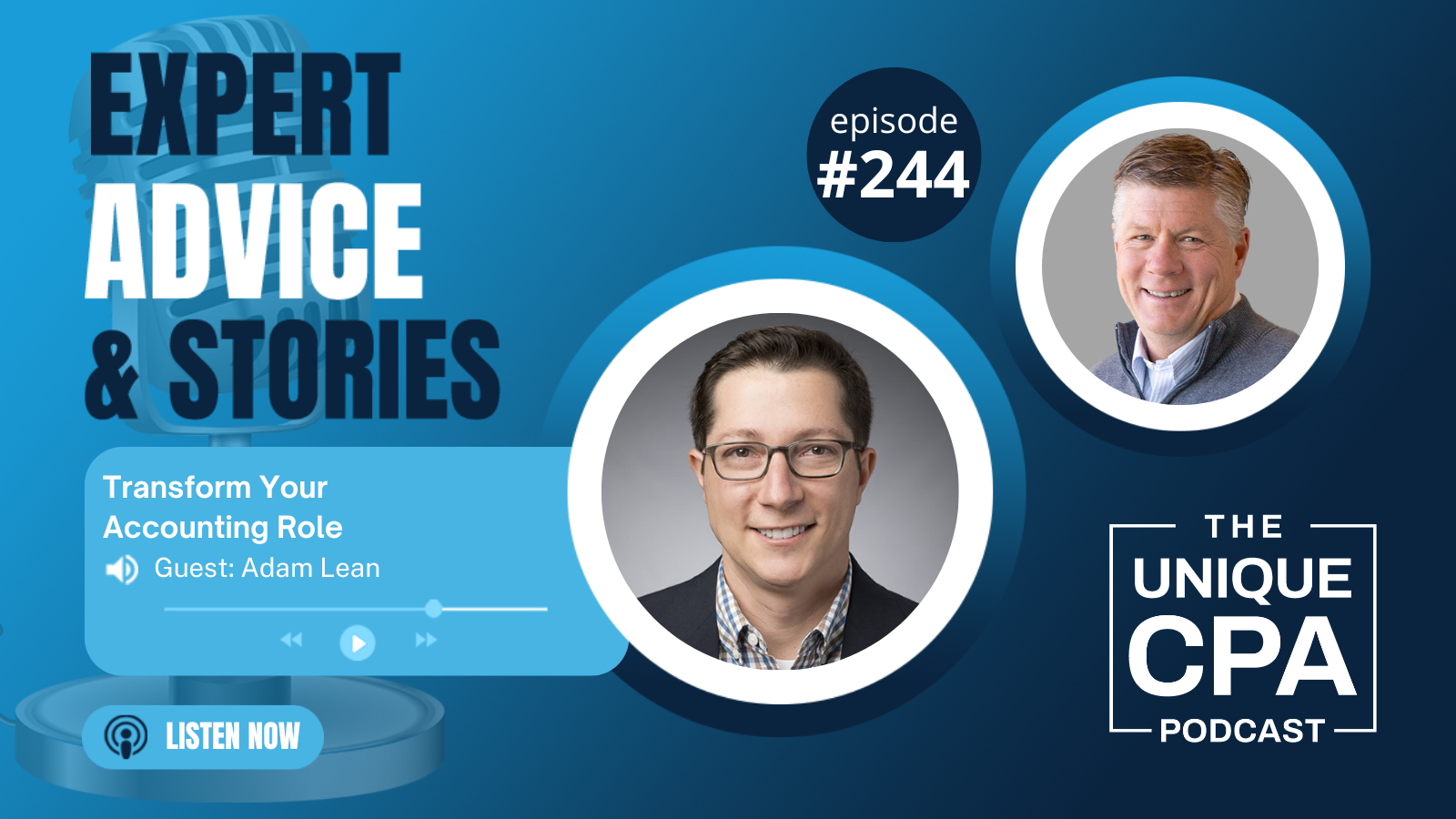
With Adam Lean
Adam Lean’s journey from disenchanted accountant to entrepreneurial advisor takes center stage as he reveals how a simple desire to help business owners understand their numbers sparked the creation of the CFO Project on Episode 244 of The Unique CPA. Follow Adam from late-night e-commerce hustle to the formation of a productized CFO advisory service, designed to eliminate scope creep and empower accountants to deliver real value. As Randy’s prompts unpack the pitfalls of commoditized compliance work, the “Accountants Trap,” and the mindset shifts required to move from tax prep to trusted advisor, Adam shares a candid look at the challenges, and most importantly the rewards, of advisory work.
Today, our guest is Adam Lean. Adam is the brains behind, and runs, The CFO Project, which is a training company for accountants to help them offer outsourced CFO services and business advisory services. We will discuss the importance of that today, but before we do, Adam, welcome to The Unique CPA.
I am really excited to be here. Thanks for having me, Randy.
Yeah, and I appreciate you being here too. I do know you are a podcast host as well, right?
That’s right, yes. Been doing the podcast for a couple years now.
Oh yeah. And it’s at, what’s the, is it The CFO Project Podcast?
It is!
Oh wow, look at that!
Yeah, The CFO Project Podcast, that’s right.
Alright. Well, that’s cool. We’ll have to go take a listen to that. I actually did skim through a couple episodes. It’s good information for sure. Well, before we get into our discussion today, which is going to be around CFO and advisory services or the melding of both, and the definition of both, and before we get to all of that, why don’t you give us a little more background than that two seconds I did on you and how you came up with this idea to start The CFO Project?
So I used to be an accountant after college. I had an accounting degree, so I thought I’d become an accountant. Well, unfortunately, Randy, I didn’t really like being an accountant. I spent four years in the profession, and honestly, I thought the job was okay, but I was really more interested in helping the business grow. But I worked in private industry for a very large company, and they didn’t really care what I thought. They just wanted me to sit in my office and record the past.
So at nights and on the weekends I started a business, an e-commerce business back in 2006, 2007 before e-commerce was easy to start, and I started it, and within a couple of years I actually got enough revenue going so that I was able to leave my day job, and I started running my business as an entrepreneur. But then I started joining all these entrepreneur and web groups, basically these nerds that liked to sell things online back in the early two thousands, got together, I remember because I was living in Atlanta, we met at Georgia Tech and we were called the Atlanta Web Entrepreneurs, and we met every couple weeks. But as I started getting to know these people, they were running their businesses, but they had no clue what was going on financially with their business. No clue. They didn’t know their numbers, they didn’t understand what was happening. And I realized I took for granted the fact that I understood the numbers in my business because I was an accountant. I knew what was driving revenue and what was driving profit and what was driving cash flow, and they didn’t, so I started helping them. I remember the first guy I started helping, I was like, do you want help with this? And he said, absolutely. I didn’t even call myself a CFO or advisor or whatever. I just said, we’ll meet once a month and I’ll go through everything with you and I’ll give you guidance. He was like, absolutely. He ended up becoming a client for about eight years.
Fast forward, I ended up selling my e-commerce store after a while to one of my largest suppliers, and I thought, why don’t I formalize this idea of helping business owners, but I didn’t want to approach it like I knew—I’m sure we’ll get into this, but there’s a term fractional CFO. There’s a lot of these fractional CFOs out there, and I did not want to offer that service. I wanted to offer a service that business owners could immediately resonate with and get value from. So I essentially called what I did a CFO advisory service. It’s part CFO, part business advisor, and put them together.
Nice!
CFO advisor. The difference was I didn’t approach my clients from an accounting standpoint. I didn’t even review the P&L, the balance sheet with them. I did all that behind the scenes, and when I met with my clients, I ended up explaining their business in a way that made sense to them without them having to even look at one single financial report. Then we came up with a plan for the next 30 days to improve the one or two or three drivers of cash flow that were hurting the business the most. The result of that is that the business owner, because they’re way more engaged, because they’re not having to learn accounting, which most business owners don’t want to, they actually took the advice and they did it. And it makes sense.
Fast forward, I ended up meeting my now business partner, Jeff. He’s been doing something very similar since the 80s. We started talking and comparing notes and realized that we both approached CFO advisory services almost the same way. So we thought, why don’t we come together and form this company where we train other accountants and financial professionals on how to offer what we call a productized CFO advisory service, very different than a fractional CFO service: A productized CFO service, meaning we’re selling a CFO service like somebody would buy toothpaste on the shelf at the store. It’s a product form, they know exactly what they’re getting, they know what they’re buying, they know how much it is. There’s no ambiguity, and there’s no scope creep. We teach all these accountants how to sell this productized CFO advisory service to their clients. But the best part is, even though it’s a product, we teach that you should price it like a service. So the average person that we teach is charging $2,000 a month per client. So you can do the math. You don’t need that many clients to make pretty good money in this profession.
Yep. So, well, I’m going to go into that question then, $2,000 a month, but what does that, because you said there’s no scope creep, they know the product they’re getting. So when we go at 2000 a month for our client, what kind of burden is that on us as the advisor now? I mean, we spend an hour a month on this. Are we spending five? Can we define it that way, or is it just the type of services that we’re offering for that?
Yeah, No, that’s a good question. Four hours a month: That’s what we suggest you earmark per client. The client doesn’t know that. The client knows that they’re going to have a meeting, one hour monthly meeting with you per month. During this meeting, we’re going to do two things. We’re going to review what we call a scoreboard, which is a color-coded dashboard of the client’s business. So the whole business, not just the financials, but everything from lead generation all the way to cashflow in the bank, we’re going to review it and it’s color-coded, red, yellow, so we’re almost gamifying it. Then, and that really is only the first 10 minutes of the meeting; the rest of the meeting we’re going to talk about how to improve those items that are in the red or yellow, how to get them in the yellow or green, and if the client does that, the client gets all the items on their scoreboard in green, the client will hit the targets that we set. The beginning of the engagement for profit and cash flow, which means the client will be happy and we’ll probably retain our clients.
Right. And referrals.
And get referrals, absolutely.
So let’s back up then, because I love that idea that we’re setting it. Man, I have so many questions based on what you said already. Let’s go to that first too, because I have another question. You said you basically eliminate scope creep, so how are you doing that in this engagement?
Yeah, so here’s the thing: Most, if not all, small business owners—when I say small business owners, businesses doing less than $5 million annual revenue, our sweet spot is about a million dollars in annual revenue.
Wait, back up a second. Your sweet spot for the accountants that you’re training are a million or that the clients that they’re working with are a million?
The clients they’re working with.
Okay.
So we recommend to the accountants we train to go after businesses doing between a half million [dollars] and $5 million in annual revenue. The sweet spot’s about a million. Got it. For a variety of reasons. But the sweet spot’s a million dollars. We’re charging on average $2,000 a month, even though they’re doing a million dollars, which doesn’t sound like a lot. Only 9% of all businesses make more than a million dollars, which is mind-blowing, but those businesses, even though they’re making a million dollars, they’re still being run by usually a single person who is running the business like a craftsperson. In other words, a plumber starts a plumbing business, five years later, they’re doing a million dollars in revenue, but they still operate their business as if it was five years earlier: They’re usually the chief salesperson, the chief employee supervisor, the chief marketer, they’re chief everything. They are the boots on the ground, they’re an expert in what they do. They’re usually not an expert in numbers. They don’t know what they need from a CFO. They don’t even know what closing the books means half the time.
No.
So we can’t expect them, like a lot of fractional CFOs do, and create a customized engagement based on what they need—they don’t know what they need. So we are telling them what we provide and coincidentally what we provide is what they want, which is a growing and successful business. There’s a lot more to that, but the point is we are going to them and saying, here’s what I offer: I’m going to help you every single month have a growing and successful business so that not only you don’t fail, but that you’ll have way more cashflow that you can use to reinvest back in your business. You can pay yourself more, you can hire more people, go on vacation, whatever. The point is, if I’m not helping you generate way more cash flow than what you’re paying me, then I would fire myself. This is what I do. Do you want it?
Of course, there’s more to it, but yes, if you put it in those terms, what business owner is going to say no to that? Their business is their livelihood. It’s the thing that puts food on their family’s table. If their business fails or they’re not making enough money, what are they going to do? Go back and get a job they didn’t want in the first place, which is why they started a business? We have to remember, $2,000 a month for this service is peanuts to a million dollar business. They’re likely paying a low-skilled employee more than that every year to do whatever. Meanwhile, somebody like all of us comes along and says, I’ll help you for $24,000 a year essentially, to ensure that you have a growing successful business.
Yep. So that’s great. Let’s talk about now the importance of this for the CPA firm to be starting to offer this, because everybody wants to offer advisory, everybody wants to get more into that area. Like you said earlier, you were asked to be a reporter basically, when you had your first job, you were reporting what happened, you wanted to impact the future of this company, and you weren’t able to, because they didn’t want to listen to the accountants for this, “We’re the ones that started this business!” But now we know, and I’ve seen stats out there. We know clients want this. We know that they are willing to pay more for you having an impact on their business. I’ve seen this out there and the numbers are staggering. Really, the number of clients that are willing to pay for more of this and the number of accountants that are offering these services, there’s a huge disconnect there. The last time I saw these numbers, like 72%, and I’m making these up, but I think I’m fairly close. 72% will pay for it, only 27% of accountants are offering it.
Part of that, I believe, is that the accountants just get so bogged down in the compliance end because this is what they’ve always done, so we’re just going to keep doing it, even though they want to have these services, they don’t make the jump. So when you go then to start to talk to them, do you run into that? Do you see that they want to, they just don’t know how to, and I guess I’m going to make this a multi-question diatribe here. In addition, they don’t really understand what it means. “I know my clients want it, but what’s it mean? How, well, how, I don’t have all these skills. How am I going to do it?” So when you come into these stumbling blocks, when you’re talking to people, what do you see, and then how do you overcome those with the accountants?
Great question. We’ve actually coined a term called the Accountants Trap. We feel that a lot of accountants are in. They’re in this trap working for low fees, offering commoditized services, meaning most people can’t tell the difference between a good tax accountant and a bad one. They just can’t. They’re referred by Bob the neighbor on who their tax accountant is, that’s how they choose who their accountant is, so because most people can’t tell the difference between a good quality product and a bad, price usually dictates, just like gas at the gas station. If you’re driving and there’s two gas stations, one 50 cents higher, most people are going to go to the cheaper one because most people can’t tell the difference between two types of gas. So therefore, what most accountants are offering in the minds of a non-accountant is a commoditized product. And that’s important for the accounting profession to understand, most people are not accountants. They don’t speak account-ese, so they think that what accountants do are commoditized. Accountant A is going to put out the same work product as accountant B. So anyways, offering commoditized services for low fees, dealing with high-demanding clients. All the while, a lot of accountants are burnt out offering these compliance or transactional services. They just don’t want to go through another tax season, for example, in many cases.
But more importantly, most accountants recognize, and you sort of mentioned this, that their clients are wanting. They’re asking things like, can I afford to buy this truck for my roofing company? Should I raise my prices? Should I have hired the person I hired today? Am I going to have enough cash in the bank next Friday for payroll? Those types of questions, they’re wanting answers for, but the accountants can’t answer the questions usually for two reasons. One, they don’t have the time to answer the questions because they have a stack of tax returns. Two, they don’t really know how to answer the questions because their business is taxes or bookkeeping or auditing, whatever the accountant does. Not saying the accountant couldn’t answer the questions, it’s just they’re not set up for that. Anytime they spend on that client is wasted time because they’re not getting paid for an advisory service.
So now why are they not getting paid for advisory services? I touched on the first point, and they don’t really know how to offer advisory services. Two, CFO advisory services, because everybody almost has a different definition of what a CFO is, a lot of accountants think, because a lot of accountants went up the ranks in traditional, either big accounting firms or whatnot, and there’s a giant gap between a staff accountant and the CFO of a company, and they’re thinking, “I can’t call myself a CFO. I would be an imposter! I’m not a CFO.” And what we tell accountants is, are you qualified or will you be able to be qualified to be Microsoft’s CFO tomorrow? Maybe, but probably not. But can you be qualified to be the CFO for a $995,000 heating and air business in Atlanta, Georgia? Of course, because those people, the small business owners, need a completely different set of deliverables than what the Microsoft CFO is delivering at their day job. Those small businesses, they need somebody that can empathize with them, that can be their confidant, that can just make things make sense. They don’t need complicated, complex, and tons of experience that Microsoft CFO is required to have before they get that job. Two totally different things. It’s like me saying, I coach a five-year-old’s basketball team. My title is Coach. Am I the same as the Atlanta Hawks basketball coach? No. We have the same title, it is two totally different things.
Got it. That makes sense. Although I think I could coach the Atlanta Hawks. Alright, so now, so let’s go to the next step then. So, alright, so now you’ve talked to them, they’ve gotten past that stumbling block. “Okay, yes, I can do this. I have the skills. I can deal with a million dollar company. I can deal with a $5 million company, because I have knowledge. I have financial knowledge, but I also can translate into advisory knowledge as well and be an impactor of what’s going on rather than a reporter.” And now the next step is, “Yeah, I want to do it. I don’t have time. I mean, look at all this compliance work I’m doing. How do I transition there?” So what’s the next step then to get them past that stumbling block?
Yeah, so it sounds simple, but it’s not easy, of course, as with anything. But the simple answer is that you’ve got to replace low-paying, low-profit clients with high-profit clients. That’s a simple answer. One of our members, when he joined about four years ago, he had, I think he said 450 tax clients, and he was making less than a hundred grand a year take home. He owned his own CPA practice, and he hated it. We have what we call a wins board in our program, and he posted about a year and a half ago, he said that he sold the entire tax practice and he now has a handful of advisory clients and he’s making more than he ever had in 25 years of business, with less than 20 clients.
And that’s the difference. It’s simple to say, to fire all your clients or sell them. And of course we all know it’s not easy. But we recommend that you do step firing. You take the lowest level, the lowest profitable clients every quarter or whatnot, and then offload them either to somebody on your team, like an employee, co-firm partner with another firm that all they do is tax work and white label the taxes or just simply sell that work. But those that you replace, every 20 tax clients or bookkeeping clients can be replaced by one CFO client. And then you just keep doing that until you’re at a level that you’re happy with.
Yep. And I agree with that. That’s the steps I would advise people as well. That makes sense. I think people get overwhelmed. How am I going to go from a tax preparer today to an advisor tomorrow? I don’t have opportunity. Well, yeah, you do one at a time. You get a new client, you fire three clients like you just said. You get one $2,000 a month client, and you’re doing four tax returns for $2,000 that’s going to take you four hours each, even if it’s two hours each, you just cut your time in half, and they’re making the same amount of money. So people just need to see that.
Yeah. And if you’re the type of person that likes doing taxes and the bookkeeping and wants to be the client’s all-everything finance person, just still do the taxes for those small amount of clients. Be their full-service bookkeeper, tax accountant, and CFO, but just have it for a handful of clients, but just charge them accordingly.
Right, and then that’s outside the scope of that advisory service because you’re doing additional things. So people have to be aware of that. It’s not included in these advisory contracts you have now—that’s where you avoid the scope creep because you have already defined that this is, we are X for tax returns, we’re X for bookkeeping, and we’re X for advisory. However that works. So that is great advice. I really think that there’s just that stumbling block of too many questions, and I can’t do it because I don’t have the knowledge, I don’t have the time. And if people just look at it from an incremental change, I can make one client change to advisory, and they see the benefits of that and they see the impact that they’re having, people want to have impact. Clients want you to have impact, but us as accountants, we want to have an impact on our clients. And by doing that, I think we’re going to see, if people could start to see past a couple little mindset stumbling blocks, not real stumbling blocks, but mindset stumbling blocks, I think we could see a big change in that.
Alright, Adam. Well, this is great information. I love what you’re doing, educating the profession so that they can go out and do the things that they’re going to get value from themselves as well as their clients. They’re going to get a positive attitude towards, they’re going to feel like they’re making a difference in their clients’ lives. So I think people should really take a look at this, and I think you’re giving them the gameplan, the flowchart, the knowledge, the skills, the training to do this, so that’s exciting. Before I ask you how people can get ahold of you, I have one final question here before we get to that: When you’re not working, when you’re not educating the profession, what are some of your outside of work passions? What do you like doing?
Actually, I like swimming. I do that almost every day.
So swimming’s your thing. And you’re in Florida, so it’s a lot easier to swim every day when you’re in Florida, I assume.
Yep, that is true. I swim at 6:00 AM. I’m definitely a morning person.
Alright, well, you touch on my passions. I think exercise first thing in the morning, it just energizes you so much. It really sets the stage for the rest of the day. I’ll pretty much exercise every day, and if I don’t get it first thing in the morning, I’ll do it maybe right before a presentation when I’m out speaking at a conference. It just gets me so focused. I love that, swimming every day, that’s a great answer. And then, if anybody wants to find out more about what we talked about today, more about how they can get educated on becoming this CFO advisor, where would they get ahold of you?
Yeah, our website’s the best way. It’s TheCFOProject.com, so THE CFO project.com. On the homepage there, we have a ton of free trainings to see if this is even right for you, and to learn a little bit more about what CFO Advisory Services entails. So check out those trainings. We have trainings for bookkeepers, and we have trainings for CPAs and other financial professionals. So check it out.
Alright, Adam, well, thank you so much for being on the show. I enjoyed the conversation and I think this is important information for people to check out, at a minimum, to see if it’s you and your firm.
Thanks, Randy!
Important Links
About the Guest
Adam Lean is a former accountant turned two-time entrepreneur who built, scaled, and sold two businesses. While helping other business owners, he realized his passion was teaching and providing tools to business owners to help them make more money and have a peace-of-mind. He currently runs The CFO Project – a training company that trains financial professionals on how to offer an outsourced CFO and business advisory service.
Meet the Host
 Randy Crabtree, co-founder and partner of Tri-Merit Specialty Tax Professionals, is a widely followed author, lecturer and podcast host for the accounting profession.
Since 2019, he has hosted the “The Unique CPA,” podcast, which ranks among the world’s 5% most popular programs (Source: Listen Score). You can find articles from Randy in Accounting Today’s Voices column, the AICPA Tax Adviser (Tax-saving opportunities for the housing and construction industries) and he is a regular presenter at conferences and virtual training events hosted by CPAmerica, Prime Global, Leading Edge Alliance (LEA), Allinial Global and several state CPA societies. Crabtree also provides continuing professional education to top 100 CPA firms across the country.
Schaumburg, Illinois-based Tri-Merit is a niche professional services firm that specializes in helping CPAs and their clients benefit from R&D tax credits, cost segregation, the energy efficient commercial buildings deduction (179D), the energy efficient home credit (45L) and the employee retention credit (ERC).
Prior to joining Tri-Merit, Crabtree was managing partner of a CPA firm in the greater Chicago area. He has more than 30 years of public accounting and tax consulting experience in a wide variety of industries, and has worked closely with top executives to help them optimize their tax planning strategies.